Author Archives: Dorothy Max Prior

Dorothy Max Prior

About Dorothy Max Prior

Dorothy Max Prior is the editor of Total Theatre Magazine, and is also a performer, writer, dramaturg and choreographer/director working in theatre, dance, installation and outdoor arts. Much of her work is sited in public spaces or in venues other than regular theatres. She also writes essays and stories, some of which are published and some of which languish in bottom drawers – and she teaches drama, dance and creative non-fiction writing. www.dorothymaxprior.com

Still Hungry: Raven

So, what sort of a mother are you? Raven, woodpecker or eagle?

Still Hungry’s collective of three artists – Anke van Engelshoven, Lena Ries and Romy Seibt – have come together to create innovative circus works that are ‘fresh, feminist, strong, and do not shy away from exploring personal themes that are not easily found in circus’. In Raven, they explore what it is to be a mother – and more specifically, what it is to be a circus artist mother.

The German Rabenmutter (Raven Mother) is a derogatory term that refers to absent mothers, who in extreme cases give up their children for adoption or neglect them, or in a more mundane example, are just ‘not there’ for their children. Maternal guilt, the desire to do the best for your children whilst retaining some sense of self, the eternal and oppressive nature of laundry, worrying about whether your body is up to it after childbirth, fielding the calls from agents that have no awareness that family life might mean that being on the road 200 days a year is not feasible – it’s all here in Raven. But expertly mixed and mulched in with top notch circus skills: these three have CVs that include appearances with Cirque du Demain (Paris), Montreal’s Les 7 Doigts, Cirque Eloize, and (inevitably) Cirque Du Soleil.

At the start of the piece, each woman, sporting a vest emblazoned with her name, introduces herself – physically, through her own chosen circus skill; then we hear her words, delivered in recorded voice-over, which she listens to attentively, looking out to the audience – a lovely touch. Through meeting them via their physical skill, then watching them listening to their own stories, we get a real sense of each woman’s uniqueness. We start with a fantastic corde lisse routine from Romy; then Lena, a brilliant contortionist; and finally Anka a thrilling straps artist. All three are mothers of two children apiece, ages ranging from 3 to 13.

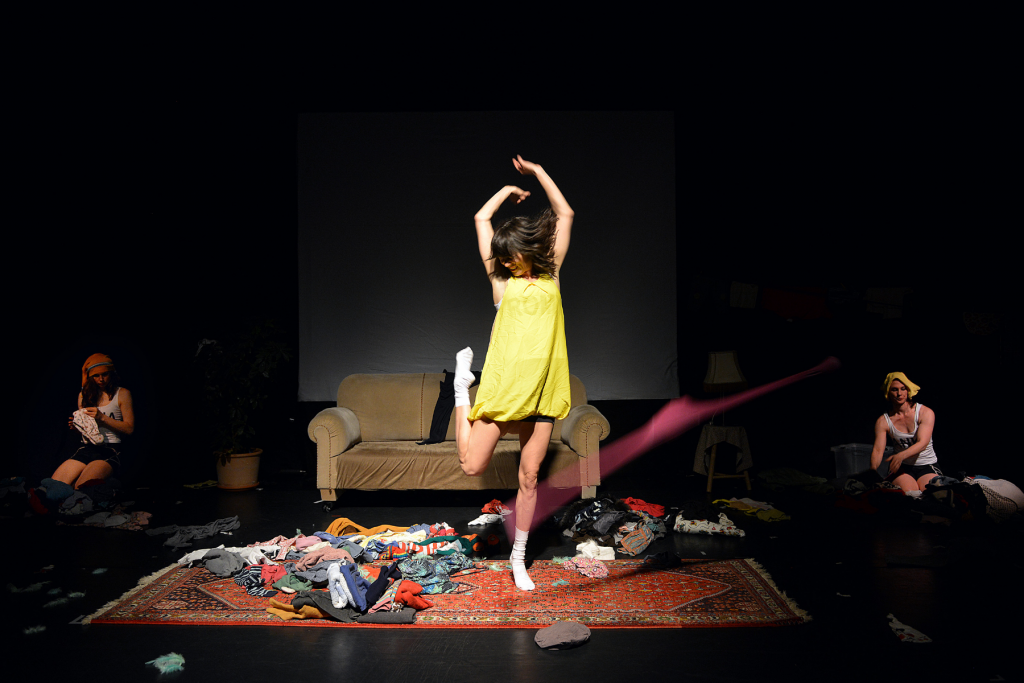
The piece flows effortlessly from one scene to another. The laundry mountain sparks a brilliant dance and object manipulation vignette from Romy. There’s a fabulously funny birth scene, then a whole army of baby dolls take over the stage, as we hear stories of post-natal exhaustion, breastfeeding and trying to be all things to all people, always. A sofa is the centrepiece of the stage setting – a sofa to be clambered over and through, leapt over, laid upon. The complicity between the three women is tangible, and the integration of the circus work into the theatre narrative is commendable.  Then, we step out of the domestic mire to witness a Berlin club scene, our Ravens delighted to have flown the nest for a while to smoke and dance and forget, just for a moment, that they have chicks in the nest.

Later in the piece, we get to meet the real-life offspring (on screen), who all seem wonderfully happy and well adjusted, not at all damaged by having mothers who sprout wings and fly from time to time. 

Raven has been co-authored by the three performers. In the early stages of making the work, the company worked with Bryony Kimmings, who is credited with  ‘creative support’ rather than named as director of the piece. (The show is co-directed by the company and Rachel Hameleers.)

Edinburgh Fringe 2019 has seen a fantastic amount of excellent circus, much of it challenging the boundaries of the form. Even amongst this plethora of high quality circus-theatre, Raven stands out as an exceptional piece of work.

Raven is presented at the Edinburgh Fringe 2019 by Chamåleon Productions in association with Aurora Nova.

Featured image (Top): Still Hungry: Raven. Photo by Daniel Porsdorf.

Ontroerend Goed: Are we not drawn onward to new erA

Ontroerend Goed, who have previously wowed Fringe audiences with one-on-one performances, sensory journeys, gambling casinos, and dating games, return to Edinburgh with a show that – gosh! – is presented on a regular stage, and doesn’t involve any audience interaction or immersion. Although actually, this isn’t the first time… The company have very many modus operandi, a whole bag of theatrical tricks up their sleeves, and in my experience their ‘regular’ staged theatre shows have, in recent years, been their most exciting and innovative work. Are we not drawn onward to new erA is a magnificent piece of theatre: inventive, absorbing, challenging, surprising.

In case you’re wondering about the title, it’s a palindrome – and that is highly relevant. The programme contains a Kierkegaard quote, which is also highly relevant: ‘Life must be lived forwards, but can only be understood backwards.’

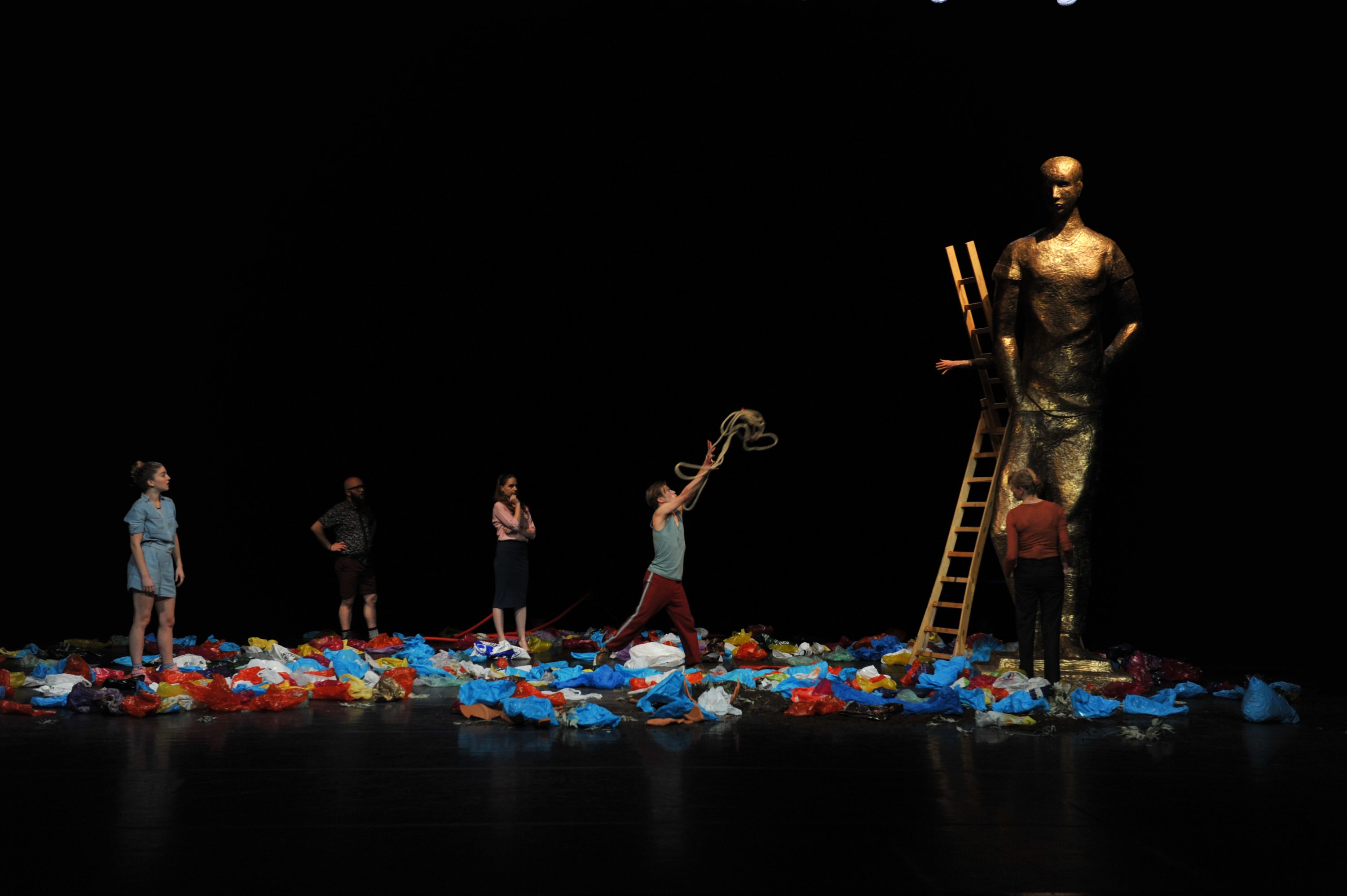
So, a wide stage. A small tree bearing one apple. A woman lying curled on the ground. Ah, Eve then. A man enters, the apple is eaten, with calm concentration. And so it starts. Little by little, one step at a time, the stage becomes populated by people and objects. People speak in a strange language. I try to work out what it is, and eventually twig. Talking of twigs: one of the men lays into the little tree and pulls it to bits. Another man, carrying a party balloon, goes off to get the head of a giant gold statue. Other parts of the statue are dragged on, and it’s erected. There’s a selfie moment. The stage gets more and more crowded, and a point of complete ludicrousness is reached as clouds of prettily-coloured plastic bags rain down, covering every bit of available space.

And then? Well, we’ve reached the point of no return. Point Zero. The moment when humanity has caused so much damage to the planet that it has become uninhabitable for our species.

And then? What can be done? We can’t turn the clock back, can we? There’s no Planet B, no second chance. Is there? Time’s arrow flies forward…

The second half is an extraordinary coup de theatre – and it would be unreasonable of me to say any more about the narrative. I will switch instead to talking about form rather than content.

Are we not drawn onward to new erA mixes engaging and carefully choreographed live performance by an ensemble of six actors, a very novel and clever use of video (Jeroen Wuyts and Babette Poncelet), and original musical composition (by William Basinski) played by a sextet of musicians from the Spectra Ensemble. Director Alexander Devriendt, who is a co-founder of the company, does a great job pulling all elements together to create a piece that is both funny and disturbing, frighteningly pessimistic and full of melancholic, perhaps desperate, hope. The twist at the centre of the piece has the quality of one of those bargaining rescue fantasies you have after someone dies, in which you imagine that you can go back to the fateful moment and just do things differently. Or the fantasy in which the dead person turns up in your dreams to reassure you that they haven’t died after all. But then you wake up… But no, you’re still dreaming, just dreaming you’re awake.

Are we not drawn onward to new erA is a cleverly staged, visually sumptuous dream – technically, a fantastic achievement, and artistically, a truly beautiful show full of pensive sadness.


Featured image (top) Ontroerend Goed: Are we not drawn forward to new erA. Photo Mirjam Devriendt


Total Theatre Awards 2019 – Shortlist Announced!

Total Theatre Network are delighted to announce today the shortlist for the Total Theatre Awards 2019. From the list announced today, a total of seven awards will be awarded across five categories: “Physical & Visual Theatre”; “Innovation, Experimentation & Playing with Form”; “Emerging”; “Circus”; and “Dance” at a ceremony to be held on 23rd August. 

Following a shortlisting meeting on 14 August, a total of 27 productions from 8 countries have been selected as the 2019 Shortlist for the Awards across the five categories outlined above.

The Total Theatre Awards are a peer-to-peer assessment process of dialogue and debate to recognise excellence and artists pushing the boundaries of independent performance.  In order to produce this shortlist, a total of 403 eligible shows have been assessed over the first 11 days of the Edinburgh Festival Fringe. These shows have been viewed between two and four times by a curated panel of 26 peer assessors, comprising artists, producers, programmers, curators, critics and academics, alongside a number of senior industry supporters and advisors.  Meeting every two days, the Total Theatre Awards Producing and Assessment team have engaged in 36 hours of collective discussion of all eligible productions in depth, across specialism and across discipline.  

Following the shortlisting process, the selected shows will now move to a judging panel where shows are seen by leading arts industry figures including critics, academics, artists and programmers. Seven awards will be given across five categories and the judging panel will announce their decisions at an awards ceremony on Friday 23 August. The judges for the Total Theatre Awards reserve the right to award further productions that open at the festival after the shortlisting has taken place.

The full shortlist for the 2019 Total Theatre Awards is below:

Shows by an Emerging Company / Artist
This Award is supported by Theatre Deli

 Burgerz by Travis Alabanza

Hackney Showroom (England)

Traverse

 Life is No Laughing Matter

Demi Nandhra (England)

Summerhall

 Sex Education
Harry Clayton-Wright (England) 
Summerhall

 STYX

Second Body (England)

Zoo

 YUCK Circus

Underbelly and YUCK Circus (Australia)

Underbelly


Total Theatre & Jacksons Lane Award for Circus

Contra

Laura Murphy (England)

Summerhall


Jelly or Jam

Ampersand (Australia)

Underbelly


Knot

Nikki & JD / Jacksons Lane (England)

Assembly


Raven

Chamaleon Productions in association with Aurora Nova (Germany)

Assembly


Super Sunday

Underbelly and Race Horse Company (Finland)

Underbelly


Staged

Circumference (England)

Zoo


Total Theatre & The Place Award for Dance


Ensemble

Robbie Synge and Lucy Boyes (Scotland)

Dance Base


For now we see through a mirror, darkly

Ultimate Dancer (Scotland)

Greenside


Seeking Unicorns

Chiara Bersani / Associazione Culturale Corpoceleste (Italy)

Dance Base


Six Feet, Three Shoes

Slanjayvah Danza (Scotland)

Dance Base


Steve Reich Project

Isabella Soupart / MP4 Quartet (Belgium)

Dance Base


Total Theatre & Theatre in Mill Award for Innovation, Experimentation & Playing with Form

Total Theatre & Rose Bruford College Award for Innovation, Experimentation & Playing with Form


 Are we not drawn onward to new erA – Ontroerend Goed

Theatre Royal Plymouth, Vooruit, Richard Jordan Productions, BiB with Zoo

Zoo (Belgium)


Below the Blanket

Cryptic (Scotland)

Royal Botanic Garden Edinburgh


Frankenstein: How to Make a Monster

Battersea Arts Centre and BAC Beatbox Academy (England)

Traverse


Louder Is Not Always Clearer

Mr and Mrs Clark featuring Jonny Costen (Wales)

Summerhall


Nightclubbing

Rachael Young

Summerhall


The Canary and the Crow

Daniel Ward and Middle Child (England)

ROUNDABOUT@ Summerhall


The Accident Did Not Take Place

YESYESNONO (England)

Pleasance


Tricky Second Album

In Bed with My Brother (England)

Pleasance


Total Theatre & Cambridge Junction Award for Physical / Visual Theatre


Die! Die! Die! Old People Die!

Ridiculusmus (England)

Summerhall


Limb(e)s

Ci Co (Canada)

Assembly


Working On My Night Moves

Julia Croft and Nisha Madhan with Zanetti Productions (New Zealand)

Summerhall


Featured image (top) FK Alexander, previous Total Theatre Award winner, and an assessor at the Awards 2019.

Please note Total Theatre Awards and Total Theatre Network operate independently to Total Theatre Magazine. See https://www.totaltheatrenetwork.org/

Jo Crowley, Co-Director: +44 (0)7843 274 684 / crowley.jo@gmail.com

Becki Haines, Co-Director: +44 (0)7732 818401/ haines.becki@gmail.com

Total Theatre Awards: totaltheatrewards@gmail.com 


Sh!t Theatre: Drink Rum with Expats

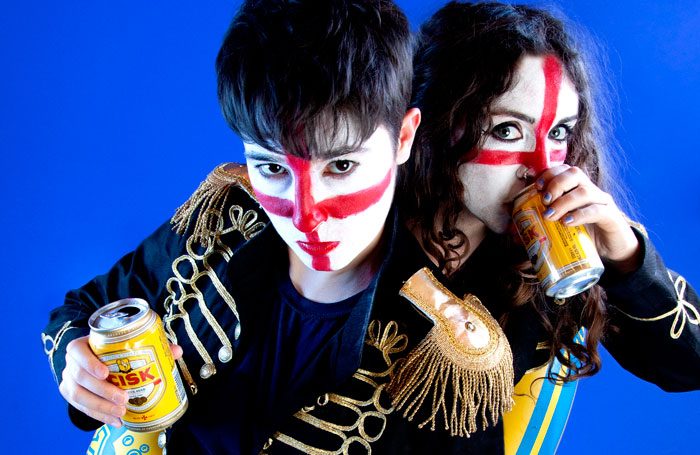
Welcome to The Pub – footie on the telly, and our two hosts in pirate jackets and denim shorts, faces painted with what appears to be the St George cross.  Grab yourself some Cisk beer and a bit of cheese. Cisk beer? Ah right, we’re in Malta, and Cisk is Maltese for Czech (you work it out). So not the St George cross, but the Maltese cross – pretty similar. Anyway, Cisk are providing free beer in a sponsorship deal, so enjoy.

So, Malta – what do we know about Malta? it’s an island, small enough for everyone to know everyone else’s business. It’s in the middle of the Mediterranean, inside a triangle with Italy, Tunisia and Libya at the points. It used to be a British colony, independent since 1964, and it’s full of British ex-pats (and why are Brits abroad ex-pats, and everyone else abroad immigrants?). You can buy a Maltese passport for €650,000. Its capital Valletta was a European Capital of Culture in 2018 (cue audience participation ‘ding ding’ every time this is mentioned).

And why Malta? Sh!t Theatre’s Louise Mothersole and Rebecca Biscuit find themselves invited over for the Capital of Culture, and given money (‘we like money! we need money!’) to make a show in The Pub, and now they’ve made the show, and brought The Pub to us.

What is this Pub, I hear you say? It’s not just a pub, it is The Pub. That’s its name, and it’s where everyone in Malta goes. All the ex-pats, anyway. The immigrants have their own dive.

The Pub’s biggest claim to fame is that it is here that Oliver Reed had his last drink. And the last but one drink, and the last drink before that. They don’t make too much of it there – not really. Cue video footage panning round The Pub, highlighting all the Ollie Reed photos and T-shirts and mugs and so much more.

In typical Sh!t Theatre fashion, we get facts and fancies, sea shanties sung with great gusto, autobiographical confessions, stories about the telling of stories. We get to drink a rum toast to Reed, pinching his words (‘For the Peasants!”) We even get to learn some Maltese. (We learn that Zop is Maltese for penis, for example – that leads us to a jolly sing-a-long.) On video, we meet a whole raft of eccentric characters. There’s a nice device of meeting people through the cartoon drawings that one well-known Maltese artist has made of the locals in The Pub. We hear about all the immigrants/refugees (not ex-pats, then?) rescued from the Mediterranean daily, from a constant stream of boats of various levels of suitability for the journey that make the crossing from Libya.

It all bounces along merrily, but there are hints of darker things – hints that grow as the piece progresses. A darker side to the migrants’ stories (torture, threats, bribery). A darker side to Malta’s news media, as the story of Maltese journalist, writer, and anti-corruption activist Daphne Caruana Galizia unfolds (after years of threats and attempts to silence her, Daphne was murdered by a car bomb in 2017).

Drink Rum with Expats sees Sh!t Theatre doing what they do best – drinking, joking, singing, confessing, body surfing through the crowd. But, as with other Sh!t shows, there is also social awareness, a journalistic approach to storytelling, and a strong political consciousness permeating everything. In their work, the personal is political, and the political gets personal. Drink Rum is a jolly jape, but it’s a whole lot more too, opening our eyes to things that we don’t immediately see…

There is something slightly unnerving about the mix of  lighthearted nonsense and serious reportage – but that’s one of the many things I love about Sh!t Theatre, and the balance is cleverly maintained in Drink Rum. So bravo, another rip-roaring success for our brave buccaneers.

Featured image (top) photo by Bronwen Sharp.

Sh!t Theatre: Drink Rum with Expats is presented at Summerhall by Soho Theatre in association with Show&Tell.


Brusnikin Studio: Forest

Visiting Assembly’s Checkpoint venue always brings back fond memories and summons ghosts, as it was in this space that the legendary Forest Fringe was based for very many years. It is therefore always a delight to see the space used imaginatively, as it is here for this highly physical and visual Russian ensemble production, featuring recent graduates of the renowned Moscow Theatre Arts School. And it feels special and an interesting resonance that the piece I’m seeing here is called Forest!

I take my seat in the front row (there are two front rows, forming a kind of L-shape around the performance space, with both the stage and the floor in between used). In front of me is a mound of earth and some sort of large vessel, covered. To my left, a young man in a white robe is standing, holding a tall stave. A young woman is crouched down, by a sawn log that is standing up vertically in the space. In fact, there are very many young people dotted around the space, on the stage and in the auditorium, all clad in white robes. Lots of the logs too! At the back of the stage is a circular screen, a kind of glowing disc on which monochrome images of rippling water are projected.

The following 55 minutes bring us a beautifully enacted, ritualistic performance piece that is word-free, other than for the lyrics of the haunting songs (sung live, by the ensemble of fourteen, seven men and seven women) that accompany the physical action. And what a pleasure it is to see such a large ensemble at the Fringe! I have virtually no Russian, but I pick out one word that I understand – Nec. Forest.

Forest, inspired by the ‘New Russia’ philosophy of writer Vladimir Bibikhin, takes us on an elemental journey, honouring the five elements of the ancient world – earth, fire, wood, metal and water. We encounter these elements both literally and metaphorically: the smell of the earth and the stripped wood is tangible, the water splashed on faces real. Meanwhile, on screen, we take a bird’s eye view, then an earthworm’s view, of the primeval forest.

The show, devoid of any polemic, honours the natural world, and reflects on humankind’s relationship to it. Forest, unlike some other work at this year’s Fringe, is not here to preach about environmental concerns. It instead honours and praises the power of Mother Nature, and lets us form our own views on how we should relate to the earth.

One particularly strong scene sees timbers falling on screen, as one ensemble member after another climbs onto one of the tall, stripped logs and falls, straight-backed, into the arms of their companions – forward for the men, backward for the women (the ensemble is often divided in its actions by gender, which is a comment not a criticism). The message is clear, and doesn’t need to be spelled out: There are no divisions – we are the trees, and the trees are us.

The interaction between live and onscreen image is excellent, here and in other scenes. The ensemble are a skilled bunch, who work in male-female pairs, in gender-divided groups, or as a whole ensemble taking on archetypal ideas, exploring balance, conflict, birth and death. Scenes have names such as ‘Play – Intimacy’ and ‘Magic – Incantation’. We most definitely feel that we have been taken back to the very beginnings of theatre – we are witnessing (or taking part in) in an animistic ritual, honouring the earth and the spirits that inhabit and draw everything together.

The video work (by Kirill Pleshkevich) is excellent, mostly dreamily realistic with a touch of the surreal, reminding me sometimes of scenes of the natural world in Tarkovsky’s films; and the sound design (by Niyaz Karim) is of the highest quality. From my position in the auditorium, I can’t tell if the soundscape (beyond the live vocal and percussive work of the ensemble) is being created and mixed live or is pre-recorded – but either way, it is an exciting combination of Foley sound, pre-found sounds, and composition which uses guitar alongside less familiar instruments such as the kalimba. Direction and stage design is by Dmitry Melkin, who comes with a reputation for creating site-responsive devised work across Europe,  and here has led his young ensemble into creating a series of strong, sculptural visual images, making enchanting sounds, and enacting physical movement motifs that explore archetypal human experience.

If you want a point of reference, Forest – in its blend of beautiful polyphonic singing and strong physical ensemble work – reminds me a little of Polish company Song of the Goat. The director, in his notes, talks of moving back to a fundamental theatre, and this is indeed what we have here – a theatre that is truly embodied, miles away from the intellectual, conceptual and abstraction of much contemporary theatre.