Author Archives: Dorothy Max Prior

Dorothy Max Prior

About Dorothy Max Prior

Dorothy Max Prior is the editor of Total Theatre Magazine, and is also a performer, writer, dramaturg and choreographer/director working in theatre, dance, installation and outdoor arts. Much of her work is sited in public spaces or in venues other than regular theatres. She also writes essays and stories, some of which are published and some of which languish in bottom drawers – and she teaches drama, dance and creative non-fiction writing. www.dorothymaxprior.com

Sliver Lining & Jacksons Lane: Throwback

What’s she gonna look like with a chimney on her… If you wanna be my lover… Stop right now, thank you very much… It’s not unusual to be loved by anyone… Hey, the Macarena!

What’s your feel-good throwback song? The song that reminds you of the good times? Write it on a piece of paper, make the best paper plane you can, and throw it onto the stage…

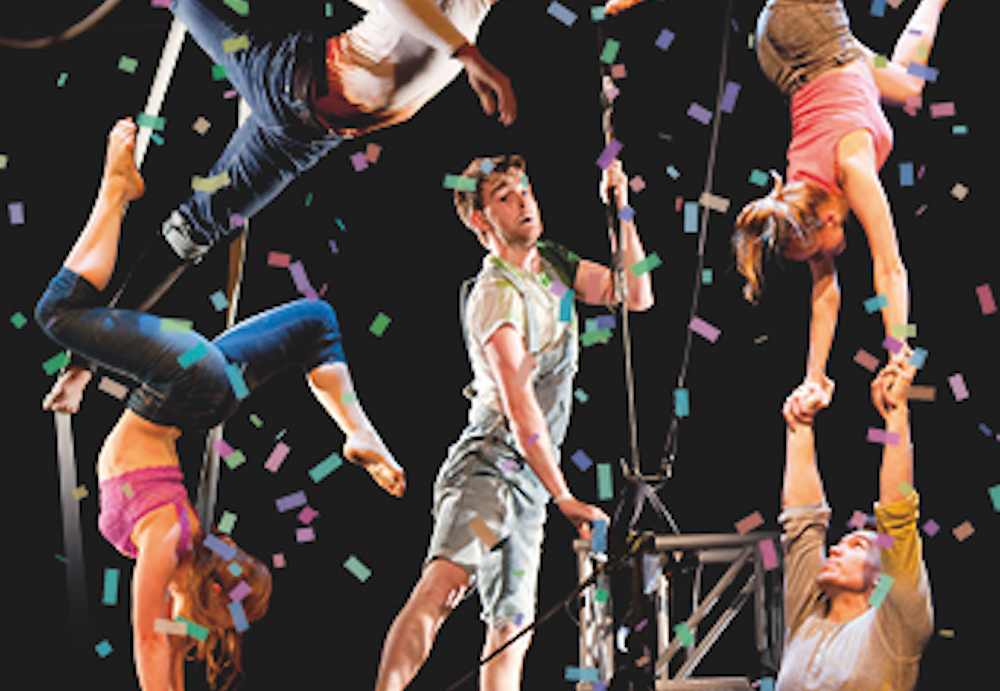
And their off! Dancing and tumbling and talking straight out to the audience, Silver Lining take no prisoners in an energetic and exuberant start to their show Throwback. Within five minutes of arriving on stage, bouncing round like a litter over-excited puppies, they have us eating out of their hands. And that’s it for the next hour. I’ve seen a lot of shows where those on stage show us what it’s like to be at the best party of your life – in this one, we feel part of the party from the word go. And they do the fabulous Patrick Swayze lift from Dirty Dancing – on top of a three-person tower! – in the opening sing-along sequence of the show, so even if I hadn’t been completely sold from the start, they’d have had my undying love from that moment on.

Using a format that, in the interest of fairness it needs to be said owes a little something to both Traces by Quebec’s Les 7 Doigts, and UK circus hit Pirates of the Carabina, Throwback is a kind of confessional coming-of-age circus show that intersperses skill-based acts with the sharing of little vignettes of autobiographical material – stories, songs, and more. But actually, do I care if I’ve seen something similar(ish) in format before? Not at all. This troupe of six super-talented young performers (graduates of the National Centre for Circus Arts, aka Circus Space, and nurtured by London’s premier circus venue, Jacksons Lane) make it all their own.

Skills-wise, we have a boy on the trapeze, who I think might be called Tom, who starts his solo slot off very nicely with a neck-hang, eliciting gasps from the girls in the row in front of me. Tom is a sweet soul who seems to have an obsession with horses. In a line-up yes-no game they play out twice in the show, Tom tells us he had a Pony in my Pocket and wanted to be a horse when he grew up. The line-up game is used to tell us what age everyone is (22! 24!), whether they prefer tea or coffee, whether they are single or not, whether they prefer cats or dogs. An Irish girl with an auburn pony-tail and a lovely smile sings the song Smile acapella, a favourite in her family of singing sisters, before going into a very nicely executed hand-balancing act. An energetic break-dancing boy who might be called LJ channels the spirit of Michael Jackson and does a good strong straps act to Come Together. Sam is the dark and moody-looking one who tells a heartbreaking story of his mother getting in to debt to buy her children a piano, who then gets cheers from both the ladies and the gentlemen of the audience when he takes his shirt off for his elegant hand-balancing act. The girl from Berlin in the red dress has tales to tell of her love of traditional German tunes. She is also a great foot juggler, using not only the traditional rola-bola, but an assortment of colourful umbrellas. Number six is the Scottish guy (cue cheers from the audience), a beefy base in an AC/DC T-shirt who confesses to a broken heart brought about by his own infidelity. His frustration gets played out in a Chinese Pole act in which the pole seems to bear the brunt of his frustration.

Inbetween and around the solo acts are lovely little moments of ensemble work. Tom’s trapeze act ends with him sliding down from the trapeze over a human slide. He also gets a moment that needs to be mentioned where he plays air guitar on a hoop…

 Throwback is a show full of upbeat energy, humour and a sound body of circus skills. They may be young, but they have already learnt how to use what they are good at in the service of the show, rather than just performing tricks for the sake of showing off the skill. Great team work, lovely stage presence, plenty of humour, a whole swathe of cute and clever pop culture references.

I had The Time of my Life, thank you very much.


Company Here and Now: Perhaps Hope

‘Good evening this is your captain speaking. Get ready for a crash landing. We’re going down’. 

 Perhaps Hope is a circus show with a difference: a dark and moody circus-theatre exploration of a dystopian future. Or perhaps it’s the present. Two people – a kind of end-of-civilisation Adam and Eve – are marooned somewhere, who knows where, or when. We presume that there has been some sort of disaster – probably an ecological meltdown. ‘There must be someone to blame’ says the recorded voiceover at one point: ‘No birds, no bees, no HIV. No Lions. No tigers. No vegetarians. No lesbians. No smuggling. no recycling. No immigration.’ The point being, all the pros and cons of human life, all the opinions and personal identity issues that currently engage and concern us, will have become nothing, meaningless.

To the sound of a slightly remixed and distorted version of Laurie Anderson’s O Superman, they stand staring out at us, leaning into each other; one tall, one short, their shadows cast large behind them onto the wall. It’s an image that’s repeated, with slight variations, throughout the show – one of many sound and movement motifs returned to again and again, rituals or obsessive-compulsive tics.

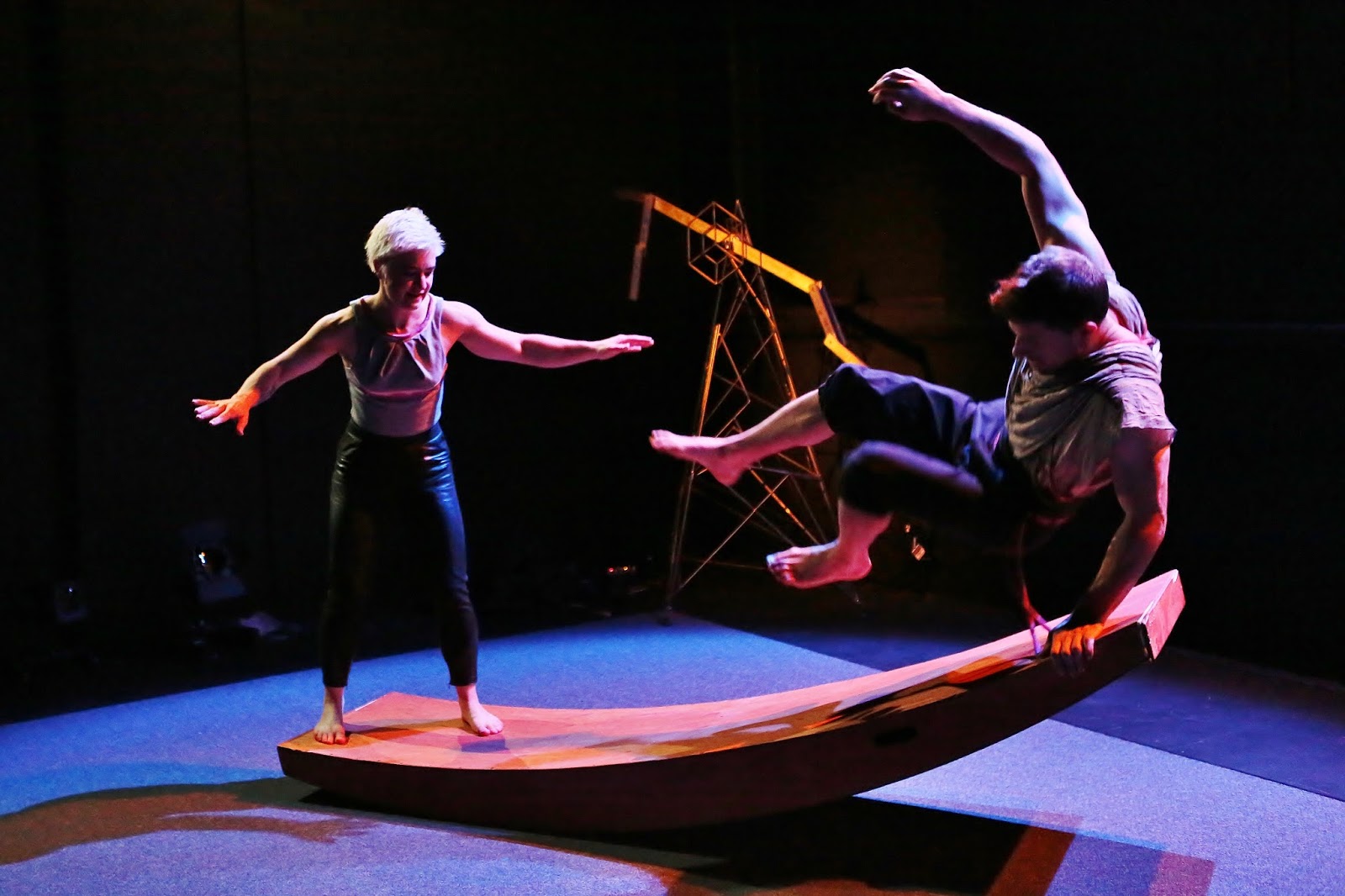
Onstage with them is a lovely carved-wood boat cum see saw; and behind that a metal sculpture reminiscent of a ship’s mast or a radio antenna that is animated and played at regular intervals. There is also a stack of bottles and wooden tabletops/trays, that are formed into an ever-higher tower which is eventually stood on, the woman at the top staring out defiantly. Or perhaps hopefully. The bottles are also placed along the ‘boat’ and walked over: the circus skills employed throughout are predominantly balancing of one sort or another – acrobalance duets, solo hand-balancing, and walking or standing on or manipulating the see-saw boat.

The two performers (both Australian, with a performance CV that includes work with both Circa and Casus) are, inevitably with that track record, highly skilled. The acrobalance work together is beautifully controlled – and they are clever enough to play the ‘try, fail, and try again’ trick perfectly, for example as she teeters along on the bottles, reaching out to him for help.

Their characters, or onstage performance personae, work well together. There are some very lovely scenes. I love her crazy silent disco dancing whilst he stays straight and still, upside down in a perfect handstand on the balance sticks. They are not afraid to do nothing, often returning to points of stillness before the next bout of activity.

It is so great to see circus employed to say something about the world; and to see a show in which the various components – acrobatic and balancing skills, recorded spoken text montage, an elegant sound design, sparse but beautifully crafted set, and great lighting design – all merge so beautifully and harmoniously together, put to work in the telling of the tale.

And despite the shadowy gloom (literal and metaphorical) throughout, there are moments of humour – and the show ends on an optimistic note: it’s a new world, it’s a new dawn, it’s a new day… there is, perhaps, hope.


IT-FOLDS-BrokentalkersJunk-Ensemble-photo-Luca-Truffarelli-WEB-show

Brokentalkers/Junk Ensemble: It Folds

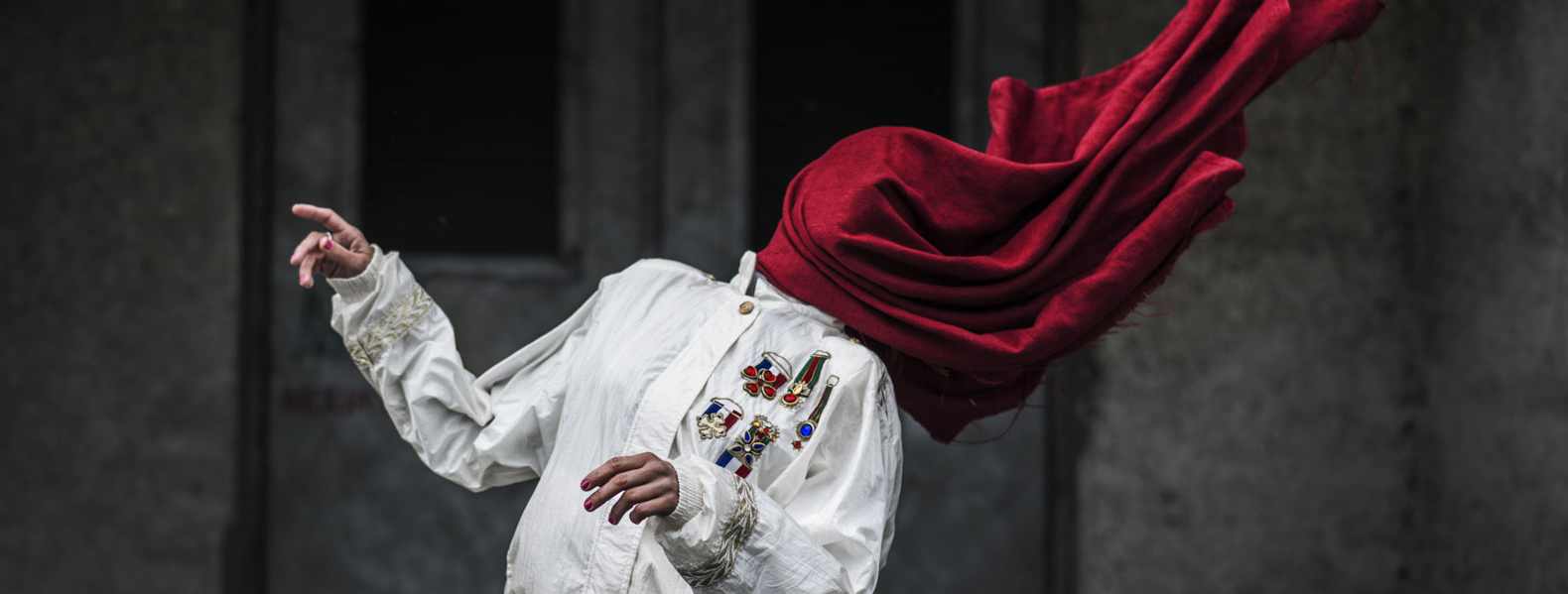
It Folds is a harrowing, heartbreaking and sometimes darkly humorous investigation of death and grief. It is mostly the story of lost children. Children abused or abducted or run over or gone missing, permanently. It is a story told by a (holy) ghost in a sheet with holes for the eyes, and trainers; a dishevelled, twitching angel; a pantomime horse with a rebellious rear end; and a banjo-playing, grieving mother.

The onstage world presents us with a series of disturbing dream images, conjuring up a bardo of becoming beyond death for those who have departed, and the confused and frightened imaginings and memories and rituals of those who are left behind.

Objects – real or imagined – play an important part. There are at least two pairs of broken spectacles spoken of – a blue plastic pair found somewhere near where a dead boy might be buried, and a distraught father’s specs with a broken lens that he dons to read an eulogy to his son at the funeral (much to the embarrassment of the boy’s friends). As for real onstage objects: we have a toy horse pinata dangling from the ceiling and an ornate padded chair. That’s our lot. Everything else is in or on the bodies of the performers. A tatty horse costume, a gold cardboard party hat, a blindfold, a stick…

It Folds is a collaboration between Total Theatre Award winning theatre company Brokentalkers, and dance-theatre company Junk Ensemble. Both companies are based at the Project Arts Centre in Dublin. The piece is a perfect mesh of the two company’s styles and mores. Brokentalkers’ talent with earthy, deconstructed, poetic text; an interesting and surreal exploration of physical object and costume; and ritualised action is very present. See, for example scenes that give us an older woman talking to an empty suit sat in a chair;  re-enactments of a visit to seek the advice of a spirit guide; or the repeated motif of the happy birthday song that recurs throughout the show. The beautifully real and edgy choreography from Junk Ensemble includes a wonderful duet between two men – an older, sturdier man moving and manipulating and imposing upon a boyish and slim figure who stiffly leans and falls whilst being hugged and pulled about, then is dragged across the floor whilst straight as a plank. It makes for an extraordinary and disturbing picture of abuse.

There is a large cast, the professional actors/dancers joined by a community choir who play a host of ghosts singing angelically. But often the stage is occupied by just two or three performers at a time. There is space to breathe – visual images, exchanges of words, or choreographic sections are allowed to play out; to have the time and space to work their way into our imaginations.

Disturbing, but not distressing – a surreal exploration of the elephant (or stuffed horse) in all of our rooms, death. We are the dead.


FK Alexander: (I Could Go On Singing) Somewhere Over the Rainbow

I’ve been sung to by FK Alexander! I waited until she had taken off her black sequinned cabaret singer jacket, and her harness, and her not-silver (as in the original Wizard of Oz book), not-ruby red (as in the Judy Garland film) but sparkly coppery-gold shoes. I stood on the black cross on the floor and she noticed me and smiled and walked over to me, took my handwritten ‘admit one’ ticket, then went back and took a sip of water, put her harness and jacket back on again, re-applied her lipstick, and put the lovely shoes back on her feet. Ready.

She takes up her microphone, walks over, and stands in front of me. She smiles another, bigger, smile, takes my right hand in her left hand (her hand down, my hand up: the giver and receiver). She raises her right hand, holding the mic up high as the wonderfully intense and rich wash of industrial/sampled/layered sounds starts to crack and break into fragments of Over the Rainbow.

And then she sings to me: ‘Somewhere over the rainbow, way up high, there’s a land that I’ve heard of, once in a lullaby.’ All the other people in the room can see and hear this too, but she is singing to me. I sing back. Later, as I watch other people come forward enthusiastically, or fidget in their seats wondering if they’ll have the courage before jumping up hurriedly before someone else does, I enjoy noticing who stands very still and listens, allowing themselves to be washed over with the sounds and the experience, and who sings back to her or with her.

An hour passes very quickly. Perhaps nine or ten people are sung to directly? There is no allocated slot – you just take the space if you want to. The duration of the show is one hour, and when that hour is up, she stops, it stops.

She’s supported onstage by two other performers, musicians from Glasgow noise band Okishima Island Tourist Association – a man and a woman, both in black, wearing shades, standing perfectly straight and still behind their (music making) stations.

Oh and Judy Garland is here too, in a manner of speaking. Her voice is here in the mix, and her spirit is conjured. A deranged, distorted spirit, a ghost in the machine of sound; a spirit using the vessel of FK Alexander to stand in the spotlight once again. Or at least, to bask in the strobe flashes that are the climax of each one-to-one performance.

FK Alexander’s performance presence throughout is immense – beautifully held, controlled and in charge, loving and giving. The actions of donning and removing the ‘costume’ and the stance with the microphone, acknowledge the performance rituals and mores of the heavenly host of legendary divas and pop stars that are here with us, somehow. They also remind us of the power of ritual, on stage and in life. We all have our lucky jacket; our favourites shoes; our need to do things in the right order each time.

Alexander, who I’d previously seen and admired at SPILL Festival (London, 2015) is one of a number of contemporary performance artists working in the space between and around music and art. At that previous show, I’d seen her walk across hot coals accompanied by an intense barrage of sound so deep and strong that it penetrated to the bowels (as my friend and former colleague Genesis P Orridge might have put it). As a veteran of the Throbbing Gristle/Industrial Music scene, I feel that FK Alexander, and her collaborators on this show, are carrying the torch for the artistic intentions laid down in the 1970s that are sometimes referred to as ‘punk’ or ‘post punk’ or ‘industrial music’.

Yet the show is also, of course, her own thing. This is now, and she is out there.

This is an intense, vibrant, beautiful piece of performance art – delightfully different to most other work you are likely to see at the Edinburgh Fringe.


Derevo: Once

Once.

Once upon a time…

Once. But in another time, not this time. Another world, not this one. We have entered another world, another time. An ethereal world, outside the boundaries of space and time. (Ether is the substance that angels are made from…)

Once upon a time there was…

A pair of angels looking down upon a world. A tiny toy doll.

A cafe, with tables and chairs, and pictures of ships a-sailing. And a radio, pinned askew on a wall.

On the radio, a dancehall foxtrot.

In the cafe, which may well be the restaurant at the end of the universe, a waitress. A pretty doll-like girl in a little white dress and bunny ears, she trips merrily across the floor with her clickety-clackety high heels. She sits at a table and daydreams. She stands and tweaks her dress and ears. Someone who might be the janitor, someone of low status anyway, comes in pushing a broom across the floor, his vulture-like head jerking forwards, his tatty beige coat falling off his lanky frame – a downbeat clown, with big yellow shoes and a red nose. His heart is broken, that is obvious – he is wearing his heart on his sleeve. Enter the customer, a suave gentleman in a dapper black suit. He calls for the menu, he orders a fish. He’s obviously a fishy character…

These are our three main characters – or perhaps archetypes rather than characters is the better word, for we are in a world of fairy tales and dreams. The pretty ballerina, the princess, a version of Columbine; the heartbroken clown who wants to win her love; the suave dastardly villain who wants her too, and will fight him to the death for her love. Meanwhile, a very stupid cupid has come and gone – he seems too big for his own body, limbs akimbo like a young colt. He misses his target, fires offstage, breaks his arrows (and later his bow). He is useless.

The scene is set…

There follows a thrilling word-free montage of clever clowning sequences, eccentric and beautifully executed choreography, and gorgeous moving pictures – sometimes literally, as the painted storybook scenery  seemingly shifts itself, or the wonky pictures on the walls slide away to reveal startled faces.

The fairy-tale and mythological references come thick and fast. Here, a leaping and dancing Sinbad the Sailor (or maybe it’s the Prince of Persia) with his sabre flashing and cutting the air; there, a kind of Trojan Horse, a giant head hiding two people inside it. The simple props are used with a child-like glee: a cardboard fish on a dish is thrown across the room; a piece of piping becomes a periscope; a head pokes through a cardboard box tied up with a bow.

The soundscape is an eclectic musical mix – a kind of jukebox of cultural dreams and memories. Waltzes and polkas. Distorted fairground organs. Mournful blues numbers, and a cheesy rendition of Brazil.

Music and physical action work together beautifully. There’s a gentle repeated waltz motif as the Girl and the Suitor face each other from either side of the stage, stepping forward and back in time; and a joyous polka as they dance around the room together, as the Clown looks on in anger and despair. The Clown, seized by a demented desire, plays out a totally stupid and funny heavy-metal cock-rock dance with a cardboard falling star.

Once is one of Derevo’s lighter and gentler pieces of work – although not without its dark and dangerous edges. An hour and a half skips by quickly – we lap it all up eagerly.

It is great to see Derevo,  the Russian maestros of physical/visual theatre, back in the UK – and oh what a joy it is to see the company’s three founder members Anton Adasinsky (the heartbroken Clown), Elena Yarovaya (the lovely Girl) and Tanya Khabarova (the villainous Suitor) reunited on stage. All three give superb performances, working beautifully together. The trio of central performers are aided and abetted most ably by Aleksey Popov, Makhina Dzhurayeva and Aleksey Merkushev. The fabulous fairy-tale set is designed by Maxim Isaev.

Twenty years on, Once has an added poignancy – it is even more touching and funny and heartbreaking than it was 20 years ago. And with its universal theme of unrequited love and broken hearts, it is a timeless play that will never cease to entertain us and thrill us through and through. Love hurts, for sure.