Author Archives: Dorothy Max Prior

Dorothy Max Prior

About Dorothy Max Prior

Dorothy Max Prior is the editor of Total Theatre Magazine, and is also a performer, writer, dramaturg and choreographer/director working in theatre, dance, installation and outdoor arts. Much of her work is sited in public spaces or in venues other than regular theatres. She also writes essays and stories, some of which are published and some of which languish in bottom drawers – and she teaches drama, dance and creative non-fiction writing. www.dorothymaxprior.com

Fiction

David Rosenberg / Glen Neath: Fiction

‘The numbers on your headphones should match the numbers on your seats.’ There’s a slight air of anxiety as people try to find their seats, which aren’t in numerical order. We notice as we sit that although it is a sell-out show, there is no-one in the seat to either side of us. whole columns are empty. So friends are separated, and we each sit alone with no human contact, staring at a screen. ‘This is your last chance to leave’ warns the screen. We see some photos of a bland hotel room. A bed, two chairs, light fittings, a nondescript ornament or two. The lights dim, we’re in the dark. Total blackout, not even an emergency exit light.

Then the voices start, far away at first, then very close. The person whispering in my ear is called Julie. You have to imagine that with a French accent. Julie. She is apparently taking care of me. We are in a hotel room. There is a conference speech to be written urgently. An ornament is broken – I was dozing but the crash woke me up. Julie is arguing with someone about me. I’m taken into a lift, where she apparently has to bribe the lift operator. Now I’m in a car. The goalposts keep changing. More noises. Other voices, engines running, crunching footsteps, the patter of rain. The rain stops, but the windscreen wipers carry on, regardless. We cut from one place to another. Indoors morphs into outdoors with no clear logic. It’s a film script. It’s a dream.

The thing this show most reminds me of is the experimental drama slot on Radio 3 on Sunday evenings, listened to under the covers. Radio, as we know, is a highly visual medium. The power of words whispered in your ear to conjure images, this is what’s at work here. Sometimes it goes beyond the radio effect, becomes a whole-body visceral experience as the room itself shakes and shudders.

Writer Glen Neath and director David Rosenberg are upfront in their objective to induce a state of shared dreaming in the audience. They stand on the shoulders of many other writers and directors who explore a dream-state of heightened reality chock full of puzzling non-sequiturs. Lynch. Saramago. Kafka. Murakami. Add a dash of Film Noir and French Nouvelle Vague into the mix. Or Nouvelle Vague Film Noir, even. Alphaville, especially. To steal a line from Murakami, Fiction takes us to edge of Kafka’s shore, and leaves us there, pondering. What does it all mean? Everything and nothing.

Fiction is one of a number of theatre-in-the-dark productions at the Edinburgh Fringe – Daniel Clark’s Earfilms is also playing as part of the British Council Showcase, for example. I’d say it’s a growing trend – but then I remember that BAC programmed a whole season of (literally) dark theatre at least a decade ago, possibly two. It’s an ongoing trend – and the advances in technology make for evermore sophisticated manifestations. Rosenberg seems to be making works using binaural headphones his thing. And more than that, his fascination with the Peeping Tom / Rear Window and other voyeuristic / pulp fiction cinematic motifs goes right back to his earlier work with Shunt in shows such as Amato Saltone.

Not for the feint-hearted. Or the claustrophobic.. Someone had to be taken out by an usher with a torch at the show I was in., which was a nice moment of unplanned theatre. Or maybe it always happens, who knows.

A rollercoaster ride of Artaudian theatre of the senses for those who dare.

Goodnight. Sleep tight.


Fiction by David Rosenberg and Glen Neath is presented by Fuel at the British Council Edinburgh Showcase 2015.
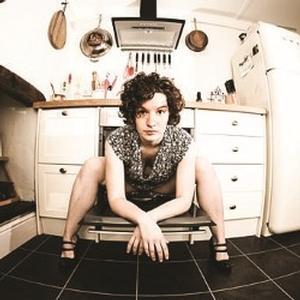


Souvenirs

The Human Animal: Souvenirs

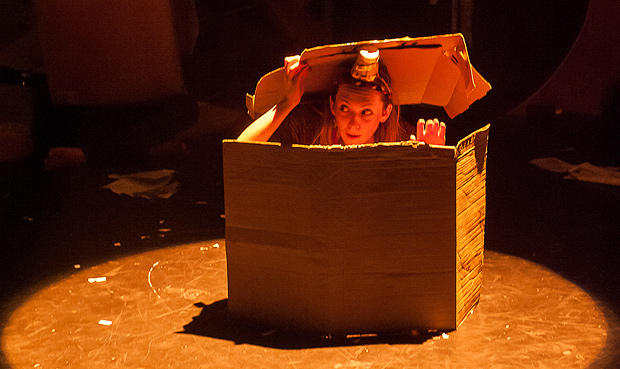
‘One man’s trash is another man’s treasure’ is the tag line for Souvenirs. There’s a pile of boxes and shelves at the rear of the performance space, boasting a hotch-potch of everyday objects and ornaments, looking very much like a display in any one of the many Edinburgh charity shops just five minutes walk away on Nicholson Street. There are also old newspapers in the space, and three people sat in child-like (or teddy-bear, perhaps) poses, with roughly decorated cardboard boxes on their heads. They burst out and name themselves: One, Two, Three. They dash around in high spirits, playing games of various sorts, a nice evocation of the golden years of mid-childhood – those years when your old enough to be allowed outside for long spells, building camps and forming gangs.

There’s a new girl on the block, they name her Four, but she’s not sure she wants to take on the tag. She does, though, want to be one of the gang – but to be accepted she has to fulfil a dare. Break into the Birdman’s house and steal a jammy dodger.

She does – and she finds a lonely single man with stories to tell. His memories are evoked by the ensemble, who have now become (variously) his legendary journalist grandfather, his new-age poet mother, and his boyhood best friend turned lover.

It’s a story that has precedents – literature is full of these odd-bod adult/child confessional relationships, from Pip and Mrs Haversham onwards. Which is no bad thing – it’s an eternally interesting theme. I don’t have any gripe with the essential story, although feel it needs work. The key dramaturgical problem is the age of the child bearing witness – the tone of the game-playing, and the jittery physicality of the mock-children, has set up the suggestion that she is around 7 or 8 years old, perhaps 9 tops – but once in the company of the Birdman, she becomes someone far older, offering reflections and words of wisdom that would be pretty grown-up even for a teenager.

The writing is rather erratic – and it is thus not a surprise to see four writers (none of them the performers) credited on the play, along with a director and two producers. For this is a play, developed in association with Freshblood New Writing – despite its listing in the Dance and Physical Theatre sections of both the Edinburgh Fringe brochure and Zoo’s own marketing. It is a piece of new writing delivered by a young ensemble, who use add-on physical/visual theatre tricks as illustration of the text, rather than as the means to tell the tale. The promised object play is pretty old-school physical theatre – newspapers becoming masks or fluttering bird-like around; lengths of cloths becoming wings etc – although done well, and I do enjoy this aspect better than the poorly executed sections of early Complicite style hero-chorus movement work (slo mo movement across the stage; bodies lifted aloft – you know the sort of thing). No one on stage seems to have any particular aptitude for movement work, and there seems to be a mistaken belief that physical theatre is all about running around a lot, rather than it being what emerges from a performer trained in the use of their body as the storytelling medium.

The six onstage performers tear around the space morphing from one character to another, or providing ensemble support to other character’s stories. I do wish, though, that they had been discouraged from their terribly actor-ly acting. Their voices boom and project out into a small space that really doesn’t need this, and despite their proximity to us in this small space, with no divide between performers and audiences, our existence is never acknowledged. There are a couple of sections of monologue where the text is delivered over our heads into the void beyond. I suppose that’s what they teach you at acting school. It might work on a massive stage, but here it is just plain weird.

Apart from feeling strangely ignored as an audience member, fourth wall firmly intact, I also feel the whole show is just so busy that I’m starting to feel giddy and over-stimulated. So much needs cutting down, refining, carving into something more cohesive. It’s a text-based piece, and finding ways to deliver that text in a more cohesive, less shouty, and less busy way within the interesting scenographic context (the junk aesthetic, which I like a lot) would be the way forward, I feel.

To end on a positive note: the live music is good – always great to see live music in theatre and our multi-instrumental here works it well, with a mix of keyboards, recorder, guitar and floor tom, sometimes pure and simple, and sometimes looped. And the ensemble have to be commended for their physical energy and commitment.


Herstory

Zosia Jo: Herstory

As we enter the space, a woman is standing on the empty stage. She’s fairly young, tall, slim, pale skinned, auburn haired, attractive in an understated way. Dressed in a short floral dress, bare-legged, no obvious make-up. If we had to be more specific, we’d say that she looks like a typical educated, personable young woman from the English middle classes. She looks out at us, returning the gaze. This is me, her posture seems to say. Just me – here I am. As the doors close, the recorded voice-over starts: ‘I’ve never told anyone this story…’

It purports to be a love story, although always with the edge that something is going to happen – it’s clearly not going to end in happily-ever-after. There’s a section of movement work that follows the words about meeting, first date, and falling in love unexpectedly. Soft, sensuous, flowing – reflecting the words. This is the pattern set up: text, then movement in response – a kind of call and response. There are also words spoken live – dancer/choreographer Zosia Jo’s own writings, adding a poetic element to the more prosaic voice-over text

The affair progresses, and the movement changes to something more earthy and robust. She has, says the recorded voice ‘a proximity crush’ and she waxes lyrical on his tight torso, glimpsed as he pulls up his T-shirt a little, absentmindedly. She moves down to floor level and stands, again and again. ‘I guess this is why they call it falling’.

There is also (recorded, but original compositions) music: Ry Cooder-style slide guitar – for a moment, evoking Wim Wenders’ Paris Texas. Whether deliberate or accidental, this is a nice touch. This shifts into full-on raunchy rock, as we learn that the object of our character’s desire is the frontman in a band. Standing at the front, gazing at hm adoringly, she turns around and sees that she is not the only one. The room is full of adoring female eyes. Doubts creep in, and there are a number of alarm bells ringing. ‘A text can change your life’ is said more than once. We start to construct narrative, to guess where this is going.

The piece seems, for a while, to be stuck in a bit of a groove, with the structure  of movement illustrating the text progressing. But just when I start to feel a little bored, wondering why I’m being told this everyday story of a normal, youthful relationship with its ups and downs and ins and outs, it changes. There’s a punchline, and it comes as the shock it is intended to be.

The show ends as it begins, with the performer standing calm and upright in the space, watching us – although the story we have heard has changed the relationship we have with her.

It is a story of love going badly wrong that is, sadly, timeless. It is a story that the creator describes as ‘both true and untrue’. The recorded text is based on verbatim interviews with a number of women about their relationships with men. I find the structure of the piece a little formulaic, and feel that there could be more development (in this or in future work) and exploration of how text and movement can interact in a more challenging, less illustrative, way.

But this is an important story that needs to be told, and although the show  has flaws, it is good to see dance employed in the telling of important verbatim stories.

Hitch - Mary Bijou Cabaret - Photo by Tom Beardshaw

Big Sexy Circus: Hitch! | Swing Circus |Cabaret

There’s a brand new circus venue at the Edinburgh Fringe! No, I don’t mean Circus Hub (although that too). What I’m talking about is Big Sexy Circus at Fountainbridge. A large site, with two tents – which they miraculously managed to erect and rig in the wind and rain of the Edinburgh summer. It can be done! An outdoor bar, and tables bearing parasols. A couple of food stalls. At the gates, a couple of stilt walkers in Regency garb greet us. As we sip our pre-show drinks, a pair of smiley performers do a pretty good acrobalance set, standing on tables, plinths and walls. And – oh look! – high above us a wire-walker is moving from an aerial rig up, up, up and over the larger of the two tents.

I’ve come to see Hitch! which is presented in the smaller of the tents, with international spectacular Wings running concurrently every night in the large tent. But as it turns out, all of us here for Hitch! have a three-for-the-price-of-one ticket, with an invitation to stay for Swing Circus and the late-night Big Sexy Circus Cabaret. The ethos of the space seems to be about sharing and supporting, so it feels appropriate to round up the whole evening as one experience.

Hitch! I’ve somehow managed to miss at both the Brighton Fringe 2014, and this year at Jackson’s Lane. So I’ve had it on my list for a long while. It was worth the wait – a really engaging and entertaining circus show. As the name implies, the piece is an homage to the films of Alfred Hitchcock. A number of circus acts inspired by, or adapted to, the theme are mulched together with an overarching, rather camp, aesthetic. The men are, for the most part (more on that later!) in sharp suits, white shirts and ties; the women cool Grace Kelly blondes or dark-haired vamps. There’s a band too – always great to have live music with circus, and what we get here is a nice mix of original compositions and clever musical references to the classic Hitchcock soundtracks, all done very nicely (the Psycho screeching violins are delivered in a short burst, just enough for us to get the reference without over-egging the cake). On a beguiling mix of guitar, bass, vocals and laptop are the very versatile Tom Elstop and Tia Kalmaru (who, rather marvellously, looks like an escapee from 1927 theatre company, with her Louise Brooks bob and her straight-up-and-down black dress with a little collar).

When you think about it, Hitchcock’s themes lend themselves very well to circus. Rope. Vertigo. Stagefright. Birds. As the hour whizzes by, we ricochet from one film to another.  Spellbound in the form of a very nice, laconic solo trapeze piece by Tom Ball; then Rear Window with our compere, George Orange Fuller, now changed into pyjamas, wheeling himself round the space in a wheelchair, leg in a cast, binoculars in hand. ‘Grace Kelly’ appears, and there is a lovely duet – sitting somewhere between contact impro, acro and clown – on, around over and under the wheelchair. Stagefright is hoop – with a great mix of controlled hooping and a teasing spoken text by the mesmerising Anna Sandreuter. The Birds is, of course, an aerial act – silks, by the feisty bird-girl Aislinn Mulligan. As is (later) Topaz, with the multi-talented Sandreuter back on corde lisse. There’s plenty of ground action too, and the relationship between ground and air is used very well in both a 39 Steps/North by Northwest man-fight scene, which moves from ground to air (the trapeze again, but this time a duet), and a mock-tentative slack rope act by George Orange Fuller channelling Vertigo. More Vertigo in a marvellous Hitchcock Blondes scene, which sees performer Joe Wild relieved of his dapper brown suit and re-dressed in frock and blonde wig, whilst lip-synching to the soundtrack of what I assume is an interview with Kim Novak about the deception at the heart of the film’s plot. He makes a very lovely Madeleine – and is joined onstage by the other gentlemen of the cast, showing off their legs…

The team of circus artists, physical theatre performers, and musicians all work together to create a winning ensemble work. It isn’t deep or profound, it doesn’t challenge any boundaries – it’s solid skills and sound entertainment delivered with panache, and that’s good enough for me.

After a short break, it’s back in the tent for Swing Circus. Which is exactly what it says on the can – swing dancing and circus acts. The dancing element is some pretty nifty swing / lindy hop from two couples. The circus acts include a unicyclist / juggler called Sam, who has a lovely way about him, a long, lanky boy with an innocent gaze held behind geeky black-rimmed glasses. He’s dressed as a waiter, and his finale is a cycle ride over a row of wine glasses. A girl in a dress with Charleston style fringing delivers a clever and cheery mix of juggling/object manipulation and dance/gentle contortion. There was a drag king club juggling act too. But it’s not all juggling – there’s aerial too. There are times when the dancers and the circus performers come together, demonstrating the obvious connection between aerial lifts in swing and acrobalance. A good-time show that does what it sets out to do well.

I stay on for some of the following Big Sexy Circus Cabaret, which (as is the wont with late night circus cabarets) focuses on the comic and the burlesque. I catch a horrifying nail-through-nostril to hand-in-rabbit-trap sideshow act; a very odd sort-of juggling act employing large yoga balls and audience participation; and a kind of synchronised swimming on silks comic aerial act. All fine and dandy, for what it is. But by now my concentration levels have dropped, and I feel it’s best to quit while I’m winning. I sneak away into the night, out through the gate, up the road past the re-sited Ladyboys, and back into the Edinburgh night.

Al Seed - Oog

Al Seed: Oog

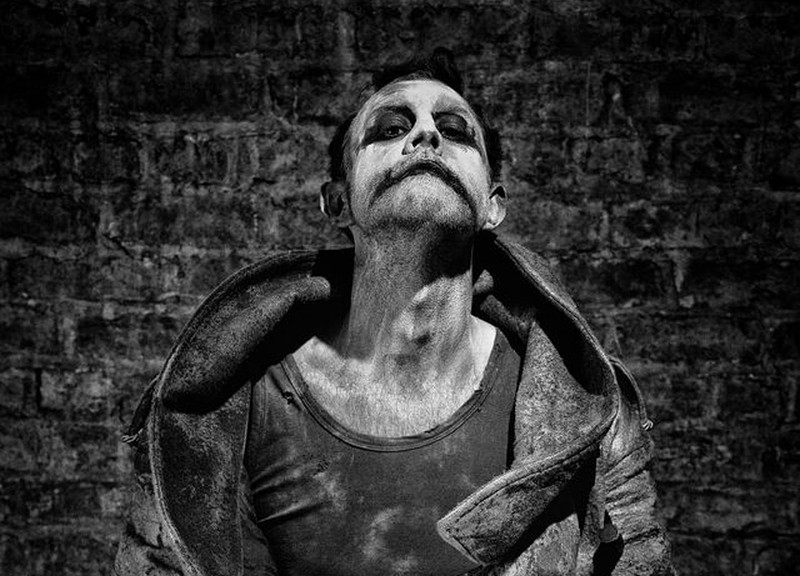
Entering the dim space, there appear to be two sculptural forms. To one side, towards the rear, is a tall metal stepladder, the top end of its steps disappearing into a kind of open-ended cocoon. To the other side, towards the front, is what seems to be a hulking rusting statue. The statue is lit in an intense beam of light, and we see that it is made from old and battle-scarred leather. A dull electronic drone intensifies, and the distorted echoes of mortar bombs sound. a hand emerges from what we now see is a battered old great-coat. The hand is pale, naked, and as it emerges from the coat sleeve it twitches unbearably. It looks raw, exposed against the rough leather. A second hand appears. Now both are twitching and flicking, the only signs of life in the great mass of leather, lit by the beam of light. Next, a head. A mostly shaved head – although there are two strips of hair, a kind of mohawk strip on top, and a Coco the Clown semi-circle of hair round the back. The head is tortoise-like as it pushes itself forward. The eyes are large and look out to us, then dart to each side. It is a face that is simultaneously monstrous and utterly human. As the sound grows ever more chaotic and intense, the bass notes of the thudding bombs resonating through our bodies, the body that we are watching emerge from its protective shell becomes, part by part, fully animated. Eventually – and it is after a long time, a mesmerising sequence of  precise physical action – the man emerges, shrugging off his great-coat, and standing to face us.

As the piece progresses, we witness a stunning evocation of the experience of post-traumatic stress syndrome – specifically, that experienced by  soldiers who have survived war. It’s a completely word-free piece – everything we experience is in the performer’s brilliant physicality, the visual landscape (defined by beautiful lighting design by Alberto Santos Bellido), and the intense, multi-layered soundscape (by Guy Veale). All merge beautifully to create an extraordinary and shocking language of trauma. We are taken right into the heart of the soldier’s experience.

The heart of darkness is always present, but there are variations in tone. Sometimes our soldier laughs wildly, sometimes he shakes and sobs. There’s a break in the intensity of the soundscape of distorted drones, bomb blasts, and machine-gun fire for a blast of danceband music. ‘Home Sweet Home’ croons the singer on the scratchy recording, as the soldier sits on his chair and sways, swigging brandy from a bottle.

At other points in the piece the movement work is less mimetic, more hardcore corporeal. Often, a mimetic movement morphs into an abstracted choreography. For example, as he takes on a long cardboard cone onto his arms, playing with the suggestion that they could be either prosthetic limb or machine gun. Later, a second cone is added, and he stands tall and strong, and spins his arms in all directions, a cyborg powerhouse, a killing machine. The stepladder takes on an ominous, mythical role. It is edged around, approached, leapt away from as if  it was burning hot. It is an object of fascination, desire and terror.

Al Seed’s Oog comes almost a decade after The Factory, and is described as a companion piece to that seminal work. In between, there has been an extraordinary body of work in many different forms and genres – some with and some without words – crossing the divides of dance, theatre and performance art. I’ve enjoyed everything I’ve seen by this extraordinarily talented artist – but The Factory and now this new work Oog, twin towers of  terror  and despair,  I love to bits. If you have any interest at all in physical theatre, in theatre without words; or if you perhaps doubt the power of word-free theatre to tell stories, then this is the show for you.

I left, to steal a metaphor, shell-shocked. An extraordinary piece of work.