Author Archives: Dorothy Max Prior

Dorothy Max Prior

About Dorothy Max Prior

Dorothy Max Prior is the editor of Total Theatre Magazine, and is also a performer, writer, dramaturg and choreographer/director working in theatre, dance, installation and outdoor arts. Much of her work is sited in public spaces or in venues other than regular theatres. She also writes essays and stories, some of which are published and some of which languish in bottom drawers – and she teaches drama, dance and creative non-fiction writing. www.dorothymaxprior.com

A&E Comedy: Witch Hunt

Watch out, there are wild women on the loose: where there were crones, now there are witches…

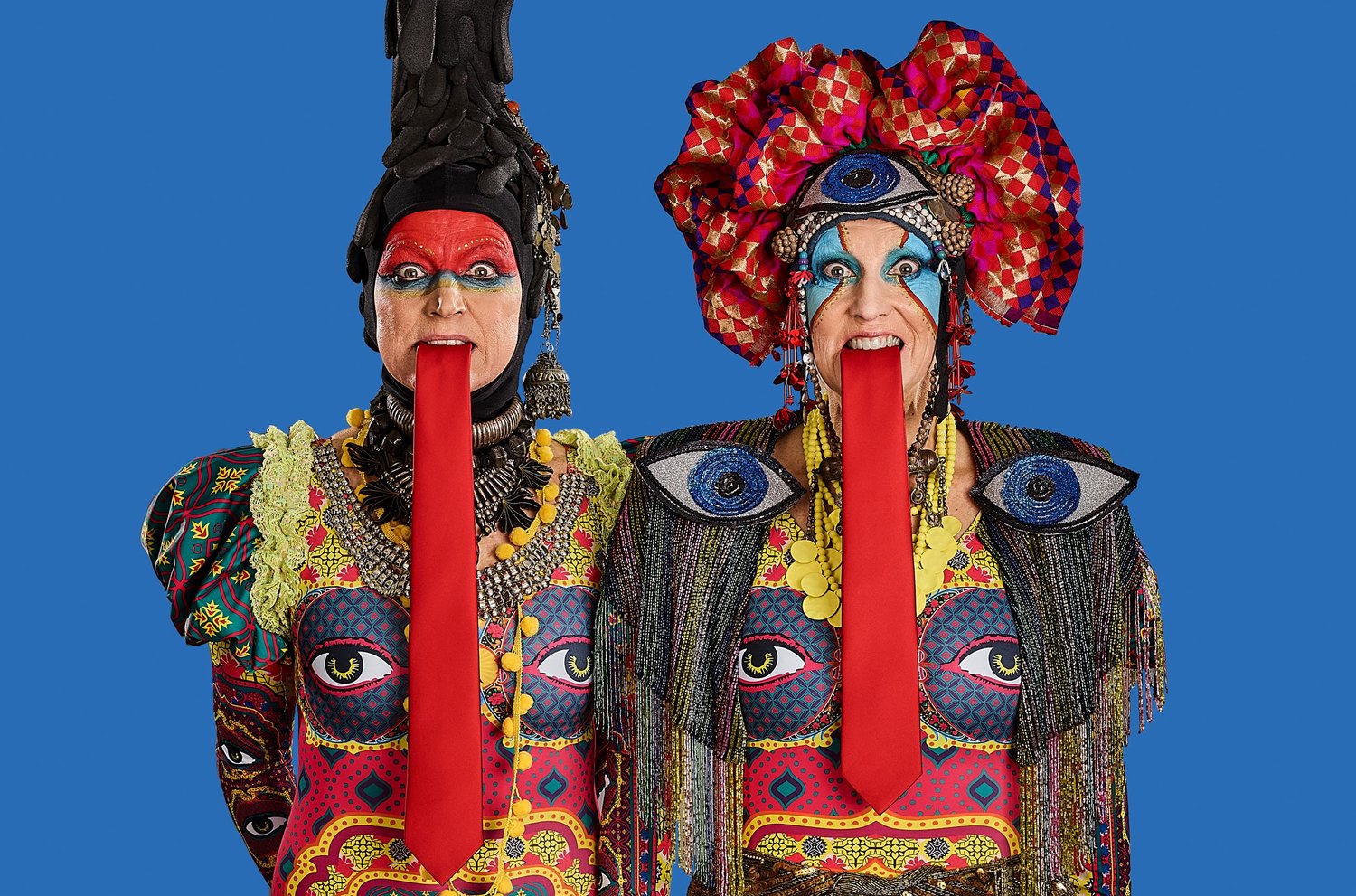
Fans of A&E Comedy’s Enter the Dragons will be delighted to learn that the new show Witch Hunt also features dreadful false teeth, wacky wigs, ludicrous arm extensions (gnarly nails growing down to the ground, this time round), frantically fast costume changes, knicker-wettingly funny sketches, perky sing-a-long songs, and totally gratuitous nudity (‘no one wants to see the hanging gardens of Babylon’). In Witch Hunt, these two wild, wild women continue their quest to expose misogyny and sexism in the funniest and most irreverent ways imaginable with great aplomb, armed with an excellent script and solid clowning skills. No territory is too dangerous, no woods too dark for these brave women to venture in to – there’s even a paedophile joke (Wicked Wolf to Little Red Riding Hood: ‘I like my women as I like my whiskey: 12-years-old and lying locked in the cellar’.)

In some ways, Witch Hunt (which is directed by Cal McCrystal) is a continuation and extension of the format of the first show – a series of comic sketches tied together by a narrative theme that has an anarchically feminist slant, the two actor-clowns stepping in and out of narrator/character roles, playing out their clown personae of master (Emma Edwards) and servant (Abigail Dooley) – although those given roles are allowed to be challenged and usurped in the cleverly written scenes.

Where Enter the Dragons stayed firmly focused on the menopause, and what ‘the change of life’ really means – which I’m sure nobody thought could be the stuff of comedy until they saw that show, but my goodness it really worked – Witch Hunt takes a broader theme, merging together all sorts of takes on witches and witchiness, from the persecuted wise women of Salem, to wicked witches in fairy tales, to the wizard-and-witch territory of magic tricks.

And yes, it all fits together in thematic terms, and every single element works well in its own right, although it sometimes feels like there is some odd ricocheting from one idea to the next, with so much complicated stage action as props and costumes hurtle on and off. Although there are times in which we get both of our wonderful women onstage together – including the hilarious ‘refined poetry versus filthy limericks’ scene – there is less of this than I’d like, as each scurries out in turn to get into the next elaborate costume.

But my goodness, what magnificent costumes (designed by Holly Murray) and what fantastic solo skits, with a special mention for Emma Edward’s red-rubber clad robotic Red Riding Hood squirting water from her pneumatic breasts; and Abigail’s horribly horny and vulgar wolf with fabulous furry legs and behind.

Design wise: a giant pop-up book that forms the centrepiece of the stage is OK, but not as beautifully painted as it could be – although it serves well for the fairy tale aspects of the show, and provides a stage-within-the-stage for the puppetry sections, featuring some rather wonderful creations by Annie Brooks. The Cabinet of Swords that is the site for a magnificent finale is a fabulous thing of beauty.

The soundtrack is suitably spooky, the songs are saucy, and a special mention goes to Abigail for her musical saw playing!

There is, perhaps, a little work to do on the dramaturgy and structure of the piece – I remind myself, though, that I am seeing what is only the third ever performance of this new show, and already it is a rip-roaring success, receiving standing ovations.


Nwando Ebizie: Distorted Constellations

‘You are entering an Afrofuturist, mythical landscape that explores what it’s like to see the world through someone else’s eyes.’

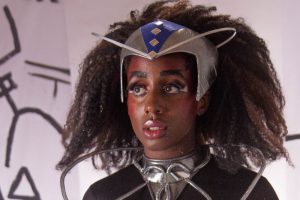
We are at Lighthouse, a film and multimedia centre specialising in ‘connecting new developments in art, technology, science and society’. It’s the first weekend of the Brighton Festival, and we’re here to mark the opening of Distorted Constellations, the new exhibition-installation by Nwando Ebizie. At the far end of this large, open-plan, ground-floor space is a bar, and a DJ station where Nwando is behind the decks (or behind her laptop, more precisely), resplendent in a pleated silver jumpsuit, enormous lashes, and a fabulously wild and woolly Afro – channelling her alter-ego, Lady Vendredi, I assume at the time – although I later learn that this particular alter-alter-ego is called Nwa-Kpa-Kpa-Ndo.

At the street end of the room there are sofas and a coffee table heaving with books. Titles include The Nature of Mind,  Haitian Vodou – Spirit, Myth and Reality, Neuroscience – Exploring the Brain, Women Who Run with the Wolves, A Short History of Myth. There’s Maya Deren and at least two Angela Carters. I grab a glass of wine at the bar and settle down with Roberto Strongman’s Queering Black Atlantic Religions – Transcorporeality in Candomblé, Santeria and Vodou. Yeah I know – a bit of light reading for a Saturday night…

Actually, it’s far more of an accessible read than the title implies. I speed-read the introduction, which reflects on similarities in African diaspora or ‘creolised’ religious practices that have their origins in Nigeria or other parts of West Africa; transposed to Haiti (Vodou), Brazil (Candomblé), and Cuba and other Spanish speaking islands in the Caribbean (Santeria). I read about the role the Initiation Chamber plays in the rituals; and the importance of moving through levels, working from entrance space to ante chamber to the inner sanctum.

Although – as Nwando would be the first to say – what we encounter tonight is not a Vodou ritual, it honours those traditions, and builds on them to create a new, personal form of ritual as interactive performing arts practice. Nwando and her collaborators have created a sacred space in which, working through from ‘outer’ to ‘inner’  levels, a ritual is enacted to usher in her new installation work. Distorted Constellations explores ideas of perception and neuro-divergence – inspired by Nwando’s rare neurological disorder ‘visual snow’, which causes visual distortions such as flickering dots, auras and glowing lines. The main installation is sited in the downstairs gallery, but we are not ready yet to go there…
 

The Initiation Chamber


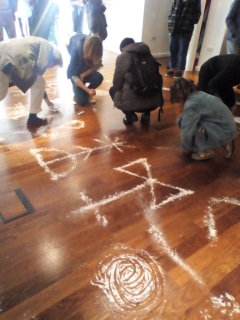
So, upstairs in this Initiation Chamber, we are invited to make a large circle, and are welcomed in by Nwando and her companions, two women dressed in white (the traditional colour for Vodou/Candomblé/Santeria initiates). One of these women is the guardian of the Sensory Ante Chamber – which we will get to in a while. The other is ritual practitioner and Haitian dancer Karine Label. A white circle is marked with what I take to be salt (although it could be powdered chalk) and Karine Label takes the space. Her movement work is elegant and engaging, referencing the healing practice of Vodou dance, which aims to draw together the elements of fire, earth air and water; and to provide a conduit for the ‘loa’ or lesser gods, thus uniting the physical and spiritual worlds. Karine’s dance, moving as it does through a cycle of gently flowing, undulating movements evoking the purification of water, then into energised fiery staccato and chaotic movements, reminds me that many contemporary ‘free dance’ practices such as 5 Rhythms and Chakradance owe a lot to traditional ritualistic dance. Nwando joins her in the circle, with the third woman, placed in the doorway to the Ante Chamber, supporting from afar in a three-way movement and voice call-and-response.

We are then invited to make our mark – drawing our responses, or reflecting on ideas and images conjured – using white chalk. The circle on the floor becomes a teeming canvas of symbols: simple arrows, stars, and triangles or more complex spirals, snowflakes and labyrinths. 


The Sensory Ante Chamber


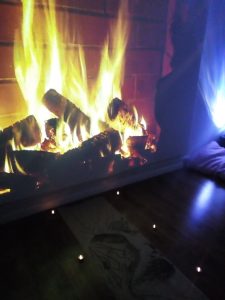
There is now an open invitation to come into the Sensory Ante Chamber, its guardian stepping aside from the door with a welcoming smile. Inside, there are two spaces, one dedicated to fire and one to earth. Always intrigued by the lure of a hidden space behind a black curtain, I first go into the smaller room where I find tiny peat pots, compost and an assortment of seeds ready for planting and watering. In the ‘fire’ space, there is more opportunity for drawing: this time with charcoal, onto a brown paper ‘carpet’ that leads off from a whole-wall video of a raging fire. Tiny night-lights line the walkway, and in the corner is an egg: a tent that becomes the site for shadow theatre when bodies enter. Part of me is disappointed that there is no real fire – but once I’ve got over that, I end up sitting in this room for a long time, enjoying the flickering of the filmed fire, and listening to the audio installation of ambient music available through headphones propped up on big cushions in the corner. (Nwando is also the composer of the music and soundscapes used in the installations.)

Meanwhile, groups (we had all been issued with a coloured dot on arrival) are being called down to the main installation, in the room which is dubbed Install.

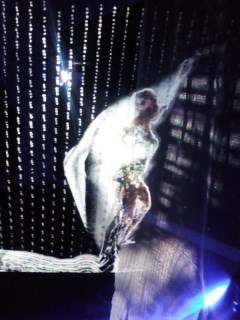
This downstairs gallery space sees a maze of panels dressed with white gauze. We are free to move through the paths between the semi-see-through walls, which become the site for projections, as do the white walls of the room. There is no attempt to disguise the architecture of the room, so speakers, switches, light fittings, and wooden doors are all visible through the gauze. Which I muse on for quite a while, and don’t reach a conclusion on. It is obviously a deliberate decision not to neutralise the space with white plasterboard walls or whatever galleries usually do, and I respect that, even though I find this defiance of the usual ‘white cube’ rules a little odd at first.

As we move through the space, we inevitably become part of the installation, casting shadows or becoming silhouetted figures viewed from outside of the labyrinth. The multi-layered projections animating the space are mostly monochrome. Sometimes the effect is the visual equivalent of white noise – a blur of fuzzy dots and lines, like the tuning-in static of an old TV set. Then, there are the more distinct, repetitive abstract patterns, with columns and rows of white dashes intersecting and interlacing. But there are also figurative images – a kind of deconstructed dancing figure appears in many places all at once, sometimes losing her edges, blurring out as if dissolving into her own aura, and at other times a clearly delineated reverse-silhouette image. The cultural values and associations of ‘black’ and ‘white’, ‘light’ and ‘shadow’, are there to reflect on. As the speed at which the projections shift and change increases, it becomes harder to distinguish between image seen and after-image perceived – one of the many clever plays on perception in the piece. Another is the Alice in Wonderland feeling, as you walk through the space, of pursuing an image that doesn’t seem to be there when you arrive. Sometimes you turn your head to be dazzled by a light or projection, causing a moment of sympathetic ‘white snow’ experience as white dazzle-dots appear in front of your eyes to echo the projected dots in the installation. What is inside and what is outside? The two merge after a while.
 

Distorted Constellations: Install


Back upstairs, we find the room arranged so that sofas and chairs face the DJ desk and screen above it. Then comes the only section of the evening I don’t enjoy – a lecture on the psychology of perception. The lecturer (a guest scientist whose name I didn’t catch) lacks performance presence – yes, she’s a scientist not an artist, but still! Her technology fails (there’s a kind of interactive online quiz that we are asked to engage with, but the link doesn’t work and she spends a lot of time obviously thrown and irked by this); and her tone is jolly GCSE teacher, as she (unnecessarily, surely? We’ve all been to school) explains the difference between rods and cones, and muses on those tired old visual perception conundrums (Is it a vase? Is it a face?). I struggle to understand why we have to sit through this. 

A much better presentation follows, as Nwando treats us to some Autonomous Sensory Meridian Response (ASMR) inspired storytelling. We sit in dim light, and are asked to close our eyes. Nwando’s lovely voice, with her soft Brummy accent, tells us the tale of the Skeleton Woman, hauled from the bottom of the sea by a sailor, who takes her home to his bed. (The story is featured in Women Who Run with the Wolves, by Clarissa Pinkola Estés, and has become a feminist classic in recent years – a story of female empowerment, of love conquering fear and death, and of the merging of the male and female spirits in order to become whole.) As Nwando speaks, Karine moves through the space with scented water in a bowl and soft brushes, giving a moment of massage here, an anointment there.

After, follows the ritual feast: the serving of tapioca pancakes, a dish popular in the Caribbean and Brazil, which sadly has to be abandoned after a short while due to another technical failure, this time with the portable electric stove, which seems to be short-circuiting the system. Never mind, we’ll stick to crisps…

The evening ends joyously with a last dance, in which all, performers and audience, are invited into the circle to shake off or integrate (whatever way you want to view it) what we’ve absorbed over this long evening. There is much laughter and hugging before a parting of the ways.

A week later, I return to Lighthouse for Nwando’s 20 Minutes of Action which takes place within her Distorted Constellations installation. The music has been composed using analogue digital instruments/equipment. Nwando draws on a dance practice that has embraced Haitian Vodou, Vogueing, Ballet and Contemporary Dance. It’s a performance that balances opposites adroitly. At times, she is still for long periods, lying low in the installation to the sound of a low-level drone, another object in the space to be projected upon. In another moment, she is up and dancing with full energy, the music matching her physical action, making for a ritualistic and repetitive trance-dance that needs no audience. Then at other points, relationship with audience become paramount – she looks through the gauze at us, making eye contact, or seems to mirror the actions of the projected dancing figures to us. She draws on her interest in a contemporary feminist exploration of folklore (Clarissa Pinkola Estés, Angela Carter et al), and traditional African mythology to create archetypical images of womanhood: I see (or think I see) many voduns (orixás.): a proud and womanly mother-figure moving with slow steps through the space, a personification of night-time moonlight energy; a younger woman who shows off her own virility, beauty and sensuality in a series of Vogue poses; an earth-creature, drawn down to the ground with increasing heaviness; a light and lyrical air creature who spins and turns with child-like abandon.

After about fifteen minutes the monochrome images made of white light and shadow shift into a brightly coloured palette, and in its final five minutes, the installation-performance starts to resemble something from the heyday of psychedelia – Andy Warhol’s  Exploding Plastic Inevitable, say. The colours are a shock – I can’t remember them from the week before. Did I experience them on that previous occasion? Could I have forgotten? Ah, memories, dreams, reflections! What do we really see? What do we think we’ve seen? What do we remember seeing?

Distorted Constellations – the installation and all the associated live actions and related activities – is a thoroughly satisfying experience. There are many artworks out there that pay lip-service to an investigation of the borderline between art and science – in this case, I feel that there has been a genuine engagement with the psychology of perception, and a truly interesting artistic investigation of a new scientific discovery. (‘Visual snow’ was only formerly identified as a syndrome in 2014.) We are invited not only to see the world through someone else’s (Nwando’s) eyes, and to imagine how a particular neuro-diversity alters perception; but also to question our own perceptions.

To see is to believe; but perhaps also, to believe is to see.
 

Nwando Ebizie


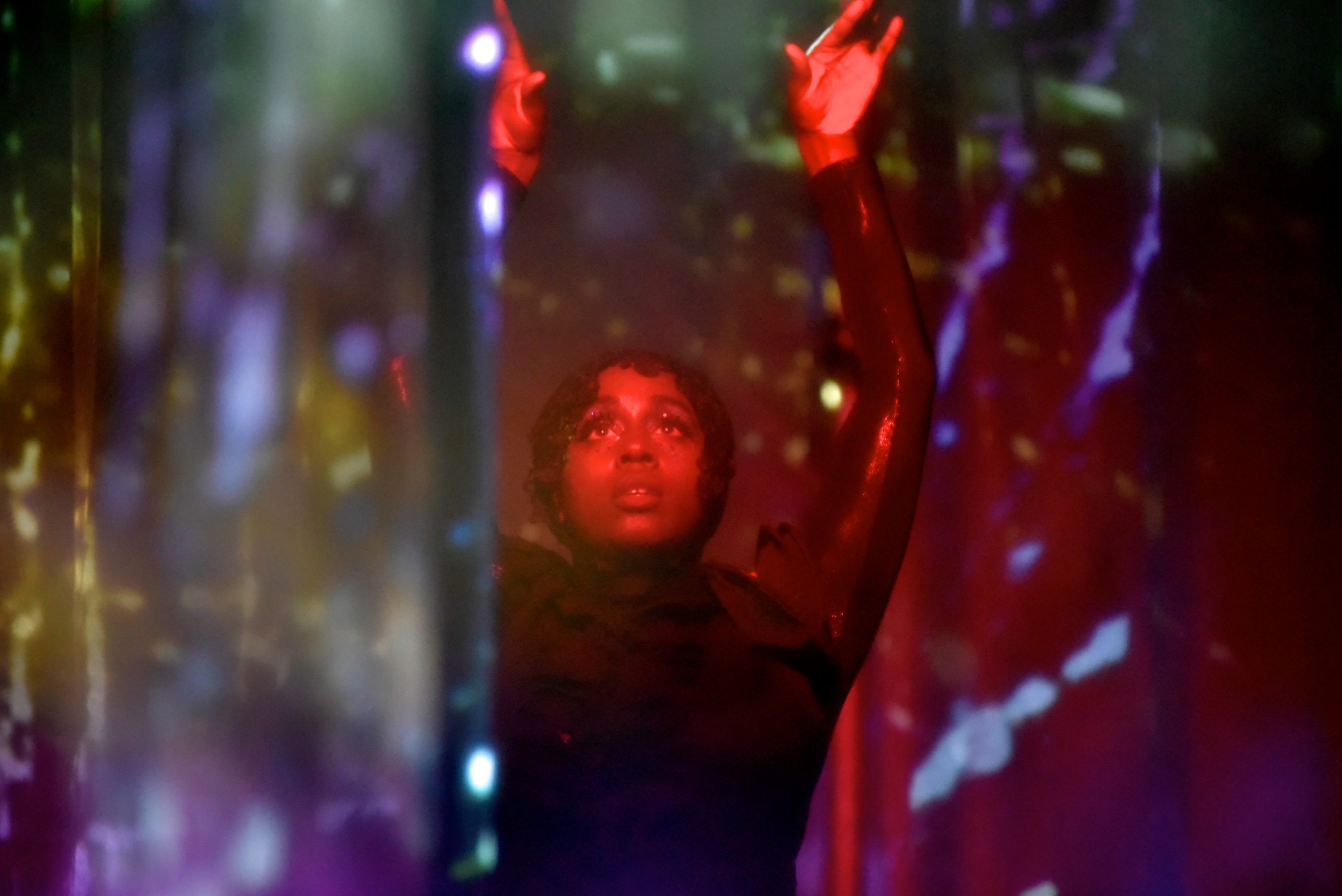
Featured image (top of page}: Nwando Ebizie: 20 Minutes of Action, Distorted Constellations at Lighthouse, 11 May 2019. Photo by Anya Arnold, courtesy of Lighthouse.

For more about Nwando Ebizie’s work see www.nwandoebizie.com

Distorted Constellations ran at Lighthouse 4–19 May 2019, co-presemted by  Lighthouse and Brighton Festival 

It was supported by Re-Imagine Europe, and co-funded by the Creative Europe project of the EU. The project also received support from Arts Council England.

Distorted Constellations comes from ideas developed originally with MAS productions, Nwando Ebizie working with director Jonathan Grieve, and supported by Arts Admin, Guest Projects and Wellcome Collection. 

Movement elements of the piece were created with the support of choreographer and dramaturg Laura Kriefman. Digital Visuals Designer: Coral Manton.

The installation was accompanied by ritual performances, workshops and other activities, including: The Opening Ceremony, Saturday 4 May and 20 Minutes of Action, Saturday 11 May (both of which were attended by Dorothy Max Prior); a Haitian Ritual Dance workshop led by Karine Label; Intimacy/Touch/Tingles, Saturday 18 May; The World of Visual Snow (talk by neuroscientist Dr Francesca Puledda) plus The Closing Salon, also 18 May.



Jaamil Olawale Kosoko: Séancers

Lots to look at before the show begins… Or to put it another way, this show is part installation, part performance. There is no line drawn – both elements co-exist in this space, which will become the site for a ritual exploration of ‘personal and public histories and notions of identity’.

The lights are up. We see, upstage, a small table and two chairs, a framed photo of a woman on the table. Behind, a silver foil wall hanging. Stage right, a piano with a baby doll sat on the stool, and a screen above it. Centre-stage, a pile of sparkly white fabric, its tangled tentacles making it look like a discarded Carnival jellyfish costume. Above it, a small chandelier on a rope. Also hanging down, two white cotton women’s nightdresses.

The installation draws the auditorium into the stage space. There’s another of those vintage Victorian nighties hanging over the auditorium. On and offstage, electric fans. To each side of the stage are a number of books carefully placed on narrow ledges – I note Alice Walker’s In Search of Our Mothers’ Gardens. On our seats, glossy print-outs on photographic paper, each with a short text and an image, marking the murder of men of colour by white men: 1999, four men acquitted for the killing of Amadou Diallo; 1968, three students killed in the Orangeburg Massacre; 1973, officer Thomas Shea acquitted of killing 10-year-old Clifford Glover; 2015, Samuel DuBose shot in the head by officer Ray Tensing; 2014, Michael Brown fatally shot by Darren Wilson. There are more. Also on each seat, a small chocolate wrapped in silver foil. The chocolates are called Kisses.

There is the sound of hearty laughter from the back of the auditorium, and we turn to see a glorious figure – a tall and broad-shouldered man with a big smile, dressed in an enveloping velvet gown – making his way through the space. He’s carrying a tray of the chocolate Kisses, and he hopes we appreciate that he’s brought these over from America for us… 

This is Jaamil Olawale Kosoko – a Nigerian-American poet and Afro-Futurist performance artist, who is here to engage us in the Séancers ritual. He will move freely in time, embracing the world of the living and the world of the dead. Acting as a medium, he will confront and mourn key moments of racist trauma and violence. Séancers is both a cathartic mourning for those black men slaughtered by racist white men; and a joyous celebration of the powerful black women who spearheaded the civil rights movement, and continue to lead the way as writers, philosophers, and scholars. It is also an autobiographical piece, charting a personal journey as Jaamil embraces and celebrates his own black and queer identity. His spirit guides in this endeavour are the Afro-American Mothers who are, in one way or another, in this space. Alice Walker, Maya Angelou, Howardena Pindell, Ruby Sales, Audre Lord – and Jaamil’s own mother.

Another female element in the space: Tété the little doll, who is lifted from her place by the piano and offered out to an audience member, who is asked to look after her – ‘and no putting her under your seat on the floor’ adds Jaamil. I’m honoured to be chosen as Tété’s temporary mother and I hold her in my arms throughout the performance. I see her as representing all the lost (black) children – and also as the hope for the future, the innocent child who expects and deserves the best that life can offer.

There are two other artists in the space, forming a ‘triangulation’ with Jaamil. There is, up on a balcony, fellow séancer, sound designer and engineer Jeremy Toussaint-Baptiste. Then, in the front row, mic in hand, there is the guest séancer – performer, writer and academic Season Butler. As Jaamil settles himself on stage, the velvet cloak removed to reveal a tight-fitting bodysuit, Season muses on what she is seeing and noting in the space. She mentions the books on the shelves to the side, and talks of the ‘homage’ to the Mothers that is being made. 

These powerful women spirits manifest in different ways throughout the performance ritual. The photo on the table is Jaamil’s mother. Her influence on her son is publicly acknowledged and honoured. Audre Lorde’s devastating poem Power is delivered in full, with enormous strength and presence, by Jaamil, as he moves from direct communication with his audience and fellow séancers into his own ritual performance space. The poem starts: ‘The difference between poetry and rhetoric / is being ready to kill / yourself / instead of your children…’ and the words ring out, electrifying the audience, who take a collective in-breath. We meet Howardena Pindell through samples from her film Free, White and 21, an ironic reflection on how it felt to be a black woman coming of age in 1960s America. Pindell filmed herself saying the words ‘I’m free, white and 21’ whilst wearing a white mask with a blonde wig, and Jaamil follows her lead by also creating a white female persona through the donning of mask and wig, voicing the words in tandem with the recording. We experience civil rights heroine and philosopher Ruby Sales via an audio clip from Where does it hurt? a reflection on the ‘spiritual crisis in White America’ – her words  echoed and re-voiced by Jaamil, who moves through the auditorium saying ‘I want a liberating White theology. I want a theology that speaks to Appalachia’.

All of these texts and clips are merged expertly with extraordinary visual pictures, spellbinding sections of intense movement work, and ritualistic engagement with the objects in the space. There are numerous costume changes – although that phrase doesn’t do justice, they are more than that, they are metamorphoses – as Jaamil embodies and celebrates iconic black and queer imagery. In one section, he looks like a member of a 1970s American funk band; in another he’s a West African shaman; and then again, he’s a Superstar from Warhol’s Factory. Often he is many things all at once. There is an extraordinary scene where, delving into the pile of fabric, he pulls out masks and moulds and morphs into a many-headed creature, as if carrying all of humankind on his body – a kind of magical living puppet processing across the stage and beyond.

It is such a wonderful show. The visual images are beautiful and haunting; the sound design superb; the texts, presented in so many different ways, are both jarring and inspiring. The structure of the piece – in which we are gently eased into the ritual space, allowed time to feel the shifts in tone and performance mode – is caring and respectful of its audience.

When the show ends, there is no bow. Jaamil exits, and we are left, somewhat dazed, looking at a stage strewn with the remains of the process. Only the objects are there to receive our applause.

Séancers is described in the post-show discussion as ‘both a wake and an awakening’ – which seems to sum it up pretty accurately. I leave feeling that I have been generously invited into a communion.


Samira Elagoz: Cock Cock… Who’s There?

’Not your average show about rape, female bodies, feminism, and the male gaze’ in which Finnish-Egyptian filmmaker and performance artist Samira Elagoz takes us on a journey across three continents, in a ‘personal research project’ to encounter (male) strangers in Berlin, Havana, New York, Tokyo and numerous other places. The encounters are of a sexual nature, and/or are ciné vérité style interviews, and/or turn the camera on men who are keen to show off their skills and attributes. There is also footage of her family members and friends. This material is presented to us as a mash-up of (often shaky) footage filmed on a smartphone, slightly better quality video, and screenshots, this all interspersed with live – although rather deadpan and unemotional, so she feels very ‘unalive’ and disconnected a lot of the time – commentary and reflection from the artist.

So, what’s it all about, Alfie? The story begins in 2005, when Elagoz was raped (‘force fucked’ he calls it) by her then-boyfriend. Samira (Sam to her friends) tells us that she couldn’t even think about it for ages, but on the one-year ‘rape anniversary’, as she names it, she starts to interview friends and family – sometimes specifically about the rape, but more generally about how they perceive her. Was she ‘asking for it’? Does she look like she’s ‘up for it’ ? The answers, from people near and dear to her, are pretty disturbing. One close male friend points out that although she is encumbered with the problem of being ‘liked too much’ he on the other hand is not getting any because no one wants him. Where to start with this analysis of rape? His views are just left there with us, unchallenged. And this is one aspect of the piece that I like: people just damn themselves, without commentary. Her mother has been told about the rape, and is suitably broken-hearted and concerned. Her father isn’t told, and the only footage of him shows him reading Arabic poetry in a massively untidy den or study, in which books and other possessions are piled up in heaps around him. Nero fiddling whilst Rome burns? My words not hers: again, Samira just leaves that one with us. No comment.

Having met her family and friends, we dive down the rabbit hole with her to begin a journey into the dark underworld of internet dating and sexual encounters – a journey that takes her across the world over four or five years, as (via Craigslist and other sites) she meets strangers and explores the gendered power dynamics of sexuality, turning the male gaze back on itself with her phone in hand and her winning smile.

There’s a lot of humour: I particularly like a video montage section called ‘skills’ in which men she meets impress her with their talents. My favourite is a muscle-bound fire-staff spinner on a roof who forgets to bring up a bucket of water to douse his flames (this could be a metaphor). Men show off their cocks, demonstrate their dance skills, fiddle with Shibari ropes whilst explaining that being God’s gift to women is about a lot more than liking pussy, and – most interestingly – talk eloquently about dominating women as an exchange of equals who agree what they want and how they want it. This Fifty Shades / Story of O guy is the one whose words give the most food for thought. In particular, the BDSM question and how issues of sadism (in men) and masochism (in women) relate to feminism. Every hip, liberal, modern person pays lip service to the notion that what happens between two consenting adults is their affair. But somehow, BDSM within gay relationships, or the Venus in Furs scenario of dominant female, submissive male, feel far easier to deal with as a feminist than the male sexual domination of women – which somehow feels a bit too much like everyday life for my taste!

We then learn that Elagoz was raped again, whilst in Tokyo – and again,  the perpetrator is a person she knows rather than a stranger. So despite all the ‘stranger danger’ worries of internet-driven encounters, the statistical fact – that when women are raped it is usually by men they know – is manifest here. This brings us to a rather odd section of the show, in which two Japanese actors emerge from the audience to act out the post-rape interrogation scene in a Tokyo police station, using a crash-test dummy sat on a chair. I really don’t understand this scene and why it is in the show – it is in such a completely different performance mode, moving us away from the documentary storytelling into something more ‘theatrical’ in the worst sense of that word.

The piece ends with a rather brilliant piece of video footage featuring Sam, her mother, and her grandmother – and the family dog (‘she’s also a woman’ says the grandmother, of the dog). The women of the family are united. The men are absent. The message seems to be: ultimately, it’s the women who are going to have to work together to do something about rape.

This is an odd show to try to evaluate critically. On the one hand, when people lay themselves on the line, exposing stories of traumas such as rape, how can you say anything critical? On the other hand, they have chosen to make art out of life, so fair game.

So, here goes with the reservations: I don’t like a lot of things about the show, but I am aware that there is a disconnect – I find some of the material about internet dating and sexualised social media imagery disturbing and worrying. There’s a whole world out there I know nothing about, and am glad to know nothing about. I worry about the artist’s choice to throw herself into this world. It feels like an acting out of her distresses – and I just want to shout, ‘stop, just see what you’re doing!’ But she has stopped. This is in the past. So OK, I’ll let that one go.

I can’t decide if I like the amateur-hour shaky footage / low production values. Again, it’s part of (or, at least, referencing) the modern world of dodgy reality shows, cheap TV dramas, video blogs etc. that isn’t my milieu. I’m aware I’m probably just not the right demographic to appreciate the irony of the presentation style (if it is irony).

I can’t quite work out the low-key performance mode – she is far more live and alive on screen than in person. I end up concluding that this is, in essence, a five-year art/documentary film project, not a show – and perhaps screen is her best medium. Looking her up, I’ve noted that she has made an award-winning film called Craigslist Allstars, using some of the same material, and I’m interested in seeing how that works.

Samira Elagoz won a Total Theatre Award at Edinburgh Fringe 2018 in the Emerging Artist category. I think we may well see vindication of that decision in future work – but possibly in film rather than theatre (although she has trained as a choreographer at the renowned School for New Dance Development in Amsterdam, so perhaps there is more in there to emerge). Should she, some time in the future, want to make something that is more of a show, rather than a showing of the outcomes of a longterm art/ film project, she would ideally seek someone else’s input – a dramaturg or director to collaborate with, to shape the raw material into something cooked. But that is perhaps not what interests her. On her website she says: ‘I aim to view my life as cinematic, as material to be manipulated, to see reality as both subjective and malleable. Hoping to capture and form reality into a work that is unsettling and encourages discussion of an audience’s own ethics and intimacy.’

Well, she certainly achieved that – the show sparked a lively impromptu discussion in the bar afterwards, and a day later it is right at the front of my mind, the questions it raises niggling away. That’s something! And also to note that I like it much more 24 hours after seeing it than I did in the moment…


Hair Today, Gone Tomorrow: Without Walls at Brighton Festival 2019

Rain, wind, sunshine, hailstones – and all within the hour. Ah yes, the great outdoors in the UK in May!

The Without Walls programme brings a number of outdoor arts commissions and other shows to a consortium of festivals across the UK. Brighton Festival opens the season – and being so early in the year, there have been many previous occasions when play has had to be stopped due to the weather, as happened this year, when four shows were presented on the lower promenade by Brighton beach on Saturday 11 May. And as the programme was confined to one day rather than two (as has been the case in past Brighton Festivals), there was no second chance to see the work another day – although there were multiple showings throughout the day.  I was unlucky in picking the afternoon, I believe all four shows went ahead in their morning or lunchtime slots.

So there was a lot of disruption – but over a three-and-a-half hour period between 3.30 and 7pm (which included a fair amount of gaps spent huddling under cafe awnings), I did manage to see two of the shows in the programme, and a short excerpt of a third one.

In the order seen: first up was Talawa Theatre Company with The Tide.

Talawa Theatre Company: The Tide. Photo Summer Dean


Co-created by writer Ryan Cameron and choreographer Jade Hackett, The Tide ‘explores the narratives and experiences of migration within The United Kingdom whilst holding a mirror to an evolving British culture… it unpicks the stories and imagery of the most pertinent issue of our era: migration.’ 

I like the design and scenography: a moveable door (number 10!) through which arrivals and departures take place; the inevitable vintage suitcases (no physical theatre show complete without one – we’ve all done it!); simple, neutral coloured costumes, with a variety of extras such as blue silk scarves becoming sashes, turbans, sarongs, and cumberbands; tin bowls and jugs used for a nicely enacted sequence of ritual hand-washing, gently drawing in some audience members; chairs that turn into barrow-boy stalls (‘English spuds!’ ‘20 mangos for a pound!’) or political soap-boxes. Jade Hackett’s choreography is fine, featuring some nice hero/chorus ensemble work, and a few intensely acrobatic moments. There’s a drummer, whose percussive riffs work well with the live action and merges with the pre-recorded music (guitar, bass and keyboards) that comes in later in the piece. There are some good characterisations by the cast, who play a multiple of roles, representing a diverse range of migrant experiences, with an enjoyable babel of languages emerging as a kind of grommelage undercurrent, rather than a spoken text we need to hear clearly.

But the dramaturgy of the piece is unclear. Yes, I get the broad brushstrokes, and there are some lovely details, as listed above – but the show doesn’t really have the drive and oomph needed for street work. A scene about citizenship and taking the oath of loyalty to the queen comes across as too simplistic a parody, and it doesn’t seem to say anything much beyond the obvious, which is that citizenship tests are silly. In the final five or ten minutes, the piece really comes to life – and this is because we suddenly get the extra element of a very beautiful pre-recorded spoken text coming into the mix and holding the space – a poetic reflection that gives a much needed extra layer of depth and meaning: ‘This is my home. The bruises are fading, but some scars remain’ says the voice. There is now focus, and a unification of all the elements of the piece. Talawa are a highly experienced company who have a strong track record of indoor theatre work covering three decades, but The Tide feels like a show made by people who do not yet fully understand how to structure and formulate an outdoor piece. It is praiseworthy that Without Walls want to encourage more theatre-makers into outdoor arts – but it also feels important to acknowledge that making indoor theatre and making street theatre are, in fact, two quite different things.

I then made my second attempt to see On Edge by Justice in Motion – the earlier scheduled show was called off, as even though rain had stopped, the ground and scaffolding set were deemed unsafe for the performers, and of course safety must be paramount, but after Talawa’s show ends, they make the call to try again, and we are summonsed back to their site, on the other side of the i360 tower.


Justice in Motion: On Edge. Photo Summer Dean


And we’re off, hurrah! A man sits on the top of the scaffolding. He consults what looks to be a map, and is moved around on sections of the set that come apart, to represent (I presume) vans and trains carrying him across continents. At least, that’s how I’m reading it – the rather swanky programme says the piece is about the construction industry as a site of modern day slavery, and I’m thinking about the sections of Sunjeev Sahota’s book The Year of the Runaways which detail Indian migrants’ experiences on building sites in the North of England. Our protagonist removes his civvies, and is decked out in a workman’s hi-vis vest and hard-hat, joining the construction team. We are just moving into a more dynamic ensemble dance/parkour section – and this is a big ensemble, eight men drawn from the UK, Germany, Switzerland, and Spain  – with what seems like is going to be a Meyerhold type ‘humans forming themselves into one big machine’ section – buckets swinging from feet to hands, bodies turning around metal poles – when down comes the rain. And that’s that. They call off the show, take a bow – and we all wander off, disappointed. So, impossible to offer much critical opinion having only seen a third of the show, although going on what I saw, I fear it may possibly have suffered from some of the same problems as The Tide, in attempting to deal with ‘serious issues’ in an accessible way, but ending up being a little over-simplified. But I am aware that it may well have shifted radically as it progressed – who knows what I missed seeing? Also to note that this is another experienced company making their first outdoor show…


Motionhouse: Wild. Photo courtesy of Xtrax


I shelter for a while, then as the rain eases off, move over to the next stage area, which also has a set made of metal poles – this for Without Walls regulars, Motionhouse, with Wild. Will they be going ahead? Sadly no. Hopefully I will catch them somewhere else this summer, and learn what it is to be wild.

One thing strikes me about this year’s programme, which is that all four shows being presented on this Without Walls day are static, movement-based pieces – and three of the four shows involve metal scaffolding structures. And if we think about this for a moment, we’ll realise that if anything is going to be seriously affected by rain, it is a static, movement-based show that involves a big scaff structure, which will of course immediately become slippery, even in light rain. I’m not for a moment saying these shows shouldn’t be programmed – they should, as there is always the ‘what about the weather?’ question in British outdoor arts, and this is the risk any of us working in street theatre take. But perhaps there could be more thought about the combination of work programmed on one day, so that shows that are a little more weather-resistant are included in the mix…


Initiative.dkf: Scalped. Photo by XTRAX


But back to the day’s programme: further east, we have the staging for Initiative.dkf:’s Scalped in place, also featuring another kind of metal structure. They are scheduled in for 6.30, but there are rumours that because of the cancellations of other shows, Scalped might be brought forward, if it happens at all. It’s now 5.30, so it’s time for tea, drunk huddling under a cafe awning, hoping that the show will go ahead.

And – yes, they are, bravo! The performance area is being swept by a team of broom and mop pushers. A crowd gathers slowly (nothing like people sweeping to attract a crowd) and after a couple of technical hitches, it starts.

What a show it turns out to be – it is well worth the wait. Exploring and confronting ‘life as a fashion show’ Scalped is a collaboration between creative producer Wofai and movement director, writer, and co-producer Damilola DK Fashola. It takes as its starting point the assertion that: ‘For black women one of the most common shared experiences is a passive but ever present scrutiny. From what you wear to the way you walk, and most especially hair. Whether permed, braided, or in locs, black hair is “political”’

Scalped is a brilliant example of work that can tackle a serious issue whilst staying accessible and entertaining. Grace Jones is a cited inspiration – but I can also see parallels with Liz Aggiss’s Grotesque Dancer in its adventurous and humorous bringing together of popular dance with a kind of vaudevillian expressionist angst. It is performed by six feisty young Black women, who collaborated on the creation of the piece.

They start the show standing or lying still in distorted Fosse-esque poses, as words tumble from the speakers: ‘Oh, your hair looks really funky today, innit… Yeah, really suits your personality… Only you could pull that off… Can I touch it? Is that real?’

Which is an opportunity to say that the soundtrack (by Tyrone Isaac-Stuart) is brilliant, mulching together a whole array of fabulous dance tracks and found sounds with spoken word, using cut-ups and edits to create really rich and resonant sound motifs. I love the slowed down Spice Girls, for example. ‘Tell me what you want, what you really really want…’ emerges as a monster’s groan, as the women sculpt their faces into fabulously horrible gargoyle gurns. Paulina Domaszewska’s costume design is brilliant – they start in little black maid dresses with cream collars and cuffs, progressing to Move Up to the Bumper figure-hugging black ciré, and pale pink and black space-age circus leotards, with a fashion-show-worthy finale (on that metal structure, which is otherwise not used very much) in ever more eye-catching wigs.

Most importantly, this is a show that works well outdoors – very well. The blazing soundtrack, the clever choreography, the intention, the delivery – it all comes together brilliantly. The performers milk every moment – they play to the crowd and with the crowd. They are down on that hard, wet ground getting their knickers muddy with ne’er a care in the world. They strut and stride and twerk and groove with endless energy, then they flow and flock and pose effortlessly with elegance and grace. There is a constant, witty interplay between the soundtrack and the physical performance. The movement direction gives us a pleasing evolution of shapes, patterns, groupings, using the three sides of the performance space with a clever awareness of the dynamics of outdoor space and relationship to audience. It’s an object lesson on how to perform in the street, restoring my faith in outdoor arts. I skip away energised – let it rain, let it rain, let it rain!


Featured image (top): Initiative.dkf: Scalped 

Brighton Festival is a partner in Without Walls, working with festivals and artists in bringing outdoor arts to people in towns and cities across the UK. Other festivals presenting a Without Walls programme include Norfolk and Norwich Festival, Greenwich + Docklands International Festival,  Winchester Hat Fair, Just So, and Stockton International Riverside Festival.

 www.withoutwalls.uk.com

Other outdoor arts shows presented in Brighton Festival are Luke Jerram’s Museum of the Moon, 17–20 May 2019, Queens Park Brighton, and Thingumajig Theatre’s Ghost Caribou, 18 May, also in Queens Park (Ghost Caribou is supported by Without Walls). Also supported by Without Walls: Upswing’s Catch Me, and Apocalyptic’s Circus My House both appear on the Our Place programme, on 18 May at Manor Gym, East Brighton; and at Hangleton Community Centre on 25 May.

www.brightonfestival.org