
Author Archives: Dorothy Max Prior

Dorothy Max Prior

About Dorothy Max Prior

Dorothy Max Prior is the editor of Total Theatre Magazine, and is also a performer, writer, dramaturg and choreographer/director working in theatre, dance, installation and outdoor arts. Much of her work is sited in public spaces or in venues other than regular theatres. She also writes essays and stories, some of which are published and some of which languish in bottom drawers – and she teaches drama, dance and creative non-fiction writing. www.dorothymaxprior.com

Little Bulb: The Future

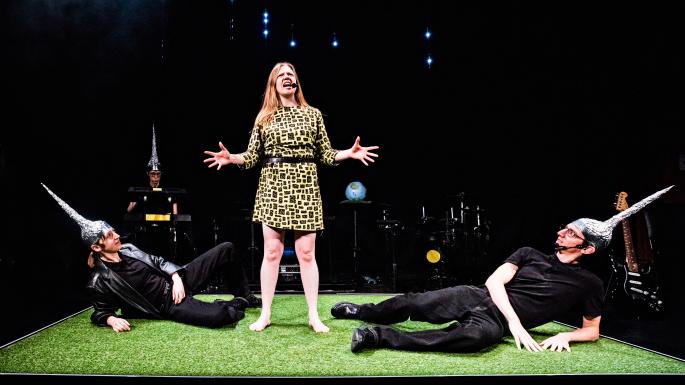
All the lights are on, but is there anyone in the house? Eat your heart out, Jacques Derrida – David Deutsch, David J Chalmers, Max Tegmark, and Nick Bostrom are the menu of the day, summonsed to the stage by Little Bulb theatre company to explore The Future, in which three boffins in black (with fetching silver-foil pointy hats) and a charismatic new-age arty philosopher (in a yellow-and-black Aboriginal print dress) channel the spirit of a whole bunch of scientists, cosmologists and forward thinkers on the subject of AI and human progress (or not).

Imagine a TED talk with breaks for physical theatre workshop games (‘Let’s all be snakes. Or Eagles.’) – together with some mighty fine polyphonic a capella singing. Oh, and sometimes the four cast members become a band (guitar, bass, drums, keyboard), turning it all into a kind of prog-rock space opera.

It’s Little Bulb, so of course it’s zany and fun and brimming with good ideas. Does it work? Not quite. Perhaps, to this jaded reviewer, it’s a case of ‘been there, done that’. The ideas on the table are familiar ones, first explored in the 1920s by Czech writer Karel Čapek, who invented the word ‘robot’; and subsequently developed in the 1940s by Isaac Asimov, in the stories and essays that would be published as I, Robot – in particular, his introduction of the Three Laws of Robotics. And on it all went, through Kubrick’s 2001: A Space Odyssey to Spike Jonze’s Her.

From the very beginning, as soon as the idea of a robot, or the notion of artificial intelligence, entered the sphere of human enquiry, writers and thinkers started to explore what this meant, and the worries kicked in… and going on what we witness here, not a lot has changed. Life 3.0 citing the possibility of an AI Apocalypse feels like Emperor Asimov in new clothes.

So, off we go with the familiar questions: What does it mean to be human? What do we mean by consciousness? How do we keep control of our inventions? At what point do we cease to be the master and become the slave? Can a non-organic being be thought of as having consciousness? Is it reasonable to say that progress can’t be denied, even if it leads to our demise? And will the death of (hu)mankind lead to the death of consciousness? Past, present, future – are we at the start, the middle, or the end of human civilisation?

All this and more is raced through breathlessly… it’s exhausting. And although I appreciate the referencing and parody of the TED talk format – ideas upon ideas, a rush of animated words delivered through tinny radio mics – I don’t personally enjoy it too much. My brain hurts. It’s a personal thing – I like my ideas digested in slow, cautious media formats: books, newspapers, radio broadcasts…

I find the trio of  boffins a bit tiresome, but I do understand why the company felt that exploring the clichés about male scientists and intellectuals, through having two of the ‘men’ played by women, and seeking out the clown qualities of each expert, was an interesting idea. Plus, robots turning on their masters is an obvious subject for a physical theatre skit. It’s all done well, but to my eyes and ears, it’s only mildly amusing.

On the plus side, company co-founder Clare Beresford is magnificent as Marina, a kind of super-hybrid of David J Chalmers (in whose honour she adapts an Australian accent to enthusiastically present his ‘crazy ideas’), and performance art enfant terrible Marina Abramovic, tossing her hair like a 60s hippy Eve, running barefoot around the astroturf with gay abandon as she muses on how boring the Garden of Eden would be, and how long it’d take before she gave in to the desire to burn it down. And it is always great to see a gal behind a drumkit.

The scenes/narrative threads that go beyond the usual worries about AI into more interesting reflections on future problem-solving – how we cope with the coming environmental crisis, a scientific theory that can encompass artistic reflection, an acceptance of fundamental consciousness as something shared by all living things – are the more interesting ones. To my mind, at least. It’s all subjective, even the view of what is subjective and what is objective.

As far as staging goes, this is a simple set-up, without the familiar Little Bulb paraphernalia of cardboard props and signage, and dressing-up box gowns and wigs, and the like. The lighting design (by Fraser Craig) is mostly responsible for holding the space – and it does its job ably, with strings of lights of changing colours suggesting, at various points, a psychedelic gig, the infinite cosmos, and a scientific lab in the dead of night. The glowing light box that often takes centre-stage attention is at once Pandora’s Box, the Intelligent Machine, and the Holy Tabernacle of the Ark.

The unaccompanied barbershop style singing is superb, and the synthesised prog rock channels the spirit of the Spooky Tooth meets Pierre Henry experiments, and delivers the result with a goofy knowingness. Cosmic, man!

As with earlier work, the show is co-devised by the performers (in this case, the aforementioned Clare Beresford, with boffins played by the company’s musical director Dominic Conway, and Little Bulb regulars Eugénie Pastor and Shamira Turner); and it is directed, as are all the company’s shows, by co-founder Alexander Scott.

It’s a new show, and that shows. It ebbs and flows, playing with the show-within-the-show format, as our intrepid team whizz around the world from conference to conference. The last few scenes are stronger than the early scenes, the show interrupting its own set-ups with ever more urgency. The Future currently feels a little young and unsteady, like a foal just finding its feet – but it’ll grow and develop, I’m sure.


Hoipolloi: The Ladder

He’s back! Welsh emerging artist Hugh Hughes, that is – the naively clever alter-ego of Hoipolloi co-founder Shôn Dale-Jones has been in the closet for six years, but is here dusted down and thrust forward to tackle the big questions of male identity, Welsh identity, changing social conditions in Welsh small towns, father-son relationships, bereavement, and grieving. Phew, no pressure then! Just so that expectations don’t rise too high, Hughes has decided that he will stay an emerging artist for the whole of his career, as that way he is free to fail. Sounds like a plan.

In The Ladder (‘an uplifting story about a downfall’) Hughes and Dale-Jones get a wee bit muddled up, as Hughes tells us that he is doing this show at the request of Dale-Jones, who has emailed and passed it on to him. Hugh Hughes shares the stage with his father, Daniel Hughes, who is dead. Daniel is played by an unnamed actor. (In another life he is Julian Spooner, of Rhum and Clay Theatre.)

So, here is Hugh and here is the dead dad Daniel. And together, they are going to work out how to tell Daniel’s story. The story of his death, but more importantly the story of his life. We learn that Daniel had a heart attack and fell off a ladder to his death, his whole life (no doubt) flashing before his eyes as he tumbled down. There’s video footage of the actual ladder, and also a nice animation, showing us the ladder and the falling father. The little tumbling figure can be stopped at any point, and this is what happens – time is frozen, and we get to hear dead dad Daniel’s thoughts and memories from that moment.

We are taken back to his childhood, sitting in the family grocery store, watching the black and green floor tiles dry. Later, he inherits the shop, taking good care of regulars such as Mary, who buys her apples there every day. All is fine and dandy, in an unassuming and low-key sort of way, until the new supermarket opens nearby…

Daniel’s reminiscences – often delivered in memory-snippet lists in which plasters and rubber bands and schoolbooks sit side-by-side in the childhood roll-call with teak music centres and Volvo estate cars – are augmented by scenes enacted by the two performers playing at role-playing. There’s also video footage, including a shaky Super-8 reel of Daniel’s wedding day (perhaps Dale-Jones helped Hugh Hughes by providing this from his own family archives? We’ll never know for sure!), and old East Anglia TV footage of an infamous local disaster, when a bus sank down into a hole in the road (the audience love this bit!). Apparently, everyone knew there was a chalk pit under the road, and no one worried about it too much until this happened.

The banter (cleverly scripted to appear to be spontaneous) between the two onstage characters is brilliant – slaughtering many a theatrical sacred cow as they go about the business of constructing a show in sight of the audience. There’s a notebook and pencil left at the front of the stage for any audience member who fancies contributing notes, and a wonderful tussle with an expanding table. (‘Physical theatre!’ says Hugh, moving into a lunge to prove his credentials – there’s a knowing laugh from those of us who are aware that Shôn Dale-Jones is Lecoq trained.)

A story at the heart of Daniel’s memories is of a schooldays incident with a spanner, revolving around a game of chicken with friends Glyn and John. What actually happened, and who was the actual butt of the joke, is disputed – and the incident has resonances in adult life when Daniel finds himself having to deal with his former friends (one now a bank manager, one working for the council) in his quest to save his shop.

This is such a clever and satisfying piece of theatre. A show about death that is thoroughly life-enhancing. A show that embraces so much about working-class male culture and small-town life, in a manner that is humorous but never cruel or condescending. A theatre show about making theatre shows: much meta-theatre disappears up its own backside, but here we get an always entertaining and accessible reflection on how to make theatre, and how theatre makes stories come to life. The show is directed and designed by the other half of Hoipolloi, Stefanie Muller – and she has, as ever, done a sterling job.

The company is based in East of England (Cambridge, to be precise) and it was wonderful to see them on home territory on the occasion of their 25th birthday. The Ladder, seen here at the Norwich Playhouse for its world premiere, is commissioned by Norfolk and Norwich Festival and other partners, and it is the third in the Loose Change Trilogy, following on from The Duke, and Me & Robin Hood. All three shows in the trilogy were presented in NNF 2019.

Here’s to the next 25 years, Hoipolloi – can’t wait to see what you have up your sleeve for your next show! And may Hugh Hughes never fully emerge – we love him just the way he is, an Everyman who is a wonderful work-in-progress.


Victoria Thierrée Chaplin with Aurélia Thierrée & Jaime Martinez : Bells and Spells

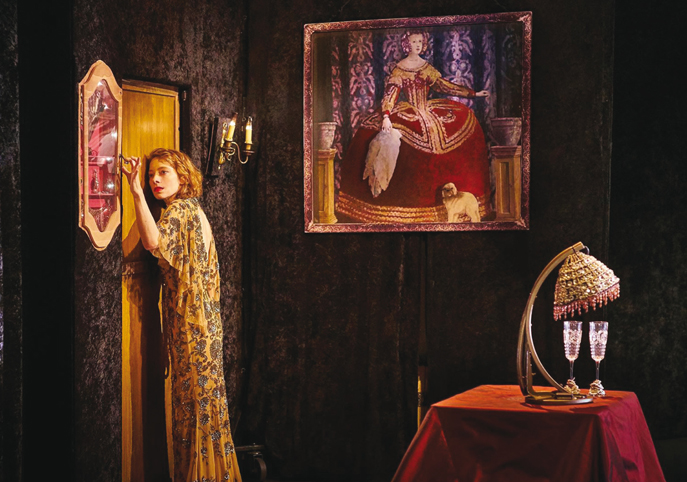
A footloose and fancy free woman is seen in a succession of dreamscape settings. She climbs the walls of abandoned buildings, enters empty apartments, and finds herself immersed in other people’s stories – acting out snippets of lives that are not her own. She is a kleptomaniac time traveller, moving through time and space with gay abandon, at the mercy of the objects she steals…

Victoria Thierrée Chaplin is the creator of Bells and Spells, receiving its UK premiere at the Norwich Theatre Royal, for one night only, as part of the Norfolk and Norwich Festival 2019 (following on from a work-in-progress showing at Coronet Theatre in Notting Hill in 2018). Victoria is the daughter of the legendary clown and acrobat Charlie Chaplin; wife and accomplice of new circus pioneer Jean-Baptiste Thierrée; mother of circus-theatre makers James and Aurélia Thierrée – and a renowned artist in her own right, creating design-led work in which scenography and dramaturgy are inextricably linked. Here, she teams up once again with a family member – this time daughter Aurélia. The two had previously worked together on Aurélia’s Oratoria, but on this show, Victoria gets the main billing as the lead artist/creator of the concept and mise-en-scene.

There are some extraordinary visual images, as you would expect from Victoria Thierrée Chaplin. Glorious costume and set design, superb quick-change skills, and some deft magical illusions combine beautifully to give an ever-evolving visual landscape. Walls of all sorts – static, encroaching, morphing from one thing to another – are a recurring motif, as are doors (revolving or otherwise). Pictures come to life, mirrors reflect distorted images. The woman merges into the wallpaper or magically disappears from behind a flapping sheet, and dresses on mannequins are somehow switched to a differently coloured dress before our astonished eyes. Tablecloths are whipped away leaving table-settings intact. In more surreal sequences (surreal in the general sense, and in the sense of directly referencing key surrealist images): a dog’s head finds itself moving across the stage to land on a person’s body, white nightdresses become sheep, and fur coats become wild beasts. A bunch of hatstands morph into a a fabulous creature, and shining chandeliers become heads nodding in the darkness.    

And there is more! Aurélia is not alone onstage! Dancer Jaime Martinez is a wonderful foil – he tangos with her, and this then morphs exquisitely into a louche solo tap number. The two dance (literally and metaphorically) around each other throughout the whole show, playing a cat-and-mouse game of absence and presence. 

It is slightly odd that the original French title of the show, Murmures des Murs, has been changed to Bells and Spells, as this show is so much about murmuring walls! The sound design is another wonderful element of the production, with ‘noises off’ and the heard-through-walls music adding to the dream-like quality of the piece. Everything is off-centre, off-kilter, and the notion of onstage-offstage is played with throughout. Offstage, out of sight, behind the door, beyond reach… Who is on the inside looking out, and who is on the outside looking in?

A truly mesmerising show – a feast for the eyes, and a clever conundrum for the brain, as we desperately try to make sense of what we are seeing! Bravo, Victoria and Aurelia – another grand success. 


Dead Dogs, Forged Old Masters, and lots of Wild and Witchy Women: Brighton Festival and Fringe 2019

So, that was May. A month spent swapping hats, literally and metaphorically, as I raced from Brighton Festival and Fringe over to Norwich to the Norfolk and Norwich Festival and back again to Brighton, sometimes performing, sometimes facilitating other people’s performances, sometimes reviewing for Total Theatre Magazine. Oh and given that the Brighton Fringe extends into June, the May madness has only, as of 2 June, subsided.

I’m focusing here on Brighton.  A quick glance through the recent posts on the Reviews section will reveal that between us, we’ve seen a fair few shows in Brighton Festival! I felt I chose well – the two very different ‘Afrofuturist’ productions, Nwando Ebizie’s Distorted Constellations (Lighthouse) and Jaamil Olawale Kosoko’s Séancers, (Attenborough Centre for Creative Arts) are both continuing to haunt my dreams. Without Walls outdoor arts programme was a little bit stymied by the weather, but I did get to see the fabulous Scalped by Initiative.dkf, so that made it all worthwhile.

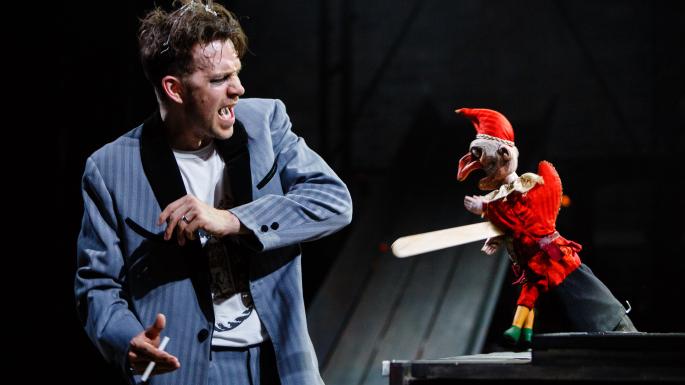
Kneehigh are always a Festival fave, and  Dead Dog in a Suitcase (and other love songs) didn’t disappoint, although for me it wasn’t quite as strong as shows previously seen in Brighton Festival, mostly because I struggled to love Charles Hazlewood’s music – and in a musical, that’s pretty key. I know that as an adaptation of The Beggar’s Opera that wasn’t The Threpenny Opera, the composer and director were keen to avoid any suggestion of Brecht and Weil, but it was hard not to long for a rendition of Mack the Knife. That said, the  direction (by Mike Shepherd), writing (by Carl Grose), and design (Michael Vale) were spot-on. There are very many snazzy dance sequences by choroegrapher Etta Murfitt, and the staging of the piece is excellent. Performances were astonishingly strong from the whole cast – with a special shout-out to gangster-puppeteer Sarah Wright, whose Punch and Judy creations – there to echo, mirror and mimic the story throughout – are beyond good, they are magnificent.The show was previously seen by TT at Shoreditch Town Hall in 2015, when it was reviewed very thoroughly by Rebecca Nice, so I will defer to her as she captured the show very well!

Another returning company were Berlin (from Belgium), who brought True Copy to Attenborough Centre for Creative Arts, an exploration of the work of famous art forger (and then later painter in his own right) Geert Jan Jansen, who in a previous show by the same company (Perhaps All The Dragons, seen at Brighton Festival in 2014) said, ‘The only one who never gets any recognition is the forger. Unless he is unmasked’. Geert Jan was eventually unmasked – and this is his story. I haven’t given this one a ‘proper’ review because text is vital to the show, and I just couldn’t read the inadequate surtitles (I asked to be moved forward and was allocated a seat a little further forward, but was still squinting to make out the words – which were in white on black, a complete no-no for any of us with visual disabilities, to add to the problems). There were a number of walk-outs from the back of the auditorium – perhaps others were struggling to see too! So as I missed a lot of key twists and turns in the story, I didn’t feel I could give it a proper critical assessment, but to say here that it is as clever, complex and beautiful as the company’s other shows. The art gallery set, with its panels that shift from reproduction paintings to screens showing video and then documentary footage from the artist’s studio, is the perfect setting for the action; and the choice of music from mock-Satie to mellow saxophones, is perfect. And although what was to be the denouement, the central twist in the tale, was apparent from the beginning (to my eyes, anyway – not-so-sharp in some ways but sharp in others!) it was an enjoyable moment when it came. I went to see the show with painter/sculptor friends, and they particularly appreciated the thorough investigation of what we mean by ‘real’ and ‘fake’; the challenging of who actually is the expert (major art collectors, galleries and auction houses across the globe have failed to spot Geert Jan Jansen’s Picasso and Kappel forgeries). It was wonderful to discover that in his castle (yes, he has a castle) Geert Jan has a room for each of the painters he mostly mimics, around 18 in total I believe. A fascinating exploration of the line between fiction and reality. Another show with visual design at the core of its dramturgy: I also very much enjoyed Vox Motus: Flight, which will be the subject of a feature article (coming soon, watch this space!) on non-naturalistic shows about migration and refugees.

Also high on the visuals was the new Gravity and other Myths show, Backbone, which had a clever and funny show-within-the-show structure of game-playing; some lovely visual images, including a great use of buckets on the head as masks; and wonderful live music (mixing violin, percussion and electronics most adeptly). There was an onslaught of extraordinary acrobatics and hand-to-hand sequences from its cast of ten. I enjoyed a lot about it, but I also struggled with some aspects. So much high-octane energy, so many evolving and dissolving human towers and swing-the-girl sequences! I became desperate for something quiet and slow – which we eventually had moments of, for example when all the cast balanced long wooden poles on their heads and walked slowly with them. There was also one very nice, calm scene between three women performers, gently nudging and edging each other over into handstand walkovers, then creating interesting acro-balances. I also longed for something, anything, that challenged the traditional male base/ female flyer dynamic. I stated to feel that if I saw one more girl swing up and over I would scream. This is an Australian company, with many ex-Circa performers in the cast list. Perhaps they feel that gender role reversal is Circa’s thing and they don’t want to go there? Who knows…  At 80 minutes, the show feels too long – it could easily lose 15 minutes and be stronger for it. But top marks for exuberance, stamina and extraordinarily skilled acrobatics! And to be fair, the packed audience at Brighton Dome absolutely loved it.

The one Brighton Festival show I wish I’d seen is Birds of Paradise/National Theatre of Scotland’s My Left Right Foot: The Musical, an irreverent look at disability and inclusion, reviewed very ably by Matt Rudkin. It is still touring, so perhaps I’ll catch it somewhere else. Oh and I failed to catch anything at all by guest artistic director Rokia Traore – although I did get to here her sing and play at the press launch (and very lovely it was too). I was intrigued to read what Miriam King made of the latest Ultima Vez production to come to Brighton, TrapTown. Mim has been a longterm aficionado of Wim Vandekeybus’ work, so I very much value her opinion. Read her review here.

Meanwhile, at the Fringe,  I saw two great shows by fabulously feisty women, both at The Warren: A&E Comedy’s Witch Hunt, the follow up to the enormously successful Enter the Dragons is fresh out of the rehearsal studio (where the the company have been working with Cal McCrystal) and still in the early stages as a touring show, but already great. Klein Blue’s Are There Female Gorillas? is also a female two-hander, in this case two much younger women, and it is also a sure winner. I was also pleased to see Cock Cock Who’s There, which won a Total Theatre Award for Emerging Artist for creator Samira Elagoz at Ed Fringe 2018, coming with the tagline ‘’Not your average show about rape, female bodies, feminism, and the male gaze’. I wasn’t wowed, but I was interested… Also a solo female show, by someone who has come a long way since she won the Emerging Artist accolade at the TT Awards: Bryony Kimmings kicked off the Fringe in style at ACCA with I’m a Phoenix, Bitch, enjoyed greatly and reviewed here. Her opening night was also the celebration event for the Total Theatre Magazine Print Archive project, the culmination of a year’s work digitising the entire 25 years worth of the magazine in print, a project made possible by a National Heritage Lottery grant. If you haven’t already, please do dip in totaltheatre.org.uk/archive

So there we have it: Brighton, May – Festival and Fringe – done and dusted. Next?


Featured image (top): Kneehigh: Dead Dog in a Suitcase (and other love songs)

Klein Blue: Are There Female Gorillas?

As we enter the space we see a girl and a gorilla sitting on the floor, on one of those compact circular dancefloors that are like a little circus ring. They are sat there a fair while, on display. The audience mostly chatter, although some of us sit silently, staring. There’s a lot of noise pollution coming into this shipping container venue at the heart of the Warren’s pop-up festival complex – the sound of laughter, loud conversations, and clinking bottles seeping in from the courtyard and bar. Somehow, it adds to the pathos of the scene.

The gorilla is just sitting, looking a bit downcast. The girl is grooming herself. Not picking out fleas – although it looks like that at first, but picking at and teasing out ingrowing hairs on her legs. She has porcelain pale skin, sleek dark hair pulled back in a neat dancer’s bun, wide awake eyes, and a smear of red lipstick extending clown-like over her full lips. She has smooth bare legs, and is wearing an old-fashioned, sweetly sexy white corset with straps and lacy bits. She’s a pretty girl. Pretty, slim, smooth, clean, shaved. The gorilla is – hairy. They are handcuffed together. There is no key. Or at least, no one knows where the key might be…

Also inside the ring: a bowl of fruit, and a whole assortment of depilatory materials. Razors, tweezers, scissors. Hot wax is bubbling away. The girl spoons some on to her leg, gets a little white strip, sticks it to the wax and – rip. The man sitting next to me in the front row flinches. The girl isn’t quite satisfied with the result, and starts in with the tweezers. Then, she stares at the gorilla, recoils, gets the pair of scissors and starts to trim the gorilla’s arm hair. There’s a tussle.

When the gorilla’s mask comes off (left to sit at the front of the circle, staring out at us – a nice touch), we see that inside is a girl. Are there female gorillas? Apparently this is a genuine Google search question. There is a name for male gorillas – silverbacks – but no name for female gorillas. We learn all sorts of interesting facts about gorillas from Gorilla: they are an endangered species. Their name comes from the Ancient Greek ‘gorillai’ meaning ‘tribe of hairy women’. They are one of the closest relatives to human beings and share most of the same DNA (95–99%) and many of the same attributes and abilities. Gorillas can be taught English Sign Language. Female gorillas have been known to engage in homosexual behaviour. Human scientists thought at first that this was something to do with attracting males – Gorilla lesbian porn – until they realised (shock, horror!) that it was all about pure sex and personal pleasure.

When Gorilla speaks, it is prosaic, conversational. When Girl speaks, it is poetic: she plays with the sound of letters and words, using assonance, consonance and alliteration. She gives us rhetoric in rhyming couplets – giving Hamlet a run for his money in her soul-searching, questioning, conflicted, coming-of-age musings. To be or not to be – a girl. What is it to be a girl? As opposed to being a gorilla. Sometimes Girl and Gorilla play a game whilst walking in a circle, around the circle. It’s a storytelling game. ‘Once upon a time there was a girl who…’ Round and round they go, handcuffed together forever, a kind of Godot Girl and Gorilla.

Then, there’s the fruit bowl. Juicy strawberries squeezed through the fingers graphically illustrate a story of female shame at the onset of menstruation. A banana strangled into a pulp demonstrates the anger and desire for revenge induced by a memory of male harassment on the streets of Shoreditch. Oh, and there’s also an old-school portable music centre and set of disco lights at the back of the circle – which are put into action for a very lovely dance section set to the Spice Girls’ ‘Two Become One’. But will two become one? Or is it more that two were one, but now have to go their separate ways? Can Girl ever embrace Gorilla’s hairiness? Will Gorilla ever understand Girl’s need to groom herself to a hair-free ideal?

Girl is played by spoken word artist and writer Sophie Ablett. Gorilla is played by theatre-maker and founder of Klein Blue, Grace Strickland de Souza. The show has been devised and co-written by both, with direction by Tamar Saphra – and it is a cleverly crafted and beautifully enacted piece. At 50 minutes it is the perfect length for a two-person show: every word, action and visual image is thought through and has a purpose; the timing is precise; and the onstage rapport between the two actors is great. It is satisfying to see a young company with such a sound grasp of dramaturgy.

What I particularly like is the acknowledgement of ambiguity – yes, yes we know that we have been conditioned by patriarchy, but we do enjoy grooming ourselves. How on earth can we really know what is patriarchal oppression and what is doing what we genuinely want to with our own bodies? Klein Blue have, in the split identity of Girl and Gorilla, found a fabulous metaphor for the inner conflict many women feel about their bodies. They’ve created a clever, funny and artistically robust framework to interrogate questions around the female beauty myth, and to explore agency over our own bodies. Most importantly of all, it is entertaining. Yes, feminism can be fun!

As they raise their arms to take their bow at the end, both now stripped down to matching neutral bodysuits, we note that one woman has shaved armpits, and one doesn’t. That feels good and right.