Author Archives: Dorothy Max Prior

Dorothy Max Prior

About Dorothy Max Prior

Dorothy Max Prior is the editor of Total Theatre Magazine, and is also a performer, writer, dramaturg and choreographer/director working in theatre, dance, installation and outdoor arts. Much of her work is sited in public spaces or in venues other than regular theatres. She also writes essays and stories, some of which are published and some of which languish in bottom drawers – and she teaches drama, dance and creative non-fiction writing. www.dorothymaxprior.com

Circus Hub: Gang of Four

Circus Hub is in its fourth year at the Fringe, and in my umpteenth year here in Edinburgh in August, I spend my first afternoon of reviewing duties ensconced here on the Meadows, seeing four very different circus shows from around the world.

The two tents of the Hub – a blue-and-white Big Top and a Spiegeltent – sport good full houses for all the shows I see, and audiences include a large number of children, as can be expected for circus shows. Although I feel the need to note that circus is for everyone, not all shows are child-friendly, and there are dark things to be found under the all-encompassing umbrella of ‘circus’. For example, it was particularly puzzling to see last year’s Total Theatre Award winning show Fauna described by some venues it subsequently toured to as ‘family friendly’. It is not how I’d describe it; it’s pretty grown-up in its themes, and I saw a fair few puzzled young children at the Brighton show. Which is not just by-the-by, it’s a way of introducing the latest work by Australian maestros Circa – Wolfgang, which is a children’s show, for age 3 upwards, presented in the Spiegeltent (‘The Beauty’).

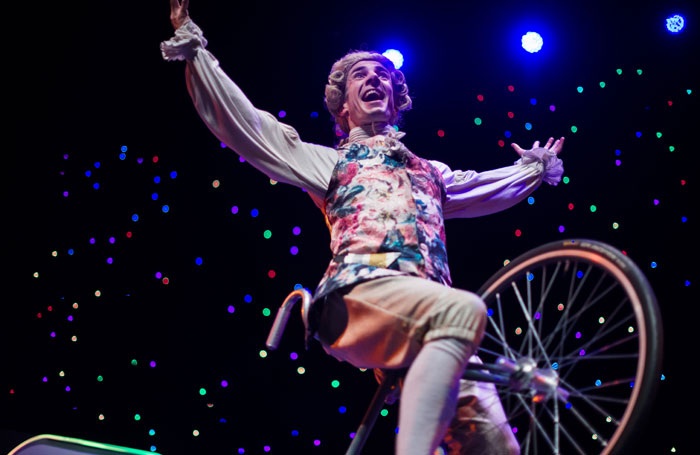
It’s great to see a company of this stature acknowledging that young children need quality circus shows made especially for them. Of course, it can be enjoyed by children of all ages – and I certainly had fun – but the most fun of all was seeing the delighted faces of the younger members of the audience, laughing wildly at clowning which was pitched at exactly the right level for them, and gasping at the acrobatics, chair-balancing and cycling tricks, all presented in a mode appropriate for young viewers. There’s no cringey playing to the adults here (the nasty nudge-nudge bane of so much children’s work), and no condescending playing down to the young audience. All the humour, all the action, is clear, precise, child-friendly, and of the same superb quality as any other production by Circa. It’s a three-person show: an accordion player, who is also a clownish character in baggy gold suit and angel wings; a bewigged and powder-puffed male acrobat who is Wolfgang (Wolfgang Amadeus Mozart – or perhaps just someone who thinks he is and takes on the mantle, in true clown tradition); and a female in a cheeky black-and-white playsuit and party hat (ah yes, the colours of the piano keyboard) who is muse/conjuror or ‘spirit of the music’ or perhaps even the piano itself…


Circa: Wolfgang

Circa: Wolfgang


Wolfgang finds himself in battle with the music in many marvellous ways: we have the classic Charlie Chaplin fight with a music stand (also employed in recent circus history by Thom Monkton in The Piano); a gorgeous slo-mo fisticuffs between the two acrobats; batons turning themselves into bunches of flowers; and escaping sheets of music flying everywhere.

Elsewhere, Wolfgang does some ace trick cycling whilst being helped by his muse to go from almost naked (squeals of laughter at his unlikely combo of beige underpants, socks and wig) to fully kitted out in silver leggings, colourful waistcoat, and dashing frock-coat; there’s some terrific acrobatics and acrobalance, including a moment where our musical muse manages to base her partner whilst  sur pointe; and a very funny sequence of conducting the spotlights, in which the muse always wins. The soundtrack is a lovely mix of Mozart favourites, some pre-recorded, some played live on accordion, which works surprisingly well. A delightful show, which will charm audiences of all ages. It’s coming to the Barbican at Christmastime, so London audiences will get a chance to experience the joy and magic that is Wolfgang.


Circus Abyssinia: Ethiopian Dreams

Circus Abyssinia: Ethiopian Dreams


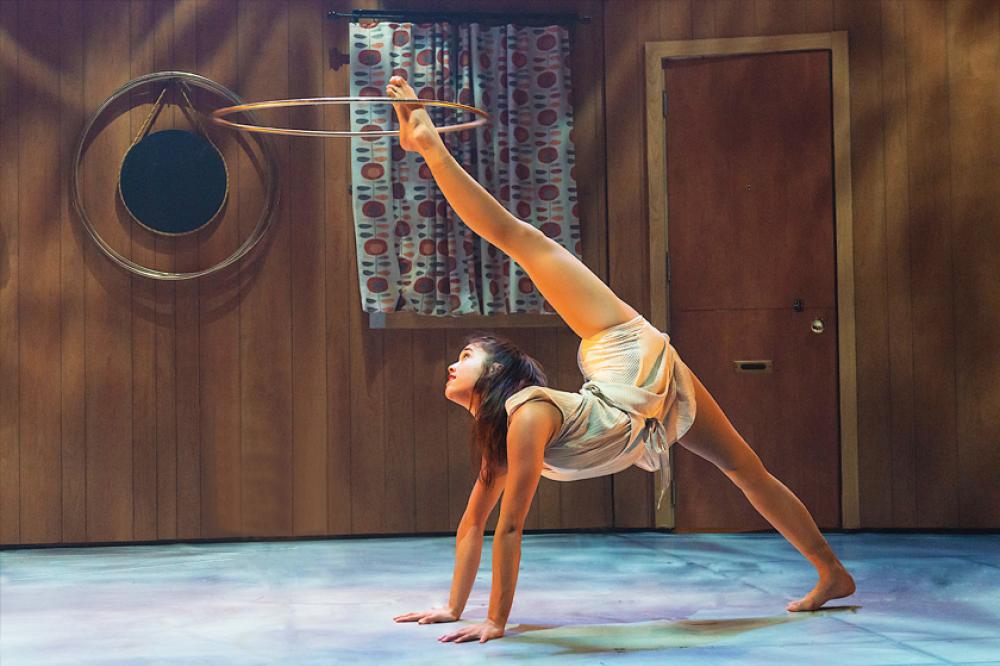
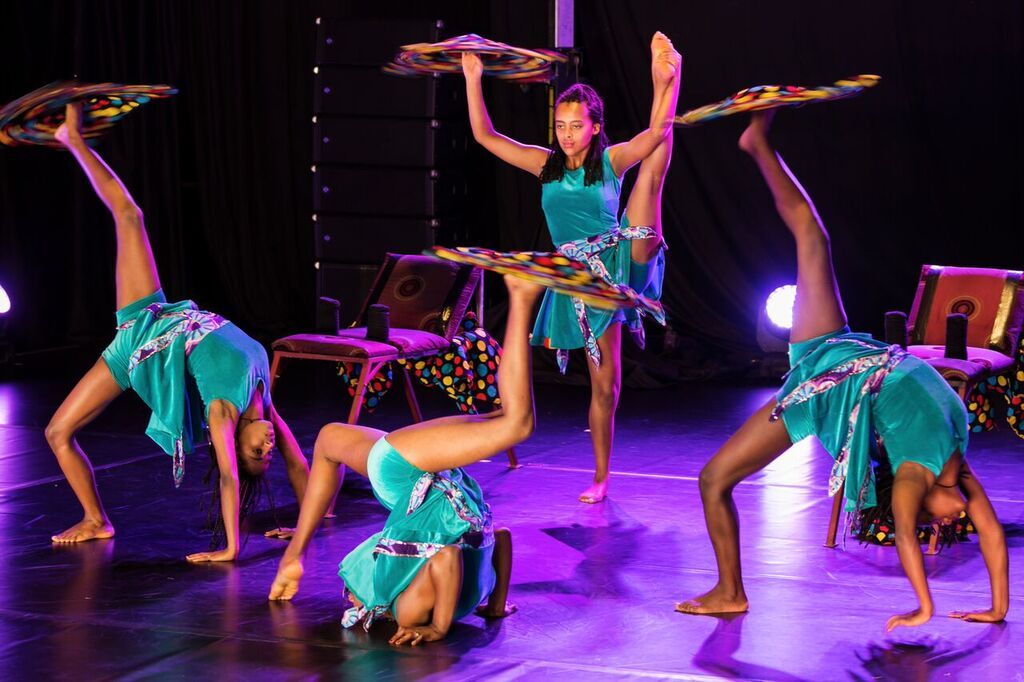
Next, Circus Abyssinia with Ethiopian Dreams, a crowd-pleaser returning to the Hub after great success in the 2017 Fringe. We start with a feel-good dance, the full team (I’m pretty sure that’s ten men and four women) onstage. I enjoy watching their faces: some look ultra-confident, some neutral, some smiling a little nervously. The emphasis in this show is on the tricks, not stage presence or theatricality. We are presented by a succession of high-quality acts – the men and women never appearing onstage together unless it is for a brief transition or for the dance numbers that begin and end the show. Definitely no body contact between them. The emphasis is on acrobatics and juggling, with no aerial acts. Traditional gender roles within circus are also adhered to. The men build human towers and tumble magnificently; the women are snakey contortionists, twisting themselves into very beautiful bends and bridges and unbelievably complex positions in which heads and limbs become shared body parts. I don’t think I’ve seen four contortionists work together in this way – they are truly astonishing. The men juggle hard red and green plastic clubs; the women foot-juggle soft multi-coloured cloths. There is a sweet hula-hoop act that is miles away from the usual raunchy burlesque vibe many hoopers employ. All of this happens to a great soundtrack that mixes languages and beats with a wide range of instrumentation: a hint of Lust for Life here; a traditional chordophone sound there, a gorgeous jazzy African female voice (Gigi, perhaps?) at another moment . One of my favourite moments is a rare theatrical one, when the group of men carry on two Chinese poles to the sound of a slow lament – although once the poles are erected, the mood is broken and we switch to flashing lights and an electro beat, and a thrills galore pole and tumbling finale. Feel-good fun for all the family – and fine as long as you don’t mind the traditional gender stereotyping.


Barely Methodical Troupe: SHIFT. Photo Gregory Batardon

Barely Methodical Troupe: SHIFT. Photo Gregory Batardon


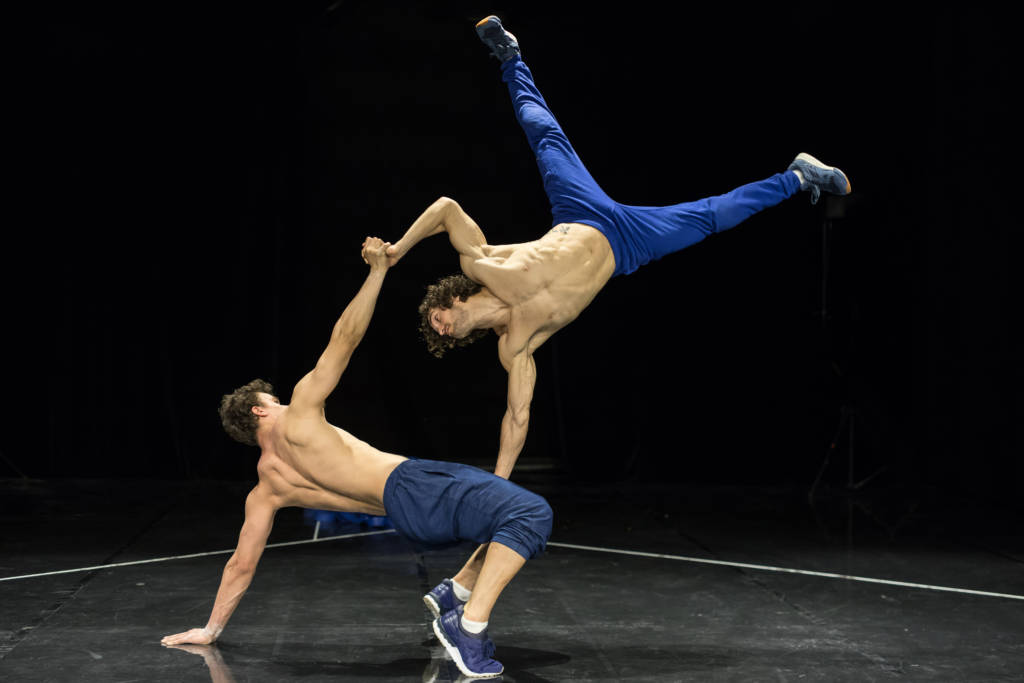
SHIFT, on the other hand, is a piece of contemporary circus full of theatrical know-how, which explores and dissects human relationship (gendered and otherwise). It’s the latest piece from Barely Methodical Troupe, whose first show Bromance won them a Total Theatre Award and whose second show Kin proved them to be far more than a one-act pony. One of the many things that I love about this company is their dedication to continuing research and change. They could easily have stuck to the endearing three-man buddies-on-stage Bromance format, but instead choose to work with new collaborators on each project. In this case, we have two of the ‘Bromancers’ Charlie Wheeler and Louis Gift, joined by Esmeralda Nikolajeff and Elihu Vazquez. SHIFT was commissioned by Norfolk & Norwich Festival, where I first saw it. A second viewing, two months on, leaves me feeling that here we really have a show of quality and substance.

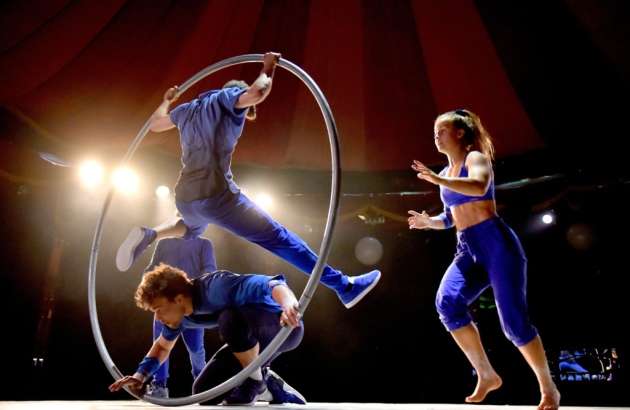
The set-up is simple. We have four people, three men and a woman, and a variety of elastic belts – large rubber bands, essentially – providing the cast with plenty of opportunity for quipping, from the very first moments onwards. (‘Throw me a line please’ ‘Friends, Romans, countrymen… ‘What’s the name of your band?’ ‘Rubber band.’)  The belts are used to explore power, tension, balance – it was Jacques Lecoq who said that all theatre is about push and pull, and here that maxim is taken literally. The company use the physics of give and take to move into an exploration of friendship, togetherness, trust. In one fantastic sequence Charlie Wheeler is ‘puppeteered’ by the others, moved and twisted into all sorts of relationship with each of the three other bodies. This scene leads into a Cyr wheel section which starts by highlighting Charlie’s immense talent on the wheel – but then moves into an extraordinary interplay between all of the ensemble, ending with Esmeralda Nikolajeff using the wheel for a balanced walk that moves from vertical to horizontal.

Esmerelda is a formidable talent. Working on hand-to-hand sequences with Louis (a big, strong base) she is tossed and swung, raised high in the air, then plummeted to the ground, seemingly light as a feather, but then it moves into a weightier acrobalance mode, the two creating astonishing balances, with Esmerelda at one point bearing Louis’ weight on her back, and then basing him in an on-the-shoulder stand as the audience gasps in astonishment. There are also many three-way and four-way hand-to-hand (or perhaps we should call it hand-to-foot) scenes, in which the performers climb over each other’s bodies and mould themselves to each other with elegant fluidity. The fourth member of the ensemble is Elihu Vazquez, an extraordinarily fluid breakdancer and acrobat. Each of the four is given space to showcase their individualism, and each also contributes equally to the ensemble work. Complicity is all.

When I saw SHIFT at the Norfolk & Norwich Festival Spiegeltent, where the show premiered in May 2018, I sat at the back of a booth, behind a pillar and, apart from poor sightline issues, missed much of the spoken text. Here at Circus Hub (also a Spiegeltent) the sound is better and the delivery of the text stronger, but sometimes I’m straining to hear the words. Sometimes this is fine as the lines are throwaway humorous quips and it doesn’t matter if not everyone hears them. At other times, the text needs to be heard. This issue is still not 100% resolved, and it is hard to know what the solution would be as radio mics wouldn’t work in this context, and the circus-performer-moves-to-the-mic-stand motif has been sorely overdone in recent years. Regardless of this small gripe, glad for this second viewing of such a beautiful and inspiring show by one of Britain’s top contemporary circus companies.


Cirque Alfonse: Tabarnak

Cirque Alfonse: Tabarnak


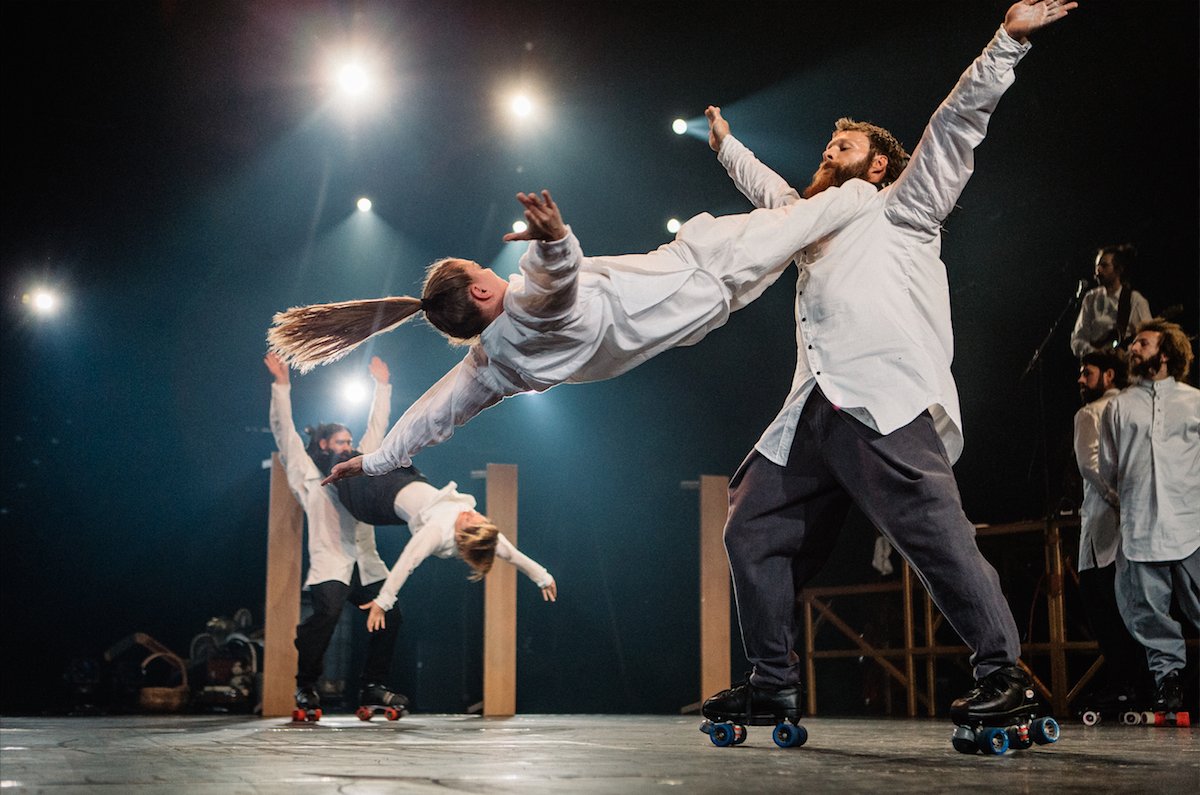
From the UK to Quebec, and from The Beauty back to The Layfayette, for  Cirque Alfonse. The company were previously seen at the Edinburgh Fringe with Barbu, and Tabarnak similarly combines butch beardy-man acrobatics with exuberant traditional Quebecois music – but there’s a whole lot more too. With a free-hanging stained-glass window and half-a-dozen wooden pews as the set, Tabarnak is a tongue-in-cheek exploration of the sacred and the profane – inviting a reflection on the comparison between religious ecstasy and the full-on ecstatic experience of singing, dancing or swinging by your neck from strops whilst wearing rollerskates.

Amen. Ah, men! Tabarnak sees the big burly blokes on-form as ever, with some wonderfully powerful pyramids and towers emerging and tumbling down. The pews, of course, become balancing equipment. There is additionally a male aerialist whose straps routine is phenomenal. In fact, everything he does is jaw-droppingly good. But, surprisingly perhaps for an Alfonse show, it’s the rollerskating whip-wielding women who capture my heart in this piece. Keeping up with circus trends worldwide, we see female strength on show, as the women move beyond the traditional flyer roles seen in Barbu. I also love seeing the men doing a skater’s waltz together, not to mention the knitting… Humour is paramount. There’s a brilliant bell-ringing duet on ropes, and a gorgeous scene in which incense holders on chains become swinging poi. A water tank becomes a surreal baptismal font; and eventually, that stained glass window transforms into an unusual piece of aerial equipment…

In this company, the live music and the circus go hand-in-hand, with acrobats turning into hair-shaking singers, or nipping up and grabbing a guitar or fiddle. The band’s female percussionist (and everyone of course knows women make the best drummers) is a tour-de-force. She beats on her kit, standing. She plays what I take to be a Quebecois version of the Celtic bodhran with aplomb. She taps and stomps on a wooden board. She plays musical saw. And she joins the two female acrobats in the whip-cracking scene, turning this Western skills number into an experiment in percussion. Mesmerising as all the rest of the stage action is, my eyes keep returning to her.

Tabarnak is such a joy, so life affirming, such a pleasure to witness. Hallelujah, brothers and sisters!


Cirque Alfonse: Tabarnak. Photo Audric Gagnon

Cirque Alfonse: Tabarnak. Photo Audric Gagnon


Circus Hub on The Meadows presents circus and cabaret work in two tents, The Lafayette and The Beauty, from 4–25 August 2018 and is part of the Underbelly programme at the Edinburgh Festival Fringe. See www.underbellyedinburgh.co.uk


Ad Infinitum: No Kids

Kids? No kids? Kids? No kids? How to decide? Some of us don’t exactly decide – while we are chopping and changing our minds daily, we suddenly find ourselves pregnant, as if God or Mother Nature or whoever just threw their hands in the air saying: enough already, I’ve decided for you.

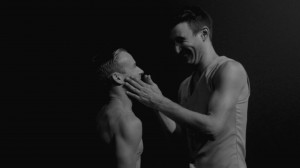
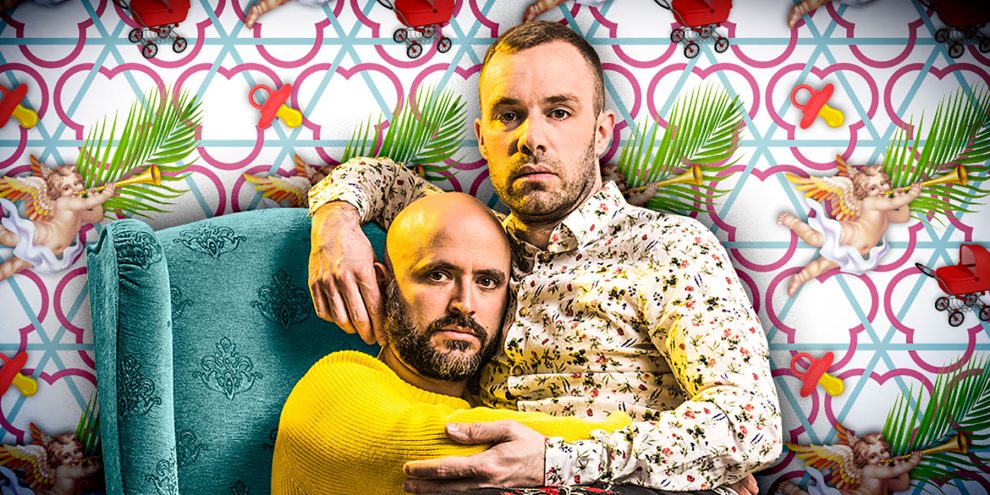
But that’s not going to happen to George or Nir. As a gay male couple, it’s going to have to be a fully conscious decision. Or decisions, because nothing will be easy. Create a mini-George with a surrogate mother who will hand over the baby at birth? Form some sort of idyllic three-way parenting relationship with the mother? Adopt a child from abroad? Adopt from the UK, which will almost certainly mean a child with severe disabilities or learning difficulties, or a child that comes with a terrible history of abuse or neglect?  All of those possibilities bring with them a whole string of ethical conundrums.

Marrying ‘gender-bending musical cabaret and verbatim theatre’, No Kids is a feisty, funny, moving, thought-provoking exploration of that decision-making process. In the making of the show, Ad Infinitum’s two co-directors do something they’ve never done before: share the stage, share the writing, and share the directing credit. And they choose to share that process with us – the referencing of the making of the piece within a piece of theatre can sometimes feel awkward, but here it is a fully immersed aspect of the dramaturgy.

‘What if?’ becomes the motif of the show, which playfully and satirically explores all the universal fears that every parent or would-be parent feels. What if he pulls a pan of scalding water over himself? What if he is bullied at school? What if he grows up hating us? What if he becomes a drug-dealer? A murderer? It’s We Need to Talk About Kevin on acid as George and Nir leap around the stage acting out their worst fears. Then, there’s the fears related to their specific circumstances. What if he’s a she? What do we know about vaginas? Wouldn’t a girl need a mother, not two dads? What if he hates us for being gay and bullies us?

The bullying theme returns again and again, in many guises. A two-way riff on how cleverly as parents they will deal with it: they’ll be praised by the teachers and fellow parents at the school! They’ll start a vlog about bullying and how to stop it called Bully4U! They’ll win the Nobel Peace Prize! And in fantasising about a possible future life as parents, they inevitably re-evaluate their own childhoods: Nir, a fake-fur stole around his neck, re-enacting the torture of a daily bus journey to school in his home country, Israel. The evil chant of ‘Suck my cock, faggot’ is the least of it.

Both men also explore their relationships with their fathers. There is common ground: military backgrounds, stern patriarchal attitudes. In one particularly moving scene, George shares the closeness that developed in his father’s dying days (just as Ad Infinitum were making their acclaimed show about bereavement, Translunar Paradise), and the shift in his attitude towards his father when he learnt what a tyrant his grandfather had been, and how his father had been regularly beaten. A reflection on how we break the cycle of violence and oppression handed down from generation to generation is a vital part of any decision about whether to parent a child.

True-life stories are at the heart of this piece, but the show is determinedly untypical of most autobiographical or verbatim theatre. Nir and George’s Lecoq training as physical actors remains at the core of their work, and every line of text is fully embodied. The staging is simple and highly effective – scenography and dramaturgy go hand-in-hand. Two rails of clothes of various sizes in rainbow colours simultaneously suggest all the possible babies that might be born, and the Gay Pride symbolism of the rainbow. A pram is fitted with a speaker so that as it moves around we hear the invisible/imaginary baby’s cries shifting through the space. A table and chairs and colourful cloth become bed or dining table, as needed.  The lighting design takes us from bedroom to disco to past lives to imaginary futures. Great writing, great acting, great design – plus, there is dancing. George tears up the dancefloor like the ‘beast of a man’ that he is. Nir reprises the diva he channelled in previous autobiographical work Ballad of the Burning Star.

No Kids is a beautifully constructed piece, exploring important issues thoughtfully and humorously. And It’s a delight to see Nir Paldi and George Mann onstage together. I truly hope the experience hasn’t scarred them for life, and that they consider doing it again!

 Featured image (top) by Alex Brenner 


Valentijn Dhaenens / KVS & SKaGeN : Unsung

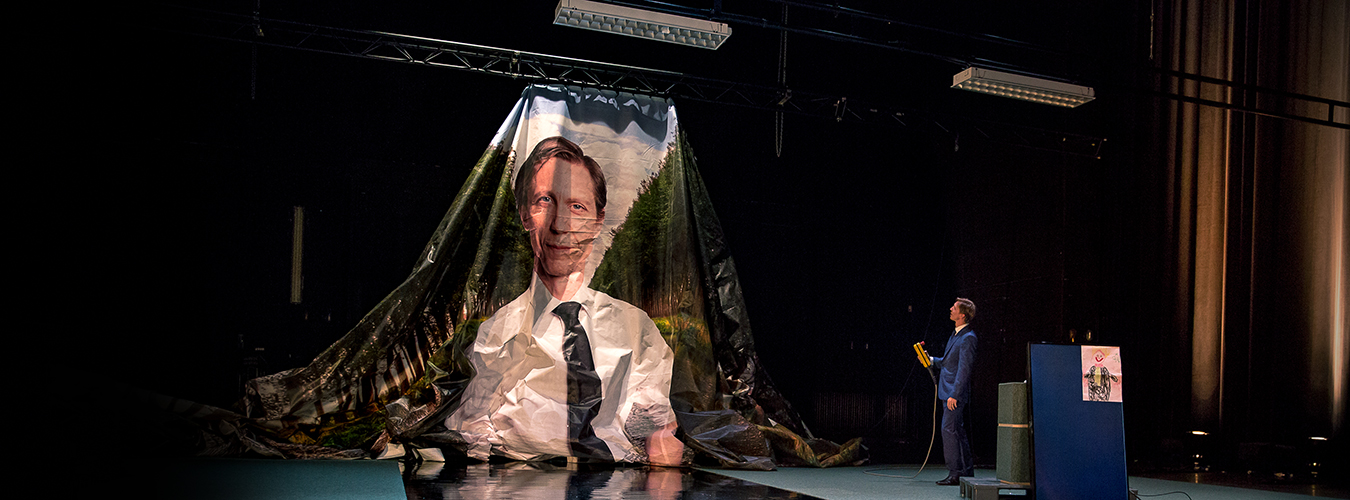
A silent space, a backdrop half-raised, the enormous printed face on it partly obscured, crumpled. Some plinths boasting nondescript plants. And bananas. A large portrait-shaped screen, looking like an enormous smartphone. A microphone. A man comes in. A fit-looking man in a smart, straight-legged deep blue suit, crisp white shirt, thin tie. His uniform. Business man? Politician? He taps the mic, smiles at us, takes a breath, and starts to speak – confidently, with energy and pace, addressing us directly, acknowledging our presence. He talks of anchors, and frames, and pillars. Level playing fields, and holistic roadmaps. Business as usual is not an option, he tells us.

Just as we are starting to think to ourselves that we have no idea what is actually being spoken of here, it is clever rhetoric without substance, a second voice from the air (or airwaves) interrupts. Political adviser? Campaign manager? Inner self? I’m not actually saying anything here, says the man, and we laugh. Switch. We see him on the screen, sitting in a pool, talking to a lover, complaining of the monotony of small towns, endless hotel rooms, loneliness.

And so it goes. We find out more, as we switch back and forth from live action to screen monologue. He’s a politician in the Blair/Macron mould. Young(ish), vital, lean, hungry. A touch of Obama. Kennedy, even. Taking calls whilst doing press-ups. Trying to solve the dilemma of whether his elder son should drop Latin. Singing Up On the Hill Lived a Lonely Goatherd to his younger son. Sitting in a lounge bar with his rival for party leadership, trying to persuade him to drop out of the race. Talking to rooms full of party loyalists on the campaign trail – could we put chairs up here on the stage with me, he asks. Practising his acceptance speeches. Having phone sex with his lover. Eating bananas (ah yes, the bananas…)

Valentijn Dhaenens, the writer and performer of Unsung, knows what he is doing. Everything that happens onstage is planned with dramaturgical precision and executed magnificently, from the excellent set design and use of props (white shirts in cellophane packages! bananas! plants!) to the snatches of music (Beethoven’s 9th!) to the clever switching from mic on a stand to radio mic to giant screen to regular phone. And what a performance – virtuoso. It’s very good theatre.

But there is a ‘but’. Unsung is far more of a straightforward play than the previous blockbuster BigMouth. The narrative is beautifully developed, but nothing happens that we wouldn’t have expected. The small local references bussed in (Cameron, Thatcher) feel awkward; and the ‘nobody loses any sleep over Europe’ line is a little cringy (the piece is stronger when it stays universal). And the key event – the politician’s embroilment in an extra-marital sex scandal – feels (sadly) rather dated in an era in which we have an unreconstructed pussy-grabber in the White House, with his rival for the presidency the wife of a sexual predator impeached for his behaviour. Real life these days leaves little room for satire or parody.

Yes, Unsung does what it says on the can, ‘unravels the DNA of the homo politicus’, and does so with enormous skill and panache. We see, and appreciate, the rise of the constructed persona and his lust for power, the flawed man behind the public face, and  – eventually – the genuinely caring political person he really is.

But to apply the Tom Morris litmus test: there must be surprises. When the play ends, we must have learnt something new, or had our perceptions challenged. There are no big surprises here: we learn nothing about politicians or politics that we don’t already know, and we need something more than a well-produced expose of things we already know. Like Valentijn Dhaenens’ unnamed politician, Unsung is good-looking, persuasive, clever, but flawed.

Unsung is presented at Edinburgh Festival Fringe 2018 as part of the Big in Belgium programme. 


Teatteri Metamorfoosi: The Sauna

On the dimly-lit stage, a figure moves around, sits herself on a plinth with a bucket. An old woman, naked, empty hanging breasts, a long sad face. The sound of water trickling and dripping and sloshing. As the light increases (slightly) we note that the figure is wearing an – intentionally, we presume – badly-wrinkled flesh-coloured body suit. As she is also in a full-face mask, we can take the body-suit to be a kind of whole-body mask rather than a costume. The lighting stays low throughout the show, which is wordless and relies on a very lovely soundscape of unusual instrumentation (chimes, bells, atonal cello scrapings) mixed with live Foley sound (brushing, scraping, clanging, slooshing) to provide the anchor for the action.

Another figure joins her – young, slim, carrying flowers. Crone, meet Maiden. Later, after the Maiden disappears, a third woman arrives – middle-aged, with ample breasts, rolls of belly-fat, and a chirpy demeanour. Hello, Mother. We gather that these three are aspects of the same woman, who is sitting in the sauna (a solemn, almost holy space in the Finnish tradition) contemplating her life as death approaches.

The notion that our bodies are temples for the soul, rather than our intrinsic selves, is tantamount to the work. Anyone who has reached a certain age – 63, say – can testify to the fact that inside they remain themselves all their lives, even though the body changes unrecognisably as the decades advance. The body, therefore, can be seen as a mask that covers the essential being. This is explored playfully throughout the show as figures turn around to show the large zip running down the back; body-suits are pulled on in front of the audience; and in one particularly memorable moment, a face-mask is slowly removed and placed on the ground, so that it becomes a death mask – the earthly remains of a now-free spirit.

Another figure is sometimes present: a ‘puppeteer’ in full blacks, creeping unobtrusively or sometimes dashing obtrusively around the stage, setting off smoke machines, or animating strange shapeless white ‘babies’. We realise by the end of the show that there are three female performers multi-tasking: Rina Tikkanen, creator of the live sound effects (the excellent music composition is credited to Maija Ruuskanen); Ilka Hartikainen and Johanna Kutala playing the woman at various stages of her life. The ’spirit of the sauna’ is free-floating…

Looking on the young faces taking a bow, I have a slight query running through my head about the validity of representing older women’s bodies in this way – the elderly and middle-aged body-suits certainly evoked sniggers from some audience members. But I decide, in the end, that what was intended was a sweet and thoughtful reflection on the female body at every stage of maturity, and that the gentle humour of the representations is fine. If we can’t laugh a little at ourselves, then what is left in life?

The Sauna is a delightful piece of word-free visual theatre, with an enchanting soundtrack – and it’s so good to see the tradition of mask work embraced by young theatre-makers and put to use in an unusual way.


The Sauna is presented at Edinburgh Festival Fringe 2018 as part pf the From Start to Finnish programme.


I’ll Be Your Mirror

 Beauty, Morality, Ageing, Power…

Theatre elder Dorothy Max Prior, young reporter/performer  Ciaran Hammond, and – placed somewhere between those two – artist and writer Zoe Czavda Redo offer a three-way reflection on Gob Squad’s Creation (Pictures for Dorian)

‘It is the spectator, and not life, that art really mirrors.’  Oscar Wilde, The Picture of Dorian Gray

Dorothy Max Prior writes: 

We have two days rehearsal. Two days! How is this going to work? This is a big show, in every sense of the word: a highly-regarded international company premiering a new work at the Brighton Festival; a cast of nine performers, three from Gob Squad plus six ‘local performers’; a whole load of kit, from large wheelie mirrors and revolving turntables to roving cameras trailing treacherous cables. Trust, we have to trust.

On day one, while the production manager Chris Umney, tour manager Mat Hand and the technical team of the Attenborough Centre for Creative Arts (ACCA) do the get-in, we are down below in a small rehearsal studio. ‘Imagine,’ says Gob Squad-er Bastian Trost, as we three older performers step forward to to lip-synch to Dalbello’s kitsch hit The Sins of Dorian, ‘that this is where you’ll stand, behind a large mirror, but the space will be twice this depth…’ Hmmm, I’m trying my best.


Gob Squad Creation: Brighton cast

Gob Squad Creation: Brighton cast


Some of us took part in the R&D stage of the process in late 2017, so have had a brief involvement in the devising process, and have gleaned some sense of the themes and intentions of the piece. Areas of investigation include: the nature and purpose of art; being on display; the human body as art object / a site of artworks; how we ‘frame’ what we see; self-image and identity; and – of course – ageing and how we deal with our ageing bodies. The guest performers are three older people (me plus two) who have spent a life onstage, known collectively as ‘the Roses’, and three younger people who aspire to a life onstage, called ‘the Daisies’. Gob Squad are also people who have decided to spend their professional lives being looked at onstage – currently mid-career and mid-life, average age 48.

Of the Gob Squad team here in Brighton, Simon Will and Berit Stumpf (and Bastian, who is off-stage this time round, acting as outside eye – there is no director) performed the show when it premiered in Berlin, but not Johanna Freiburg, who I’m mostly teamed with in this version of the show. We’re learning together, she says. In one scene, we three Roses are each behind a mirror, responding wordlessly to questions from Johanna such as ‘show me the face of someone who knows they are beautiful’ and ‘show me where the shame is’. The questions vary each time we run the scene – to keep us on our toes; to discourage us from learning a fixed choreography – but the final one is always the same: ‘show me the smile you had as a child,’ which segues into the cue for the next scene, ‘Max, do you still have that same smile?’. As Johanna and I face each other through the mirror, hugging it as one might hug a tree, I am pulled across the stage in a weird kind of waltz, each revolve of the mirror accompanied by a question inviting me to reveal personal details about identity, performance and the journey through life. Being born female in the 1950s, a tomboy childhood, finding my inner femme, working as a cabaret dancer, playing drums in the punk and post-punk years, mothering three boys… the conversation isn’t scripted, and the scene changes playfully each time we do it. Regardless of what decade we are in, it ends when one of the Daisies runs on with a shout of ‘Look At Me!’ countered with a Rose’s response of ‘Do You Know Who I Am?’

Two days on, we are running the show for the first time on the stage. It’s the dress rehearsal, and just hours before the premiere. I get through the run without tripping over any of the plinths, falling off a trolley, missing my light, forgetting the song, or being run over by a waltzing mirror. Hurrah! Because the Roses and the Daisies have been rehearsing scenes in separate rooms, I’m seeing some parts of the show for the first time in this dress run.


Gob Squad: Creation. UK premiere at ACCA, Brighton Festival 2018

Gob Squad: Creation. UK premiere at ACCA, Brighton Festival 2018


Wow, it all works! The mix of a fiercely choreographed movement of people and objects around the stage combined with the relative spontaneity of guest performers’ verbal and physical responses to instructions or questions is a good balance of fixed order and improvisation. The power and humour of the Gob Squad performers’ conversational exchanges and monologues is a revelation – we’d seen so little of this in rehearsal, partly because they’d held back, to keep the show as fresh as possible, and partly because the rehearsal period for the guest performers was so short that the focus was on our scenes and cues.

So now, a couple of hours later, we are back in our starting positions, Daisies and Roses sitting out of sight in the wings on a row of chairs stage-right. Johanna is at the back of the stage creating a flower arrangement. Ah no, sorry – it’s not mere flower arrangement, it’s Ikebana, a Japanese artform in which nature and humanity are brought together, the Ikebana Master creating displays that emphasise shape, line, and form. We hear the chatter of the audience, which gradually subsides as Simon, practicing his life-drawing skills, riffs with Johanna on the power of triangles in general, and the relationship between (A) artist, (B) object and (C) viewer in particular. Johanna is ruthlessly trimming all the leaves from a stalk, saying that she is helping the flower to be seen, improving on nature, because ‘being natural is simply a pose, and the most irritating pose I know.’  Oh yes, says Simon, five minutes in and we get our first Oscar Wilde quote! ‘I think this really needs a frame’ says Biarit, holding a gaudy gilt frame in front of Johanna’s flower arrangement, the image now projected onto a giant screen behind them –  a frame within a frame. ‘This is all very well, but I feel I need to work with a different sort of material, something more like this…’ says Biarit. And she walks over to where we are sitting, takes my hand, and we’re off, into the limelight, seeking the gaze.

 A wish come true

A fantasy revealed

By mirrors of the mind

Reflecting pictures of the soul…


Gob Squad: Creation. UK premiere at ACCA, Brighton Festival

Gob Squad: Creation. UK premiere at ACCA, Brighton Festival 2018


‘Experience is simply the name men give to their mistakes…’

Zoe Czavda Redo writes:

There’s a palpable frisson at ACCA tonight. I daresay all the theatre-makers in town are here, the older ones with spare cash in hand for the post-show debrief in the bar, the young ones making notes for their college papers. Gob Squad, the performance collective who (someone is whispering, someone else is writing) formed as university pals in Nottingham in the 90s and have been based in Germany since, come to the UK every so often as a refreshing easterly wind, ambassadors of a Berlin ‘air’ long after it was sold in bottles but before the birth of maybe a third of the audience. Their use of  – ‘irreverent!’ ‘contemporary!’– conventions (such as live camera feeds, unusual locations, and the mixing of professional and non-professional performers) is 25 years on, and now absorbed into the canon; the company trades freshness for mastery, and their latest show is – in part quite literally – a reflection on this. A controlled, sprawling, moving, and beautiful piece using mirrors, frames, plinths, humans older and younger, and flowers wilting live under a heat-lamp, brings Gob Squad’s own midlife crisis, the inter-generational encounter it provokes, and all the ensuing questions of freshness, liveness, ageing and self-regard to the stage.

 Creation (Pictures for Dorian) uses The Portrait of Dorian Gray less as a template, more as a palate; it’s more remix than reprise. In Wilde’s novel, famously, Dorian sells his soul to live a devil-may-care life while a magical portrait confined to the attic ages in his stead. Gob Squad plays with the Victorian vocabulary of flowers – star of the still-life – and portraiture, a means of preservation and archiving, in tension with artistic expression. As an accumulationist piss-take on the artistic process, as well as a poignant meditation on mortality, this piece feels messier and grander when it’s happening than its constituent elements would suggest.

It starts with an almost-bare stage, a single performer bantering with the audience, and adds elements gradually, starting with flower arrangement and extending the principles of Ikebana to the ‘locally sourced material’: three performers in their 20s and three in their 60s, at first compliant models to be directed and manipulated into works of art using frames and plinths, and the roving camera. The local material is not ‘raw’, exactly; all are professional performers (emerging or veteran) and used to being onstage and being looked at, a suspicion confirmed as they go past being arranged by the ‘artists’, and begin to offer narratives and perspectives, hopes and reminiscences of their own: a young girl reclaims her narrative on Instagram; the athletic Adonis creates movement sequences Biarit struggles to follow; an aged ex-dancer performs a version of the choreography that represents the pinnacle of his life onstage. Conversation seems unscripted, movement highly orchestrated. Performers, frames, mirrors, plinths, cameras – all seem to be gliding around the stage to rephrase themselves. Costumes are traded and exchanged, from Grecian sheet-robes to fantasy-futurist metallic getup; bodies create and invert relationships amongst each other by moving in and out of frame, behind and in front of mirrors.

Gob Squad’s pacing and deadpan humour work well in the weave of this live video; the stage itself is a mixture of behind the scenes and outside-the-frame,  a shifting series of small scenes-as-bouquets, continually melting towards, or rearranging, into something else. As expanded ikebana, it’s all happening before us, all under the light, and yet in the spaces where we aren’t looking, a sort of transformative magic seems to have taken place. We leave the auditorium softened and devastated. No one goes to the bar right away.


Gob Squad: Creation. A London Rose and a London Daisy prepare

Gob Squad: Creation. A London Rose and a London Daisy prepare


‘Be yourself, everyone else is already taken.’

Ciaran Hammond writes:

Southbank Centre’s Purcell Room: Sharon Smith stands at the back of the stage. She’s pruning a selection of flowers and arranging them on a table. ‘Ikebana’ she tells us. Co-performer Sean Patten draws a crude caricature of an audience member. Sharon tells Sean and the audience that Ikebana is a meditative practice that requires the person to appreciate each flower for what it is, and to avoid comparison and establishing any sort of hierarchy between the flowers. It is about the composition as a whole. These ideas, and others, surrounding Ikebana open up a conversation for exploring identity.

In exasperation with the flowers, the third Gob Squad performer, Bastian Trost, brings on six guest performers claiming he needs ‘A different sort of material to work with’, directing and positioning them on stage among potted plants, giant empty photo frames, mirrors and a camera – the live footage of which is projected onto the back wall of the stage. Three of the guest performers are in their late teens or early twenties, and the other three are in their late sixties and seventies. In the middle, we have Gob Squad. In the same manner that Sharon places trimmed twigs next to one another, the exposed and vulnerable guest performers are lined up, moved around and framed as art objects. Wearing skin-tight, pale body suits and hair nets, they are stripped down to their most basic and least defined; trimmed of unnecessary foliage. After bringing their guests back to a tabula rasa, Gob Squad use themselves and the guest performers to ‘find art’ by delving into what makes each performer who they are.

The piece explores both the core Gob Squad performers’ and the guest performers’ lives and personal traits through its autobiographical angle and distinctive non-actorly performance style. For a young man studying acting at Lancaster Uni, this is his first time on a stage in London. For a seasoned drag performer… well, he’s lost count. The guest performers are given brief introductions and are provided with tasks to complete throughout the performance, such as walking towards the camera ‘with the spirit of nature’ and being asked questions like ‘do you want to die on stage?’ and ‘what were the 70s like?’ The tasks and questions are designed to bring out a specific aspect of each performer, and are tailored to each performer with a level of specificity that significantly changes the piece depending on who the performers are. The performance’s structure and core ideas remain the same but its content changes drastically in each new incarnation. What holds the piece together, and keeps its identity intact throughout its different iterations, is the company’s core practice, as well as the ideas it explores: Gob Squad at this point in their careers have become well cemented in the postmodern performance landscape, often incorporating multimedia technology and a non-performative style into their shows. Their creative process is solid, and is framed within Creation as a living, breathing thing that is explored within the piece, in some ways as equally as the guest performers are explored.

The ideas that Creation explores have depth, are well developed and are open for interpretation within the performance, but due to the piece’s reshaping between iterations it is suspected that the process of essentially making a different – but quasi-identical – performance for each location has inhibited the performance’s development in more physical and technical areas. The performance feels unintentionally slow with the crescendos in energy, although well placed, feeling as though they are being walked through, lacking in an organic quality. This strips some parts of the performance of its sense of autobiographical truth and its non-performative nature. At times when the rehearsed parts of Creation stick out for what they are, the question of whether they’re rehearsed or improvised no longer exists for the audience and the performance loses a sense of mystery. This loss, at times, hinders the audience’s engagement with the performance and makes certain aspects of the piece feel disingenuous. When we can see the confessions of a performer as rehearsed, what they’re saying becomes merely another part of the performance, rather than a part of them and their identity.

The ambiguity and openness within the way Creation presents and theatricalises its performers makes them more alive on stage; what gives them strength as individuals, in the audience’s eyes, isn’t a rigid and easily attainable categorisation of their personalities, making them easier to comprehend. Instead, Creation shows constantly changing individuals, who with each movement on stage, become infinitely more complex, and is a soft reminder of perhaps how is best to observe our guest performers, and others, on and off stage.


Gob Squad: Creation, LIFT

Gob Squad: Creation, London premiere at LIFT


‘The truth is rarely pure and never simple.’

 Dorothy Max Prior writes:

I’m here to see how the show looks from the outside – but of course it is not the show I was in. Another time, another place, another show – performed by nine different people. For not only do the local guest performers change with each location, the core Gob Squad team changes too. Bastian, outside eye in Brighton, has taken Biarit’s role for the London LIFT shows. Sean Patten has replaced Simon Will as principal narrator and muser on conceptual conundrums. Sharon Smith has replaced Johanna Freiburg as Ikebana arranger and I’ll Be Your Mirror reflector on the naked female form onstage (although apparently it is Sarah Thom in this role in some of the London shows).

The form and structure is essentially the same – the order of the scenes, the mechanics of moving people and objects around, the live-feed video, the clever way of signifying a scene has ended once the artwork being created live has been named (the name, often an Oscar Wilde quote, scrolling up over the image on the enormous back-wall screen), and the central notion of having nine performers who represent a life on stage, past present and future. But the content feels radically different.

Of course, it goes without saying that I will feel forever wedded to the version of the show I took part in, and can never offer an objective view of Creation, but I will try my darnedest to bear witness in a fair and honest way to what is being offered here on the stage at the Southbank Centre’s Purcell Room.

A stage, I will say first of all, that seems a little small for all the things that are happening on it, particularly when all nine performers are onstage together, moving in and out of various groupings. I’m thinking particularly of a scene later in the piece in which all perform an ensemble score of repeated gestures, presented forward-looking to the audience ( if ‘yes’) and backward-looking to the mirrors (if ‘no’). From the third row, many of the performers feel a little too close to us for this epic, panoramic picture to really work. Was it thus in Brighton? I was on the other side of the footlights then, so can’t say – but I know that the Attenborough Centre has a particularly wide and deep stage, so perhaps not…

On the other hand, some of the more intimate scenes are truly breathtaking. Particularly, a three-way conversation between Bastian, a Daisy (‘Can I call you my past?’) and a Rose (‘Can I call you my future?). The combination of performers, and the particular content of this version of this scene is a beautiful thing. All three identify as gay, and a genuine echo-chamber is set up in which we clearly see, in an eternally reflecting triptych, the past, present and future of queer politics and performance, with Bloolips co-founder Stuart Feather’s revelations of the pioneering days of drag performance bringing a hushed awe to the auditorium.

It is also interesting to see how the different Gob Squad performers bring a completely different energy to the show. The strongest contrast is between Johanna Freiburg (Brighton) and Sharon Smith (London). For example, in the scene in which the nine performers stand in a straight line at the front of the stage, facing out, the audience invited to feast their eyes on this collection of humans who live to be looked at. As performers and audience silently mirror each other’s gazes, a woman performer removes her clothes as she returns the audience’s gaze. When that woman is Johanna, her cool, calm pose and unflinching gaze undoes the spectator, and there is a stunned silence finally broken by laughter when Johanna says, ‘They are all looking at me, you can go now.’ When it’s Sharon, there is a cheery throw-away attitude that makes for a more obviously humorous, less unnerving moment. The waltzing mirror scene also has a very different energy in this version: where Johanna and I stood nose-to-nose on either side of the mirror, arms outstretched in an embrace of mirror and each other, engaged in an intense, one-on-one conversation delivered with little regard to the audience, Sharon and guest performer Claudia Bolton (a former member of legendary 1970s women’s theatre group Beryl and the Perils) take the mirror in a one-hand grasp on either side, questions and answers swinging out to the audience with many a nod and humorous aside. Often, in this version of the show, there are winks to the audience and a feeling of knowingness that was pushed far less in the Brighton incarnation. I am sure that every incarnation of the show acquires its own special feel and form – it’s a piece that you could see again and again.

There are moments when some of the guest performers seem to have their responses over-prepared. This may be the inevitable result of this being day four of their run – familiarity has set in, and there might well be less spontaneity than on day one. Perhaps we similarly settled in too much as our Brighton run progressed – and I now completely understand why Johanna said to me, in response to a worried question about a cue, ‘I may well change what I ask you every night.’ I’m reminded of the old performance adage ‘no acting required’.

What I really get on the outside of this extraordinary piece of work is the sheer beauty of the show. Such utterly gorgeous stage pictures drawn and erased! From the auditorium rather than the wings, I can far better see the cleverness of the interplay of live and mediated image. And I adore witnessing the obvious rapport and complicity between the God Squad core team. I enjoy the way that every element of the show – costume, set, lighting, sound, performance – works harmoniously together, creating (yes!) an Ikebana arrangement in which balance and harmony is all.

Mostly, I appreciate being asked to think about what I am seeing. Where is the balance between objective and subjective viewpoint? Who am I watching most and why? Why am I drawn to one image and away from another? Who determines what is ‘good’ art, or even what is ‘art’.

Reflecting on both experiences, inside and outside of Creation, I ask myself: why do any of us crave the eye of the beholder? Is the present moment always our greatest moment? Am I happier to be (A) artist or (C) witness? I certainly enjoyed being (B) art object, relieved of the obligation to think too hard, try too hard, or take too much responsibility for the success of the show.

I’m in my mid-sixties now. It is probably true to say that there is more behind me than in front, onstage and offstage. How did I survive? Have I any regrets? I’m certainly closer to my death than to my birth. What will remain of me after I die? Does it matter? What will people do with all my belongings when I’m gone? And what about that painting in the attic – will they chuck it out with the rest of the clutter?

Though dreams may fade

The images remain

They find a secret place

To hide the terror and the pain

of Dorian

The Sins of Dorian…


Gob Squad: Creation (Pictures for Dorian)

Gob Squad: Creation (Pictures for Dorian)


 All images courtesy of Gob Squad.  

Quotes by Oscar Wilde. Song lyrics by Dalbello.

Gob Squad: Creation (Pictures for Dorian):

Concept and direction: Gob Squad (Johanna Freiburg, Sean Patten, Sharon Smith, Berit Stumf, Sarah Thom, Bastian Trost, Simon Will)

Guest performers (Brighton): CHUB RUB,  Holly Nomafu, Sam Longville, Dorothy Max Prior, Kate Dyson, Nicholas Minns

Guest performers (London): Claudia Bolton, Christina Brown, Lieve Carchon, Stuart Feather, Mike Narouei, Amelie Roch

The UK premiere of Creation (Pictures for Dorian) was presented at the Attenborough Centre for Creative Arts (ACCA) 23–27 May 2018 as part of the Brighton Festival. It was seen by Zoe Czavda Redo on 24 May 2018.

The London premiere was presented at the Southbank Centre’s Purcell Room 4–7 June 2018 as part of LIFT. It was seen by Dorothy Max Prior and Ciaran Hammond on 7 June 2018.