Author Archives: Dorothy Max Prior

Dorothy Max Prior

About Dorothy Max Prior

Dorothy Max Prior is the editor of Total Theatre Magazine, and is also a performer, writer, dramaturg and choreographer/director working in theatre, dance, installation and outdoor arts. Much of her work is sited in public spaces or in venues other than regular theatres. She also writes essays and stories, some of which are published and some of which languish in bottom drawers – and she teaches drama, dance and creative non-fiction writing. www.dorothymaxprior.com

A Good Catch: Casting Off

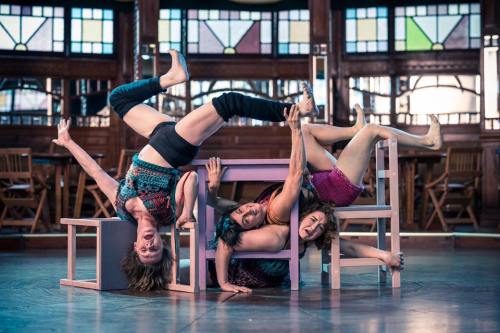
Three women of different ages, dressed in odd-bod multi-coloured knitted sportswear, make separate entrances, rolling, tumbling or running in from different parts of the Spiegeltent. They group around a table covered in a crocheted blanket. Two have chairs, one has forgotten her chair (she steals one from an audience member, giving him the blanket). ‘Hello ladies and gentlemen’ says one. Oh. Can’t we have something ungendered? How about using ‘ladies’ like some people use ‘guys’, to mean everyone? ‘Hello ladies!’ No, that’s not working. Ladies is so – genteel, upper class. What collective noun is there for a crowd of people? ‘Hello – crowd!’ All this whilst negotiating a stack of chairs and bodies moved into different alignments.

So right from the outset, the stage is set for what the next hour will contain. Challenges to gendered language. Snorting at stereotypical views of the female body. Sly humour. Clowning. Rumbunctious acrobatics. Hardcore circus skills weaved into a playful exploration of sexual politics.

Lists too – they like lists. Lists of things to do, for a start – recited whilst tumbling or crawling through chairs, or handstanding on tables – phone the dentist, book a handyperson to mend the toilet, buy almond milk and miso paste, take care of the kids, the dog and the dying cat. Life’s a balancing act. The chairs are now stacked up, and our three heroines scramble up and over them and each other as they give us their rendition of There Was an Old Lady Who Swallowed a Fly. One of the many joys of this gorgeous show is that there is no soundtrack – the physical action is accompanied throughout by a continuous flow of talking, singing, humming. Women’s voices making themselves heard.

Taking us on the journey are Knit (Spenser Inwood, at 29 the youngest of the three, acrobat, trapeze base and creator of the costumes); Slip (Debra Batton, 58, veteran performer of Circus Oz and director of Legs on the Wall); and Pearl (Sharon Gruenert, a 41-year-old Circus Oz acrobat and flyer). Although all come with extraordinary CVs and circus pedigrees – especially Debra! – this is their first show together.

More lists: I’m a perky dresser, says one. I never overshare, says another. I only eat when I’m hungry, says the other. Well, they’ve certainly been taking on board the advice fed constantly to women from magazines advice columns, blogs, vlogs, and whatever else.

The almost-30-year-old Knit (now perched in the roof-space on a metal cradle) wonders if people will take her seriously now. Slip asks if she takes herself seriously. Did you take yourself seriously at 30? We were older then at 30 than you are now, comes the reply. The serious conversation is interrupted by Pearl tearing through the auditorium on on a kiddie’s tricycle – upside down and with a balloon between her legs becoming her new head. Another joy of this joyous show is the use of the whole almost-in-the-round Spiegeltent space –  stage, thrust, aisles, audience…

Even more lists: juxtaposed lines of what seems to be family biography: ‘She was born as the war ended…’ ‘She got getting married and getting pregnant in the wrong order…’  As the racing round the space stops and the three women re-group on stage, the idea of generational wisdom passed down through the female line is manifested beautifully in a triple-tower, woman standing on the shoulders of woman, as mother, grandmother, great-grandmother are cited. Later, ’Live dangerously’ comes the advice, as three chairs and two tables are stacked up and mounted, topped off with a handstand. ‘Handstands make me happy’ says Slip.

Eventually, that cradle high in the roof space does get used for the anticipated aerial act – Knit and Pearl swing, fly and catch with breathtaking ease whilst Slip looks on, admiringly.

Casting Off is a joy: these three wonderful women have knitted together a truly extraordinary piece of feisty feminist circus that is fabulously funny to boot!


People Show: The Last Straw

‘I’m just going out to destabilise western civilization.’

‘Can you take the dog with you?’

‘Okay’

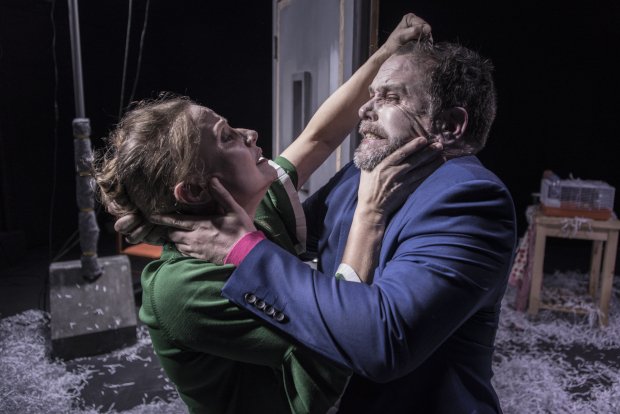
On the floor, shredded paper, strewn like straw. A door is freestanding in the middle of the space. It’s a nice shade of grey. African parrot grey. A woman in a green jumper and yellow shoes is looking at the door. Proper parrot colours. A man in a magenta jumper and blue-grey suit comes in (not through the door). He’s put on a bit of weight lately, someone has told him. Maybe she means you were looking peaky and now you look well, says the woman. She’s moving out, he says, nodding towards the door. She’ll never get her garden furniture into that Morris Minor, he says. Or her pets, she says. At least they agree on that much. The door opens. The door slams.

News. Fake news. Gossip. Tittle-tattle. Facts. True facts. Untrue facts. Yes. No. Yes. No. Your opinion. My opinion. His opinion. Where are The Philippines, anyway? She knows what sort of bonnet Anne Boleyn wore when she was beheaded, but she’s no idea where the Philippines are. He doesn’t know either. He does, though, know how to pronounce tapenade. It’s tap-en-ah-d. Tapenade (to rhyme with marinade) she says. Tapenade. No, no  it’s tapenade. The big man is always right. Or so says the woman. You’re always telling me I’m wrong.

He tells us a story, a parable. It’s a political parable. There are the bears, and there are the squirrels. Something’s got to change, think the bears. They meet. They encourage the squirrels to take over. There is change, then social unrest, then chaos. The bears step in. They can demand whatever they want, the squirrels are desperate for someone to sort it out. Meanwhile, she is telling a different story. A story about a walk in a park and a lost African Grey parrot. There is a notice pinned to a tree with a phone number. Call this number if you see the parrot, it says. What’s the point, she says. The parrot will have flown off by then. The story has two alternate endings. Two truths. The parrot is dead on the path, birds picking over its remains. No, the birds on the path are picking over a bag of chips wrapped in newspaper, the parrot is there, high in the sky. Yesterday’s news, today’s chip wrappings…

OK, so focus now. Focus on the truth. The true truth. The known knowns, not the known unknowns. But who’s right and who’s wrong? Can two different truths co-exist? Too much information. T-escape. Have a cup of tea then escape to somewhere lovely? No, no, no. Press T-escape. On your computer. Press T-escape to get out of your multiple windows. Academic research. Shopping for shoes with kitten heels. Something or other on YouTube involving people dancing in shoestring bikinis. Everything is intertextual these days. History doesn’t exist. Past, present and future are all here and now. Polka, any one? Don’t mind if I do. Maybe she’ll have the pets put down. Strobing lights. Ultra violet. Infra red. T-escape. T-escape. T-escape…

The People Show are England’s longest running experimental theatre collective. I first saw them in 1976, and even then it was People Show number 10. Now, we’re on People Show 130: The Last Straw. Working without writers or directors, each show becomes ‘an expression of whoever and whatever arrives in the rehearsal room on day one’. In this case, the people who turned up were performers Gareth Brierley and Fiona Creese (both longterm People Show artists). They had nothing. No text, no images, no ideas. They just had their in-the-moment responses to the world they find themselves in – a world of continuous news feeds, social media, tabloid headlines, and all the rest of the stuff that bombards us all, day in, day out.

From this empty space grew the show – a show bursting with ideas, sounds, images, and words which combine to make for an electric piece of absurdist theatre; structured in a supermarket-of-style, multi-layering, and over-lapping style that reflects the too-many-Windows-open-at-once world we live in.

The two performers give their all – talking non-stop, fighting, facing off, dancing – and are very ably aided and abetted by designer Jessica Worrall, sound designer Rob Kennedy and lighting designer Nigel Edwards, who have  created a suitably multi-layered, visually stimulating, and sonically rich environment for our two protagonists to live in – a world of their own.  It’s a delight to be invited into this extraordinary, funny and disturbing alternative reality for an hour.

Postscript: Don’t worry too much about the state of the world. The Man tells us that there have been six major extinctions so far in our earth’s history, and we’re heading towards the seventh. You’re welcome.


Canada, Mon Amour

‘Indigenous resilience. Three women running for their life. Separatist politics. A confrontation of toxic masculinity. And unrelenting puppet deaths. This is CanadaHub.’

In his introduction to the second year of CanadaHub, a curated programme of work from across Canada presented at the Fringe, producer Michael Rubenfeld warns against complacency in this most difficult of times. Yes, he says, cuddle up to Canada, which has become an ‘international beacon for reasonability and progressive social politics’ but while we’re cuddling, be aware that the country does have problems, and there are nuances.


Cliff Cardinal: Huff

Cliff Cardinal: Huff


Cue Huff by Cliff Cardinal, a one-man theatre show of the good old fashioned sort: by which I mean a show in which one person – the actor-writer – plays a multitude of characters, all enacted through skilled physical transformations. Although ‘skilled’ hardly does justice to the man’s extraordinary chameleon abilities, as he tells the story of a family caught up in a cycle of violence and abuse, from the perspective of a middle son of three. A hoodie up to become the psycho older brother who beheads hamsters and rapes his siblings; screwed-up eyes and shortened neck to become Rat Face, the hated elementary school teacher; a puffed chest to become the embittered father bursting with toxic masculinity; a bent back and lowered head to become the kokum (grandmother) who sees her daughter beaten and defeated, her youngest grandson following in his mother’s footsteps and committing suicide by hanging, and her son-in-law degenerating into even more of a drunken lout than he is at the start of the story. Yep, happy days. The setting is a reservation – the reduced status and social problems of the oppressed Indigenous people being one of the prime unsolved Canadian ‘problems’ that Michael is referring to.

There are times when the old-school physical and devised theatre device of having-a-conversation-with-yourself becomes exhausting, and I’m happier mostly with the longer monologue sections or the storyteller mode. But there’s no getting away from Cliff Cardinal’s immense talent as a writer and performer. Although a fictional play, the story is informed by Cardinal’s own research and inside knowledge of Indigenous communities in Canada. The Native American Trickster spirit is a key player in the story, the device of a radio broadcast is a recurring motif, bringing us messages from the Trickster: [crackling white noise] ‘This is shit creek radio, and you’re up it without a paddle.’ Cliff Cardinal’s storyteller pays him his dues, shapeshifting from role to role with superb ease…


Ming Hon: Chase Scenes

Ming Hon: Chase Scenes


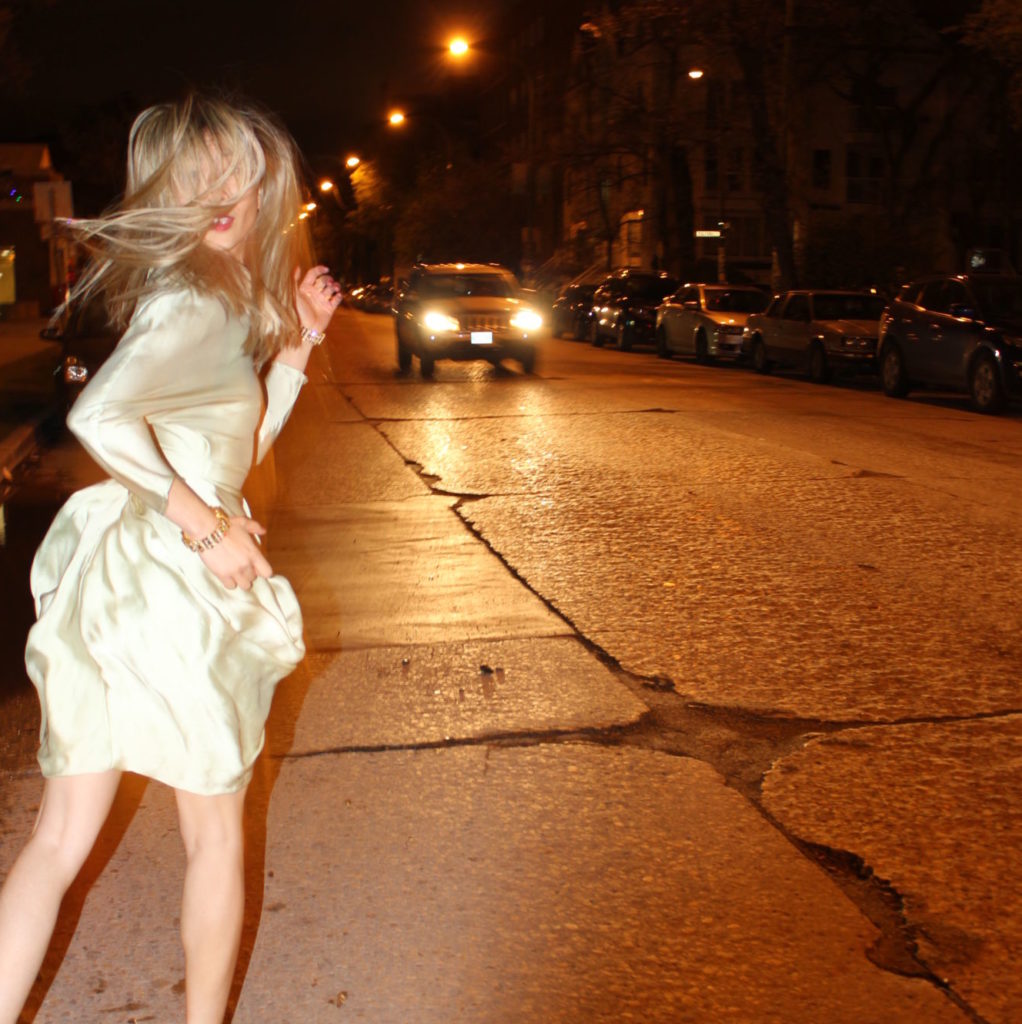
The Trickster (although a more playful manifestation) is also on the loose in Ming Hon’s Chase Scenes, in which three women performers take turns grabbing the camera and subverting the traditional male gaze on the female body in distress on film. You know, all those films in which women are chased or stalked or terrorised? All those films in which men perpetrate the bank heists and bomb plantings and car chases? The three women – Ming Hon herself, with Alexandra Elliott and Hilary Anne Crist – are tornados of energy who hardly stop to breathe for an hour – except when they film themselves or each other rapid breathing wildly after a particularly strenuous bout of running, jumping, or screaming. There are 60 one-minute scenes, and they segue manically from one to the other, swapping roles as camerawoman and actress; ridiculing the traditional female role of victim with gleeful enthusiasm and boundless energy (they are all trained dancers, and this is a supremely physical piece of work). It is absolutely, totally, brilliantly hilarious from start to finish.

In the first scene, The Park, two are behind cameras and one is acting. Running, basically – through the space, on the spot. There are two screens at the back, one showing pre-recorded film (footage of the woman walking ever-faster through the park, glancing behind her in increasing panic), one showing the close-up shots from the live video feed. This is the pattern for many  of the scenes – we get to see footage shot in a multi-storey car park, an alleyway (Dead End), a stairwell, the outside part of the hall we are in…

Stolen Goods, Gunfire, Bomb, Axe, Cops and Bedside Weapon are some of the scenes dealing with classic tropes of thriller or horror film. Nature is a recurring theme – in, for example, Fog, Blizzard, Jungle, Forest and Desert. Every cliched sound and vision effect you can imagine is employed: smoke machines, waved greenery, Foley wobble boards as instant wind machines. The stage area is a ridiculous, beautiful mess of costumes, props and mini-sets (a mattress, a table and chairs) and clothes are ripped on and off with gay abandon.

Outside of the horror/terror/thriller mode, other types of chases and dashes are explored: Late to the Gate sees our one-minute heroine dragging a large suitcase around the space, howling as she misses her plane; Parkour has her literally climbing the walls of the theatre to end up dashing around the balconies. Heroine/Body Double has one woman filmed from the waist up as she runs on the spot effortlessly in trainers; the other filmed from the waist down as she trips along in her high heels. There are some really weird ones too, that move beyond the regular running and chasing, such as two different Nightmare scenes that show pre-recorded footage of a sleeping woman tossing and turning in bed whilst live she enacts what she thinks is happening to her body. (Her legs don’t exist! Her feet are stuck to the floor!).

Chase Scenes is a very clever deconstruction of the mores of Hollywood film, a brilliant role-reversal game, and a Trickster-Clown play on our worst fears.


Ming Hon: Chase Scenes. Photo by Dahlia Katz

Ming Hon: Chase Scenes. Photo by Dahlia Katz


Also in the 2018 CanadaHub programme: there’s another humorous exploration of death and disaster in The Old Trout Puppet Workshop’s Famous Puppet Death Scenes; a Scottish/Quebecois collaboration, First Snow/Premier Niege, which uses the separatist politics in both Quebec and Scotland as a backdrop for complex family drama; and a harrowing exploration of toxic masculinity, Daughter, performed by Adam Lazarus. The venue (Kings Hall, just across from Summerhall, who are partners in the project) also hosts CanadaClub for the first time – late-night club featuring Canadian comedy, circus and cabaret.

It’s great to see CanadaHub thriving and growing in its second year, and good to see a selection of Canada’s innovative new performance work finding its way on to the Edinburgh Festival Fringe.

CanadaHub runs 1-26 August (not Mondays) at Kings Hall. Bookings through Summerhall or at: www.canadahubfringe.com

The Old Trout Puppet Workshop: Famous Puppet Death Scenes

The Old Trout Puppet Workshop: Famous Puppet Death Scenes


Circo Aereo/Thomas Monckton: The Artist

The team that brought us The Pianist are back with another one-man physical theatre tour-de-force performed by Thomas Monckton, a New Zealander who trained and lives in Finland, working in collaboration with Circo Aereo. (The Artist is presented as part of the From Start to Finnish programme.)

Then, the trials and tribulations of being a concert pianist; now, the angst of creation as experienced by a smock-wearing painter trapped in his garret studio, trying to catch drips from the ceiling in his tea cup: The Artist could be described as The Pianist meets Tony’s Hancock’s The Rebel. (In between, we’ve also had another Monckton show, Only Bones, come to the UK – but that is a very different kettle of fish.) The Artist brings us a similar premise and construction to The Pianist. The classic clown situation of being trapped in one room. The ongoing battle with inanimate objects – specifically, the tools of the artist’s trade. The beautiful stupidity of human ego and endeavour.

The piano, curtains, music stand and sheet music are here replaced by easel, table, paint and brushes. Frames and framing as a motif are returned to again and again throughout the piece. A couple of unruly pieces of wood take ages to transform themselves into a square frame – they prefer life as a Picasso-esque rhomboid. The staple-gun employed to fix cloth to frame fights back, stapling the artist’s sock to the frame. The need to reclaim a jar of brushes from a top shelf is the cue for a gorgeous classic clown routine with shelf, table and trick ladder that shows off Monckton’s very able acrobatic skills. For although the circus skills are subtly integrated into the piece, rather than being at the fore, they are very much there – Monckton is a highly trained and very able physical performer.

The show teams with clever references to art and art history, and exploits the mores and cliches of the artist-starving-in-a-garret stereotype. The classic still-life display of a bowl of fruit, a wine bottle and a glass becomes the site for an extended and very funny object animation scene, in which a banana is admonished for being naked, and an apple gets painted red to match a ‘here’s one I made earlier’ painting. There’s also a number of audience participation scenes handled expertly – including an exuberant ping-pong game, and a scene in which a model is chosen from the audience, then made to swap roles with the artist. She’s conveniently matching Monckton’s beatnik blue-and-white striped French T shirt, but I am sure she wasn’t a plant!

Timing, rhythm, pace are all crucial in clown and comic physical theatre of this sort, and Monckton is a master. Some things are speedy, almost throwaway (after the long saga getting the brushes down, he finds he had one in his smock pocket all along). Some things are played slowly and carefully ( at one point he leaves the space empty as he goes to fetch a new canvas, this morphing (ha!) into a lovely Tony Hart / Vision On moment of live painting.)

The ending is delightful, as the space is transformed into – no, I won’t say. Go and see!

What a joy, what a pleasure, to see clown and physical theatre of this quality. The Pianist, The Artist – what next? This surely has to be trilogy.


When Circus Meets Theatre

Casus, The 7 Fingers, Paper Doll Militia, and Jess Love – all are circus artists exploring the interplay between circus and theatre, all in very different ways, as seen at the Edinburgh Festival Fringe 2018 by Dorothy Max Prior

So, you’re a circus artist or company. Do you make shows that are pure circus, – a series of acts, perhaps pulled together thematically, but without an overarching narrative – or do you aim to make a show that tells a story?

Let’s say straight away that the body always tells stories. Even the most straightforward circus show contains mini-narratives in every act. Bodies are gendered, of a specific age, bearing evidence of their culture and experience in life. And circus acts are intrinsically theatrical. There is no more drama and conflict possible live on a stage than that which occurs when a human body goes up against another body or a piece of equipment. And we, the audience, construct narrative all the time. We see a large male body throw a slight female body in the air then catch her, and that says something to us. (Not necessarily the same thing to all of us!) We see a woman carry a man on her shoulders – another story.

But let’s go beyond the assumption that narrative is everywhere and look at what happens when a circus-trained artist or company chooses to create a show that, as well as telling myriad tiny stories, also has one big narrative or major theme to explore, integrating circus skills and storytelling. Four shows seen at the Edinburgh Festival Fringe 2018 do just that. Interestingly, all four use autobiographical / biographical material.


Casus You and I


Casus’ You and I is devised and performed by two of the company’s co-founders, Jesse Scott and Lachlan McAulay, who have taken the (some would say brave) decision to explore their real-life relationship onstage. The show is a very welcome addition to the company’s canon, and the circus skills on show are of the same superbly high level as seen in this ace Australian company’s previous works, Knee Deep and Driftwood. The set evokes a homely interior – a big wooden table, a rug, a side-lamp, a trunk. These two have a beautiful chemistry and complicity – they have worked together as base (Lachlan) and flyer (Jesse) for many years and that experience shows in everything they do. Learning that they are partners in life as well as work adds an emotional frisson to the honed perfection of acrobalance/hand-to-hand duets that explore push and pull, give and take – relying completely (of course) on trust and closeness. We are also treated to a stunning solo trapeze piece by Lachlan that seems to explore the tug between the need for togetherness and solitude, and (towards the end) a doubles trapeze act to die for. Theatrically speaking, there are some good choices and some not-so-good choices. The use of tango as a recurring motif representing their personal passion is a great idea, but the dancing is stiff and unyielding. On the other hand, a disco-dancing scene in which the trunk is unpacked and the men explore the cliches of gay masculine identity, pulling on and off sparkly dresses, sailor suits, sequinned shorts, and black vinyl harnesses, is beautifully enacted. It is often the small, quiet theatrical touches that give You & I its power as a piece of circus-theatre – the two lying spooned together or piggy-backed, holding hands, or one stepping back and sketching in a journal while the other one takes the stage. A slow and gentle tumbling scene using flashlights is a particularly gorgeous moment.


Reversible hoop


Les 7 Doigts (The 7 Fingers) hail from Montreal, and are firm favourites at the Edinburgh Fringe, having first captured audience’s hearts with Traces. Their latest show Reversible is here receiving its UK premiere. It’s an episodic narrative, telling stories of immigration, hard labour, housework, selling yourself body and soul, changing identities, mail-order brides, settling in to new lives, troubled romances, street-life hassles, and friendships. The stories are harvested from the nine performers’ own family histories – at the heart of the show is the notion that where we come from (historically, geographically, genetically) makes us what we are; and that above all, that we all need to feel that we ‘belong’ somewhere. The notion of ‘home’ is never far away. ‘We are not that different…’ says one performer into the mic. (This soulful taking turns on the mic is very much a & Fingers thing!) The set is a large structure of four moveable blocks/walls that make a row of house exteriors or interiors, or any combination of those needed for any one scene. We have exquisite circus skills – soft and sumptuous balances on canes, fluid object manipulation in which juggling meets dance, some fabulous teeter-board that emerges from behind the houses (so at first we think it might be trampoline), and some breathtaking Chinese pole work in which two couples (male, female) swap in and out seamlessly. Oh what a pleasure it always is to see women on Chinese pole, traditionally the most ‘masculine’ of equipment.

The acts are embedded within the stories – sometimes words are spoken to-mic, sometimes there’s recorded voice, often just music with the narrative living in the performers’ bodies. Each circus set piece evolves from physical theatre work that often echoes that of Lecoq-trained companies such as Gecko – group ensemble exploring hero-chorus; clever movings in and out of doorways or windows or through pieces of set that are in the process of transformation. Sometimes the scenes are straightforward in their meaning (a man works with a German Wheel whilst we hear the story of his grandfather’s life on the treadmill); we here the song Life Goes Down on the soundtrack as someone steps back from the washing line to keeps all the balls in the air. Others are more oblique – such as a lovely little interchange between a Spanish-speaking woman standing outside a doorway with a handbag full of keys and a silent broom-wielding man. ‘Donde esta mi llave? a no, yo tengo una otra…’ as she flings them all to the ground. Keys have such significance – our security and all our notions of ‘home’ held in these tiny pieces of metal.

Reversible is a truly delightful integration of circus and ensemble physical theatre work. The ending is a little too cheesy for my taste, but I’ll forgive them that.


Egg sarah


At the other end of the production spectrum is Paper Doll Militia’s Egg – a small-scale aerial-theatre piece by Sarah Holmes, who has written the show, and performs it accompanied by musician/composer (and occasional onstage performer) Balazs Hermann. It is a highly personal and thought-provoking exploration of female fertility, sexuality and choices in parenthood. The question asked, throughout the piece and in numerous ways, is: What does it take to make a baby? Good timing? A drunken night? The right partner? The right body parts? What if it doesn’t happen; if no amount of planning or choosing results in the desired child?

Meet Carole and Sarah (who may well be a younger Sarah Holmes, as this is a true story, although one doesn’t like to assume). Carole desperately wants a child, a desire that drives her to an agonised rant against a young mother in a park who is smoking and feeding her baby Coca Cola. She knows she’d be a far better mother! Sarah is her best buddy, and there comes a point where Sarah agrees to donate her eggs to Carole so that she and her husband can have the baby they are so desperate for. She may as well have them, I’m not going to use them, says Sarah.

The story is told using very adept aerial work, live music (double bass, guitar and electronics), a clever visual design cum installation (using cellophane, clear plastic and perspex, and a range of black and white shiny patent shoes), multimedia (some very lovely projected animation onto the double bass, for example) and spoken text. It’s this final element that is the most troublesome, for although the story of the two women’s journey, and the interweaved facts and theories about fertility, are highly interesting and informative, the text is a little overwritten, and its delivery not as strong as it could be. Sarah plays all roles, mostly – Carole, Sarah, the doctors and nurses, the consultants – with an occasional walk-on part as silent husband or doctor for Balazs. But the physical work is really strong and staged in an innovative way that dramaturgically links very well into the subject of the piece – images of eggs, ovaries and foetuses abound.

We enter the space to see Sarah cocooned inside a pod of water, and later we get a silks-style aerial section using two enormously long swathes of polythene that end up wrapping her like an embryo; a rope scene using bunches of plastic cords that look like giant catheters or intra-venous devices; and there’s a really disturbing contortion into a perspex box. When she lies curled up in foetal position on a white plastic disc on the floor, howling in agony after the removal of her eggs, we really and truly feel her pain, and recognise the extraordinary gift she has made to her friend. It is in this physical work that Sarah excels. I feel this might have been stronger as a two-woman piece, taking the pressure off Sarah to be (almost) everything at all times. Or if she really wants to be the only woman on stage, in multiple roles, perhaps a reduced text and/or more use of recorded text/sound in some scenes would have done the trick? Regardless, an adventurous and highly interesting piece of work from one of Scotland’s best aerial artists.


Jess-Love-Bingo-Press-image_NSDG_Credit-Brig-Bee-Photo-850x455


From Scotland to Adelaide, and the exuberant and rambunctious Notorious Strumpet & Dangerous Girl. The ‘notorious strumpet’ is Julia Mullins, a thief, prostitute and drunk who arrived down under as a convict; and the ‘dangerous girl’ is her great-granddaughter Jess Love a ‘Carnie and a a queer’ who likes a drink. Likes a drink a little too much, in fact, and the show is framed as an AA meeting. There’s tea and biscuits as we come in, and Jess starts the show with ‘My name is Jess Love and I’m an alcoholic’.

What follows is a high energy take-no-prisoners exploration of life on the road as a circus and cabaret performer who stretches herself so far to the limits and takes so many substances into her body (banned and otherwise) that she is on the brink of death on numerous occasions. The integration of the harrowing autobiographical confession and the circus work is excellent: Jess doing a hula hoop act that descends into  a staggering burlesque number; Jess drunk and disorderly on the trapeze (a perfect demonstration of that difficult art to master, clown trapeze); Jess balancing along a row of champagne bottles. Jess is a highly personable hostess, and deals with her audience interaction confidently.

But there are some things that could be better. The structure sags a bit. We seem to be coming to a conclusion, then it all starts up again and the drunken lurching starts to become a little tiresome. A bingo game (on DNA) feels a bit pointless  – and let’s be honest, there have been enough bingo games and gameshow motifs in contemporary theatre to last us all a lifetime. We are introduced to the marvellously debauched and feisty great-grandmother Julia via a screen interview with an expert on the Tasmanian penal colonies – but having met Julia, I wanted more of her.

So not a perfect show – it feels like it could take a few cuts and tweaks. All in all, though, a great example of how circus skills can be employed in the dramaturgy of a theatre/cabaret show to great effect.


 Featured image (top) is The 7 Fingers: Reversible.

Casus: You and I was seen at Assembly Roxy on 11 August 2018.

The 7 Fingers: Reversible was seen at Assembly Rooms on 11 August 2018.

Notorious Strumpet & Dangerous Girl was seen at Summerhall 10 August 2018.

Paper Doll Militia: Egg was seen at Summerhall on 1o August 2018.

All shows are presented as full runs at the Edinburgh Festival Fringe, 3–26 August 2018. See www.edfringe.com for full details or to book tickets.