Author Archives: Dorothy Max Prior

Dorothy Max Prior

About Dorothy Max Prior

Dorothy Max Prior is the editor of Total Theatre Magazine, and is also a performer, writer, dramaturg and choreographer/director working in theatre, dance, installation and outdoor arts. Much of her work is sited in public spaces or in venues other than regular theatres. She also writes essays and stories, some of which are published and some of which languish in bottom drawers – and she teaches drama, dance and creative non-fiction writing. www.dorothymaxprior.com

Chaliwate Company/Focus Company: Backup

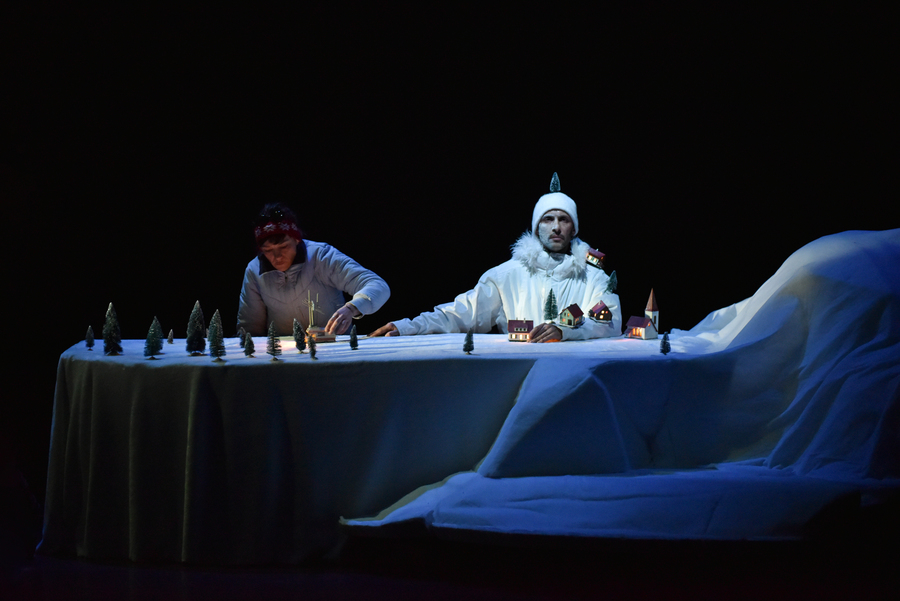
The North Pole. 4am. A van is travelling across the tundra. We see this enacted in an exquisite sequence of object manipulation. A human body forms the snowy landscape and the little van pops up on the undersole of a foot and travels along the body. Tiny lights and miniature houses complete the scene.

Switch. The point of view is now close-up on the occupants of the van, three reporters. The van is a 2-D door held up as the three bounce along. One is smoking a cigarette out of the window of the van, the window going up and down. It is touches like these that really make the performance – excellent, finely detailed physical theatre work from the three co-creators, Julie Tenret, Sicaire Durieux, and Sandrine Heyraud.

Switch. They’re now out of the van, on the tundra. (They’ve moved in front of the puppetry table, in very close proximity to the audience.) A TV crew, we presume from the cameras and boom mics being wildly swung around and repositioned. They are clambering over each other, sitting on each other’s shoulders as the ice makes menacing cracking noises…

Switch. Point of view is now what the camera sees… relayed onscreen in one of the cleverest integrations of live and screen work I’ve seen for a while.

Switch: The camera is nestled beneath the paws of an enormous polar bear. Cue a very beautiful puppetry section, the three performers now manipulators, and proving that they are equally skilled in this department. And then – it ends.

Boom – 30 minutes of gorgeous physical and visual theatre, then gone. There’s something of a delight in short-form shows for Ed Fringe audiences – allowing people to pack in even more in a day. And it’s good, as an audience member, to leave feeling you want more. In a way it works narratively –  think of it as a short story, perhaps. But I leave feeling unsatisfied with the brevity of the piece – this offset a little by the company’s announcement at the end that they are working on extending the piece. Well thank goodness for that!

I do want to see what the company make of the challenge to create a full-length show, and hope that the work does eventually come back to the UK in its finished form. In the meantime – bravo! Quality physical and visual performance, and practically word-free, delivering narrative through image and physical action.

It is a delight to see such skilled puppetry, object manipulation, and comic physical performance wrapped up tightly into such a neat bundle. Backup is a sweet little tidbit that whets our appetite for more.


Nina’s Drag Queens: Alma, a Human Voice

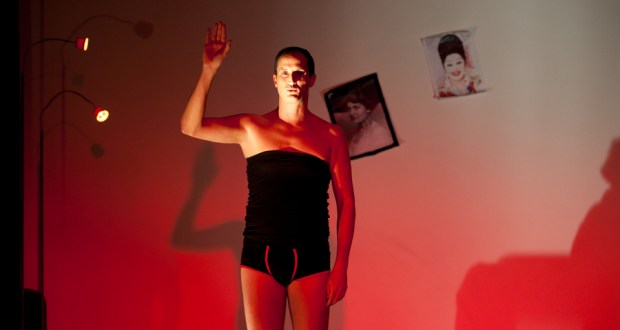
A person (male body, female presence) enters the space with a suitcase. Clothes are laid out ceremoniously – a white silk kimono, a pink satin dress, a tasteful 1920s style blue sequinned number. A sweet little black velvet hat goes on: the performer now seems most definitely gendered as female. A mid-2oth century push button telephone is pulled out of the case, the handset on its wire dragged across the floor. The light is ‘garish’. It is, says our storyteller, a ‘mediocre’ crime scene.

The phone rings. Hallo, Hallo? We only hear one side of the conversation, the actor’s voice segueing into a recorded voice that may well be Ingrid Bergman: this nameless woman driven mad by love is the subject of Jean Cocteau’s poetic drama La Voix Humane, and Bergman played the role in one of the many film versions. Is there any difference between a man waiting for a call and a woman? The actor muses on how to portray ‘waiting’ in a theatrical rather than ‘psychological’ way. Smoking would be the obvious answer, but s/he doesn’t smoke…

But there is another woman in the room. Alma – Austrian composer, wife of musician Gustav Mahler. She was also the lover of artist Oscar Kokoshka, and it is his crazed love for her that is the other major thread of this story. The two demented and desperate lovers – Cocteau’s woman waiting for the call from her lover, and the artist Kokoshka – vie for attention over the next hour, in what is a beautiful piece of solo theatre that wears its thorough research of the early 20th century European art milieu and its intelligent exploration of what it is to be artist and muse, lover and beloved, with beautiful bearing and panache.

Presence and absence are key motifs: the nameless woman’s lover is never heard – we only get her voice. Alma is not represented in any sort of naturalistic way – she  is viewed through other’s eyes, either the storyteller’s or Kokoshka’s. The clothing placed on the floor or chairs takes on the role of the absent ‘professional muse’. She is brought to life through writer/performer Lorenzo Piccolo’s drag queen homage to her. There is an extraordinary and truly wonderful story – can it be true? – of Kokoshka commissioning a giant doll in the image of his lost love. ‘Inside this doll is no soul but all my art’. The doll is conjured beautifully by the performer donning first the pink satin dress, teamed with white shoes and a curly wig – but then, as Kokoshka’s relationship with the doll deteriorates into murderous hatred and resentment, swapping in to a pink net tutu and ultra-false white furry breasts to dance manically to the Italian kitsch pop classic Bambola. Alma (and doll Alma) also appear to us in shadow theatre form on the back wall, a beautiful visual image created using the dress and wig, on and off of the human body.

So another key motif is the ‘real’ and the ‘fake’, as befits the artistic journey of Nina’s Drag Queens, a company dedicated to creating theatre using drag queen aesthetics and characters. Most obviously, ‘real’ woman versus ‘fake’ woman (doll, drag queen, fantasy lover). A male actor unpicking femininity may ring alarm bells to some in the current climate of complexity around gender issues, but as a self-declared femme feminist, I’m delighted by what I see here: a very clever and beautifully realised exploration of the tropes of ‘woman as victim of love’ and ‘woman as muse’.


Rosy Carrick: Passionate Machine

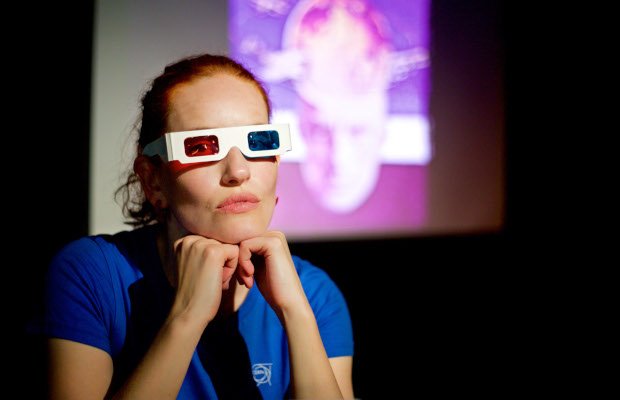
Time travel! Yeah yeah yeah. Sci fi. Hang on, just think about it. That note on the fridge: Buy Milk. It’s an instruction from a past self, time travelling into your present reality. And when you fell asleep last night and slept a straight eight hours – isn’t this a kind of suspended animation, allowing you to hurtle forward in time from one day to the next? Every time you open an old diary, or read a letter you wrote decades ago – isn’t that a wee wormhole back into the past? Don’t we all time travel all the time, at varying speeds?

And so Rosy Carrick eases us in gently to the notion that travelling through time may be something other than the wacky quantum physics /sci fi territory of Steins Gate theories, black holes, and tachyons. Oh but having seduced us in, she then gives us the quantum physics alongside a declaration of her love of Bowie and Rocky and every film ever about time travelling, and a delightful exploration of how we can all learn from our path selves, and project optimism and hope to our future selves…

Rosy is a highly personable host, and the calm confidence and smart humour of her storyteller is exactly what you need to to be brought onboard the good ship time travel. There is no acting required or involved (thank the Lord) – hers is an embodied performance mode that presents this Rosy here before us, and the many other past and possibly future Rosies we meet in this thrill-filled hour, without the artifice of over-emoting, or stepping into the shoes of other characters in the story. Frankly, it’s a relief – so many solo autobiographical theatre pieces struggle to find the mode of storytelling most effective for the telling of the tale, and Rosy gets it just right, leaving us delighted to have heard so much about her life, rather than squirming in our seats, embarrassed about the over-sharing, as is too often the case with this genre of work.

She’s a very clever and resourceful young woman, having (amongst many other achievements) written a PhD on the work of the Russian poet Mayakovsky, and overseen the translation of his work into English – but she wears her learning lightly, and the Rosy who gets too drunk too quickly and sends sick selfies to her friend James is just as important a character in the story, as is the Rosy who got pregnant when still a teenager and raised a daughter as a single parent, and the Rosy who became obsessed with the CERN Large Hadron Collider… cue Nick Cave’s Higgs Boson Blues.

All of these Rosies live out their parallel lives in the multiverse that the Rosy in front of us creates so elegantly on stage. Her setting is a simple one – a suitcase, a video screen, a table. On the table, a laptop, on which Rosy exchanges emails with a mysterious stalker Year Solver; books, including a precious gift from Mayarkovsky’s daughter, herself a wormhole allowing Rosy to experience early 2oth century Manhattan (Rosy steals some of her hair in the hope of one day cloning her); and photographs (another form of time travel) of the people that have inspired her, these portraits turned over one-by-one throughout the show. Mayakovsky, of course. And David Bowie, whose lyric line ‘Oh no love, you’re not alone’ pulls her through difficult times long before she has even heard of Bowie – first encountered as scrawled graffiti on a wall outside a public library when a 7-year-old Rosy was sexually harassed by a much older boy. Cue Bowie’s Rock n Roll Suicide.

Letters written to yourself are the key motif of the piece – these taking many forms. A very young Rosy’s promise to ‘always look after you’ written to her future self is  heartbreakingly beautiful. There’s a clever, twisting story weaving through the whole piece about a letter that might possibly have been written by a future Rosy who’d time travelled back to just before Mayakovsky committed suicide to contact the present Rosy…

So, on this stage in which past, present and future collide, Rosy cleverly manages to unite all these threads, solve a few mysteries for us, and even to dance on the steps in front of the Philadelphia Museum featured in Rocky III. Who wins? Rosy!

Featured image (top): Photo by Sharon Kilgannon


rosy-carrick-passionate-machine-702x468


Recirquel: My Land

The light is dim (an amber glow), the stage is empty, and seemingly bare – but no, the floor is strewn with sand.  We are in a desert. We are in the land of the archetypal. We see one young woman, and a group of men – shadowy hooded figures. Nomads, ancestors? Who she is we never really know – she is ‘other’ in this land of men, existing as a foil.

A figure, almost-naked, in a sand-coloured loincloth, kneels, and scrapes patterns in the sand to reveal a mirrored surface (cleverly created with a glass floor lit from below). Narcissus? At the rear of the stage, a wobbling mirror-board reflects and distorts. Now there are two men, mirroring each other perfectly, then exploring the dynamics of mirroring, shadowing and complementing each other’s movements. Their hand-to-hand work is deliciously slow and smooth. Somehow, the base man rolls and slithers and twists and turns on the sand as he supports his partner. They make a perfect head-on-hand stand, limbs extended, stair-shaped. They are on the floor, both in yoga child-pose, one on top of the other. Such skill, such beauty.

The stage space opens up in depth, a harsh light from the back silhouetting the elusive woman and the hooded figures, who all enter, kneel, slapping their hands on the ground in time to the heavy drumbeats. The woman retreats, the loin-clothed men leap and tumble in a frenetic dance-off. Walk-over splits, cartwheels, back-flips galore. Then there’s just one man – the hero, the loved one. He embraces the woman; others try to tear them apart. There’s a brilliant  play-off between the hero and his challenger; a fluid, flowing juggling and dance sequence, almost capoeira, slowly building up from one ball each to two to three to…

We next meet the woman duet-ing with one of the other men. She treats him with sisterly love, he mostly does his own thing. He’s an extraordinarily talented contortionist, his body bending into unbelievably flatness. He arches back into an ultra-tight bridge that makes him look like a bent-over playing card. She handstands on his reversed-over body, in perfect balance.

The highlight of the show is a gravity-defying ladder act by Sergii Materinskyi – a breathtaking dance to the sound of a Hungarian gypsy violin. (Recirquel are from Budapest.) The ladder and the human body waltz and whirl together, the ladder somehow staying upright, the performer weaving his body in and out of the rungs with spectacular ease. This violin track is in a rather different mode to the rest of the soundtrack, which has an epic, cinematic feel and features Moldovan chants and Tatar folk tunes mulched into the symphonic musical melange – in  keeping with the company’s mixed Eastern and Central European background – although the company is Hungarian, but most of the performers in this show are Ukranian.

My Land is a beautifully designed, lit and performed – this is a show demonstrating an extraordinarily high level of circus and dance skills, which are employed to explore and portray archetypal images from our collective unconscious: the power of the tribe; brotherhood and brotherly love; competition for the beloved ‘other’. Mankind, essentially. Or Manhood, at least. The ‘Land’ of the title is less a land of humanity than a land of men, and my only complaint against the show is the lack of a female presence with any agency. Perhaps, for that reason, better to have been an all-male show?

That aside – a gorgeous example of the merging of top-level circus skill with  brilliantly realised scenography, and a strong dance sensibility.


Kriya Arts: Sisterhood

‘Come now, come now, each woman and girl…

Take your courage, as the flames they curl.

We may burn at the hands of some men,

But from that fire we shall rise again!’

This song of the female phoenix starts and finishes the show – and on second singing, we are urged to join in. It’s time to awake our sisterhood!

Sisterhood is a three-woman show that aims to be part of the movement to ‘challenge patriarchy, create change, and begin to heal the wounds of the witch trials’. This quote is taken from the book Witch, by Lisa Lister, cited in the programme, and a major influence on the work – as are the writings of Julian of Norwich, a (female) anchorite, whose words are quoted within the play. Unsurprisingly, all bar two of the audience members are female. Perhaps men feel excluded from this conversation, but they shouldn’t do!

The setting is a church, at night. Three women have taken refuge, but it is unlikely that the marauding crowd coming for them will respect the sanctity of this sacred space as the priest is a ‘bastard’ and in cahoots with their oppressors. They are fully expecting to to be dragged away and burnt at the stake. Their sins? The older woman, Marjorie (played by Jules Craig) is a healer, knowledgable about women’s reproductive cycles and herbal remedies. She is also a Catholic, although a rather esoteric one, merging her paganism with a devotion to Mother Mary. The young one, Kitty just 20 (played by Coco Maertens), is refusing to marry the perverted old man her father has chosen for her. The middle one, Alice (company director Jolie Booth) has no children despite wanting them – perhaps that’s sin enough, and evidence of witchiness.

Settling down with a decanter of communion wine, the three women’s stories are interwoven. There are also three interludes when each actor steps out of character to tell us something about her own life, and how her circumstances echo those of her character. Jolie’s moment, for example, is a heartbreaking story of the desire to have a daughter, to continue the female line, a desire that is confounded by infertility, IVF treatment, and finally acceptance that it is not to be. I really enjoy these interludes, and find myself wishing for more interweaving of the modern day realities with the core story, which is set in the 16th century, at the height of the witch-burning frenzy.

The set is a simple one of a church pew, a stained glass window and a door. The three actors – dressed in cream and calico Tudor costumes, bonnets hiding their hair – are accompanied by an onstage musician (Sophia Craig-Daffern) who is dressed in modern pagan goddess glory – green silky dress, flowing hair, sparkles – and who sits on the floor in front of them, stage left, merging live tibetan bowl and chimes with electronic sound. The text of the play is also displayed on a screen, stage right.

There is much to like in this production. The key idea of exploring the lives of three women (the actors and the characters) at different stages of their lives  – ‘none of whom are maidens, mothers or hags’ says the publicity, although of course those archetypes are honoured in the piece. The motif of menstrual blood runs through – the red communion wine, the phrase ‘I saw red’ – in celebration of the Divine Feminine, which places many things on stage, from menstruation to menopause via discussion of female fertility and infertility, that don’t get enough of an airing.

But the play itself feels a little undercooked. The script is often telling rather than showing, over-eager in its worthy desire to get across all the historical facts and points about the sisterhood that the writer wants to make. And the choice of language, the constant litany of ‘thees’ and ‘thous’, bothers me – I don’t feel that an attempt at naturalistic 16th century language is at all necessary to convey the sense that we are in this time period. I’d also love to see more exchange between contemporary thought about the Divine Feminine and modern pagan belief intertwined with the historical setting. The moments in the play when we meet the real actors behind the characters are, for me, amongst the strongest in the production, and I feel a more fluid stepping in and out of storyteller and actor roles would benefit the play.

I’d be interested in seeing a further development of the Sisterhood project that takes all this fabulous raw material beyond a straightforward play set in the past into a different format – perhaps (if it stays as a stage play) developing further how the 16th century characters and modern women relate to each other; or perhaps taking the material and ongoing research into more of the sort of brilliant installation or immersive work that Kriya Arts (the creators of Hip and the Museum of Ordinary People) have made such a name for themselves with.

A beautiful concept, a heartfelt celebration of the ‘magic chalice’ that is the womb, and evocation of the power of the Goddess. A piece brimming with stimulating ideas – not all of which are fully realised (yet), but exciting to see in progress.