Author Archives: Dorothy Max Prior

Dorothy Max Prior

About Dorothy Max Prior

Dorothy Max Prior is the editor of Total Theatre Magazine, and is also a performer, writer, dramaturg and choreographer/director working in theatre, dance, installation and outdoor arts. Much of her work is sited in public spaces or in venues other than regular theatres. She also writes essays and stories, some of which are published and some of which languish in bottom drawers – and she teaches drama, dance and creative non-fiction writing. www.dorothymaxprior.com

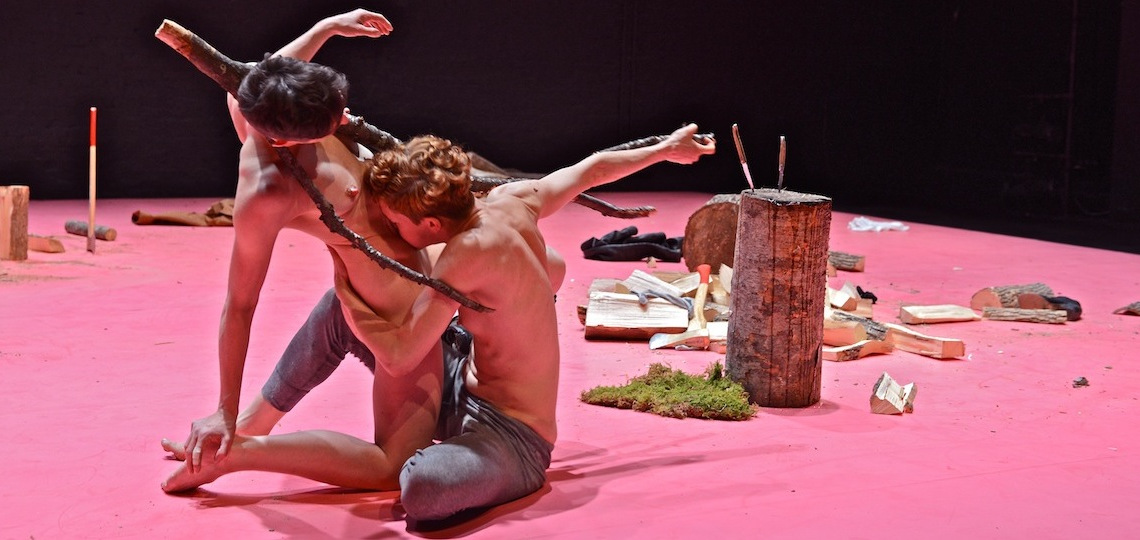
Supernatural. Photo Jorge León

Simone Aughterlony, Antonija Livingstone, Hahn Rowe: Supernatural

Chop, chop – who’s there? Supernatural is at once hypermodern and as old as the hills. The terrain is a mash-up of made and found, natural and fabricated, objects and beings. Flesh, wood, axes, rope, clothing, moss, electronics … It’s a fairytale land for the modern age. Wilderness versus civilisation? Have both!

The smell of pine – or is it cedar? – hits us as we queue outside, passing a log-pile to our left as we enter the performance space. Inside: hot pink lino covers the floor, and our ears are assailed and entertained by Hahn Rowe’s musique concrete, as gold foil paper is wrapped around a microphone to create a foley of fiery crackles and windy wooshes; or an electric violin is tormented with whatever inanimate object happens to be lying nearby. I find myself watching Rowe (a renowned musician who has worked with Yoko One and Antony and the Johnsons, amongst many others) a lot as he fiddles and tweaks and bows and rattles. Such wonderful sounds emanate…

Meanwhile, Simone Aughterlony and Antonija Livingstone act out a Brokeback Mountain lumberjack fantasy of hard and fast physical action within their ‘forest’ of logs and branches. Gender perceptions are played with most delightfully: the women – both with what once might have been called ‘boyish’ haircuts; one in a leather jacket, one in a vest showing off her bare muscled arms; both sporting cuban-heeled boots – swing their axes and bring them down purposefully on the big logs. Later, one lies topless on a pile of logs looking at the other work. She might even be chewing a straw. Later still, both are engaged in a naked tussle with a large branch, their bodies aping the rise and fall of orgasm. Slowly, clothes are retrieved – or new items found and donned – and the whole cycle starts up again…

There is a lot to admire. All three performers are highly skilled, truly proficient in their art, really owning the space –and we never doubt that we are in good hands as we are taken on this rollercoaster of sounds and images. There is a great deal of humour and joyfulness.

But I have some reservations. The first is in the staging. End-on feels all wrong. Supernatural feels like it ought to be presented in the round, or on three sides at least. I’m longing to be upfront, to sit close; and to have the freedom to move around to observe and listen from different angles. The piece, at 90 minutes, feels too long – but that could be because of the staging. The cycle of activity repeats three times (although every time is different, it is a repeat of rhythm rather than an exact replica of activity), which would be fine if it were a durational performance-installation, and you could move about, but sitting in seats, staring ahead at the performers, doesn’t quite work. We feel excluded from the action, not invited in.

Also, and  I’ve tried to resist this thought, but it won’t go away – I realise I feel uncomfortable witnessing a performance in which the women onstage get naked whilst the sole man stays resolutely clothed. That shouldn’t matter – I wish it didn’t – we should have moved on to a point where the gender (or indeed age, fitness) of a naked body doesn’t matter, but it still does – the body itself is political, no matter how much gender stereotyping is played with and subverted in the performance. Listening to comments in the post-show discussion, it was clear that for some audience members, gender was transcended. For me, this wasn’t the case.

These reservations aside: the images created are wondrous, with references to fairytale, folklore and the contemporary myth of the great outdoors tumbling out one upon the other. The physical performances from both women dynamic and robust, the soundscape created enchanting. A beautiful and thought-provoking performance.

Ignacio Jarquin: Madam Butterfly Returns

Ignacio Jarquin Productions: Madam Butterfly Returns

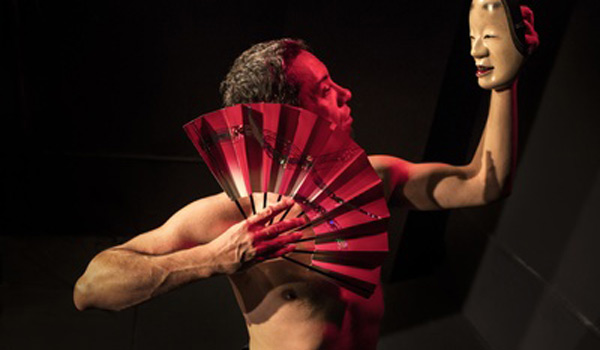
From a door at the rear of the performance space a figure emerges – tall, proud, disturbing. A dream image; an archetype of Noh theatre – a warrior with a silver mask shining in the blue stage lights, smoke curling around his feet. His precise, staccato movements dominate the stage, accompanied by a crash of cymbals. Entrance, take two: the figure retreats, and through the door into the auditorium, a man in a black jacket and loose ‘oriental’ trousers enters carrying a suitcase, looking eager but nervous. He takes a seat on a lattice-backed velvet chair, and waits…

Both of these characters – and indeed all the characters in this elegant new music-theatre production, described as a ‘one-man opera in two acts’ – are played with abundant ease and expertise by Ignacio Jarquin, a highly talented physical theatre performer who is also a lauded opera singer. In Madam Butterfly Returns, he has created a thoughtful and moving ‘sequel’ to Puccini’s much-loved opera. This, you may remember, gives us the story of the love affair between American naval officer BF Pinkerton and the beautiful 15-year-old girl known as Butterfly. Their brief tryst results in the birth of a son, and the opera ends tragically with her suicide, using her father’s hara-kiri dagger, after she is ordered to hand over her son to Pinkerton and his new American wife.

In Madam Butterfly Returns, we meet Butterfly’s ‘half-caste’ son Tomisaburo, 30 years after the end of the opera. He was never taken to America by Pinkerton, we learn, but raised by his mother’s old nursemaid Suzuki. He has now left Nagasaki for Atlanta, Georgia where the father he has never known, but often longed to know, is governor. It is a reversing out of the East-meets-West motif of the original story – now, it is American life that is exotic, other, as seen through the eyes of our protagonist.

Tomisaburo has plenty of time to think about things as he whiles away his days waiting in the lobby of Pinkerton’s office, hoping for an audience. He reflects on what has brought him to this point: reliving his parents’ meeting and love affair; mourning his doubly-bereaved childhood, as his mother dies and his father doesn’t want him; and pondering on the meaning of recurring dark dreams. He wonders about the behaviour of the kindly American family he is lodging with. The daughter of the house seems to be allowed a lot of liberty, he notes.

All this is enacted using an extraordinary array of physical and visual theatre techniques. Butterfly herself – memory or ghost, who knows? – comes to life most beautifully as the black jacket is reversed out to reveal a beautiful rose red and gold lining, and Jarquin’s movements become gracefully feminine as he raises what now look like kimono-dressed arms, unfurls a fan, and bows. In an atom, he is then transformed into the wizened old nurse Suzuki, who he begs for stories of his life. A number of traditional Japanese screens become the site for elegant scenes of shadow theatre, as we relive the courtship of Butterfly by Pinkerton, and the consummation of their love; or then, for the arguments between Pinkerton and his American wife. The suitcase is opened to reveal a Dogugaeshi inspired toy theatre (beautifully designed by Philip Sugg and Amanda Davidson), another medium to play out the endlessly fascinating story of Butterfly and Pinkerton’s love .

And the music! Madam Butterfly Returns is composed by Michael Finnissy, with libretto / book by Andrew G Marshall. It is a contemporary work that makes musical reference both to traditional Japanese forms, and also (here and there) to Puccini’s opera. Ignacio Jarquin sings beautifully, accompanied by a live quartet of four female musicians, two on violoncello (replacing the sound of the samisen in traditional Japanese music), a flautist and a percussionist, who deliver the complex score with skill and sensitivity. The production is not only performed by, but also directed by Ignacio Jarquin, with Anna-Helena McLean (of Moon Fool fame) as associate director. The team also includes choreographer Akiko Ono advising on the Japanese movement work; a simple but elegant set and costume design by Satoshi Date; and an effective lighting designer by Martin Chick.

This is a production that feels rather cramped – both literally and metaphorically – by this small pub theatre space. It deserves something bigger and better. All have worked hard to fit it into the setting, but it feels like it needs space to breathe.

A really engaging and beautifully performed piece of contemporary music theatre – let’s hope it has the chance to grow.


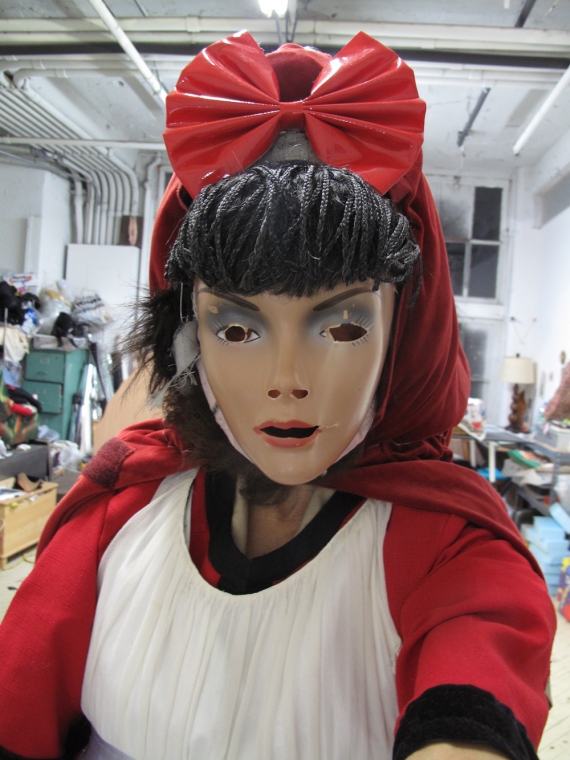
Narcissister_RedRidingHood_image_the_artist_570_760

Just Like a Woman: Sacred at Chelsea Theatre

Girls will be boys, and boys will be girls. It’s a mixed up, muddled up, shook up world. Yes indeedy. Once upon a time The Kink’s Lola was my signature tune when plying my trade as an ‘exotic dancer’. In those days (mid 1970s), I saw myself as a kind of drag artist – playing out feminine mores. After growing up wanting to be a boy, sporting trousers and a short haircut (rare for girls in the 1950s/60s) I’d discovered my femme self, and boy did I want to act it out. It’s a kind of normal thing nowadays, in the queer world anyway, this game-playing, this acting out of any aspect of the (gendered) self and switching of gender allegiances as and when you like, but then less so. Then, you were over here in this camp, or other there in that camp. Radical Lesbian feminists wore dungarees and banned people like me (people who wore dresses and make-up) from meetings. Make your mind up, girl – are you with us or against us? Bisexuality, and what we’d call ‘questioning’ nowadays, were the ultimate sins. Now, thankfully, we are in a time of greater gender fluidity. Enter stage left, ready to explore and celebrate this fluidity, Just Like a Woman – a weekend of performances, screenings, installations, and discussions, curated by the Live Art Development Agency for Sacred 2015 at Chelsea Theatre. We are here to experience women performing women, men performing women, and women performing men. And whatever else might occur.

I manage to see a fair amount of the Saturday programme. Arriving just before 7pm, I catch the tail end of Girls on Film, a screening of performance documentation and performance to-camera, featuring, amongst many others,  Cassils (seen at SPILL 2015), CHRISTEENE (shortlisted for a Total Theatre Award a couple of years back), theatre and cabaret star Ursula Martinez, and perennial favourite at Sacred, David Hoyle – who this year is presenting The Pride of Ms David Hoyle (20 & 21 November 2015).
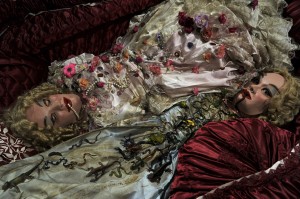
 

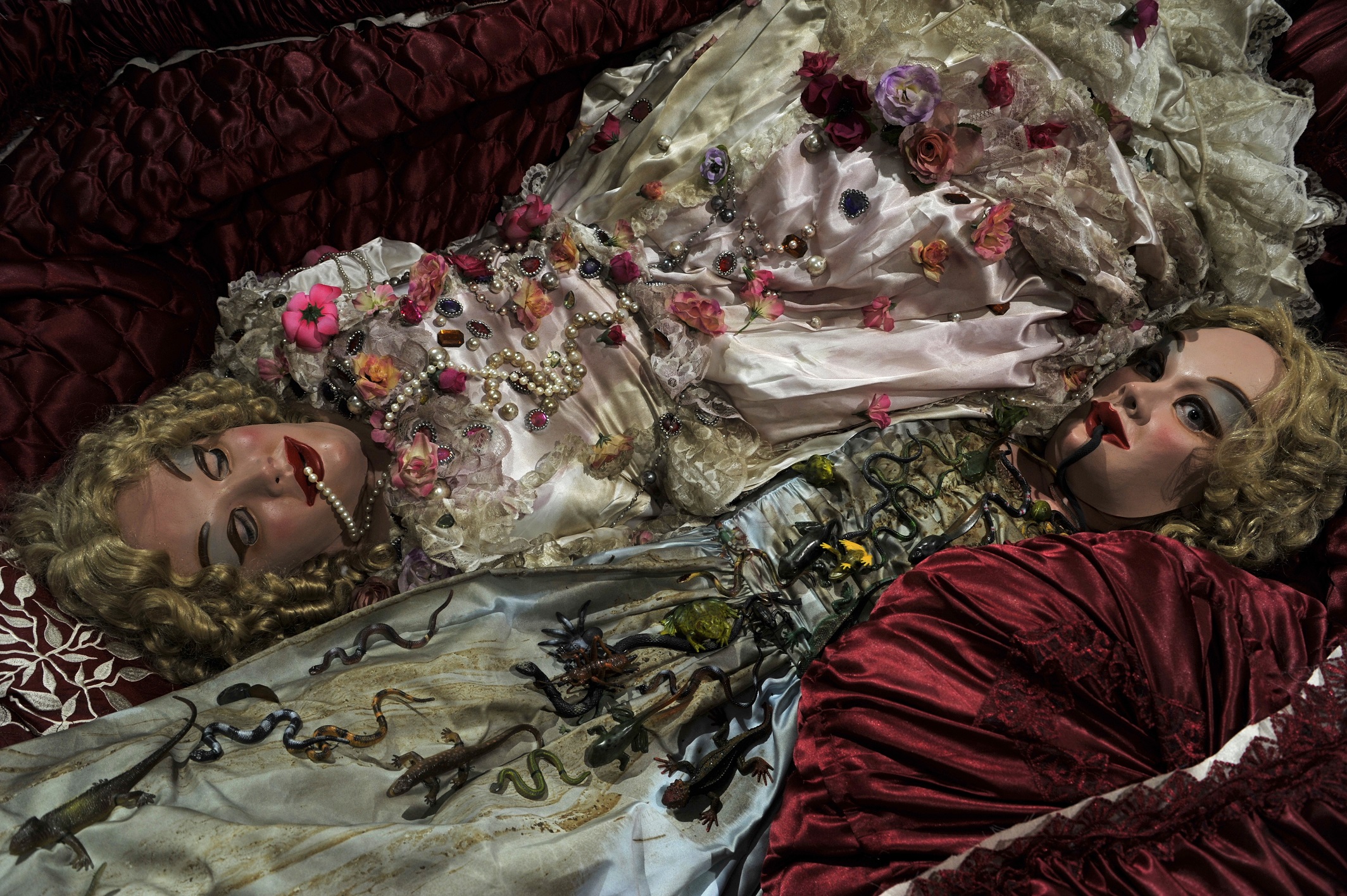
The Girls: Diamonds and Toads. Photo Anthony Hopwood

The Girls: Diamonds and Toads. Photo Anthony Hopwood


Before Narcissiter kicks off in the main theatre space, there’s time to take in The Girls: Diamonds and Toads in one of the smaller studios. This is a captivating installation piece – a tableau vivant referencing what the artists call ‘the ill-fated heroines of the Brothers Grimm and Hans Christian Andersen’, although personally I’d see more Perrault than Andersen in the luscious, Rococo imagery. Anyway, let’s not quibble about fairytale references – this is a wonderful piece of living sculpture: two ultra-feminine princesses bedecked in cream and pink taffeta silk dresses, adorned with roses and pearls, lying in state on a bed/table/altar; sleeping beauties frozen in suspended animation, although their eyes follow you around the room as you circle them – big wide eyes with eyelids groaning under the weight of enormous lashes, set in plasticised whiter-than-Snow-White faces, framed by shiny golden curls. One of the two captivates me completely – I can’t break the gaze, locked into relationship. I fight the urge to kiss her and break the spell. Maybe I should have. Instead, I gentle touch her stockinged foot.
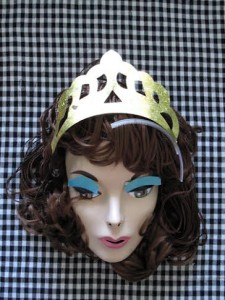
 

Narcissister

Narcissister


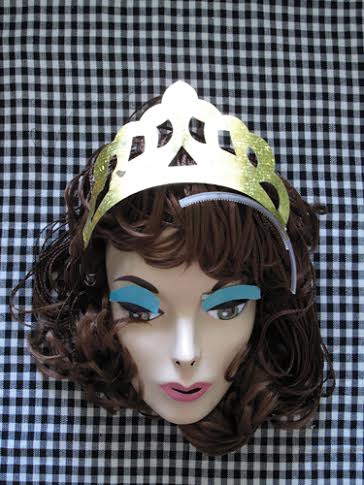
Upstairs we go for Narcissister: Conditions of the White Mask, my first experience of this New York legend, an artist of North African and other mixed heritage, whose name and face are kept hidden – Narcissister always performs wearing one (or often, many) of her trademark plastic masks.  This turns out to be a wild and wonderful rollercoaster ride of live and filmed performance. Her doll-face masks, combined with her lithe, dance-trained body, give her the appearance of a Barbie doll come to life – an image played out most brilliantly in a performance video Burka Barbie in which the full-size Barbie Girl, in stripper heels and day-glo-pink backless dress, trolls through a trashy 99-cent store, working her way through the plastic-fantastic delights on offer, stopping to lovingly fondle the bubble-wrapped faces of the packaged dressing up dolls, becoming particularly fascinated with one with Arabic packaging. We are then thrown into the world of the dolls, as Burka Barbie comes to life and go-go dances wildly with her dolly mates to The Clash’s Rock the Casbah.

The live action is equally engaging. Narcissister’s entrance is as a kind of animated vanity-table cum dresser scuttling across the stage. The table turns out to be a baby’s basinet. The baby grows into a little girl with plaits, skipping merrily across the stage, then a young woman, a mother with a baby of her own, an older woman, a very old woman, and finally a corpse, back in the basinet-turned-coffin. This delightful, funny, and moving  ‘seven ages of woman’ scenario is enacted with astonishing agility and precision, using face-masks, whole-body-mask, puppetesque false heads, and layers and layers of constantly morphing costumes. She twists and turns from one form to another: turning her back to us, she reveals a second mask on the back of her head; now, as she handstands, a further face appears; then, as she walks over from handstand to bridge, another face pops out from between her front-facing legs. It is a truly astonishing performance – rare to see someone with such physical dexterity on the performance art scene; a fabulous amalgam of physical performance and visual art/living sculpture that – although completely different, and very much its own thing – has echoes for me of the work of both La Ribot and Mossoux Bonte .
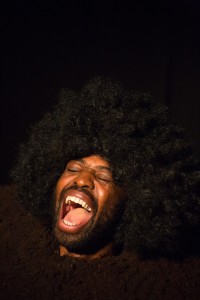
 

Harold Offeh. Photo OpenApertureUK

Harold Offeh. Photo OpenApertureUK


It’s all over far too quickly – but I’m afraid the same can’t be said for Harold Offeh’s Covers, seen next in the downstairs bar. In this piece, the artist restages, live, the images of black divas from the covers of a number of seminal albums from the 1970s and 80s. He stands there in a plain black leotard type garment, striking poses that echo the covers we see displayed on a monitor stage-left, as the music from each album plays.  I can’t really work out what is being said here, about gender, about being Black, or about anything else. The divas are female, and this is a male body. And then what? The only one of the tableaux that interests me is his Grace Jones finale, and that because there is (at least) humour in his striptease, his liberal application of baby oil, and his struggling attempts to recreate Jones’s athletic pose on the Island Life cover. Maybe I’m reading this all wrong. Maybe it was all about the failure to live up to the divas, and I just don’t see the intention or intended humour in the other impersonations, I just see someone standing on a stage, vogueing and looking slightly awkward. Who knows? Sometimes you have to admit that you just don’t get something – and this is a case in hand.
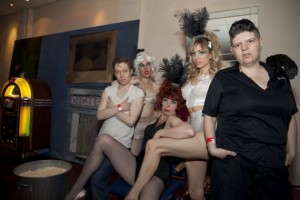
 

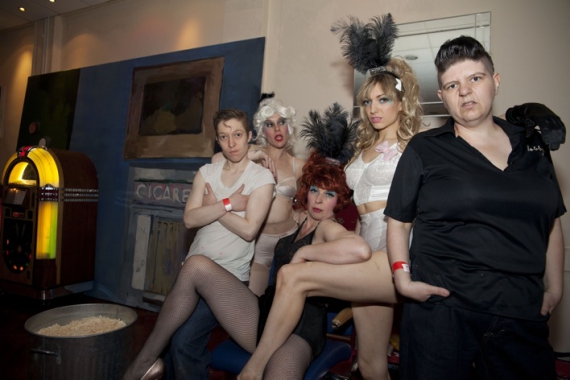
LucillePower: The Butch Femme Touch-up Service. Photo Holly Rrevell

LucillePower: The Butch Femme Touch Up Service. Photo Holly Revell


I go off to skulk around the bar, feeling a little tired and wondering whether to call it a night – but I’m then entrapped by three luscious ladies (of various sexes) dressed in vintage underwear (1950s stitched bras and big knickers) and wigs, who drag me over to a barber’s chair in the corner for Lucille Power’s The Butch / Femme Touch Up Service (a piece originally commissioned for Duckie Goes to Gateways, a celebration of the legendary Lesbian club). I’m given a make-up make-over – after some discussion, the beauty salon girls decide against a butch five o’clock shadow (my face must have given away how much I didn’t want this, although I would have quite fancied a moustache), and go instead for full-on femme. Neon orange eye-shadow, lurid peach blusher, and candy pink nail varnish slapped wildly on to nails (and onto a lot of my fingers, too). My black patent boots get a spit and polish, my crotch treated to a liberal dose of Femfresh (in case I should find myself in an intimate situation), and my barnet fluffed up and hair-sprayed. All the while, the girls gyrate and flirt and cosset and massage. Perfect! I did actually enjoy it a lot more than a recent experience of a ‘real’ pampering session in a hotel spa, which I found excruciating. But next time, a moustache perhaps?

Talking of moustaches, I regret missing The Drakes at JLAW on Friday evening, presenting The Butch Monologues, which explores the world of butches, masculine women and trans men. I am, though delighted to have caught at least some of the Gender Spectacle cabaret, which is MC’d by everyone’s favourite butch Peggy Shaw – alongside everyone’s favourite femme Lois Weaver. What a delight it is to see these two together on a stage again – and to know that Sacred is also including a Split Britches Retro(per)spective in its 2015 programme.
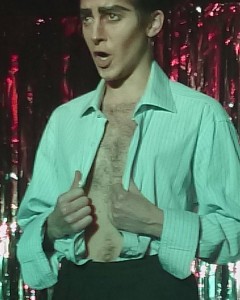
 

Eleanor Fogg's johnsmith

Eleanor Fogg’s johnsmith


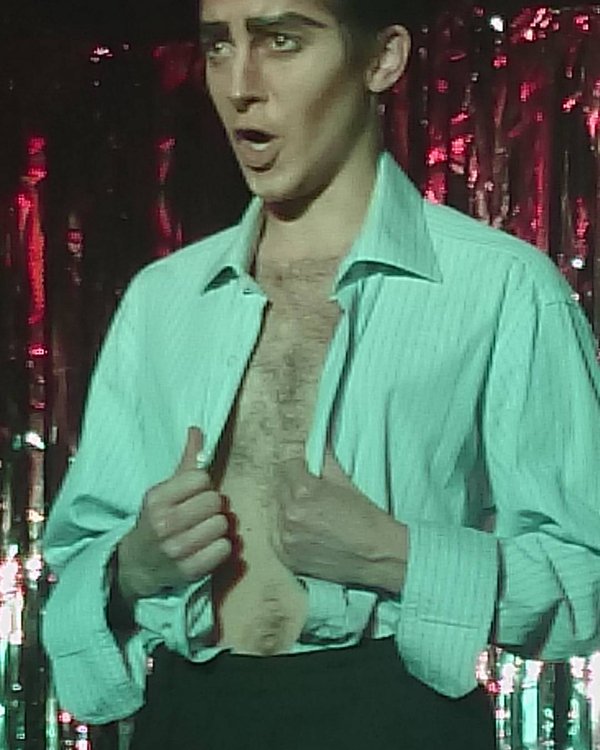
I didn’t get to see much of the late-running cabaret, but I did at least catch johnsmith (the drag persona of Eleanor Fogg) with what it feels like for a girl, a lovely piece exploring transformation and duality, combining simple, exact, perfectly-controlled physical performance with a great soundtrack, to which s/he lip synchs. What we see is a business man in a suit, at first expressing the minor dissatisfactions and frustrations of the career man. This breaks down into a voice-distorted reflection on male hatred of  all things feminine, a fear which disguises a desire to know, just for a minute, what it feels like for a girl. The tie is loosened, the shirt unbuttoned. Sexual politics that in some aspects suggest Jean Genet; sounds that in some ways echo the work of Laurie Anderson. Great stuff! I hope to see more of this artist in the future.

Talking of lip-synching, Dickie Beau’s Blackouts – Twilight of the Idols was shown in the Just Like a Woman weekender, seen by Total Theatre earlier in the Sacred season, and reviewed here. The Friday night also included performance by The Famous Lauren Barri Holstein, Live at World’s End, and the launch of the new book on Lois Weaver’s work, The Only Way Home is Through the Show, which is co-edited by Lois and Jen Harvie, and published by the Live Art Development Agency.
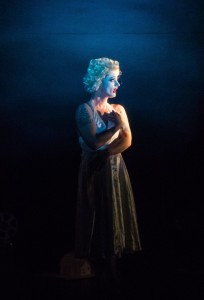


Dickie Beau: Blackouts

Dickie Beau: Blackouts


Featured image (top) is of Narcissister.

Just Like a Woman was previously presented at Abrons Arts Centre in New York, October 2015, and before that at City of Women festival in Slovenia in 2013.

Details of all works presented in Just Like a Woman, and the rest of the Sacred Season 2015 at Chelsea Theatre, can be found at www.chelseatheatre.org.uk

Just Like a Woman, 13 & 14 November 2015 and a companion weekender at Sacred, Old Dears, 27 & 28 November 2015, are the culminating events in the Live Art Development Agency’s Restock, Rethink, Reflect Three on Live Art and Feminism (2013–2015). See www.thisisliveart.co.uk 



Dickie Beau Blackouts. Photo Paul Blakemore

Dickie Beau: Blackouts – Twilight of the Idols

Well, that wasn’t what I was expecting! Dickie Beau has a formidable reputation as a cabaret and nouvelle drag artiste, but in recent years has also created full-length theatre works. Blackouts: Twilight of the Idols ‘conjures the spirits of celebrated Hollywood icons’ and ‘channels the ghosts of his childhood idols’ – but that’s not the unexpected element. It’s the form that surprised me.

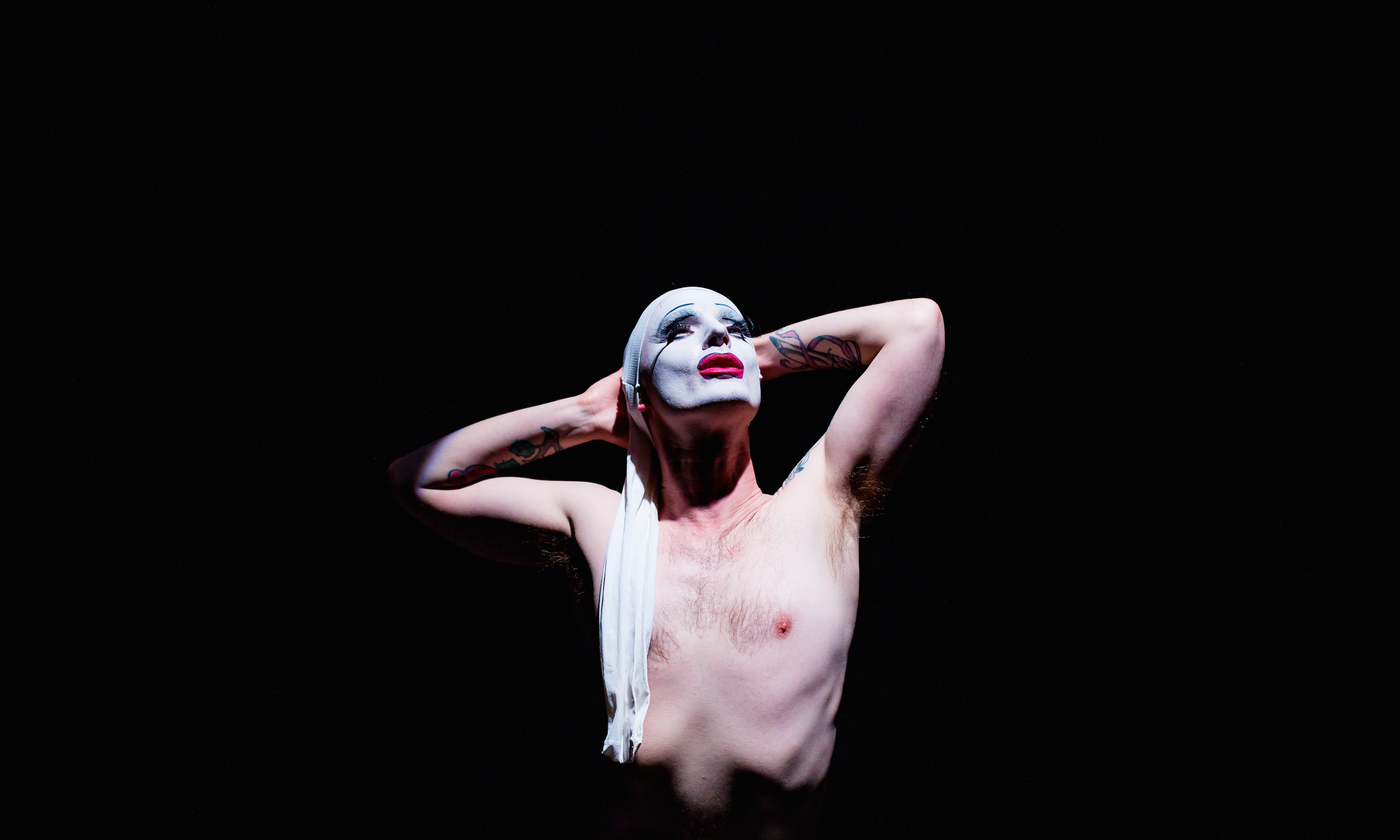
For the show – or the first half of it, at any rate – is a classic piece of physical/visual/total theatre. Precise physical performance that references traditional mime, evoking the early white-face work of Lindsay Kemp; an interesting casting of objects with dramaturgical significance (an ancient reel-to-reel tape machine; a black shiny rotary-dial telephone) allowed to sit, lit beautifully, on stage for us to relate to as characters in the story; the performance space veiled by a thin gauze on which words and images are projected, creating a multi-layered onstage world.

This first half mostly concerns itself with Marilyn Monroe, and a recording of her last ever interview in spring 1962 – just days before she died – with Richard Meryman for LIFE magazine. But here’s the really exciting twist – included in the show is not only the verbatim recordings of Marilyn’s voice, but also an interview with the interviewer, Meryman, reflecting on the process, on the content of the interview, on the writing and editing decisions (the piece was published as a first-person monologue), and on the star’s death.

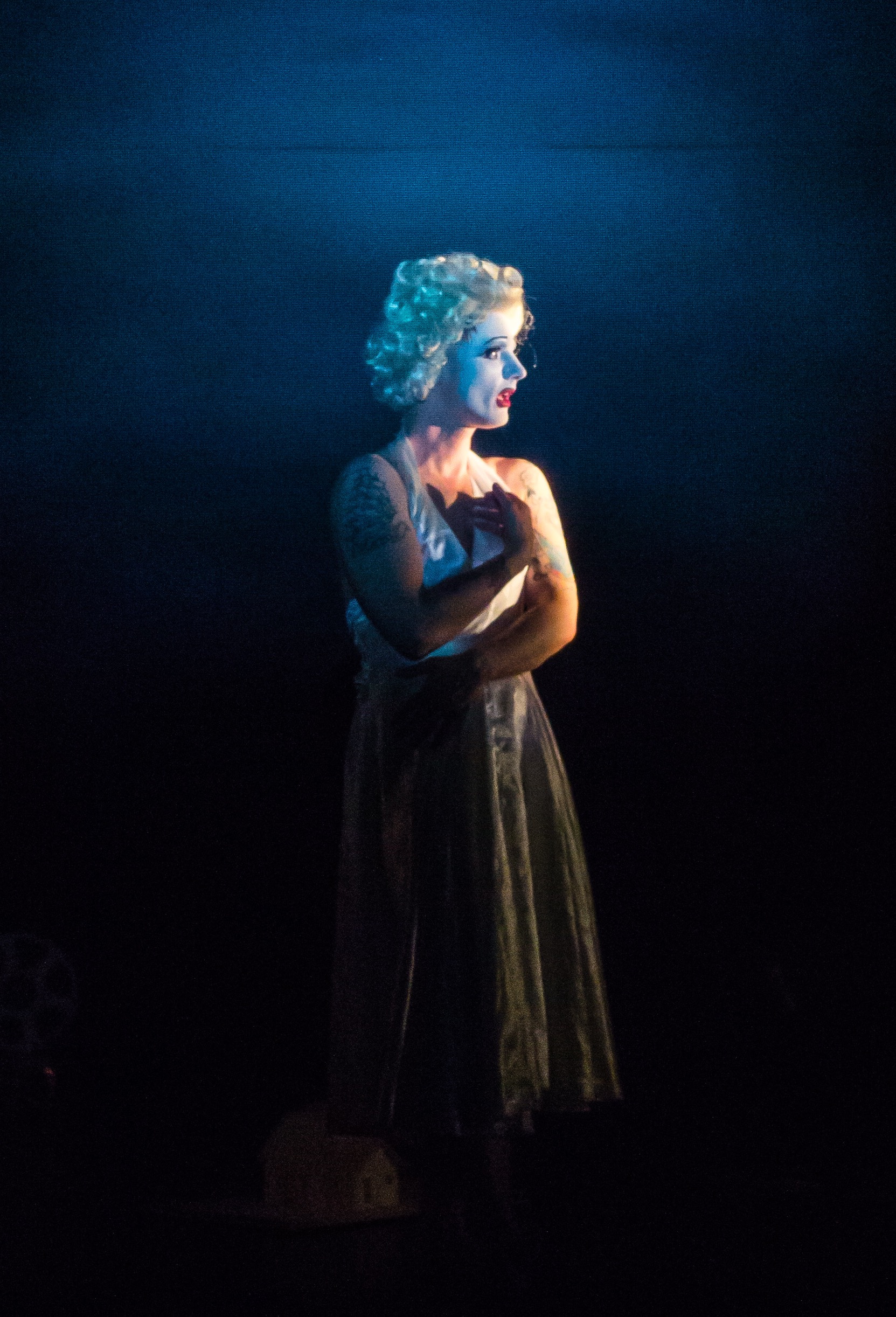
We are thus presented with an intricate theatrical web that invites all sorts of reflections on the nature of truth, artifice, disclosure, and exposure. Whose story is this? Is it Marilyn’s, is it Meryman’s, is it the media’s, is it Dickie Beau’s? It’s all of the above.  Beau’s relationship to it all is complex and multi-layered, readily mixing fantasy and reality (whatever that might be), deliberately playing on notions of mediation and interpretation. He lip-synchs both Marilyn and Meryman’s words as we stare at the cumbersome tape machine. With Beau as the medium, she tells us she wants to study and be taken seriously; he tells us that he turned up at her Hollywood home without even knowing how to work the machine, and that she was tired and listless and trying to wriggle out of the interview, until a trip to the bathroom for a ‘liver shot’ that revived her miraculously. Mostly, Dickie Beau is in his neutral ‘mime’ outfit, but in one short and beautifully enacted scene, he dons a blonde wig and a white satin dress and stands before us, recreating the iconic Marilyn skirt-blowing moment that we all know and love.

The second half of the show similarly works with the recorded voice of an idol. In this case, it is Judy Garland’s dictaphone notes for a memoir that was never written. This section of the show in fact came first, having evolved from a 10-minute cabaret/short theatre piece that Dickie Beau has performed for a number of years. It’s clever, and ultra camp. ‘Judy’ is dressed head-to-toe in blood red – plaits, a flouncy skirt, striped socks, and ruby red shoes that sparkle and glitter under the lights. Wielding a knife, she’s a kind of hybrid horror-film mix of Dorothy and a reversed-out (red rather than green) Wicked Witch – sitting, standing, tottering on those red shoes as she mutters about looking out for her little girl Liza, and how she hates always playing ‘herself’ – she badly needs time off from being Judy Garland. Lacking the multiplicity of layers of the first half of the show, being a far more direct portrayal of a drag character, this section is entertaining but nothing like as exciting or thought-provoking as the earlier part.

But skill wins out. Despite not being quite as enchanted by the latter part of the show, I’m bowled over by Beau’s skill – his ‘Judy’ is undoubtably a brilliant characterisation. But for me the heart of the work is the Meryman interview, and the way that this is so cleverly unpicked and moulded into Beau’s reflection on his relationship to the Monroe myth. It is interesting to see that Dickie Beau, in his programme notes, dedicates the show to Richard Meryman, who died in February 2015.

Blackouts is not quite the perfect piece of theatre it could have been, but it is a highly commendable show, expertly performed, and a delight to witness.

Karen Finley

Karen Finley: Ribbon Gate | Written in Sand

Karen Finley! Karen Finley smeared in chocolate. Karen Finley performing unspeakable practices and unnatural acts live on stage. Karen Finley getting banned – from art galleries, from rock venues, from public toilets. From public toilets – oh yes! I’ve never seen her live, but have admired her from afar for years. Well, I would wouldn’t I? She’s my generation – a child of the 1950s who came of age in the 1970s, embracing punk, porn and performance art with gusto, one of a number of women artists (see also Annie Sprinkle and Penny Arcade and Cosey Fanny Tutti) re-evaluating sex and flying the flag for freedom and liberation and…

And then came AIDS. It started as a rumour, towards the end of the 1970s. There were people on the scene getting sick, getting colds that went to flu and then to pneumonia, knocked over like skittles, blown about like feathers from a discarded boa. Maybe it was something to do with taking poppers or, er… who knew what. The rumours were whispered in the toilets at Danceteria (New York) and Heaven (London) as a new decade came in.

As the 1980s unfolded, we found out what it was – although there was so much fear and prejudice and mistrust it was often hard to get to the facts. People died, lots of people died. People were scared, very scared. Children who had HIV-positive relatives were asked to leave their schools. When Lady Di pointedly took off her gloves on a hospital visit and held the hand of a man with AIDS, it made the front page of the papers – a game-changing moment.

Karen Finley’s installation Ribbon Gate (sited at the Barbican, which is also the venue for her SPILL Festival show, Written in Sand) honours the many deaths from AIDS over the past 30 years, using the idea, popular in South American Catholic churches, of tying a ribbon to a metal gate in commemoration. We are invited to honour the life and mark the death from AIDS of someone we’ve known and loved. I choose Derek Jarman. As I tie my (yellow) ribbon on to the gate, incongruously placed in the middle of a busy and overlit walkway, mayhem erupts all around me. It’s a protest, demanding a living wage for the Barbican cleaners. There is chanting and shouting and banners waived. Ribbon Gate sits stoically in the middle of it all. Derek would have been amused, I think.

I look for an usher to find out what space the show is in. I start to ask the way. Are you going to see Hamlet, the usher asks enthusiastically. No. I find my own way to the Pit.

In Written in Sand, Karen Finley keeps it live, responding to the moment, reflecting on how she’s feeling, asking how we’re doing. She references both the Benedict Cumberbatch Hamlet happening above us, and the pro-cleaners fair wages protest. In fact, she gets us to applaud the cleaners, and the technicians, and the SPILL Festival producers, and the ushers and….

The atmosphere is relaxed. Less Dead Kennedys than late-night jazz lounge. There’s even a man playing a flute, for goodness sake. So yes, it’s a gig, kind of. A spoken word with music event. Music that is mostly mellow and laid-back. That flute, and piano, and bells, and synthy strings coaxed from a laptop, and gentle percussive backbeats, all conjured up by talented multi-instrumentalist Paul Nebenzahl. We get a mash-up of writings from Finley that include legendary texts like Hello Mother:

‘Hello Mother / Your son is dying. You knew – no, don’t hang up’ and then ‘Hello emergency room / Don’t bother helping someone sick. Don’t bother helping someone dying. He’s / a leper. He’s going to die anyway.’

The music might be mostly mellow, but the vocal delivery is intense and vibrant and shrill and angry, and the words are sharp, thrown like knives out into the auditorium. Time hasn’t healed. Finley tosses her hair and spits her frustration, a fiery ball of passion. Many of the songs/poems/texts (call them what you will) display the frustration and impotence of those left behind. It’s time to honour the dead, to name them. John. Howie. David. Thomas. Her grief is palpable, decades on, as she tells us of phone calls almost-made to dead friends in the middle of the night; of exasperation at the ‘positive attitude’ of a dear friend who is dying; of the sorrow of the woman nursing her dying daughter: ‘No granddaughters for me…’ sighs the mother. This song reminds us that AIDS, like Ebola, like other devastating plagues, is not confined to one demographic. It kills whoever it finds, wherever it finds them. That we lived for decades without prevention or cure, seeing our friends falling and dying in droves, is extraordinary. It was brutal.

In between songs, she sits in an armchair, sideways on to us, the audience, facing Paul Nebenzahl’s piano. She muses on all sorts of things. Freddy Mercury’s tackle. Judy Garland at the London Palladium. Rainbow candles weighing down her luggage. The Crying Game. Boy George. Her Rolodex and all the names and addresses it once contained. Do we remember the Rolodex, she asks. She explains what it is for younger audience members – a kind of Ferris Wheel with little cards attached, is how she puts it. It’s clever, this Rolodex moment, because it shows us what different times the 1980s were. A time when people hid their razors and toothbrushes when you came to visit in case they got – contaminated. A time when hospital workers wouldn’t touch patients with HIV/AIDS without wearing rubber gloves. A time when it was only just about legal to be gay, as long as you didn’t actively promote a gay lifestyle (whatever that might be). But if you were in a long-term relationship and your partner got ill, you had no rights, you wouldn’t be let onto the hospital ward, and when the time came, they’d get sent home not into your arms but to their family of origin to die. To a family that had perhaps previously rejected them, abandoned them. She takes the mic for another classic, He’s Going Home:

‘He’s going home to drapes and homemade wine. To a room of cowboys and / fire engines and twin beds. No one to share your bed ever again.’

Sometimes she sits and listens to Paul Nebenzahl play. All the music used is composed by, or was originally performed by,  people who have died of AIDS. He plays a slowed-sown version of the B52’s Rock Lobster, describing it as ‘like an Elizabethan ballad’. Occasionally she starts a song, and gives up, sitting down. ‘I can’t do it right now’ she says. She needs to breathe a bit, to drink some water, to start again. Always the liveness of the moment is acknowledged, and she wants to stay true to how she is feeling and being at this time, in this place. On numerous occasions, she asks for the house lights to be raised, so she can look at us, and talk to people directly. At one point, she invites some of us up to ‘twinkle’ with her, to join her in dancing round the chair and the lines of sand, and the candles.

Whilst ranting against the injustice of these too-early deaths from AIDS in the 1980s and 1990s, she also acknowledges what we all know. That we will all be dead one day. Do I die at the end of the movie, she asks. Yes, yes you do. I do. We all do. It’s October 31st – All Hallow’s Eve. It’s a timely reminder of our mortality. We go out into the night.

So what do you think, someone asks out in the lobby. Think? I can’t think. I can just feel. I feel jettisoned back in time, to a time that was harsh and unforgiving and full of angst, yet life-affirming too, full of music and film (Derek!), and performance. We survived. We lived to tell the tale. We rode out Reagan and Thatcher, ridiculed them with street theatre and industrial music and queer cabaret and…

I force myself to think, to be the critic I’m here to be. I’m not that fussed about some of the music, especially disliking synthesised cello. Some of the spaces between songs/poems are a bit long and unfocused. But actually – who cares. Who gives a…

This evening is not about thinking. This evening is about passion, and commemoration. About words that cut through ideas to reach feelings. About remembering, and honouring. About telling stories to those who were there, and to those who weren’t. About never forgetting their names. About lighting the candle, and holding the space. About tying the yellow ribbon around the old oak tree. Or around the metal gate. Lest we forget. Amen.

Ribbon Gate and Written in Sand were presented at the Barbican as part of SPILL Festival 2015. See www.spillfestival.com 

Karen Finley: Ribbon Gate