Author Archives: Lisa Wolfe

Lisa Wolfe

About Lisa Wolfe

Lisa Wolfe is a freelance theatre producer and project manager of contemporary small-scale work. Companies and people she has supported include: Thirunarayan Productions, A&E Comedy, Three Score Dance, Pocket Epics, Jennifer Irons, Tim Crouch, Liz Aggiss, Sue MacLaine, Spymonkey and many more. Lisa was Marketing Manager at Brighton Dome and Festival (1989-2001) and has also worked for South East Dance, Chichester Festival Theatre and learning disability arts charity Carousel. She is an occasional performer and installation maker in collaboration with other artists, and is a Trustee at Brighton Open Air Theatre.

Tron Theatre, Ulysses | Photo: John Johnston

Tron Theatre Company: Ulysses

Tron Theatre, Ulysses | Photo: John Johnston

It was all a dream! Dermot Bolger’s effective adaptation of James Joyce’s masterpiece Ulysses reconstructs the novel as if it is being dreamed by Leopold Bloom. Doing so means it can start and finish with Molly Bloom’s famous soliloquy and make that evocative speech the narrative thread.

The opening scene has Molly (Muireann Kelly) in her much loved bed, and it is evident from the start that this Molly is all for fun. She talks directly to us which is rather unnerving. Isn’t this an internal monologue, dreamy in nature and murmured seductively? The words are so fruity and become quite explicit – Molly would never have spoken them aloud. But this is the way it goes, with a focus on the sexy bits of the book, and some fabulous characterisations from the strong ensemble cast.

The set is a busy arc of cabinets, drawers, cupboards and windows through which people can enter, peek, shout or sing. It evokes the Martello Tower in which the hapless Stephen Dedalus (Michael Dylan) endures Buck Mulligan. There is a lot of playfulness in Andy Arnold’s direction. The cat is represented by a swish of a scarf, The Citizen’s dog by a smoke machine. There is a pleasing simplicity to the use of props too; a ladder becomes a pulpit, a diving board, a hovel.

The narrative largely follows the chronology of the book, with sequences such as The Sirens – a nice call of ‘Sirens please’ to introduce it – and lots of lovely close harmony singing. The climax of the first half is the Cyclops story, with Bloom escaping from the bigoted Citizen in the pub, who sends the glasses flying.

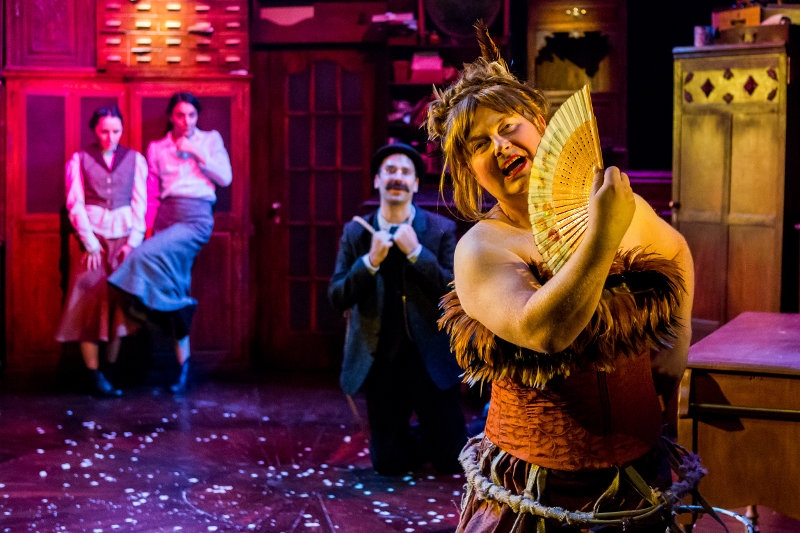
The second half (yes, an interval, in Edinburgh!) opens with the Nausicaa episode and Bloom masturbating on the beach while the provocative Gerty (Mary Murray) displays her, erm, wares. Cue fireworks. Then comes a hallucinatory vision of the brothel scene, in which the madam Bella Cohen is played with great relish by Grant Smeaton, wearing a lobster pot and effecting a German accent. He looks alarmingly like Benny Hill. Poor Bloom (Jean-Paul Van Cauwelaert) gets fisted (I said it focuses on the ‘durty’ stuff).

At last Bloom and Stephen get to walk together after narrowly avoiding arrest, and this is a welcome moment of calm and a sort of epiphany for Bloom. He can relate to Stephen more than any other character and be a father to a boy – his own son having died when a baby, the consequence of which has made it impossible for him to make love to Molly.

We end with the remainder of Molly’s monologue, describing her lover Blazes Boylan (a fine performance by Stephen Clyde) and remembering the time she first said ‘yes’ to Leopold on Howth Head.

All the cast in their various roles are highly watchable. Maeve Fitzgerald in particular is a total delight. The lighting, costumes, sound design and choreography are all top class and make for a grand afternoon of theatre. There is some odd switching from behind the fourth wall to a direct approach to us in the audience, which doesn’t sit well with the traditional presentation. But that’s a small caveat. It’s not easy to stage such an epic, complex and multi-layered text so successfully. And it is the language that shines throughout. ‘The heaventree of stars hung with humid nightblue fruit.’ It’s enough to move a grown man to tears.
Dan Canham, Ours Was The Fen Country

Dan Canham: Ours Was The Fen Country

Dan Canham, Ours Was The Fen Country

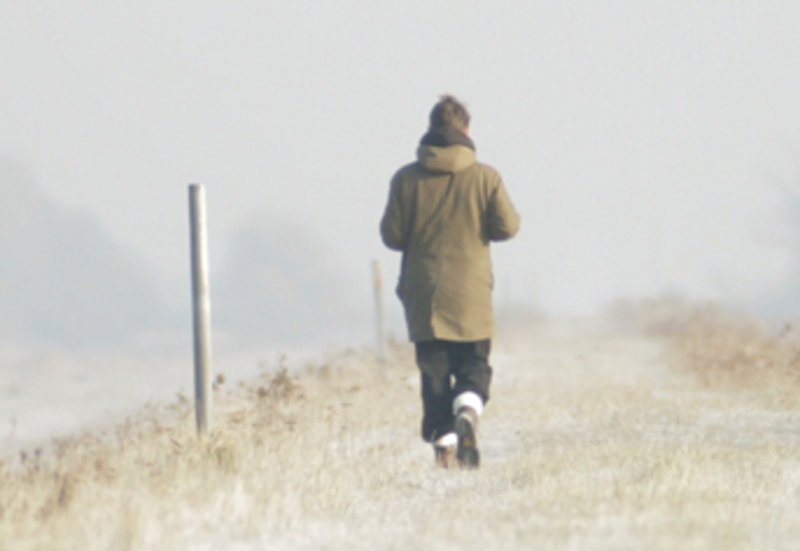
The Fenlands of East Anglia are strange. Misty, moist, flat, ancient, sinking. Dan Canham and his company give us a visual, aural and emotional account of life in this place. Of generations of farmers, cow-men, horse-men, eel-men. The work is solitary and hard and they love it. The traditional methods, the life on the soil that is ‘black gold’, the distances between their households and the old characters they have known.

We view this landscape through images on a screen and from recorded interviews, some relayed by the company, some lip-synched, some just played from the computer deck. The lighting grades through gentle gloom to a morning brilliance.

All is muted, balanced, controlled and this aesthetic carries through to the dancing, which, when it comes, brings a strong physical energy. The choreography at first is totally grounded, not representational exactly but evocative of the labour being described. The performers are all strong; Tilly Webber gives a particularly fine solo which I took to be an evocation of an eel. They can be as thick as a man’s arm and wriggle for half an hour with their heads cut off. The movement was pure and heartfelt. At other times the four swirled together in and out of clusters then spinning off to corners. They did some flat-flooted stamping rather like a clog-dance. You thought of the last horse, Monarch, working the field.

Ours Was The Fen Country captured the essence of this disappearing way of life, of the shrinking peat levels. It was a story of individuals, connected through the land and history. One fellow declares himself a Cromwellian – suggesting the Fen people are fiercely determined to be themselves and take no orders. It’s an interesting moment in the piece, giving a broader picture. I would have welcomed more variety of this sort. Perhaps a flight of fancy of what might be, of contrast. The piece ended with the four dancers jumping and it was great to watch them take flight.

Northern Stage, Bloody Great Border Ballads Project | Photo: Claudine Quinn

Northern Stage and Guests: The Bloody Great Border Ballad Project

Northern Stage, Bloody Great Border Ballads Project | Photo: Claudine Quinn

By the time we reach the thirteenth verse of the St Stephen’s Border Ballad, the foundling has had a child of her own, become a painter, escaped to the Highlands via the A9, and been battered by forces internal and external, but we have yet to find out where we stand on the issue of Scottish Independence.

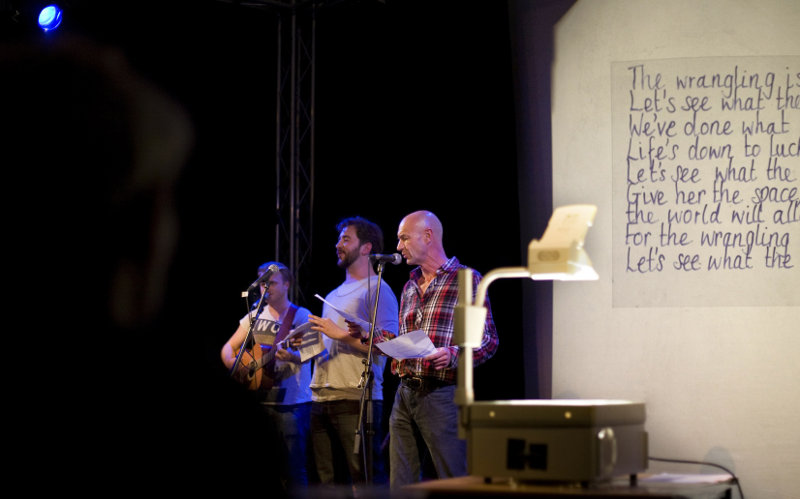
Northern Stage’s Lorne Campbell has given himself, his company and the audience quite a task here. Collectively we are to produce a new border ballad, to help us understand the broader picture of the dilemma being faced by Scottish voters. Lorne says that his own lack of certainty about how to vote inspired this huge undertaking. He says that a border ballad is no place for irony – you have to wear your heart on your sleeve. The audience is ready for it – there is good energy in the room. Tables and chairs at the front, raked seats behind. There are matchboxes and tea lights on the tables and the stage floor. Aly Macrae is musical maestro, as arresting here as he was in The Strange Undoing of Prudencia Hart. Aly also wrote the first verse of the ballad, establishing the set-up of a foundling in a Moses basket, found on the night of the dissolution of the Union.

This musical and poetic endeavour involves a guest ‘balladeer’ each night who moves the story on, like a game of wordy consequences. Supported by two or three musicians, the team of actors and writers recite the previous verses, and in between each we sing a rousing refrain from the very first verse.

Before the ballad starts, there are two personal pieces, and tonight it’s the turn of Daniel Bye and Lucy Ellinson. Daniel attempts a ballad about Middlesborough and weaves a tall tale which results in him being burnt in a sort of Wicker Man scenario by staunch ‘Berwick-on-Tweed nationalists’ by mistake. They thought he was a Geordie. He is a good writer and delivers well. ‘If you find this painful and upsetting,’ he quips knowingly, ‘just think of it as performance art.’

Lucy, hotfoot from performing in Grounded at the Traverse, gives us an exercise. The audience is invited to the stage space to sit amongst the candles and slips of paper. Lucy is quite a radical and the papers have messages from people across the country saying what national services are most important to them. Services such as healthcare, transport, education facilities that are under threat. It is great to witness a disparate group of people become a community through doing this; our voices never overlap, the tones vary, the lights are gradually blown out. It’s not a ballad, but it’s moving, and thoughtful and political.

For the Saturday night audience, the foundling’s journey ends with a lovely piece by Deborah Pearson. The foundling mother is going through a feisty stage with her now teenage daughter, whose propensity to speak ‘American’ stretches her nerves. Deborah takes language as a metaphor for nationalism. She ends with a beautiful couplet: ‘Age is its own country and border, we’re told, and the young they speak differently there.’

It will be interesting to see how the rest of the run goes. Each night is videoed and viewable online so you can keep up to date with it. And each night the audience sings a song for the next incoming audience and nominates one for them to sing. We had Eye of The Tiger, they get Jolene, poor devils.

I expected to be challenged by questions of sovereignty, of nuclear disarmament, of European isolation. I would have liked some that. Instead the evening was a varied and enjoyable mix of words and music and games. There will be many folk by the end of the week with an ear-worm of a refrain stubbornly refusing to shift:

‘The wrangling is over, the deal has been struck. Let’s see what the foundling does now.’

Pieter De Buysser and Hans Op de Beeck: Book Burning

Pieter De Buysser and Hans Op de Beeck: Book Burning

Pieter De Buysser and Hans Op de Beeck: Book Burning

Telling a story through parallel voices is a familiar theatrical device – witness Michael Pinchbeck, Chris Goode and others. Here, though, we have a story told by a theoretical cat (Schrödinger’s, no less), the writer/actor Pieter De Buysser, and a character called Sebastian who Pieter tells us is fictional.

The main story belongs to Sebastian. He is a campaigner, a big thinker, a tracker of DNA codes and a father to teenage Tilda. His torso emits light, which attracts moths. Tilda owns the cat.

Pay attention at the back!

Sebastian has discovered all sorts of world-affecting and incriminating information about international organisations that are now closing in on him in a threatening manner. Tilda responds to her father’s situation by taking objects from their house and burying them in the garden.

Complex ideas around democracy, economics, communication, utopias and freedom are explored through Sebastian’s lengthy writings to Pieter. There is a hint towards Damanhur (an Italian eco and spiritual society built inside a mountain) with the introduction of a character called Nobody who falls in love with Tilda. The story rounds up with Tilda burning her father’s book – on which is plotted her future life trajectory through her DNA code. It included the date of her death, but it didn’t include this highly emotive and often political act, of burning books.

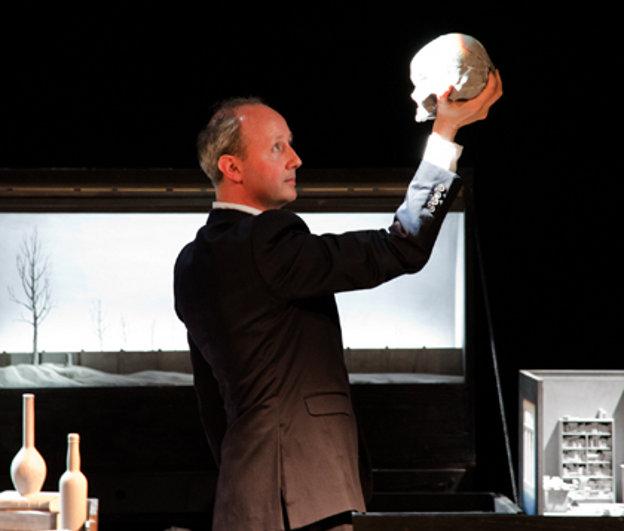
All this is beautifully played out by Pieter, a calm and engaging performer with an expressive face. A giant trunk (made by artist Hans Op de Beeck) opens out ingeniously to represent the landscape and homesteads of Sebastian and Tilda. All is grey and delicately lit, like a Giorgio Morandi still-life painting.

At ninety minutes, Book Burning is a bombardment of ideas and interweaving storylines; it requires and repays full attention. Delivered in English with playful ‘Dutchness’, it may try a bit too hard to pack everything in, and who can judge the truth – might not Wikileaks’ information be as biased as the CIA’s? But it is good to see theatre that tackles historical and contemporary issues in such an interesting and evocative way.

Yet again The Basement shows its metal in programming strong European work at Festival time.

Banana Bag & Bodice: Beowulf – A Thousand Years of Baggage

Banana Bag & Bodice: Beowulf – A Thousand Years of Baggage

Banana Bag & Bodice: Beowulf – A Thousand Years of Baggage

The initial framing device of Beowulf – A Thousand Years of Baggage is strong: three characters with a different take are our guides to the Anglo-Saxon epic poem. Each has their own intonation and style of speech; I particularly like the literary academic who speaks in that odd way that Air Cabin Crew do, emphasising certain words for no apparent reason.

The band behind them is quirky looking and has an impressive range of instruments, and is joined by more players who march through the packed Spiegeltent in the late evening light.

The audience has a role as the King’s court at his Mead Hall. It is jolly and well played and fun.

And then…

Beowulf is essentially a poem about battles and monsters and revenge. It has further levels of complexity and must have been a powerful and evocative listen for its original community, rich in nuance, danger and magic. This production however side-steps any attempt at depth or at gaining an emotional connection to the characters. Instead it opts for the broad-brush, audience friendly, music-led, story-light version.

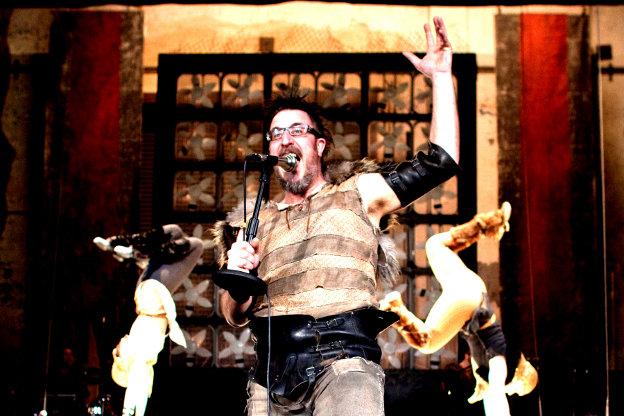
It takes as its major theme the maternalistic vs paternalistic society and sticks doggedly to it. Narrative is sidelined. Beowulf and his adversary Grendel (Jeremy Back) are dudes, Grendel’s mother (Jessica Jelliffe) is a revengeful witch, and King Hrothgar (Rick Burkhardt) seems to disappear.

The opening witty exchanges become rare as it dissolves into a motley musical, with songs in different styles – the blues number, the rockin’ number, the female wailing number. The performers are all strong and can deliver, but it is formulaic and has limited theatrical flourishes – namely thumb wrestling, water in containers, and a giant arm (now that was funny).

I’m all for a good time in the theatre, but need something more than a dramatically simplistic view of such a potentially rich text. A company like Little Bulb could, I think, have given it more depth and variety. The setting was good for it, and the audience cheered a lot, but it was certainly more of a late night fringe show than a main slot international festival offer.

www.bananabagandbodice.org