Author Archives: Lisa Wolfe

Lisa Wolfe

About Lisa Wolfe

Lisa Wolfe is a freelance theatre producer and project manager of contemporary small-scale work. Companies and people she has supported include: Thirunarayan Productions, A&E Comedy, Three Score Dance, Pocket Epics, Jennifer Irons, Tim Crouch, Liz Aggiss, Sue MacLaine, Spymonkey and many more. Lisa was Marketing Manager at Brighton Dome and Festival (1989-2001) and has also worked for South East Dance, Chichester Festival Theatre and learning disability arts charity Carousel. She is an occasional performer and installation maker in collaboration with other artists, and is a Trustee at Brighton Open Air Theatre.

Philippe Decouflé Company DCA: Panorama

Philippe Decouflé Company DCA: Panorama

Philippe Decouflé Company DCA: Panorama

First came the whistles, then the drums. Seven assorted-size dancers marched through the foyer twirling batons, looking very pleased with themselves in orange majorette outfits and unnecessarily high furry busbies. Cameras flashed as coats and drinks were gathered up and a happy throng followed them into the auditorium. Pity the poor folk in the upstairs seats who missed a great opener; lucky us in the stalls.

Decouflé is a master of the big stage picture. He has shown his versatility and range in the opening and closing ceremonies for Albertville Winter Olympics (1992) and more recently with Iris for Cirque du Soleil. His defining show Codex (1986) launched his career as a choreographer with an exuberant visual awareness and curiosity; since then his use of video has become one the defining characteristics of his performances.

For Panorama, Decouflé goes back to basics. He takes some very early works and re-stages them with a new company, different costumes, and a fabulous range of music created by six composers. It is episodic, much like the circus he so loves, and overseen by a Master of Ceremonies – Matthieu Penchinat.

The stage set is a big arching grid, a visual echo of tent frames, with the dancers changing in the wings by fairy lights. It’s informal, unpretentious and playful. There is so much variety of movement and style it is hard to pinpoint a ‘signature’ choreographic approach, other than to say it is sinuous, acrobatic and quirky with often gravity defying leaps.

Stand-out moments include a fantastic riff on computer games with human sound effects, a beautiful and funny aerial duet on bungies, and a heart-stopping solo by a dancer in huge antlers.

There is exquisite use of shadow puppetry melding into life-size cartoon characters and an all too brief taste of Codex with its surreal mutant beings.

Panorama ends with a tableaux of the company clicking imaginary castanets to Orlando’s Hideaway. The precision is absolute, the costumes (Philippe Guillotel) are again shades of orange; it is simple and sublime.

If Vague Café, for which Decouflé won the Bagnolet competition in 1983 and which has not been re-staged since, seems tame thirty years on, there is much to celebrate. I missed the film wizardry a little, but what a journey he has had and what a joy for an audience to see these re-envisaged pieces.
Gary Kitching and The Empty Space: Me and Mr C

Gary Kitching and The Empty Space: Me and Mr C

Gary Kitching and The Empty Space: Me and Mr C

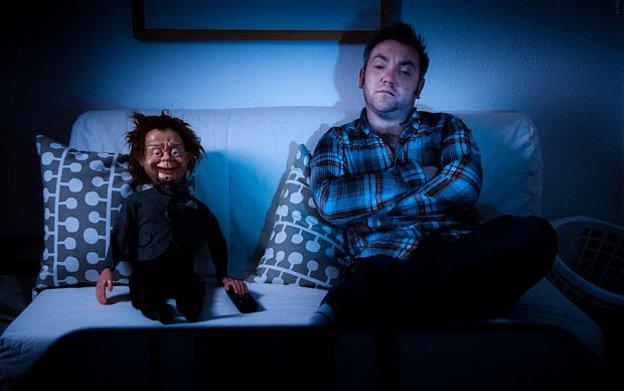
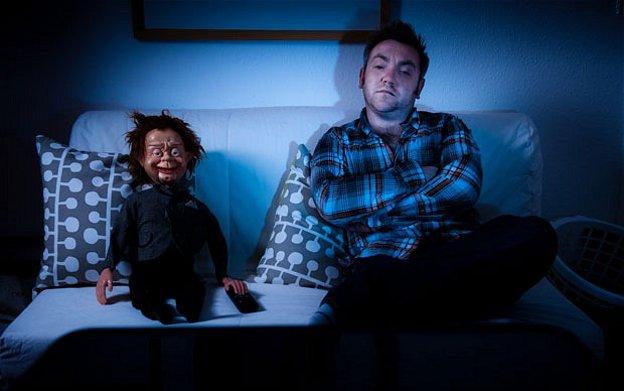
Gary Kitching is a direct, warm and welcoming chap. He establishes an easy audience rapport as he sets up the guiding premise of his show, Me and Mr C. We are to lower any expectations we might have for it, he tells us; he’s made it in order to have a one-man show as an actor rather than a comedian, and the whole thing will be improvised. Thus various audience members are allotted tasks that will assist this process, and the setting for the play is described so we can visualise it. Mr C is introduced – the rather alarming 1960s Chinese vent doll that features in the publicity photographs.

Twenty minutes or so in, the ‘play’ begins and our playfulness is taken on a darker, more complex journey. Gary’s character is exposed as a man suffering the fallout of his girlfriend leaving him, with no one to help him through these feelings of grief. His one friend is a silent dummy. To challenge himself Gary is advised to have a go at stand-up comedy. The audience has been primed to heckle and to not hold back.

In between his disastrous attempts at stand-up are visits to his therapist, on this occasion ably played by volunteer Tom, who reads audience questions and nods sagely when prompted. Gary brings in his improvisation skills in answering these questions; some riffs work and others fall flat.
Persevering with the stand-up he gradually loses it and here the piece balances on a sharp-edged knife. The audience on this occasion was still heckling cruelly as Gary went beyond comedy to a place of rage and despair. I felt he intended to take us with him, for us to be forced to stop being frivolous, stop playing, start listening.

The ending, in which Gary and the dummy swap roles is perhaps overcooking the subtext, but on this occasion it did make the audience realise that Me and Mr C was more than an invitation for it to raise its own voice.

Guilherme Leme: The Stranger

Guilherme Leme: The Stranger

Guilherme Leme: The Stranger

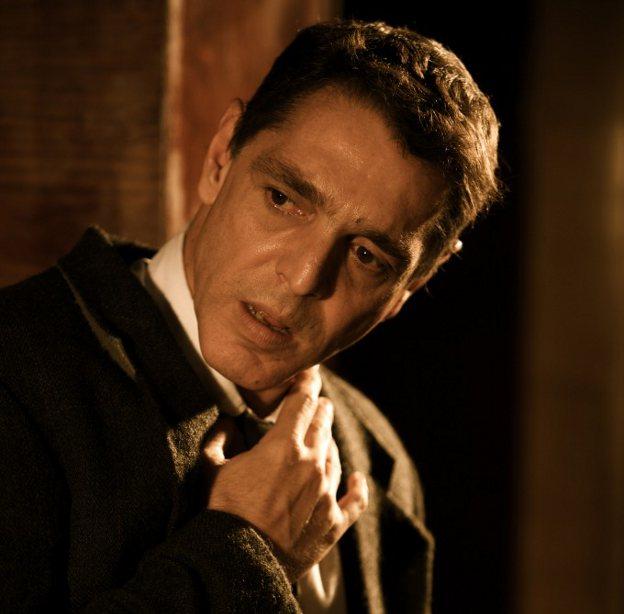
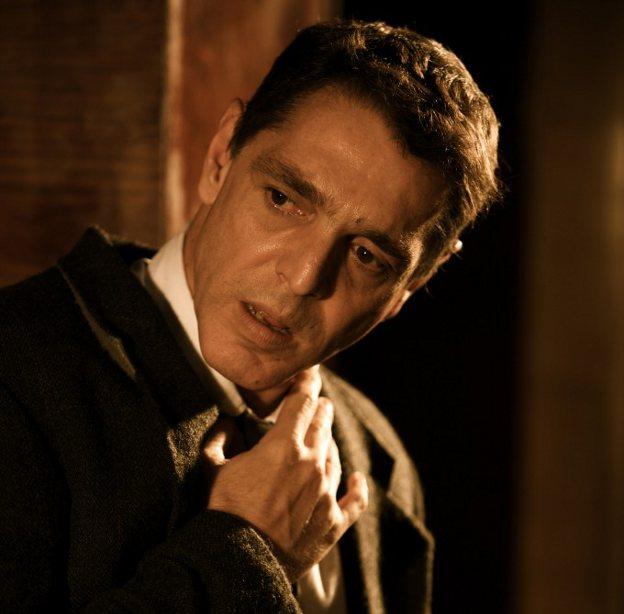
He seems a decent sort, this man Meursault, present at his mother’s funeral but not overwhelmed with grief. They had had an understanding and neither needed nor expected anything more of each other than they had. She had been at a happy point in her life, content in the place she lived and with a new male friend.

But by his inability to follow normal codes and modes of behaviour, Meursault becomes a victim of a society that cannot accept his philosophy or his way of living – his lack of belief in God, his seemingly heartless response to his mother’s death, and the naivety which leads him to kill a man and show such little remorse.

With echoes of Kafka’s The Trial, Camus’ L’Étranger presents an outsider who gradually comes to terms with his situation and his difference from others. He finds a release prior to his execution in a confrontation with the prison priest and his final wish for the crowd at his beheading to be full of hate.

This adaptation, by Morten Kirkskov, highlights the French/Algerian context. The life of the Arab comes cheap; the viciousness of Raymond, the ‘real’ villain, towards his Arabic mistress is seemingly accepted behaviour.

The story is told in a powerful and tightly controlled performance by Brazilian actor/director Guilherme Leme. The stage design is simple and striking in black and white. A central chair, a suit of clothes, beams of light, the sound of the Muezzin. Good use is made of these few forces, evoking the heat of the beach and the containment of a cell. Concentration does not wander and audience focus is complete throughout; we hang on the words needing to know more, convinced and somewhat spellbound.

Meursault remains a morally ambiguous and troubling figure, out of time, hard to like but with a fierce sense of righteousness. We are left with room to think as his final cigarette burns in the darkness.

Caroline Horton: Mess

Caroline Horton: Mess

Caroline Horton: Mess

Caroline Horton’s runaway hit You’re Not Like The Other Girls Chrissyestablished her as a writer and performer of some distinction – a gracious and engaging presence on stage with a good ear for the rhythm of prose and a natural wit.

Mess has been a harder call. A play about her own experience with anorexia, made for the Traverse and premiering at the Edinburgh Fringe – on paper it’s a challenging prospect. But Caroline has devised a method for telling the story that is clever and wise – one that takes Mess away from being a personal and inward focused piece and makes it into a play that could relate to any illness or human condition.

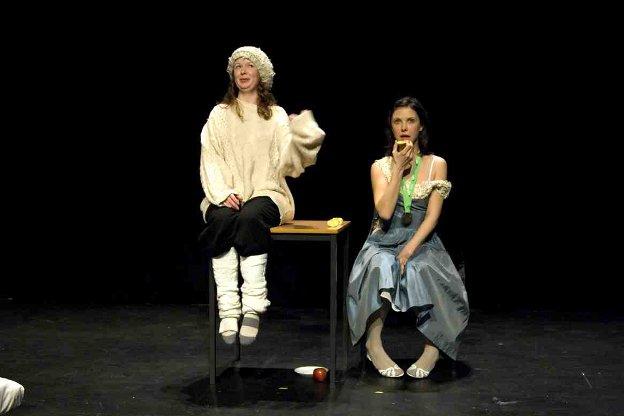
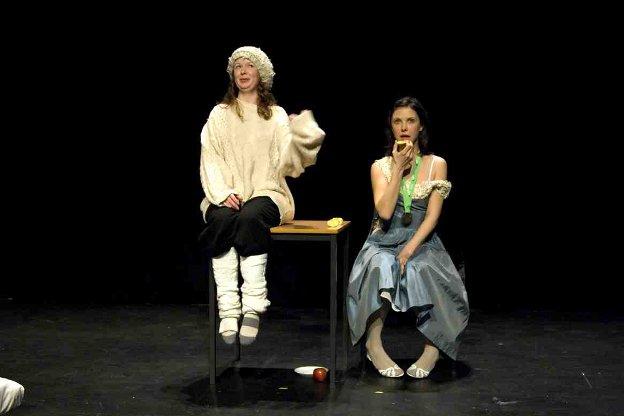
A cast of three, who perhaps trained at Lecoq, are going to put on a play to tell the story of Josephine who was an anorexic. The premise is that in the future this little story will be told on a big stage, with proper scenery and an orchestra in the pit and a much bigger audience. So for now we are getting Mess ‘Lite’. Josephine (Horton), is supported on stage by Seiriol Davies as Sistahl, who provides music and foleys, and Hannah Boyde as Boris, a sort of ‘everyman’ character.

Anorexia is represented by a high platform covered with white camberwick that stretches on to the floor. Josephine decorates it with a parasol hung with medals (for ounces lost), fairy lights and a duvet. Everything is white, calm, pretty and quiet up there.  In a text that weaves together painful mealtimes, episodes of hospitalisation, trips to the beach and visits to the doctors there is a subtle interplay between humour and despair. Josephine is so committed to her illness she cannot see how it affects Boris or anyone else round her. She doesn’t believe she might die. ‘You will if you don’t eat,’ says Boris, quietly, walking off set.

Sistahl provides an inner voice – ‘this is the sub-text’ – and undercuts Josephine’s more haughty moments. He is the counterpoint to her role in controlling the theatricality of the play.

Mess deals with a difficult subject and one that on the face of it might not have broad audience appeal. It is a tribute to Caroline Horton and her team of producers, her director and advisors that she has produced a play that, whilst not easy to hear, is a delight to watch.

The characters are engaging, the musical accompaniment has just the right tone and the piece is elegantly lit and staged. Like the illness it shines a light on, Mess is controlled and knowing, yet playful. There is little punch in the final message. The play can’t end because that would suggest the issue of young men and woman with eating disorders has gone away.  So we celebrate Josephine’s regained spontaneity and release, in the knowledge that Caroline will always be at risk.

www.carolinehorton.net

National Theatre of Scotland: An Appointment with The Wicker Man

National Theatre of Scotland: An Appointment with The Wicker Man

National Theatre of Scotland: An Appointment with The Wicker Man

It opens like a Farndale Avenue show. An am-dram production by the Loch Parry Players of The Wicker Man, with suitably dilapidated scenery, naff costumes and an inappropriate West End style showbiz song and dance number which is very ably done.

The core cast of familiar Wicker Man characters are assembled to rehearse, sending cues to the technician at the back of the hall, bickering and establishing their family relationships which will become integral to the subtext.

So far, so as expected. The entry of a ‘real’ actor, Rory Mulligan, a ‘TV star fromBlood Beat‘ changes the narrative to one of further intrigue and sets up the idea that the patriarchal Finlay Fothergill runs his Players with a fierce sense of self-aggrandisement and some malice.

There are several layers of theatrical conceit at work, a fair bit of slapstick, some very lame jokes, lots of Scottish jokes, and some funny ones that keep an afternoon crowd giggling. The key scenes of the film are portrayed bawdily and the songs, as ever, are delightfully twee and bonkers.

Written by Greg Hemphill, who plays Lord Summerisle, and Donald McLeary, it’s a fast-paced and ballsy production, directed by Vicky Featherstone. The performers enjoy themselves and the convoluted plot does play out to a satisfactory conclusion. The Wicker Man is actually made of metal – for health and safety reasons – and is impressive. The baddy – Lord Summerisle – gets burnt and it ends with another high-kicking song and dance routine with vivid lighting and a burst of silver sprinkles.  Whilst thin on any richer satire it’s a crowd pleasing show.

www.nationaltheatrescotland.com