Author Archives: Lisa Wolfe

Lisa Wolfe

About Lisa Wolfe

Lisa Wolfe is a freelance theatre producer and project manager of contemporary small-scale work. Companies and people she has supported include: Thirunarayan Productions, A&E Comedy, Three Score Dance, Pocket Epics, Jennifer Irons, Tim Crouch, Liz Aggiss, Sue MacLaine, Spymonkey and many more. Lisa was Marketing Manager at Brighton Dome and Festival (1989-2001) and has also worked for South East Dance, Chichester Festival Theatre and learning disability arts charity Carousel. She is an occasional performer and installation maker in collaboration with other artists, and is a Trustee at Brighton Open Air Theatre.

Ivana Muller: 60 Minutes of Opportunism

Ivana Muller: 60 Minutes of Opportunism

Ivana Muller: 60 Minutes of Opportunism

I decided to see 60 Minutes of Opportunism knowing precious little about Ivana, her work or this particular piece, just taking the words and image from the Basement’s brochure as my guide.

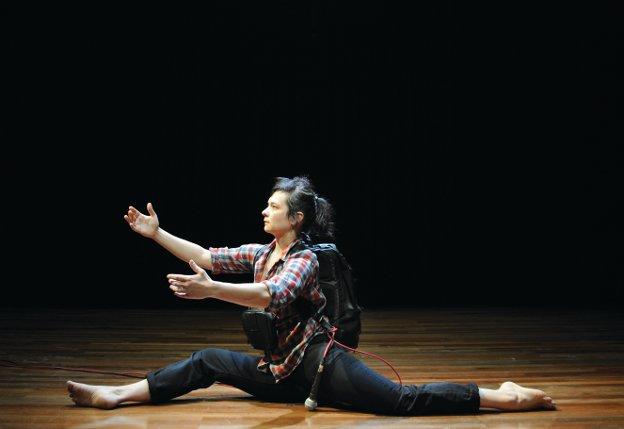
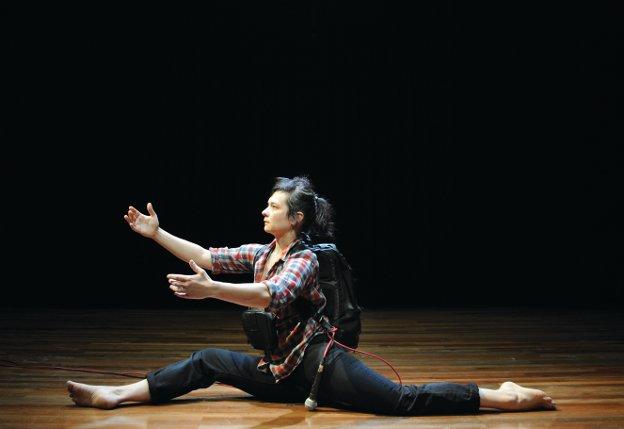
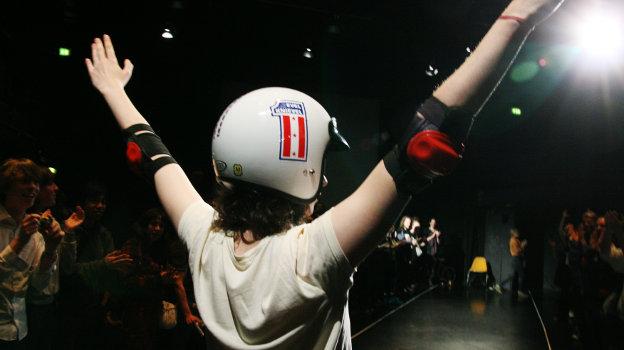
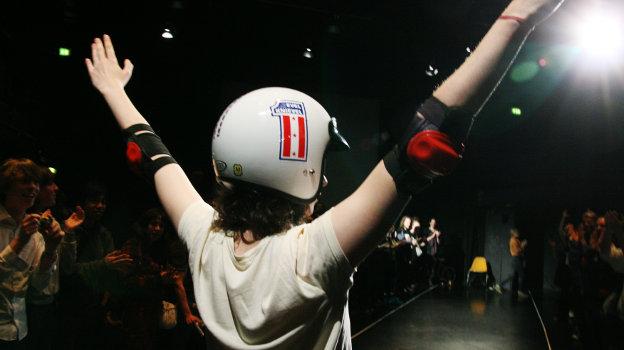
The seating is raked up one end of the space, with a long and empty vista ahead. Into this walks Ivana, wearing a green top, black trousers, carrying a backpack and with a pouch on her chest. A microphone dangles by her hip. She has a faraway look in her eyes. There is a continuous beeping sound. I like her look and composure as her voiceover begins to reveal the premise of the performance.

Ivana has been asked to make a show in which she is physically present on stage, rather than behind the scenes (she is a choreographer) and with no use of film. Not trusting her ability to dance well enough, or not wanting to, she subverts this request into a text-based piece which requires the audience to look at her and listen, to imagine scenes, to visualise her dancing, to take a journey with her.

The text is punctuated by the repeated refrain ‘I want to take this opportunity to…’ Opportunism has a negative connotation. She’s taking advantage of our patience as an audience and offers a playful challenge. The piece is series of suggestions, commands, jokes, asides and thoughts. Ivana controls the voiceover and switches between this and her live voice via her chest pouch. High-heeled shoes are taken from the backpack to help us view her as a dancer; longer legs, more feminine. She holds a ‘dancer’ pose. The shoes don’t stay on long. She pretends she’s got a bomb in her backpack. She smokes a cigarette, despite having given up. She sings us a song to her own Karaoke backing. Although little happens in terms of movement or action there are plenty of images conjured through the writing. There is a clever wit at work playing with the relationship of performer to audience, of self-representation and the audience gaze.

In essence she plays with the conventions of what we expect a performer to do. The Ivana whose voice we hear is somehow different from the one on stage. She says this is the first time she’s been on stage since 2002, yet the physical Ivana is touring the show and has performed it fourteen times (I admit I looked that up on the interweb). That it doesn’t become pretentious or boring is evidence of the thought and skill that have gone into its making and to Ivana’s confident, disarming performance.

Covering herself with a black cloth, she begins to crumple. The narrative becomes more internalised and revealing now that we can’t see her. She, however, can see us.

At forty minutes in, and acknowledged by Ivana, it is the right time for something new to happen. From the rear door, other black cloth covered people appear and adopt fixed poses. It’s like a railway station concourse full of static commuters – uniformed, homogenous, rendered invisible. One becomes a mountain for Ivana to climb. The audience needs a change of viewpoint and she needs to overcome her vertigo. The cloths are removed to reveal the characters beneath; volunteers who hold their poses beautifully and with great strength of character.

By the end of the show I feel I have got to know Ivana, to like her style, her voice and her mind. When she finally meets our gaze, puts her eyes into ours, it feels like an act of friendship and a thank-you rather than a smug establishing of authority. It has been an intricate and intimate hour of self-centred opportunism that didn’t alienate the audience. We hear repeated beeping again… is the bomb about to go off?
www.ivanamuller.com

Action Hero: Watch Me Fall

Action Hero: Watch Me Fall

Action Hero: Watch Me Fall

I have an in-built suspicion of young companies who suddenly become darlings of the critics and the theatre-pundits.

Action Hero is one such, and though I enjoyed their previous production, A Western, I couldn’t compute the measure to which it overwhelmed many who saw it.

So I was pleased to find myself engaging far more with Watch Me Fall, which to my mind is a piece with more to say and a more theatrical construct for saying it.

Based around the theme of daredevils, but largely focused on Evel Knievel, it has a traverse set-up with the audience on two sides. We are onlookers at a series of stunts rather than participants, encouraged to whoop and holler from the start. This is what expectant audiences do. We are here to see something spectacular happen. We can see that this will be stunt-lite, given the limits of the space, the ping-pong balls, mini-Coke bottles and mini-bicycle, but still we join in with the unashamed crowd rousing from the tousle-haired James Stenhouse. The well chosen music contributes too.

Referencing daredevils such as Henri la Moth who, aged 71, dived 40ft into only 14 inches of water and Roy Fransen, who dived 60ft into a blazing pool after first setting light to himself, under various pseudonyms (Dunc Danger, Jonny Legend, Dick Cheney) James performs a range of innocent stunts for our pleasure. Assisted by Gemma Paintin in a stars and stripes dress, they pop ping-pong balls from mouth to bucket and play mini golf, set light to the crash helmet, do weight-lifting with big bottles of Coke.

Our discomfort grows as the stunts take a tougher turn. Gemma kicks James around the head with real energy, he waterboards her with Coca-Cola and then he makes the jump off the ramp on the little bike, landing in a broken heap. This final act mirrors the grim end of Knievel’s career in 1975 when he broke many bones and finished up in a coma for months.

Action Hero layer this engaging spectacle with ideas around the attractiveness of the alpha male and the public’s seemingly unending thirst for entertainment at any cost. It doesn’t go particularly deep, but it is thought provoking. I particularly liked the nod to London 2012 and the incongruous sponsorship of sport by Coca-Cola, and the frisson of danger from being so close-up. The whole was made more enjoyable by the presence of a group of young kids opposite me (a breakdance troupe perhaps) who were very keen to get some free pop, keen to chuck balls around, and genuinely pretty terrified when events turned dark. They are the audience that matters. I wonder what star rating they would apply?

www.actionhero.org.uk

Tonight Sandy Grierson Will Lecture Dance and Box ¦ Photo: Idil Sukan

Sandy Grierson / Lorne Campbell: Tonight Sandy Grierson Will Lecture Dance and Box

Tonight Sandy Grierson Will Lecture Dance and Box ¦ Photo: Idil Sukan

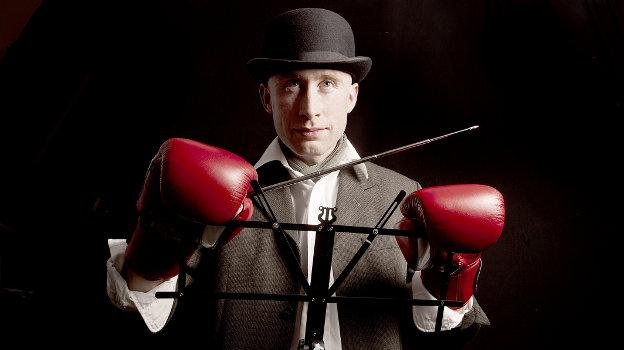
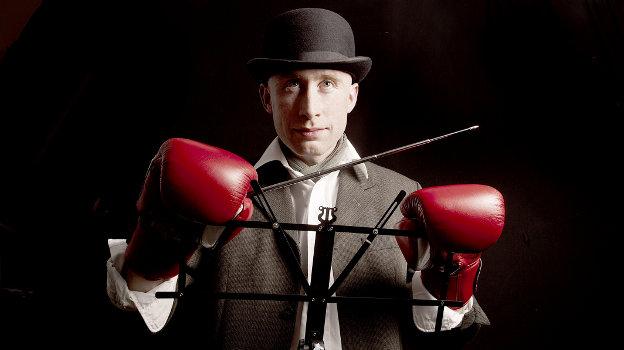
‘Arthur Cravan: poet and boxer, captain of industry, sailor of the Pacific, muleteer, orange-picker in California, hotel thief, snake charmer, grandson of the Queen’s chancellor, nephew of Oscar Wilde, lumberjack in the great forests, chauffeur in Berlin, Alfred Lord Tennyson’s great nephew’…and so the list goes on.

He is best known as a writer and weaver of tales, which gives the performer of this piece the opportunity to take as many liberties with fact and fiction as they like. To play with form, to play with the audience and to effect an act transubstantiation, as actor becomes subject.

Sandy Grierson and co-creator Lorne Campbell have taken the play through many stages of development to reach its current state of text, movement and meta-theatrical construct. The audience is in on it from the start; there is no pretence or over-cleverness. If you are told at the beginning that Sandy (playing Sandy) met his great grandfather Arthur Cravan in a drum and bass club in Lisbon in 2010 – and that Arthur was born aged 22 – you can relax and enjoy the ride to come.

Highly enjoyable it is too. Our programmes become paper hats and several of us are given roles to play, or asked questions, and memorably, brought on stage to box (in my case Tom Morris who did sterling work with the fists). Sandy is magnificent and mercurial given the complexities and conceits of the text and the physicality of the role. There is a delightful looseness of limb about him and he works the stage like a prize-fighter, confident in control of a small range of props and the audience.

The story moves through various episodes in Cravan’s life, introducing a range of characters: Marcel Duchamp, Trotsky, Apollinaire and Mina Loy, the love of his life. Audience members are allotted these names but other than Mina are not invited to engage much more. The piece ends beautifully as we pass a paper boat around the auditorium, waving goodbye to Mina on the coast. We are asked to consider our options – to leave forever or return to port and Mina. Sandy tells us: ‘Know that dreaming you are here, know that dreaming you are there, is exactly the same. Know that a slight imaginary choice is the only difference and that for good or bad you are making it.’ And we still have our boats, if we should ever need to use them. It’s a great metaphor for what theatre can do, how it can affect change and take you places whilst being aware of the actor on the stage and our complicity and involvement in its making.

Barrowland Ballet: A Conversation with Carmel ¦ Photo: Brian Hartley

Barrowland Ballet: A Conversation with Carmel

Barrowland Ballet: A Conversation with Carmel ¦ Photo: Brian Hartley

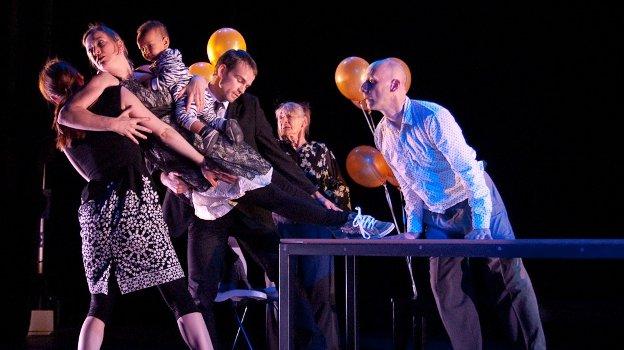
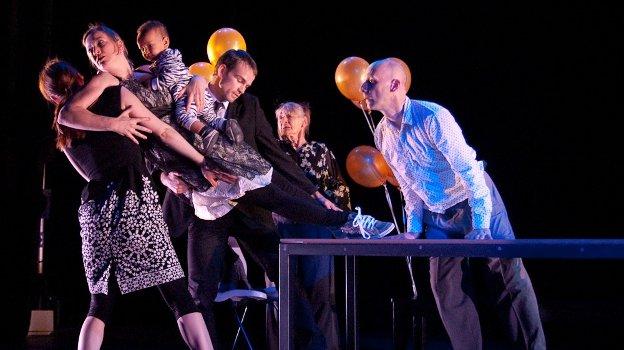
The stage is set simply: two long tables with white tops, a cup and saucer placed centrally on each, and behind one, prim and petite, sits Diana Payne-Myers. She is the eponymous Carmel, celebrating her 80th year with a family gathering that exposes truths and tests assumptions, and within which the life-enhancing benefits of dance are central. Two younger dancers, Vince Virr and Jade Adamson, have a lovers’ tryst around and about the tables. Matthew Hawkins, in a dad’s cardigan, is a benign presence, and Natasha Gilmore with her scene stealing baby Otis completes the professional company.

Tabletops become screens for films of a range of mothers and fathers, all dancers in their own way. Their chat charts the ebb and flow of family life, from the loving and nurturing of their babies, to their disappointments and regrets. These on-screen lives are a powerful counterpoint to the dance on stage. The choreography is fluid and rhythmic as in groups, duets and solos each family member expresses an emotional response to Carmel’s strength and frailty, and to the new baby in the family. A further dimension is added through a dancing chorus of people from Edinburgh. Mixed in age, gender, size and ability they are a warm and happy gang – the extended family perhaps. Again, the movement is perfectly matched to tell this story with tableaux and some fine show-off party pieces.

As a piece that sets out to explore cross-generational attitudes to dance it certainly achieves its goals. The dance is lovely to watch, the use of space and the interweaving of film and chorus very well managed. There is the added frisson of a toddler on stage, and Natasha fairly heavily pregnant, and an eighty year-old who can do the splits with ease but has the frame of a bird. These take it a touch beyond sentimentality. Most moving for me was the final filmed scene of the on-screen contingent, dancing together rather than being talking heads, showing their signature styles. Hats off too to Quee Macarthur’s original music, which, together with some well chosen pop-numbers, made me feel like dancing.

www.barrowlandballet.co.uk

Ray Lee: Ethometric Museum

Ray Lee: Ethometric Museum

Ray Lee: Ethometric Museum

Six people, wearing hard hats and treading carefully, are led into the basement of the Hill Street Masonic Lodge. Dr Kounadea, in a neat tweed skirt suit and sensible shoes, explains that we are about to enter some ancient tunnels, wherein was found the Radiometric Analyser Mark 4. There are concentric circles etched into the metal disc atop the wooden box with knobs on: perhaps, says the Dr, they are ancient signs?

So begins our visit to the Ethometric Museum, a dark and atmospheric space in which to encounter these wonderful machines, devised to generate ‘a system of harmonically resonant sound and electromagnetic waves that can generate “goodwill” among the recipient organism.’

They do this, if operated by a trained practitioner, by retuning our super-electrical fields and realigning the body’s electrical flow, thus counteracting the overwhelming and often negative proliferation of radio and microwaves with which our minds are daily bombarded.

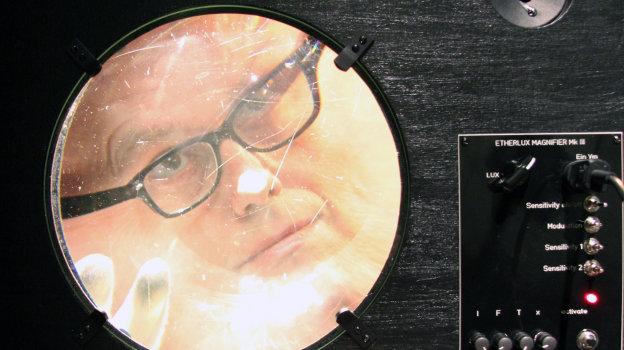
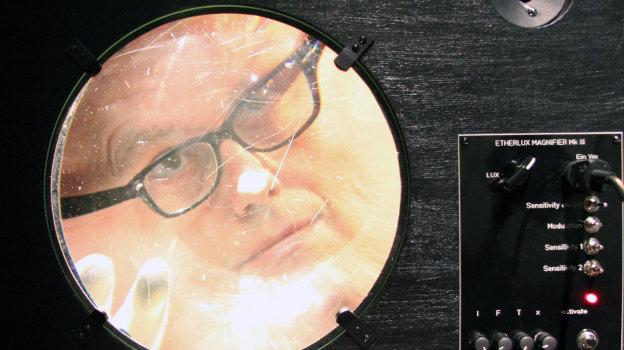
It might sound a bit heavy going, but this is a delightful conceit, explained with deadpan but genuine excitement by the Doctor who steps aside to allow Professor Ray Lee to enter. Slowly and meticulously his white gloved hands twiddle knobs, adjust frequencies and volume, spin metal balls on rotating wheels and build an aural and visual world for us to explore at our own pace. Personal favourites are the Etherlux Magnifier Mark 3, with its booming background sound and theremin operated by his magnified hand, and a device that creates the effect of subatomic particles whizzing round and jumping over his fingers. An exquisite palette of sounds is created in this echoing chamber.

There is a backstory of company takeovers (the first being set up in 1765), a fire in Dalston which destroyed many valuable pieces, and the establishment of the World Ethometric Association to present these remaining wonderful machines to the world.

The curated tour finishes with large, spinning discs which have a richer sound and an undercurrent of something that sounds a little bit like voices, indistinct and otherworldly, but connecting us through their ‘arete’ (virtue) creating ‘eunoia’ (goodwill).

Less grandstanding than the Professor’s previous installation, Siren, this is a winning combination of a theatrical device, sound, vision and proper science.

www.invisible-forces.com