Author Archives: Lisa Wolfe

Lisa Wolfe

About Lisa Wolfe

Lisa Wolfe is a freelance theatre producer and project manager of contemporary small-scale work. Companies and people she has supported include: Thirunarayan Productions, A&E Comedy, Three Score Dance, Pocket Epics, Jennifer Irons, Tim Crouch, Liz Aggiss, Sue MacLaine, Spymonkey and many more. Lisa was Marketing Manager at Brighton Dome and Festival (1989-2001) and has also worked for South East Dance, Chichester Festival Theatre and learning disability arts charity Carousel. She is an occasional performer and installation maker in collaboration with other artists, and is a Trustee at Brighton Open Air Theatre.

Schweigman&: Blaas (Blow)

Ever dreamed you were being smothered by a giant marshmallow? Me neither, but this is one of the many thoughts or sensory images that might occur when watching Blaas

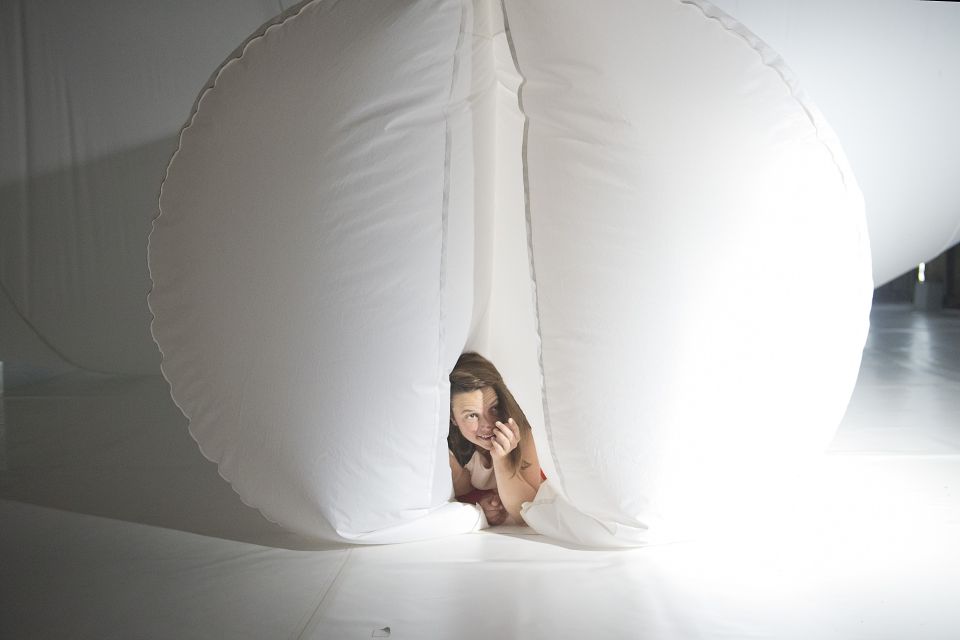
Categorised as dance in the Brighton Festival programme, it is a dance of sorts – between an inflated white cube and an audience, initially seated. Director Boukje Schweigman says her intention is to make us think about our bodies in relation to a space or an object. Blaas, meaning blow or bubble in Dutch, is a collaboration with designer Cocky Eek, who, apart from having a brilliant name, has created a sensational bit of kit with which to fulfil that intention.

It would be unhelpful to say what (ahem) unfolds, as this is a seriously experiential work. I find myself considering scale: the big billowing cube, skilfully manipulated by performer Ibelisse Guardia Ferragutti, seems delicate in the lofty public gymnasium. I’m aware of it clanking against metal doors and reflecting light from the green netting that separates off the basketball pitch. There’s a feeling of being underwater from that green light and the way the thing sways, lifts and rebounds almost weightlessly, anchored by human limbs inside. Some might find the setting distracting but I like how this workaday environment contrasts with a pristine, almost clinical, otherworldly encounter.

Further transformations take the audience by surprise and increase our anticipation. There have already been confrontations with air-filled fabric and now things are getting bigger, louder and closer. We feel a little in jeopardy on tiered benches as our plastic foot coverings rustle against Jochem van To’s subtle and curious music. His soundscape seeps into your brain, occasionally reinforcing the idea of oceans with whale song and clicks. A boy who looks about ten is spellbound and keen to engage and it’s a shame he’s the only child: the guidance age of twelve seems strange.

That said, I keep seeing body parts amidst the abstraction of form: a bosom with an inverted nipple, a sphincter. Fabric full of air lends itself to these images, especially when gripped and twisted in a fist. You’re never unaware of the person making things happen, and you do get to meet her (she pops out of another orifice), but you can suspend disbelief enough to feel wonder and enjoy working out how it is all done. Who is running around the outside? How are the fans positioned to make such effects? In the central 20 minutes of the show, when we’re asked to just ‘be’ in the chilly space, I think about other large inflatables encountered over years of theatre going. Forkbeard Fantasy’s magnificent pneumatic Blue Woman, The Luminarium becoming a glowing and disorientating space for dancers, the Udderbelly deflating on the Ornate Johnson’s in 2008, turning into a giant purple cow pat…

The masterstroke comes in how the piece resolves. We have all been quite separate for the past hour, thinking about breath or light or nipples (OK, just me) but the company cleverly brings the audience together at the end to the extent that I was I able to blag a lift home from a fellow traveller.

File it under a visual, sensory, performative, disorienting experience then. Or, as my kind driver said when asked why she had booked for this show: ‘I had no idea what it was. I just like the strange stuff.’


 Featured photo (top) by Geert Snoeijer.

 Schweigman& will be presenting For The Time Being (UK premiere) at IF, Milton Keynes International Festival, on 22 and 23 July 2018.


Dancenorth, Lucy Guerin Inc, Gideon Obarzanek & Senyawa: Attractor

We are at a tribal campfire or perhaps a sweat-lodge. At the centre our Shamans, the Indonesian musicians Senyawa, are building an unearthly soundscape from Rully Shabara’s throat and Wukir Suryadi’s bamboo spear.

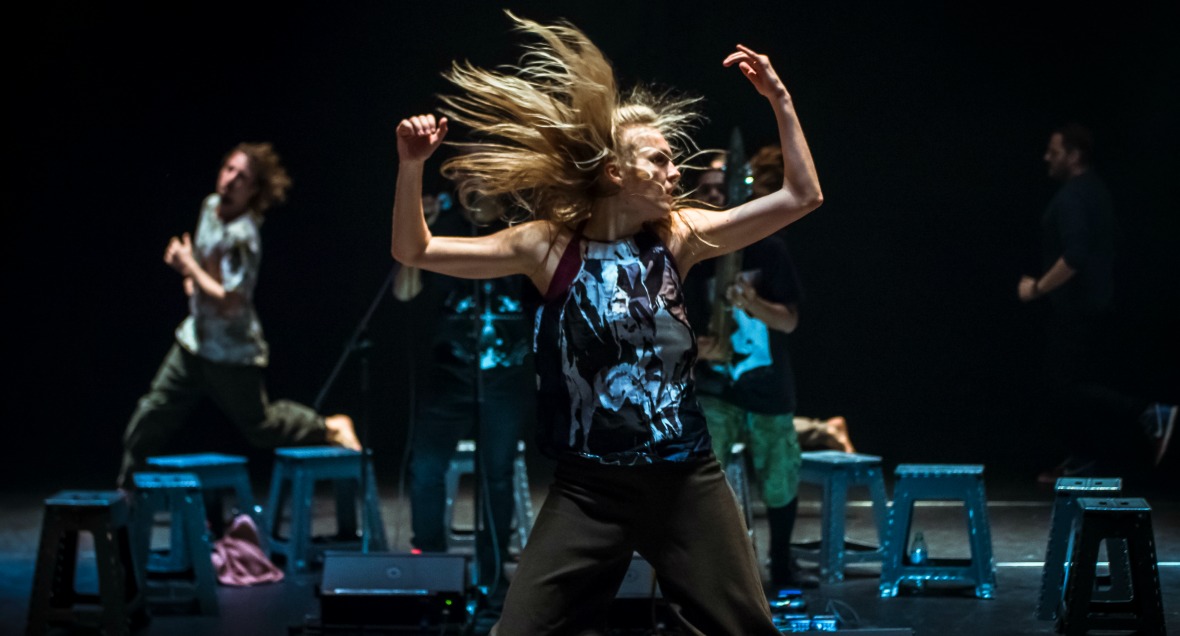
At a certain moment, when the energy is ready, the eight dancers spark out of the circle like electricity – shaking, whirling, sinuous, crazed.

Lit like a Caravaggio painting (by Ben Bosco Shaw), Attractor is beautiful to look at and deliciously abandoned. It’s no surprise to read in the programme that the Australian directors/choreographers Lucy Guerin and Gideon Obarzanek met Senyawa at a traditional trance ceremony in Java: they have transmuted that experience into the work with all its raw energy and transcendental overtones.

Whilst Attractor uses some familiar contemporary dance tropes – dancing in unison, flailing limbs, repeated rhythms, running in circles, and flinging of hair – it avoids ever being dull. How? By always having the stage picture in mind and choreographing with an artist’s eye. Patterns are formed and swiftly broken at a satisfying pace. Amidst the euphoric action are moments of repose and gathering, of listening and breathing. A Pina Bausch-esque tableau gives us a pale and flickering kaleidoscope of arms and fingers.

The integration of the musicians into the work is skilfully done. At one point they are picked up, still throat gurgling and flute tooting, and moved around the stage, then dragged along the floor. The Shamans are temporarily spent. There seems to be percussion coming from the audience – it is, and soon the dancers are joined on stage by a procession of ordinary folk who join their circle and begin to dance. It’s an open-hearted gesture that adds extra humanity to an already heart-felt piece. The company has, throughout, been one of unity with no stars or lengthy solos, and now the mass of people move through simpler steps as one big family, different shapes and sizes, each themselves yet part of the whole.

It’s no surprise that Attractor has won several awards around the world. Nick Roux’s sound design is a masterpiece in its own right: the music is truly exciting. Only the rather lacklustre costumes, which are little more than street-wear, let it down.

But in the way it makes dance so vital, so part of everybody’s life, is magnificent. I would have joined them all on stage and danced myself to oblivion given half a chance. Maybe next time.


Ever So English: Caravan 2018

Lisa Wolfe attends Caravan, a biennial showcase that introduces England’s brightest independent theatre artists to festival organisers from around the world. 

In his welcoming address to Caravan 2018, Gavin Stride, director of host organisation Farnham Maltings, described the event not as a showcase, but as a conversation between ‘us’ (Caravan self-describes as ‘new English performance’) and the rest of the world. That conversation is getting harder to navigate as we move towards Brexit, but we will, he believes, be defined by the things we share, as that is how we express who we are.

The programme, held over four days in May, follows the Edinburgh British Council Showcase model of performances, a ‘marketplace’ of stalls hosted by artists, and pitch sessions. Caravan is a partnership with Brighton Festival (within which it is embedded) and supported by the British Council, whose programme managers, along with the Caravan team, liaise between delegates, artists and producers to further these conversations.

Work presented in this year’s showcase (as I’m afraid I am going to continue to call it, because great conversation aside, that is what it really is.) included the Total Theatre Award winning Palmyra, an investigation of the politics of destruction, made by the creators of Eurohouse, Bertrand Lesca and Nasi Voutsas; Milk Presents’s acclaimed Joan, performed by drag king champion Lucy Jane Parkinson; and Gobbledegook Theatre’s mesmeric outdoor arts piece Cloudscapes, which Total Theatre Magazine saw at Inside Out Dorset 2016.

Due to time restrictions, I could only experience a small sample of the programme – but that sample included Stopgap Dance Company’s The Enormous Room, a reflection on bereavement reviewed here; Third Angel and SBC Theatre’s durational installation The Journeys, reviewed here; and a smattering of the pitch sessions and presentations.

On Monday, I slipped into the Old Courtroom in time to hear Anna Beechar and Rachel Lincoln present a pitch for their show for babies, Nest, which was a great success at Brighton Festival 2017. In this rather adversarial setting, more suitable for a Ted talk than a ‘conversation’, the attention was firmly on the work and the artists and all the pitches were well received.

Jenny Sealey MBE has been ‘Shouting and Signing from the Sidelines’ (as her provocation on Tuesday afternoon was titled) for nearly three decades as the artistic director of Graeae, who describe themselves as ‘a force for change in world-class theatre, boldly placing D/deaf and disabled actors centre stage and challenging preconceptions.’ She talked passionately about loving difference, the importance of authenticity in casting, how accessibility needs to be artistically imbedded in the work and the lack of training for D/deaf and disabled artists in the UK. What most provoked her was that despite the huge gains achieved through, for example, the Paralympic Opening Ceremony (which she co-directed), and the strides being made by Arts Council England and others, she is still having to do daily battle to make diversity in all its senses understood. Her words all rang true to me from my work with Carousel’s learning disabled artists, who, if anything, have even higher mountain to climb in terms of visibility and viability as artists.

As for the marketplace, it was good to see Brighton artists Seth Kriebel and Rachel Henson in the mix alongside Edinburgh Showcase favourites such as Deborah Pearson, Blind Summit, Dante or Die, and the inevitable Richard DeDomenici.

There were a few shows programmed at Caravan that I’d seen previously, including Ursula Martinez’s Free Admission, about which I wrote: ‘She’s not one to do things by halves, so if there’s going to be a stage metaphor, it’s going to be a bloody great big one.’ Since making this show, she’s been baring her all with Adrienne Trustcott and Zoe Coombs Marr in Wild Bore, which divided critics but, when I saw it, held and entertained audiences. From the social media gossip around the Caravan performance, it seems Free Admission is having a similarly divisive impact amongst some who saw it.

I’ve followed Victoria Melody’s career for about ten years, seeing her change from visual artist to solo performer and now heading up a mid-scale show with a New Orleans style band and her dad in a giant barrel. Ugly Chief, which I saw at BAC last year, is hugely ambitious and risky – her dad, Mike Melody, whilst no stranger to performance (he’s a TV antiques pundit) is a liability on stage. The push and pull between them, and his staged demise, is often hilarious and frequently disarming.

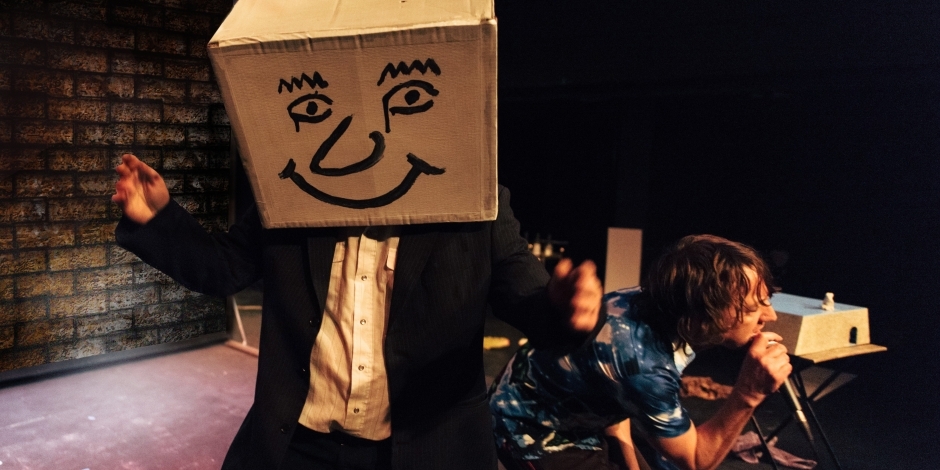
Vic Llewellyn and Kid Carpet’s The Castle Maker is a lively battlecry for art in all its messy glory. I loved this show in Edinburgh Fringe last year, as did Dorothy Max Prior when she reviewed it.

When I asked an Italian delegate if she enjoyed The Castle Maker, she said yes, but it was ‘very English’. I think the same might be said of Ugly Chief, which if anything is more idiosyncratic – but both shows have universal themes: the democracy of art in one, the inevitability of death in the other.

It seemed an odd comment, too, given that Caravan is all about new English performance. Perhaps some national characteristics just can’t translate after all. It will be interesting to see which of this year’s showcase works make waves overseas.


Additional material by Dorothy Max Prior.

Featured image (top): Vic Llewellyn and Kid Carpet: The Castle Builder. 

Caravan is delivered by Farnham Maltings with the ambition of increasing the national and international profile of England’s artists. This year’s programme took place 12–15 May 2018 as part of the Brighton Festival.


Third Angel and SBC Theatre: The Journeys

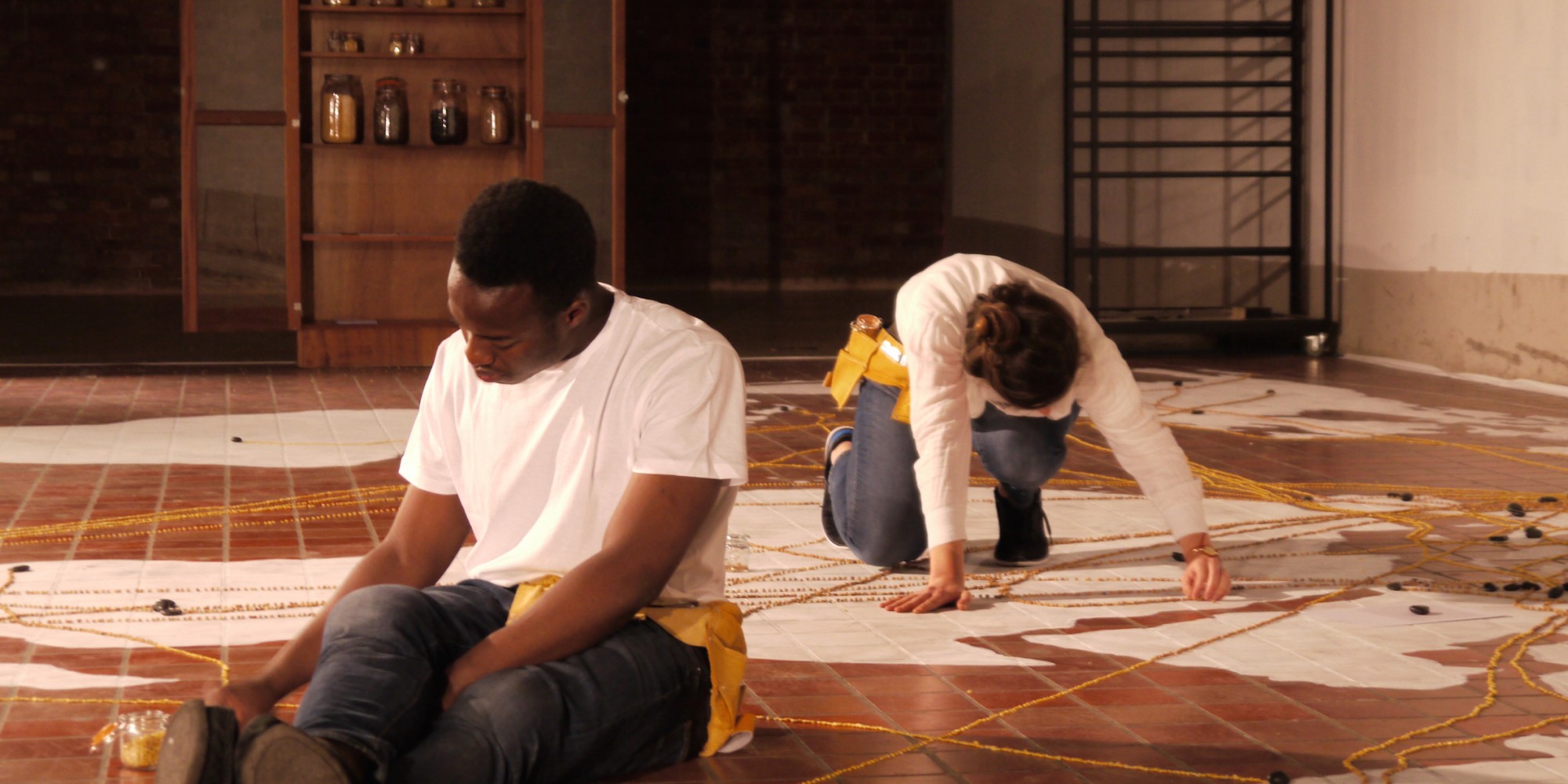
Here is one of those ideas that seems simple on the surface but which digs deep. Across a map of the world, two men and two women are gently placing split chickpeas in lines, joining points between black pebbles. The lines mark journeys, and notes of some of these journeys are read out at intervals. You can read them too, placed along the map’s edge.

There are stories of migration and immigration, at once personal and political and the gentle rhythm of the work being done on the floor, and the non-theatrical delivery of the readings has a quiet power. Sunlight filters through high, stained glass windows. There are dark wooden pews to sit on. Both add to the peacefulness and intent of the action.

It’s not unlike Stan’s Café’s Of All The People In All The World, which used another well-traded commodity – rice – bringing abstract statistics to life through piles or grains of rice. The Journeys may lack that show’s visual impact and wow factor, but it speaks powerfully of life today for hundreds of thousands of humans.

Some will find the speakers insufficiently performative and mutter ‘use bigger print on the cards’ or ‘get some sight reading practice’. But I found the occasional mis-reads and hesitation refreshing – they are representatives of ordinary folk, and it’s good to hear an ordinary voice.

As invited, I wrote my own migration story, which for my forebears involved a timely escape from pogroms, but which has had little impact on how I have lived my life. The Journeys is a graphic reminder that for many, that is sadly not the case.

The production, presented by Brighton Festival as part of the Caravan showcase, is a collaboration between SBC, the UK’s first Theatre Company of Sanctuary and Third Angel, who have been producing politically engaged work since 1995. Initially commissioned by Migration Matters Festival in Sheffield, it is a piece that can travel easily and resonate widely across borders.


Stopgap Dance Company: The Enormous Room

It’s a Jewish custom to cover mirrors and black out windows for the seven days of mourning following a death. ‘Sitting shiva’ brings people together to sit without thought of themselves; the lack of mirrors denying vanity and bringing the focus inwards.

This is the state in which we find bereaved husband Dave and his daughter Sam. They’re unable to talk or even look at each other. Each is trapped in their own deep grief. There’s a sense of the past all around: the trace of long gone pictures on the walls, nostalgic 1970s music, a Jack Warner movie on the telly. And there are ghosts, two women, one for each mourner, to help them find a way through their grief and ultimately to find each other.

Stopgap tells this story in a dance of two parts, performed initially against James Lewis’s clever, stacked set of living room furniture and high windows, with lighting designed by Chahine Yavroran (continuing a long relationship with the company). David Toole, known for his work with DV8 and Candoco, and here in his fourth collaboration with Stop Gap, plays Dave.

He’s hulking, moody and uncommunicative, distracting himself with coffee from a flask and an old film, trying to avoid his teenage daughter’s brewing romance. Hannah Sampson’s engaging Sam is every inch the uppity, hormone fuelled teen, unable to stay still except when gripped by grief. This gap between them is partly filled by the two ghosts (Meritxell Checa/Elia Lopez and Amy Butler) whose synchronised movements and similar appearance makes this an interesting quartet. When Sam’s friend Tom (Christian Brinklow – all sharp shapes and break-beat rhythms), and Death’s servant Chock arrive, the stage is suddenly full with competing energy and style. You sense that something is going to give.

Chock is a taunting sprite, emphatically performed by Nadenh Poan, flinging his lower limbs about with abandon, making remarkable use of his remarkable body. It’s a given with Stop Gap that physical difference is celebrated and exploited. In the second part of the show, when all the dancers work as an ensemble and fill the floor, this strength is most in evidence.

The narrative of the final episode is hard to read from the choreography alone: it’s lovely to look at, if over extended, but less clear what it is trying to say. I’m all for dance just happening for its own sake, but there is definitely a story trying to come out here. I wonder too who Dave is talking to when he describes his wife’s accident? If not himself it must be us, but I’ve no idea where we come into this, especially when addressed directly by Chock. Are we being warned of death’s approach too? It’s something to ponder as the talented cast take their bows.

The piece was devised by the company with artistic director Lucy Bennett, and credit should go to whoever suggested and choreographed the performed interval. Deconstructing a set and moving artists around a stage has never been so gripping. David Toole is unceremoniously tipped off a table top into a chair and the floor tape is wrenched up with a satisfying rip. Everyone moves in silence fitting seamlessly into a complex pattern. It’s an interval that no-one wants to leave – that’s a tribute indeed.


Stopgap Dance Company’s The Enormous Room was presented at Brighton Festival 2018 as part of Caravan, a biennial showcase of England’s independent theatre-makers.