Author Archives: Lisa Wolfe

Lisa Wolfe

About Lisa Wolfe

Lisa Wolfe is a freelance theatre producer and project manager of contemporary small-scale work. Companies and people she has supported include: Thirunarayan Productions, A&E Comedy, Three Score Dance, Pocket Epics, Jennifer Irons, Tim Crouch, Liz Aggiss, Sue MacLaine, Spymonkey and many more. Lisa was Marketing Manager at Brighton Dome and Festival (1989-2001) and has also worked for South East Dance, Chichester Festival Theatre and learning disability arts charity Carousel. She is an occasional performer and installation maker in collaboration with other artists, and is a Trustee at Brighton Open Air Theatre.

Indepen-dance 4: A:Version

Terminology can often strangle debate around work made by people with learning disabilities – or is that difficulties, or disorders? If a company has both learning and non learning disabled people is it integrated or inclusive? Whether these distinctions even matter is a hot topic, so it is great to see two dance pieces starring learning disabled dancers programmed into an important dance venue at a major arts festival. The approach to making the work is what is interesting and the particular, nonconformist nature of the dance produced. Who wants to see everyone doing the same thing in the same way? Here is originality and a different world view. Bring it on.

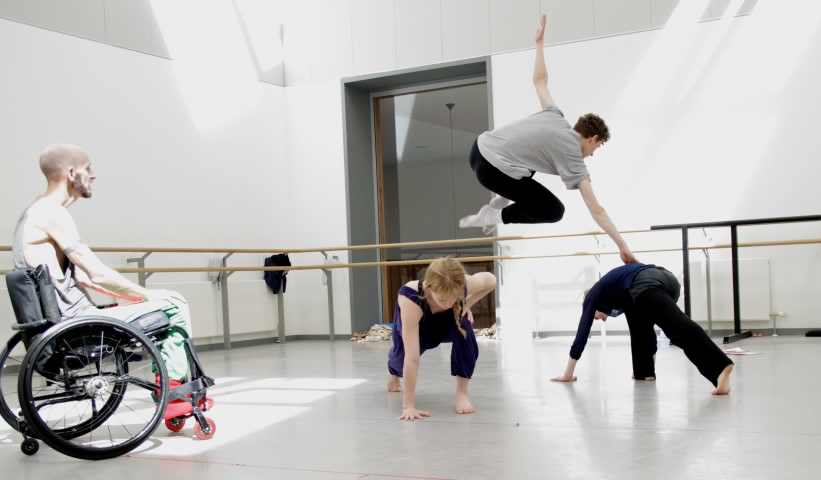
Like Ian Johnston’s Dancer, A: Version also takes apart the creative process, showing us a rehearsal for a piece, with all its mistakes and marking and mucking about. The company is an inclusive (their term) ensemble of four who seem comfortable with each other on stage and have an easy rapport. Where Dancer makes plain the gap between the performers ability, A:Version works around it, putting the dancers on an equal footing and working to their individual strengths.

In Adam Sloan, they have a natural comedian with brilliant timing and an assured stage presence. Neil Price brings an off-kilter and edgy energy. Haley Earlam and Emma Smith add glamour and all the contemporary dance moves you could wish for. They demonstrate the way the dance piece has been made three times, breaking it down into separate moves and sequences. The choreography is described in dance terminology undercut by more helpful terms like ‘the lifty-up bit’ with occasional digs at choreographer Laura Jones. It’s obviously a phoney set-up, it’s meta-dance after all, but the writing isn’t sharp enough here and the exchange between dancers feels rather forced.

When the dance is finally ready to show to us, with glittery costumes and a change of lighting stage, it’s magnificent. The four move with superb technique, strength and passion to an upbeat score by Garry Scott James. There are lifts, leaps and intricate footwork in a broad choreographic palette, from which Adam and Neil’s complex duet stands out. The four dancers are equally thrilling to watch, distinctions fade away, it’s a proper ensemble piece. The real-time rehearsals have obviously paid off, but the staged version could shift up a gear, be a bit less corny and have some more playful lines. I’m sure Adam can rise to the challenge.


A: Version was presented at Dance Base as part of a double bill with Pitch by Skye Reynolds with Jo Fong.


Gary Gardiner/ Ian Johnston / Adrian Howells: Dancer

Meta-dance is really on trend this season. The three shows I see at Dance Base in swift succession (Dancer and a double bill, A:Version and Pitch) all deconstruct their process and let the audience see their ‘undercrackers,’ as the late Adrian Howells would have put it.

Adrian was a collaborator in Dancer, made with Ian Johnston and Gary Gardiner, and the piece is dedicated to him. They met during Adrian’s residency at Sense Scotland and his mantra that everyone can dance, regardless of physical or learning disability, is their manifesto. Anyone who experienced a one-to-one with Adrian will quiver at certain moments in this piece.

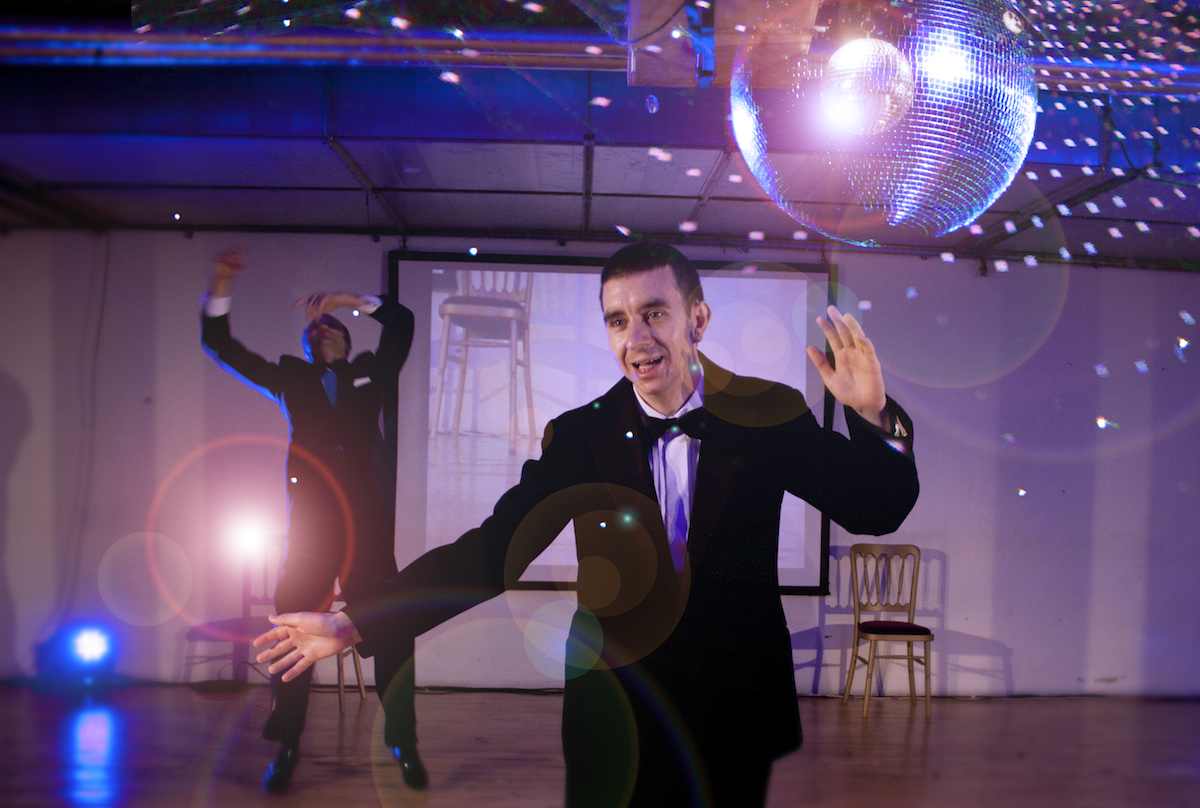
Gary is a tall, beautifully constructed human, with the steely gaze of the professional creative learning practitioner. Ian is compact, has soulful eyes, and a soft voice with a broad Scots accent. Ian dances with companies such as Dance Ihayami and Artform. He also, Gary tells us, has an eclectic range of disabilities. They are here, Gary says, to dance for us; to discuss and demonstrate how it feels to dance, in your body and your mind.  They’ll use Ian’s favourite dance tracks. The floor is theirs, empty save for a pattern of white footprints to help mark positions, and a camera filming them, projecting onto a rear screen. It’s a monochromatic scene; the men costumed in dinner suits. Dancer is going to make its process and its intentions clear and simple, in black and white.

So they dance to Kylie and to Nick Cave; the latter a tender duet on two chairs of wrapped limbs and entwined hands, that conjures Adrian Howell’s embrace. Ian owns the choreography here and in later more upbeat sections; it’s in his muscle and bones. Ian’s expressionistic but controlled movement style is refreshingly free of contemporary dance tropes. They play games with us and we throw paper snowballs at them. Gary reads questions about himself that become progressively more pompous. There is no pretence that Gary is not guiding this story, or that the language spoken is Ian’s rather than Ian’s. The support that Ian needs to perform this piece is there on the surface, he can be unpredictable – a true improviser. But the dependency is shared; they need each other to make this work and Gary won’t be made to look a fool, he’s far too clever and handsome for that.  It’s a piece that grips and charms with its cleverness and disarming approach. They both get wholly lost in the dance at times as do we, joining them on stage for joyful bop to Pharrell William’s Happy. As Gary says at the start, ‘we are going to show you how it’s supposed to be done’ and, with both Unlimited behind them, and bookers clamouring for tickets, Dancer seems to be doing it right.


Dancer is presented as part of the Made in Scotland programme at Edinburgh Festival Fringe 2016. 

Featured image by Niall Walker.


MIss Revolutionary Extreme Voices

Miss Revolutionary Idol Berserker: Extreme Voices

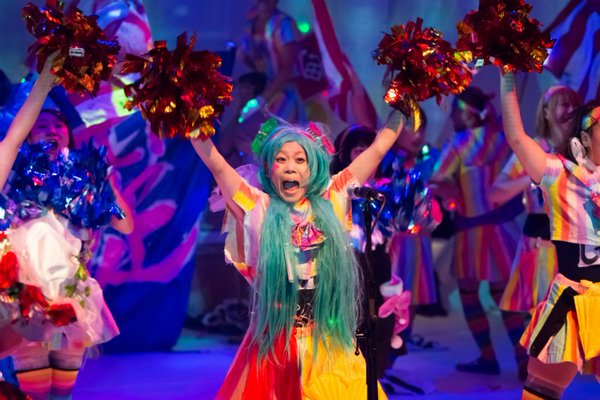
No neat folding of T-shirts here. Toco Nikaido and her fearless, 33-strong troupe are going to turn the theatre into a playground and give us all a ‘happy, hysterical time’. So for 45 intense and colour-saturated minutes they bombard the audience with sound, light, dance and liberally flung stuff. It’s messy, loud, thrilling and exhausting to witness. We get very wet.

Nikaido wants to make performance that resonates with young people and shares their ‘genki-ness’ (which roughly translates as energy and liveliness). Part political rally, part rave, Extreme Voices uses J-pop tunes, a chorus-line and projections of manga-style graphics and slogans (my favourite being ‘nommal [sic] theatre is boring’) to create a high-octane pastiche of Japanese youth culture. The music is fast, beat-heavy and lip-synched: it’s weird when performers are sitting on your lap and miming lyrics; they are so physically present throughout it seems odd not to hear them too. But it frees them to focus on the complex business of performing this show, which they do with an amazing level of skill.

Choreography is whip-tight: lots of symmetrical tableaux and ensemble movement, blending Japanese and Western dance-styles, as cheerleader pom-poms and knee-socks give way to bondage undies. As for props, the theatre is riddled with plastic buckets holding confetti, balls, flowers, seaweed and water – gallons of water, which is flung with glee at the rain-poncho’d audience. The on-stage picture is similarly dense. Songs are performed behind life-size Russian dolls, there are light-sticks galore including some shaped as leeks, there’s a song about technology – ‘who controls the future, who controls the past?’ – during which big cut-outs of monsters romp about. The energy is infectious and the anarchy controlled. Through very cleverly directed movement flow everyone gets to the right place in time for the next costume change, the next lighting effect, or the next audience invasion.

Whilst it’s the power of the pack that impresses most, it is Amanda Waddell, a Texan long-resident in Tokyo, who leads the singing and what there is of narration, in English. She brings a touch of the rodeo to the mix and is a powerful presence, skewing the ‘otherness’ a wholly Japanese cast would offer, perhaps as a symbol of America’s growing influence on their aspirations.

Extreme Voices is an extreme spectacle, beautiful to watch and hugely photogenic. It hurtles along blazing with noise, colour, energy and perpetual smiles. The audience is encouraged to clap and sing, and punch the air, and finally invade the stage, but there’s not the space, or the time, or the health and safety permission, to fully let go and be as genki as our hosts. That’s part of the tease: being tempted by the toys and glitter, the lights and fleeting fame enjoyed by these bright young things, yet firmly held at arms length. But how I wished to be less of a spectator. I’ve no doubt Nikaido and her crew could make easy work of channeling an audience to properly be part of the action. Be careful what you wish for…


Lucy Hopkins: Surprise Event

Lucy Hopkins, last seen at Brighton Fringe provocatively swirling her red scarf in Le Foulard, wants to surprise her audience and herself. She is using her three shows in the Bosco to work out how and all are different. The performance that I see, on a blustery Sunday afternoon, has an audience small in number and height, as half are under 10.

Today the piece is site responsive from the start, with Lucy emerging worm-like from the beneath the seats. Surprise! She plays with the opportunities offered by the space: the light that comes and goes through cracks and ill-fitting doors, the wind rattling the rafters, and the creaky floor all allow her the chance to move and react and clown it up, saying nothing, using just her incredibly mobile body and brilliantly expressive face.

A hand-held lamp becomes a key prop, spotlighting people in the audience and herself. There is an extended riff on a small square of red shiny paper peeled from the floor. A child’s preoccupation with some elastic forms a running theme. These are simple pleasures performed with a huge measure of joy. She invites people to join her on stage to do very little but just be with her, or follow her dance moves, or lead her in theirs. A microphone is used for just a couple of throwaway lines ‘It’s nice to have a holiday isn’t it?’ she says, apropos of nothing.

There have been several stand-out clown-based shows in this Brighton Festival and Fringe – by Trygve Wakenshaw, Jody Kamali and Spymonkey for example – and Lucy holds her own with them all. Her look can switch from delight to daggers in a flash, she can be elegant and awkward, fallible and in control all at the same time.

When three game men join her on stage, holding their arms aloft, the piece takes flight. Lucy gambles around between them, shouting ‘forest of men – tell me what I am searching for’, almost questioning her creative process. Making a new show every time is a challenge for any artist. Hannah Ringham’s Free Show trod similar territory. For me, the forest of men, and the kids on Sunday afternoon, Lucy Hopkins’ Surprise Event surprised, and I look forward to seeing how it plays out in other venues, with other audiences.

The Wardrobe Ensemble - 1972 The Future of Sex

The Wardrobe Ensemble: 1972: The Future of Sex

The Wardrobe Ensemble - 1972 The Future of SexAt my girls’ grammar school, the English class of ’72 found DH Lawrence’s descriptions of ‘fecund loins’ and ‘butting haunches’ both hysterically funny and utterly disgusting. For Penny, a college student in The Wardrobe Ensemble’s hugely enjoyable show, Lady Chatterley is a role model, an emancipated woman who ‘wants it as much as he does.’ But Penny (Helena Middleton), like Lady C, is going to be rudely disappointed when her turn comes – or rather fails to.

1972 is a year on the cusp, adrift from the permissive, free-loving, mini-skirted swinging of the 60s and not quite yet embracing Glam Rock, let alone Punk. We have the Osmond vs Cassidy dilemma, flares and feather cuts, Edward Heath and the IRA. Thank goodness for David Bowie and Ziggy Stardust. He connects all the characters in The Future of Sex, providing a glimpse of hope that something special and exciting might happen in their lives. His is the music and persona that can carry them through their experiments in doing it.

But first, the journey to this awakening, introduced with flamboyant panache and a cry of ‘This is it!’ by Tom England’s exuberant Martin. He’s like Antony Sher’s The History Man, and will later seduce Penny with his poetry.

The set is a row of chairs against a patterned wall, a square of dance floor, and four microphones at the corners. Just off stage, composer and musician Tom Crosely-Thorne provides guitar backing, in loons resplendent with Union Jack inserts.

Characters are introduced, and while they are all archetypes, they have idiosyncrasies enough to make them singular and memorable. Their thoughts and actions are described from outside the performance space – ‘This is Antony. His friends call him Tony’ – making the play unfurl like a novel and assimilation of detail easy. Within minutes we know that Christine (Kerry Lovell) is going to struggle to commit to losing her virginity, that gawky Anna (Jesse Meadows) will fall for the seductive Tessa (Emily Greenslade) and patient Rich (Ben Vardy) won’t get to play in a band.

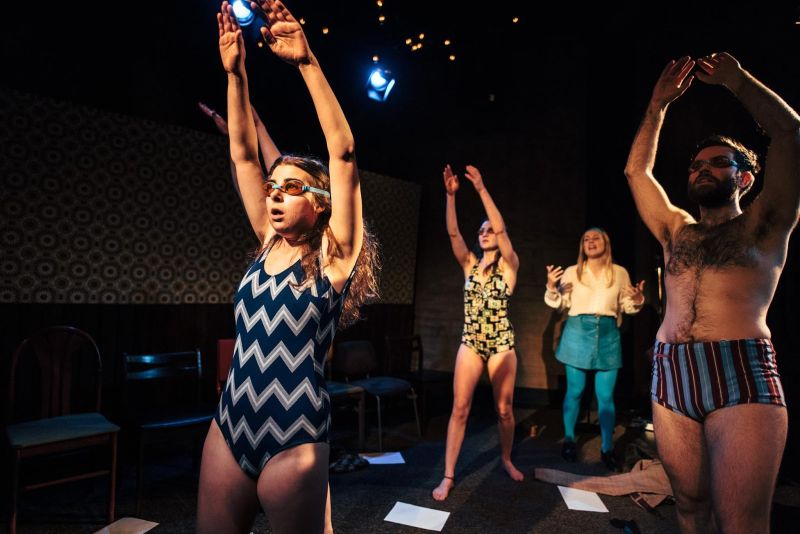
Storylines overlap and the action is seamless, with beautifully choreographed movement and properly integrated music and songs. As the different relationships begin to unbuckle, the pace increases until clothes are ripped off and, in some unflattering swimmies, the sexually liberated teens dash about until exhausted then lie panting on the floor. How was it for you? If all this sounds hugely jolly, it is, but not at the expense of some more serious contemplation. The women in particular find contradictions in the way they are expected to behave; The Female Eunuch is telling them one thing, Linda Lovelace in Deep Throat another. For Antony ‘he calls himself Anton’ (James Newton) gender is more problematical and he finds solace dressing in his mother’s clothes. Tessa and Anna will meet decades later and be disappointed in each other. Christine’s parents’ loveless marriage will disintegrate. Germaine Greer will upset a generation of feminists. Today’s youth may have different reference points and, in Western Europe, a more permissive society, but the same pressures and concerns about sex remain.

The Wardrobe Ensemble’s work, including previous piece Riot (2011), has been rightly praised and they are certainly one of the most accomplished and original companies I’ve seen for a while. Proving, yet again, the city of Bristol’s key role in the development and support of young performers.

As a flashback to a decade that saw me trying desperately to blow-dry my curls into Farah Fawcett flicks, reading Jackie and riding an orange Chopper, The Future of Sex offers focus and fun. The clothes are just right, the haircuts slightly less so, and, if we never said ‘chill’ or ‘hanging out’, I was still right there, with the Spacehopper, the high-waisters, and the awkward fumblings. A very satisfying hour.