Author Archives: Lisa Wolfe

Lisa Wolfe

About Lisa Wolfe

Lisa Wolfe is a freelance theatre producer and project manager of contemporary small-scale work. Companies and people she has supported include: Thirunarayan Productions, A&E Comedy, Three Score Dance, Pocket Epics, Jennifer Irons, Tim Crouch, Liz Aggiss, Sue MacLaine, Spymonkey and many more. Lisa was Marketing Manager at Brighton Dome and Festival (1989-2001) and has also worked for South East Dance, Chichester Festival Theatre and learning disability arts charity Carousel. She is an occasional performer and installation maker in collaboration with other artists, and is a Trustee at Brighton Open Air Theatre.

Kriya Arts - Hip

Kriya Arts: Hip

Kriya Arts - HipI like a traditional boozer: wood panels, carpet, functioning jukebox, and a decent sherry. So it’s no surprise that the Heart and Hand in Brighton’s North Laine has long been a favourite. Years ago I noticed a framed poem on the wall; odd, I thought, it doesn’t quite suit the rest of the décor.

Now, thanks to Jolie Booth’s forensic and enlightening piece, I have knowledge not just of the poet, Lee Harwood (check his Guardian obituary) but also his muse. The poem, titled ‘The Heart and Hand, North Rd Brighton, for Ann’ [sic], is dedicated to one Anne Clark and it is Anne’s world that we’ll inhabit for too short a time tonight.

The show starts outside the Marlborough Theatre, as a promenade with a nod to psychogeography: ‘Here is the Clocktower, here is Pizza Hut.’ Jolie is our tour leader, telling the story of how she squatted a Brighton flat in 2002.

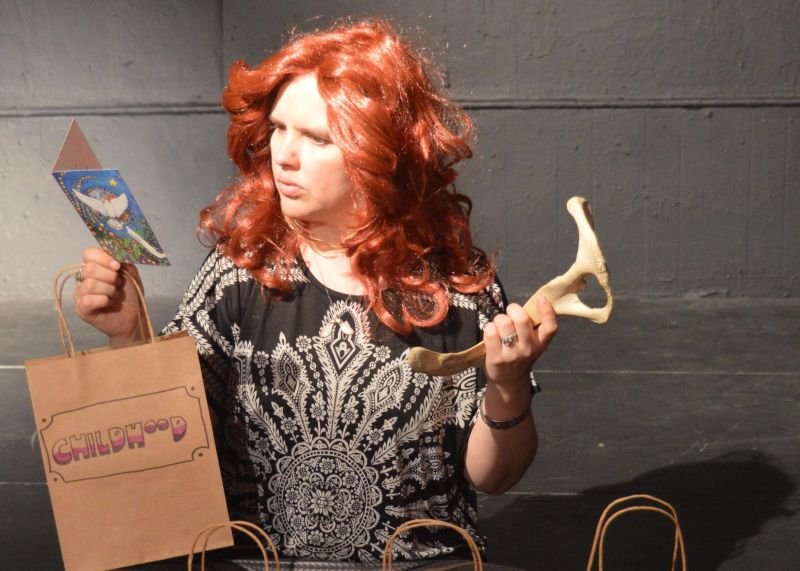
We follow her inside and quietly up the narrow stairs, and enter a 1970s counter-culture happening, with the audience as guests at a bohemian party. Jolie performs a little ceremony, Rumi is recited, incense burned, and we summon the previous occupant of the flat who died four years earlier. Here comes Anne Clark, whose possessions remain in situ: diaries, letters, artwork, records. Jolie rescued the ephemera of Anne’s life from the bailiffs and it has become central to her life now, as a maker of interactive theatre. The setting is spot-on, with a lava-lamp, floor cushions, Little Feat on the gramophone, cheese and pineapple on sticks. There is subtle and evocative lighting and effective use of a hand-held torch – it’s a squat after all.

Once settled, and with the spirit of Anne now present, Jolie begins to show us what the bundles of correspondence left behind reveal, about a woman and a life. We get to feel the yellowing paper of her many letters to friends and family; some of us read passages aloud. An overhead projector magnifies a court summons  (unlawful behaviour on the Victoria Gardens) and photographs of the pubs Anne frequented. Most revealing is a timeline Jolie has compiled from thorough reading of the diaries. They show a big gap in knowledge for the last twenty years of Anne’s life; what happened? There are parallels too with Jolie’s own life and experience, as she’s also a longtime diary writer and they actually used the same brand. She tells us that such coincidences appear daily, as if she has triggered something, something connecting her to Anne. People Anne worked with, at Avalon Bookshop, or Wax Factor, provide new background. Her daughter has been in touch. The landlady of the Heart and Hand is coming to see the show.

It’s impossible not to be moved by the stories and the gradual piecing together of a history. We get to choose subjects for deeper exploration from bags labelled Hedonism, Work, Mother, Travel, and more. There’s a description of a proper 1970s threesome, photos of her working at Infinity Foods, a poem about dusting – or rather, not dusting.

Jolie is the perfect host, gently authoritative, in control of her material yet slightly in awe of it. As performance it is fascinating to watch and be part of, and there are some nice directorial touches – the eponymous hip-bone gets used as a telephone, a vibrator becomes a flute (Emma Kilbey and Brian Lobel contributed to the making process.)

Jolie describes the show as ‘ultra-real theatre’ by which she means that the audience is welcome to use their phones, move about, and interrupt as they wish. In this environment there is little opportunity for conversation and the action is quite tightly controlled. It’s a shame, because there is so much more to discover and to share.

We’ll just have to repair to the wood-panelled, carpeted, multi-gendered bar of the Marlborough pub instead. Jolie proclaims, over a Tequila toast to Anne Clark, ‘thank you for trailblazing your way through life.’ In an age of instant communication and fleeting memories, Hip is a hugely enjoyable, engaging and at times profound reflection on what we create and what we leave behind.

Bom-Bane Family Players: Bom-Banimals

Bom-Banimals - Photo by Peter ChrispEach stage of Jane Bom-Bane’s meticulously crafted promenade show is a dramatic reveal. It’s a journey through a house and a tale that gathers pace and impact as it travels, as the audience of six twists and turns down the narrow stairs of the ultimate ‘artist’s open house.’

Bom-Bane’s performance café is a Brighton institution in miniature, and previous Festival shows have been themed around palindromes (2015’s Saippuakivikauppias) and the city’s lost Wellesbourne river (in 2014).

Bom-Banimals, as you might expect, features creatures of the woods, trees, and undergrowth, but at heart is a very human story. ‘How can I match your triumphant call,’ sings Jane, ‘when I can’t find my voice at all?’

This is an immersive happening taken to extremes, from the soundtrack when you enter to the décor on the banisters, to the little nested quails eggs on the tables. It crams big ideas and big things into tiny spaces and for 45 minutes we are in a strange, magical world. And what’s that awful honking noise – is something in pain?

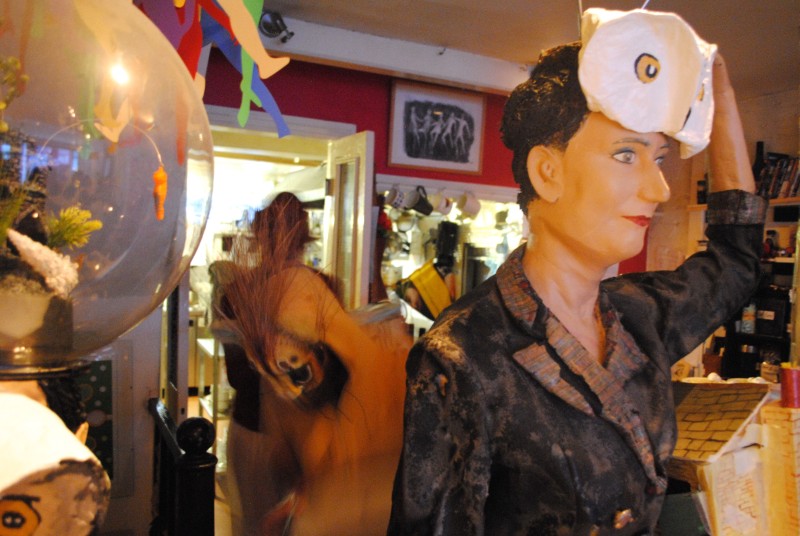
The animals’ songs are beautifully matched to character and vary in tone – some twinkle, some honk – accompanied by small instruments: ukulele, toy piano, penny whistle. Costumes and settings have a lovely hand-made aesthetic and a highly imaginative use of materials. There is puppetry, poetry, visual jokes, and transformations as the menagerie gathers together and with their help Jane finds her voice and her skin.

Lyrics (by Jane Bom-Bane and Eliza Skelton) are meaningful and clever, the performances beguiling and there is so much to look at that it seems to be over too quickly, rather like a fairground ride that whips you through a haunted house before you’ve had time to scream. I wanted to do it all again straight away.

Instead it’s meal-time which is always a treat here. Strange that most diners happily eat the animal option (did they learn nothing?). I have the veggie choice, a swan sculpted from filo pastry. There’s a meringue snail to follow.

Bom-Banimals is perhaps a touch lighter in content than previous Bom-Bane’s shows, but the effect is just as enchanting. We end feeling properly at home with the Bom-Bane Family Players (Jane Bom-Bane and Eliza Skelton are joined by Foz Foster, Kate Daisy Grant, Raven Kaliana, Jo McDonagh, Sebas Contreras, Kate Vaughan, and Tom Walker) and rather reluctant to leave.

I’m Hunt, She’s Darton

 Tea for two? Lisa Wolfe finds the place where food meets art, at the Hunt & Darton Café 

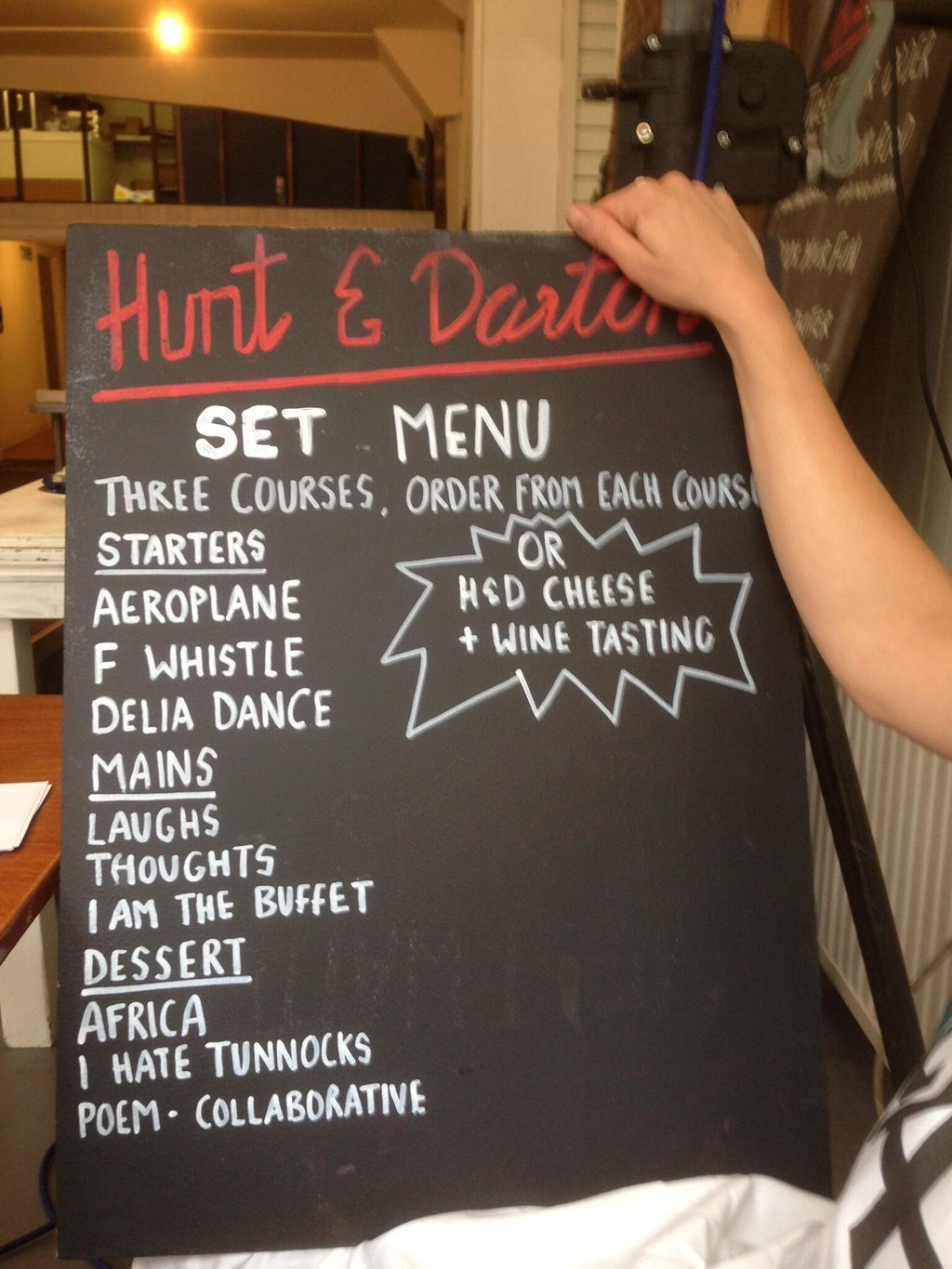
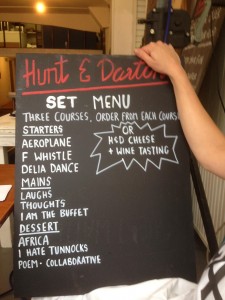
‘Regret nothing’ is a great life motto for some, but I still curse myself for leaving Jenny Hunt and Holly Darton’s SICK! Festival Café minutes too early one lunchtime in March 2014. My sister-in-law had just courageously selected ‘I Am The Buffet’ from the daily Set Menu, and soon found herself lying on the table being pelted with salad by merry, if bemused, customers. Sadly no photographs exist, but the scene haunts both her memory and my imagination. You don’t get that in your local Costly Coffee Shop – but there again, Hunt & Darton’s is no ordinary café…

During 2014 and 2015, Hunt & Darton Café set up shop in seven UK locations, supported by a Strategic Touring Grant from Arts Council England. To conclude the project, Hunt and Darton held a free Symposium to share their experience of the tour with others. Did they hold it in a café? No, demand required the grand theatre at Toynbee Studios, hosted by Arts Admin. In the course of three hours, with a break for tea and Tunnocks, the Symposium provided an illuminating overview of their work.

I’ve had the pleasure of attending Hunt & Darton Cafés in Brighton and Edinburgh, and was eager to discover more about how the project had developed, its artistic and social ethos, its impact, and what the future might hold for the company. On the Symposium menu were talks by contributing artists, collaborators and commissioners.
 

Hunt & Darton Cafe

Hunt & Darton Cafe


Starters

Hunt and Darton opened the session showing images of venues that had hosted the Café – highlighting the consistent elements that each contained, customers, key events and some photographs of the food they served – before handing over to the invited speakers.

Documentation rarely looks so good. In essence, Hunt & Darton Café is, in their words: ‘An interactive performance/installation and fully-functioning pop-up café.’ The idea emerged at a camping retreat with fellow visual artists Rachel Dobbs and Hannah Jones of Low Profile, who have since made artworks for the café, and created the loyalty schemes, of which more later.

Idea in place, it was with the support of the first speaker, Anthony Roberts, director of Colchester Arts Centre, the Live Art East Collective, and the Escalator East initiative, that they launched the first Hunt & Darton Café at the Edinburgh Festival Fringe (as part of Escalator East to Edinburgh), followed by subsequent visits to the Fringe and to other cities. Over time it developed from a café run by artists, to a café with a performance space and guest artist/waiters.

From the start, Hunt and Darton, who share a background in both visual arts and intermittent catering jobs, wanted the café to be somewhere that fulfilled a physical need – hunger, thirst, getting out of the rain, resting the feet – as well as a creative need they might not have known they had: a place where the public is invited to participate in or initiate a creative event, contribute to an artwork; to be performer or audience.
 

Hunt & Darton Cafe

Hunt & Darton Cafe


Service Please

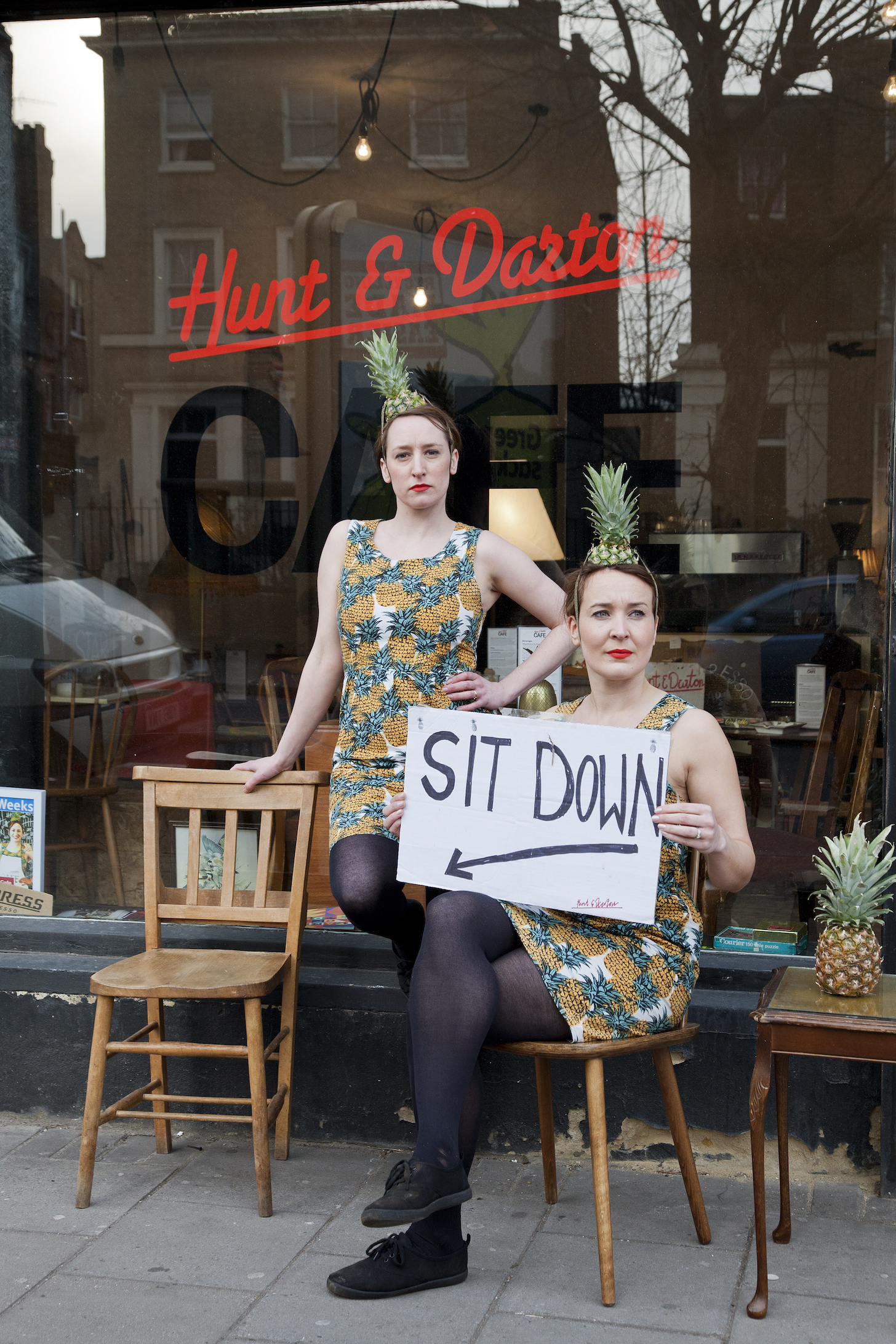
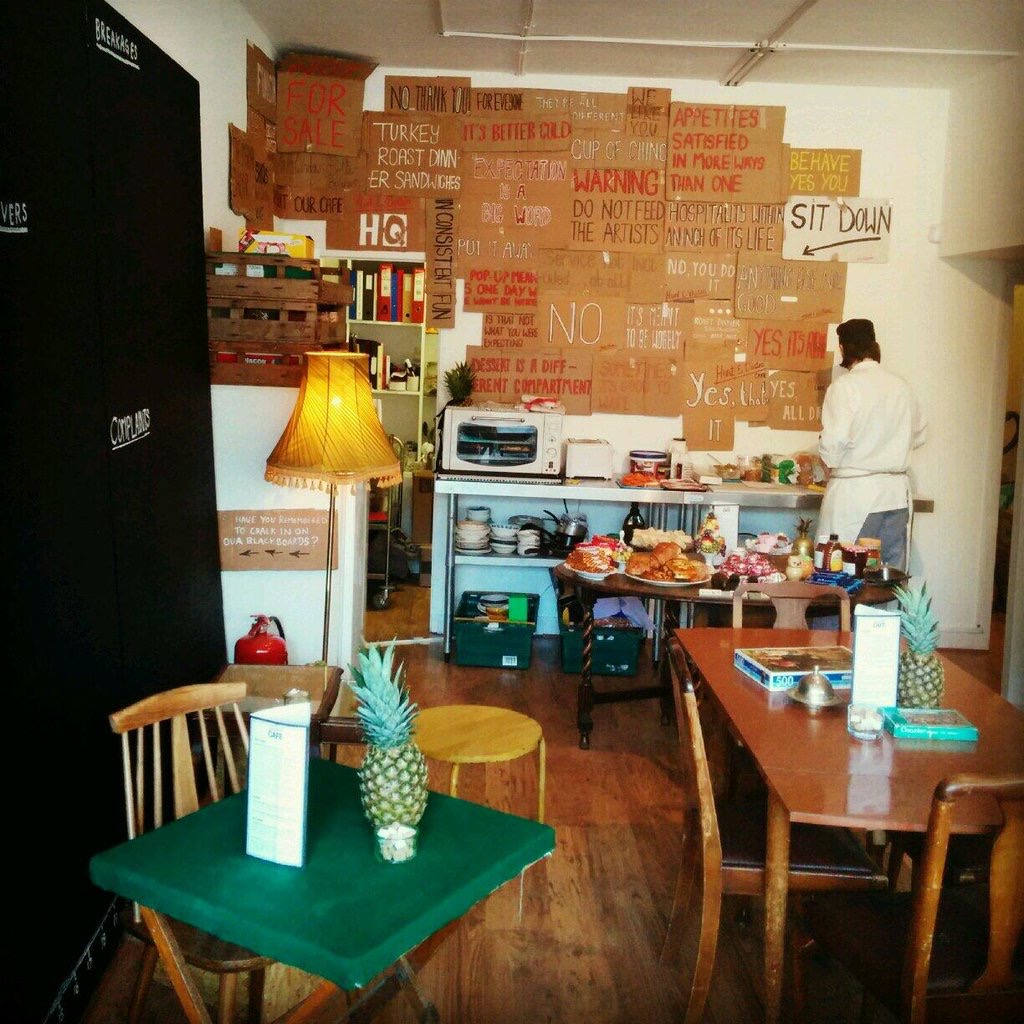
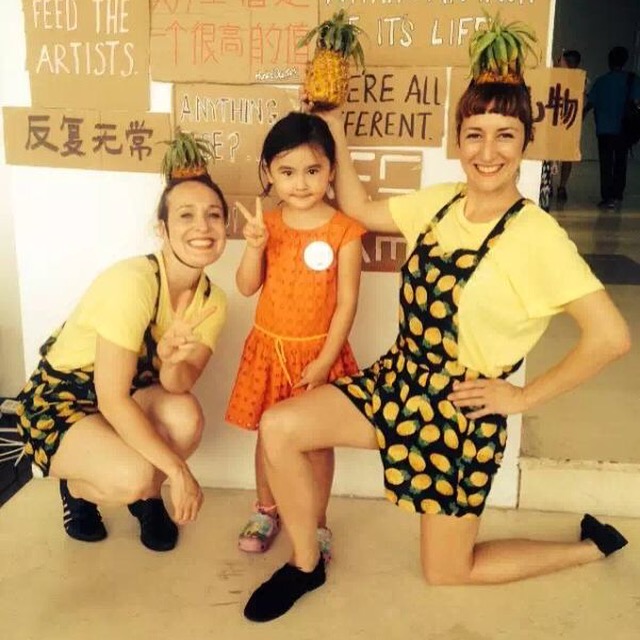
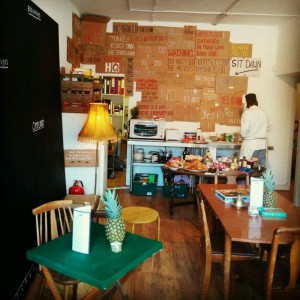
Customers’ expectations are challenged through the style of the service. Hunt and Darton present a dead-pan, slightly severe authority in their role as Café proprietors. This is no-nonsense service that somehow puts a customer at ease while instructing them, often quite firmly, on where to sit and what to do. The formal personalities of the staff contrasts with the novelty of their uniforms – pineapples on the head, bright ‘Lady Danger’ lipstick, fruit patterned aprons – and with the kitsch aesthetic of the Café design. Over the years, Hunt and Darton have trained other artists to be surrogate Hunt and Dartons, adopting their outward characteristics. Artists may go through an Academy process, which, rather like a franchise, allows Hunt and Darton some time off, and more importantly extends the experience for artists and customers alike.

The performance troupe Figs in Wigs are long-term Café associates. They demonstrated ‘Service at lightning speed, delivered at a snail’s pace’ – a fast and slow relay run with plate of peas as the baton. They then invited Hunt and Darton to try and beat the world pea-eating record (they failed).

Guest waiter Brian Lobel took this further in his performative contribution to the afternoon. He told us that his key interests were food and customer service and that, when performing his often highly personal work, he realised that most people were thinking about themselves. Brian finds this interesting rather than annoying; he is keen to hold the space for them. So for Hunt & Darton Café at SICK! Festival in Brighton, he offered customers an exchange, as demonstrated with an audience member, that could easily move you to tears. As someone who has participated in Brian’s work several times, I can appreciate how challenging this approach might be for a drop-in customer with a pot of tea and a crumpet, and also how life-changing and memorable.
 

Hunt & Darton Cafe

Hunt & Darton Cafe


Doing the Business

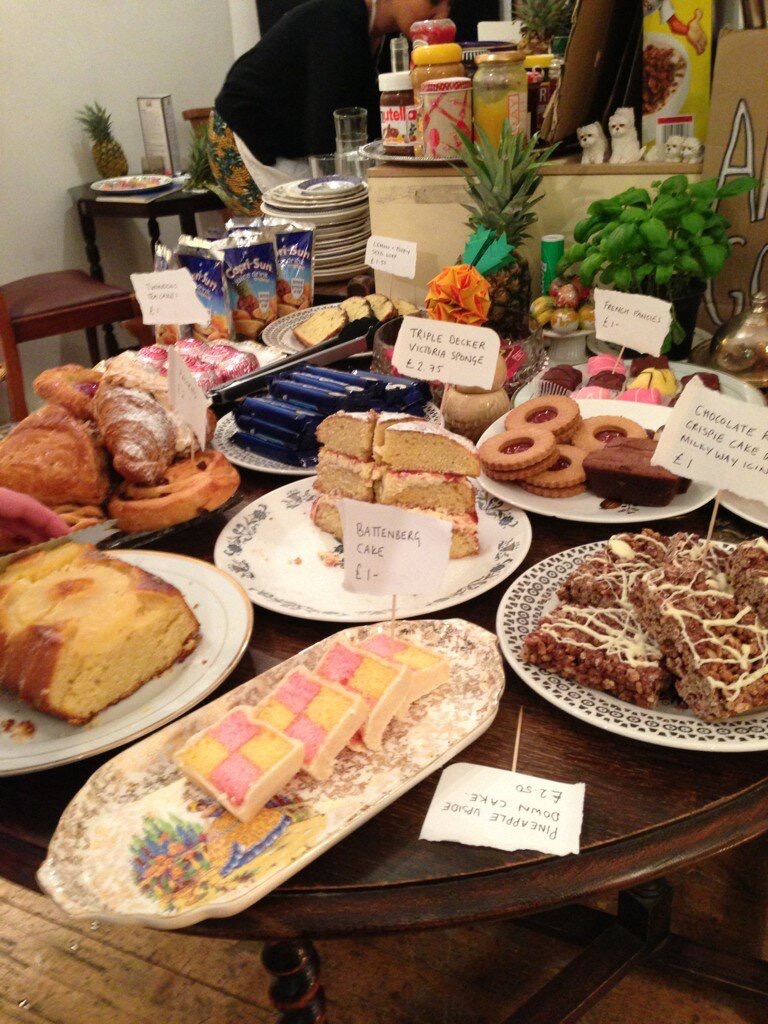
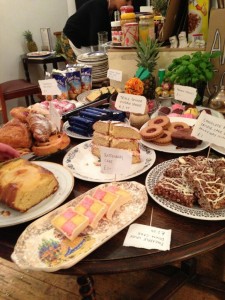
Food is obviously integral to the Café and, in collaboration with chef and artist Max, the menu offers a brilliantly twisted range of things toasted, unduly elaborate cakes, and retro shop-bought snacks (such as the legendary Tunnocks Tea Cakes, or perhaps a Mr Kipling Fancy). Everything is tasty, tea is served in pots, and price points are fair.

There is Art on the menu too: Community Day, where customers sit with strangers, do jigsaws, share trifle; and Health and Safety day when hair nets and rubber gloves are obligatory.

So how can this model function in a commercial setting? Hunt & Darton Cafés distort and disrupt the normality of a café by placing equal value on the art ‘on sale’ as the food and drink. Figs in Wigs’ Rachel Porter read a paper entitled The Service Economy of Hunt & Darton Café’, which made interesting connections between how art functions within commercial enterprise, where the art or the performer is the commodity. Like Brian, she referenced the relationship between hospitality and performance; the Café brings art into a workplace, and makes a workplace an artistic happening. Initiatives like Open Barbers – a community interest company and regular pop-up at Duckie, and Say Cheese which delivered themed meals alongside a Martin Parr exhibition in March 2014, offer a similar bridge between commerce and art. Somewhere there is a wax sculpture made of my hair, courtesy of barber and sculptor Stuart McCaffer (Summerhall, Edinburgh Fringe 2014, £10.) There are those, in government right now perhaps, who would be happy for all art to be commodified and price-tagged. But, as Jenny later explained, while the food part of the business might break even, the art has to be subsidised. To make this crystal clear, all transactions at the Café are chalked onto blackboards, by customers and staff; the profit and loss is transparent, the responsibility shared. We give and we receive.
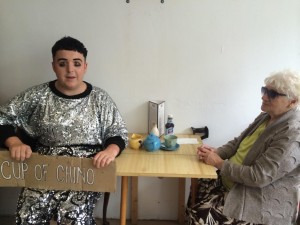
 

Scottee at Hunt & Darton Cafe

Scottee at Hunt & Darton Cafe


Always Right

At the heart of the Hunt & Darton Cafe ethos is the audience-cum-customer. It’s all about us. This manifests most clearly in the loyalty scheme, outlined for us by Rachel Dobbs of Low Profile. It shares several characteristics with the familiar Nectar or Boots Loyalty Card, but in adopting the style of a name badge, simply saying LOYAL, it is also a conversation point and a badge of honour. Low Profile later created KEEN, a framed word-piece for anyone who travelled to several of the venues on tour. One proud couple visited four.

Daniel Pitts, arts producer at Cambridge Junction described how big an impression the Café had on the public in his region over three successive visits. In China, which Hunt & Darton Café visited courtesy of Forest Fringe and The British Council, people thoroughly enjoyed the disruption the Café brought to their lives. Forest Fringe’s Andy Field wondered if he was exporting something quintessentially British, and if so, what? He discovered that what the Hunt & Darton Café offers is not an obscure, nor fundamentally British commodity – it belongs to the space it visits.

You can see the happy faces of customers on countless Facebook pages and websites. It was down to performance artist Scottee, after the tea-break, to flip the coin. His learning, from two years on the road with the Café, was that England ‘was and always will be a poxy shithole.’  Scottee is furious that we, the public, allow this to be and do too little to incite change. He wants a revolution.

In the final artist’s presentation, Richard DeDomenici screens an ‘audio visual extravaganza’ of the life of the Café. It illustrates just how the Hunt & Darton Café has forced change, does shake things up, does cause people to reflect on their conduct and be part of a community, even if only for an hour over Sunday Lunch in a Sandwich (a famous Café dish that is is exactly what it says – a roast dinner sandwich).

If Richard’s films highlight the fun of the place, the final Q&A bangs home the broader issues.

From the outset, the artistic ambition matched the business ambition. The audience experience, whilst playful and original, has purpose – customers are complicit in the art. Aesthetic choices are not frivolous – pineapples don’t just sit well on the head and look good, they have long been a symbol of wealth and trade. The Cafés have given opportunities for artists to make new work and share it with a very different audience. Hunt and Darton have also learned a lot over the life of the project, enhancing their artistic practice, and have been astonished at the generosity and loyalty of customers. What happens next is for another chapter. Hunt & Darton Café will exist, but probably not as a touring construct. The need to create something new is pulling. If today we didn’t quite learn how to go about setting up something similar, our home-going Party Bag with tool-kit and starter ornament will help.

As Andy Field so rightly says, ‘silliness is not the opposite of seriousness.’ Hunt and Darton prove this perfectly with a throwaway final remark – ‘by the way, I’m Hunt, she’s Darton.’

Thanks ladies. We’ll remember that.
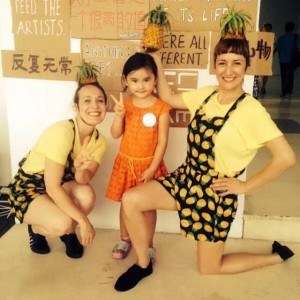
 

Hunt & Darton

Hunt & Darton


The Hunt & Darton Café Symposium took place on Friday 5 February 2016 at Toynbee Studios, London, hosted by Arts Admin.

All images courtesy of Hunt & Darton.

 

Mel Brimfield & Gwyneth Herbert: Springtime for Henry (and Barbara)

Plaster-bronze-and-BarbaraImagine – it’s opening night of a long-awaited new musical on London’s West End. Can director Larry Goldblatt (David Bedella) succeed where Sir Laurence Olivier, Sir Peter Hall, and Peter Brook have failed? Will the book surpass those of Harold Pinter, Howard Brenton, or National Treasure Alan Bennett? Might the music eclipse that of Stephen Sondheim?

The audience gurgles with anticipation. We’re about to witness, in musical theatre style, the tempestuous relationship between a truly great artist and another artist (a woman), and the whole history of modernism – all in 70 minutes!

This is the premise of Mel Brimfield and Gwyneth Herbert’s joyful show about Henry Moore and Barbara Hepworth, staged at Wilton’s for three performances only, with a hastily-gathered top-notch cast, a punchy band, and PowerPoint. Described by the makers as ‘a fictitious lost musical reconstructed in fragments’, it neatly skewers gender politics, artistic status, and performing arts practice, in one sweep of its razor-sharp chisel.

The back story to the musical’s three decades of wrangling by theatrical luminaries is told via a spoof Arena TV programme. It sets the tone for the evening: clever, funny writing and inventive music, brought to life in performance and on film.

The Starling Arts Choir opens the show, rehearsing Truth to Materials. Their voices are stratified: sopranos are marble, altos are plaster, basses bronze, belting out that they are ‘together releasing the form’ – as much a comment on contemporary performance as it is a definition of modernist sculpture. This subtle intelligence is at play throughout.

There is the characterization of Henry as a DH Lawrence archetype, pictured hugging the ‘vital trunks’ of trees, while Barbara moons over dangling catkins and pink anemones. Andrew C Wadsworth is a glorious Henry, with just the right amount of swagger and Yorkshire vowels, singing a lusty paean to Adel Rock. As Barbara, Frances Ruffele’s solo show-stopping number defines the status of women in art through lines like ‘My shapes were bold, his were archetypal.’ She inhabits a world where stone replaces the glass in the ceiling. We feel for Barbara chipping away at her monumental blocks, quietly changing the face of British sculpture – from representation into abstraction – in the shadow of the Yorkshire titan and his money-making enterprises.

The personal relationship between sculptors is deftly traced. Henry’s star rises while Barbara cares for the triplets, his international reputation burgeoning while she has Hull.

It is a shame that the ambition, stated in the publicity, for ‘breathtaking set design’ didn’t manifest at these performances. I missed the visual elements that looked so alluring in pre-show clips. There are spoken interludes, featuring the rounded tones of Hugh Ross as The Critic, and moments of recorded interviews against archive film that would have benefitted from a richer palette, particularly given the grandeur of the space. The performances are all first rate; David Bedella (Jerry Springer’s Satan), reading from notes, injects real West-End glamour.

Hopefully the piece will be developed further and the slightly odd conjunctions and transitions eased out. I wonder too whether leaving us with the refrain of Springtime for Hitler and Germany (from The Producers) is the right decision? It does scan beautifully as Henry and Barbara, but given Gwyneth’s evident talent for a song and a tune, it would have been great to have left humming something of hers.

Mel Brimfield has been delving into the lives of artists for several years, creating wonderfully playful films and installations that pack a punch. It was lovely to hear Joanna Neary’s pitch-perfect narration to a film of Barbara Hepworth at work (from 2011). This final fragment of the evening overturned the whole premise of the musical, showing that Barbara too was driven and pompous; ‘Sometimes a low wattage bulb is just what one needs’ she drawls, referring to Henry’s mediocrity.

Springtime for Henry (and Barbara) has been lovingly developed by two highly accomplished and idiosyncratic talents, and I for one would be thrilled to see it take its natural place on Broadway.

Ridiculusmus - Give Me Your Love - Photo by Sarah Walker

Ridiculusmus: Give Me Your Love

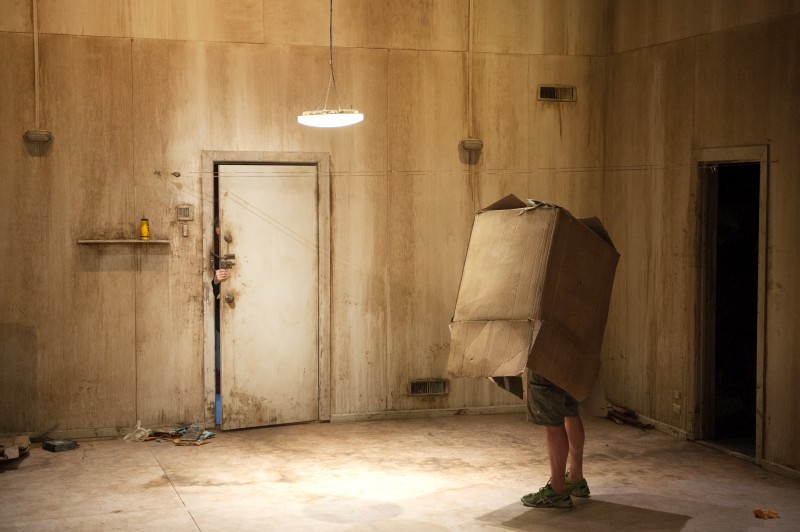
Ridiculusmus - Give Me Your Love - Photo by Sarah WalkerEveryone here is trapped. Welsh ex-squaddie Zach (David Woods) has retreated to a cardboard box. His wife Carol (Jon Haynes) is trapped out of sight, perhaps in her own box, perhaps upside down, certainly in an unforgiving marriage. Band mate and fellow war veteran Ieuan (Jon Haynes again) is trapped outside by the door-chain and by the demands of his bowels. It doesn’t take long, in this off-kilter world, for the audience to recognize its own position: trapped in a similarly dark box to Zach’s, on hard seats, in a cold auditorium. And hold on, aren’t the actors also hiding from us, literally, behind scenery and inside cardboard?

So the form matches the subject – Zach can’t find a way to escape the cage of his trauma – would mind-altering drugs help?

The story unfolds in Ridiculusmus’s signature style. We have two main quarrelsome characters, in a bizarre situation, struggling to debate a serious issue, this time about the use of mind-altering drugs such as MDMA to treat post-traumatic stress disorder.

Give Me Your Love is the second play of the company’s trilogy exploring the relationship between therapeutic innovation and mental health service users. The first, The Eradication of Schizophrenia in Western Lapland, was more ambitious in terms of staging and company size, but they share a basis in scientific research partnered with playful theatrical treatment. There are overlaps too in the way drama builds, and how catharsis has to be almost forced from the sufferer.

For Zach, ‘getting the trauma out’ is really hard. He’s tried Prolonged Exposure and it didn’t help. Does he need a therapist, like Ieuan had? Would listening to the Prodigy help? He understands that he can’t stay in a box for much longer, and if CNN said MDMA can help, and if they’ve tried it in Cardiff, then hell yes he’ll swallow the pill. But Zach is slippery. We can’t be certain that he has taken the drug, he invents a traumatic scene to get things moving, he says that his trauma is that he did nothing in the war, just sat on his ‘fat arse’. It’s almost as if his trauma is a fear of modern life; of doing nothing, being bored, feeling trapped. The language is classic Ridiculusmus, conversational and distinctive, slyly mixing the everyday with the metaphysical. An exchange about a Swiss Army Knife versus Leatherman leads seamlessly into a discussion on suicide; Ieuan drops in the line ‘keep them entertained, Zach’ acknowledging our presence.

If this sounds a bit grim, the performances and the writing prove otherwise. It’s almost an installation piece, this room with an animated box and choreographed motifs; Ieuan’s hands arcing gracefully through the gap in the door, Jon’s sudden appearance as a shell-shocked war veteran in white pants under a strobe light (lighting by Richard Vabre); the blatantly unnecessary use of a pulley as a dramatic device. The set, by Jacob Williams, looks like a cross between a condemned cell and a student squat, with a nod to a dirty protest. Having your actors either off-stage or concealed doesn’t help with audibility though, and some dialogue was very muffled.

The lack of physical presence does reduce the pleasure a notch for those who particularly enjoy Woods’s edgy explosive persona and Haynes’s dead-pan, slightly wheedling one. But Zach and Ieuan are well drawn despite being mainly invisible. We feel Zach’s frustration and readiness to try anything to escape his mental prison. Ieuan seems a bit of a chancer, but he is a proper friend and eager to help – even to procuring illegal ecstasy of dodgy provenance. I love that he doesn’t realize that Zach is in a box until very near the end. Carol, the off-stage wife, is beautifully sketched, perhaps with an addiction to painkillers and problems of her own. The action is punctuated with a fantastic sound design and music by Marco Cher-Gibard that underpins Zach’s emotional journey. The final coda, playing out in darkness, is wonderfully haunting.

There is no definitive point of view on offer here; the play rather skitters over its subject despite the in-depth research embedded in it. But as with many Ridiculusmus shows, the work is intrinsically dramatic. From Tough Time, Nice Time (performed in a bath tub), Yes, Yes, Yes (performed as two psychiatric patients) through to Say Nothing (performed on a piece of fake grass), Ridiculusmus continually reinvent theatre and speak with a unique voice.

Give Me Your Love ends with a glimmer of hope. Zach has had some kind of epiphany, however temporary. There is birdsong, a planned trip to the beach with an umbrella, the promise of an all-you-can-eat-buffet. But there is a sense too of hopelessness. Larger MDMA trials will start soon in America, but the UK is slow to invest in this form of therapy. So for Zach, and the one in nine soldiers that, it is said, suffer from post-traumatic stress disorder, the psychedelic trip-cure is still a long way down the rainbow-coloured road.