Author Archives: Dorothy Max Prior

Dorothy Max Prior

About Dorothy Max Prior

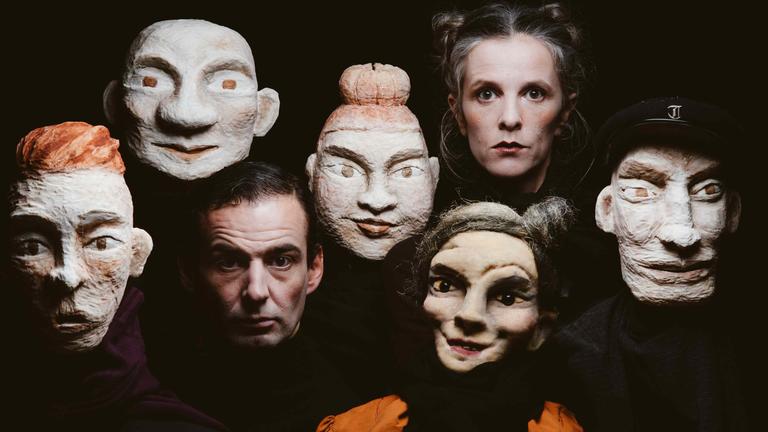
Dorothy Max Prior is the editor of Total Theatre Magazine, and is also a performer, writer, dramaturg and choreographer/director working in theatre, dance, installation and outdoor arts. Much of her work is sited in public spaces or in venues other than regular theatres. She also writes essays and stories, some of which are published and some of which languish in bottom drawers – and she teaches drama, dance and creative non-fiction writing. www.dorothymaxprior.com

Kalle Nio/WHS: Lähtö | Departure

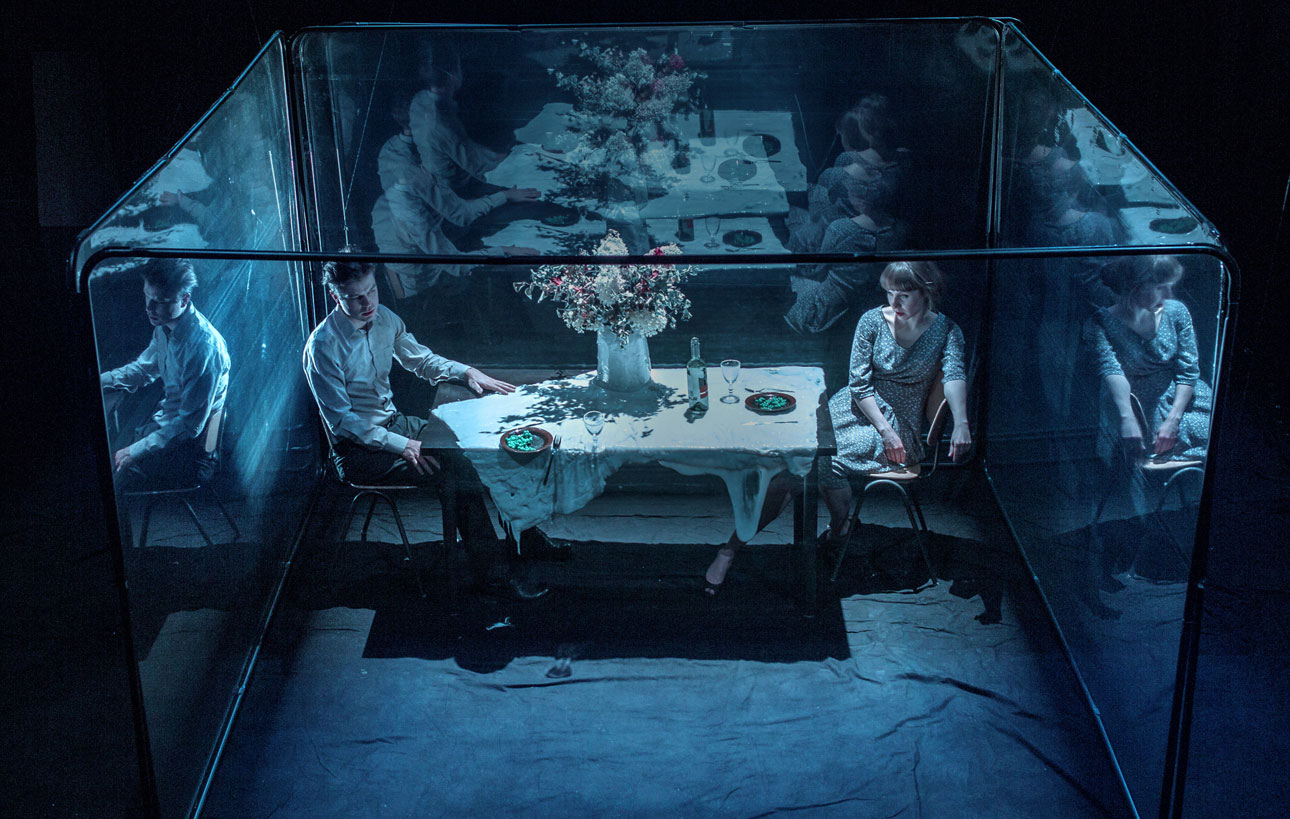
Lähtö  is a cool show. Its colour palette is soft greys and ice blues. Its two performers, a man and a woman, are forever poised in beautiful shapes – held back, restrained, even when in the throes of passion. They take their time, they repeat, they are not afraid to stop, to create the image – or perhaps we should say, the shot. For Lähtö is a cinematic show, set on a big, broad stage, with a deep multi-layered set that eloquently moves us from 2D to 3D perception from scene to scene. It features larger-than-life projected monochrome images of faces that gaze nonchalantly away from each other; or melancholy sheets of rain tumbling down; or the rolling waves of a seascape peeked through a raised drape. As well as using moving image as a theatrical element, it also – knowingly, teasingly – constantly references the world of cinema. Not only the Michelangelo Antonioni movies cited as influences (most notably L’Eclisse and Blow Up), but also the Nouvelle Vague films of Truffaut and Goddard, and the Noir tradition. Ingmar Bergman is never too far away, either. Cigarettes are smoked, wine glasses drained, high heels kicked off, overcoats shrugged into then discarded, drapes pulled open and closed. And still the rain falls, the wind sighs, and the waves roll on.

Our two performers, Kalle Nio (visual artist and magician, and founder and director of the company) and Vera Selene Tegelman (dancer and co-choreographer of the piece) play a couple in a disintegrating relationship – or perhaps, reevaluating the relationship after the death (literal or metaphorical) of their love. We are in a Bardo, a limbo world, where memory and imagination, dream and reality, play out. We witness the age-old tussle between Eros and Thanatos, love and death – the tug-of-war played out by the bodies on stage in interaction with the very many objects employed. An elaborate system of drapes and pulleys transform prissy living room curtains into the billowing sails of a ship. A great big perspex box cleverly explodes out into a variety of geometric shapes, providing the canvas for a cleverly reworked version of the classic Pepper’s Ghost trick, in which performers and their ‘ghosts’ dance an intensely melancholy choreography, and we lose track of which is real human figure and which is illusion. The couple, embracing on a table-top, find themselves trying to pull themselves clear of gluey threads of cloth that cling to their bodies. The classic Lecoq/Decroux ‘overcoat-wearing body with many hands’ scene makes an appearance, all done very eloquently. In a rare moment of light relief, Kalle Nio wrestles with a seemingly self-animating shirt that fights back as he tries to iron it. Lovely and wonderfully well executed though this scene is, it has a very different tone to the rest of the piece, and I’m not sure it belongs…

The performances can’t be faulted, the visual imagery is gorgeous, the ideas beautifully executed, and yet – I never fully warm to the show. I like it, I admire it, but I don’t absolutely love it. The glacial cool is just a little too – chilly – for me. It is also that some of the power and magic – the actual magic tricks and the theatrical magic – is lost by being too close to the action. (The show is set at floor-level in the Platform Theatre’s malleable space, with raked seats going up from a point very close to the edge of the performance space. I’m in the second row, and feel practically on top of the show.) I find myself longing to see this show on a great big, deep, proscenium arch stage, the performers distanced from us for the full cinematic effect. It is a dilemma, because London – despite being a capital city in a country of theatre lovers – doesn’t actually have very many suitable spaces for epic visual theatre work of this nature.

There are some odd lighting design choices: in particular, one ice-white light, on-high, upstage right (which may have been intended to represent the moon or perhaps the North Star, who knows?), shines continuously – not only a distraction, but also disrupting the projected images. The sound design, on the other hand, is excellent. Composer Samuli Kosminem (who is known for his collaborations with the Kronos Quartet) weaves together the sampled sounds of sea and rain and footsteps and clinked glasses with girl-group pop candy and moody electronica to create a soundscape that beautifully complements and interacts with the visual imagery and live action. The opening section of the piece, in which our couple monotonously enact and re-enact a terse dinner together, is a wonderful example: the performers and the exaggerated Foley style sound effects (a knife scraped on a plate, a bottle emptied into a glass, a pair of heels clicking across the floor, a set of keys thrown onto the table) start off in perfect synchronicity, then the sequence disintegrates just enough to put it uncomfortably out-of-synch. It is one of many beautifully enacted scenes in which sound, physical action, object animation, and film all blend together harmoniously in service of the themes of the show.

Ultimately, Lähtö is a series of scenes that, taken individually, can’t be faulted –  but the show never becomes more than the sum of its beautifully crafted parts.


Lähtö is presented at the London International Mime Festival 2018 in partnership with Jacksons Lane, and supported by the Finnish Institute in London / TelePART. For information and bookings for all the shows and workshops in LIMF 2018, see www.mimelondon.com
Featured image (top): Lähtö | Departure, photo Tom Hakala


Caravanas Ficho!

Dorothy Max Prior goes on the road in Mexico with Caravanas Ficho, an enterprising outreach and community engagement programme created by Ficho Festival, taking circus and street arts to otherwise excluded people in Guadalajara and other parts of Jalisco state 


So here we are, a motley crew gathering in Caligari, a shabby-chic cafe in Guadalajara’s hipster Colonia Americana district: artists, producers, and the Ficho Festival volunteers, a bunch of feisty young circus students and budding producers known as the ‘Ficholitos’. While I’m busy attaching brightly coloured model birds to my teased-up hair, and bells and horns to my multi-layered skirt, others are loading up the cars with props, sound systems and bottled water. And we’re off, the first Caravana Ficho of the 2017 festival programme.


Ficho artists and producers at Caligari Cafe, festival HQ

Ficho artists and producers at Caligari Cafe, festival HQ


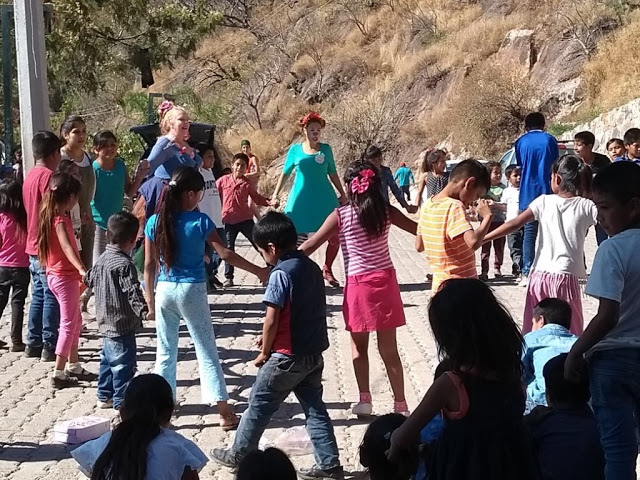
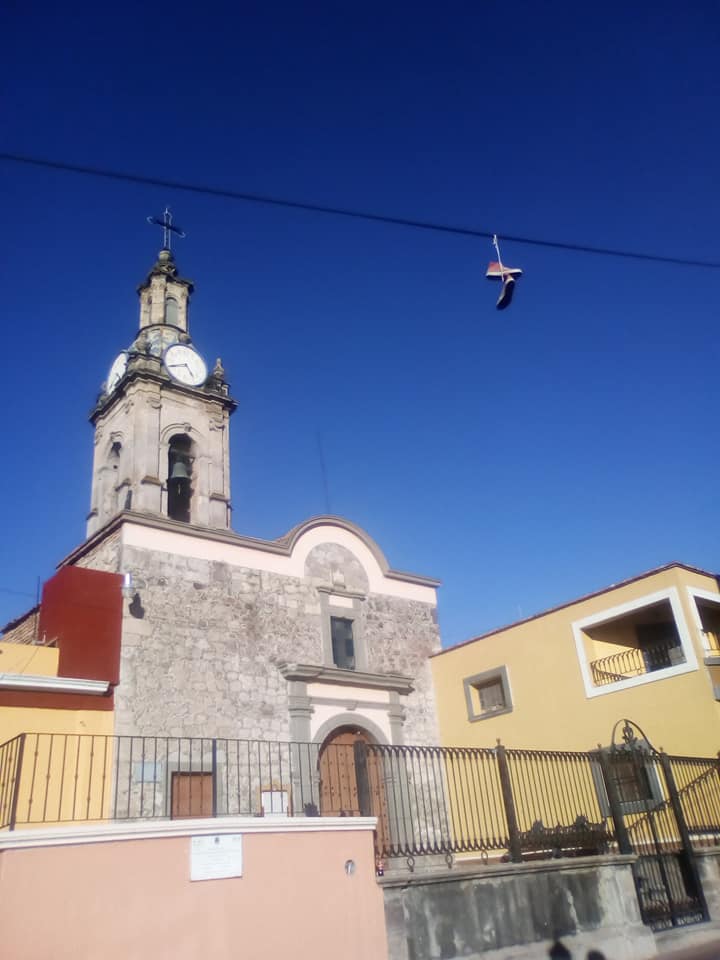
We’re not going far: today, our destination is a suburb of Guadalajara, on a hill overlooking the city. I say ‘suburb’, but that might conjure up an image of middle-class affluence, and this is a far cry from that image. We park up outside a church, in a district that could reasonably be described as dirt-poor. Steep, cobbled streets littered with discarded trash, a few battered old American cars gathering dust, and a rickety school bus heaving itself up the hill. Houses with no facades, like abandoned, oversized dolls’ houses, with families sitting out front, and dogs rifling through the food remnants in the gutter. There’s a few tacos stalls in the main street, along with a couple of desultory children’s rides – oversized blue and yellow animals with peeling paint sat on a stationary carousel. In we go, through the gate to the big open space in front of the church, where we set up shop. We’re planning on 30 to 40 minutes of street theatre, a free performance for the local community as part of the Caravanas Ficho outreach programme.


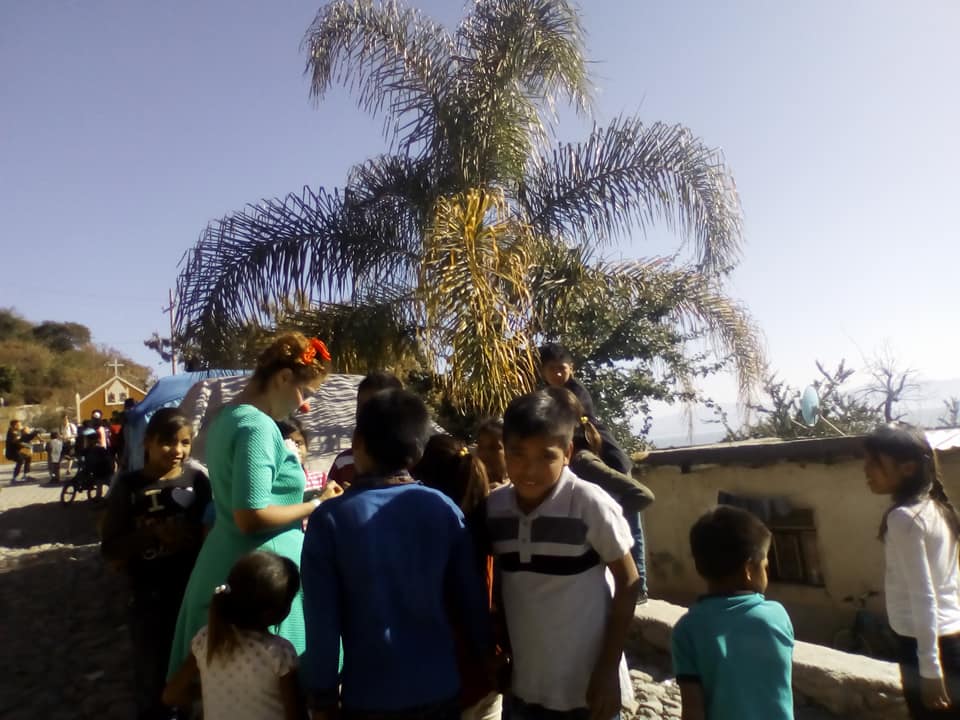
Artists and local children at Ficho Fest' 2018 Caravana in Guadalajara

Artists and local children pose for a post-show photo at Caravanas Ficho’s first stop in Guadalajara


The young project co-ordinator, Monika, sets up the sound system, then worries that no-one is here yet, even though we’re due to start in five minutes. Currently, it is just one family – a mother, grandmother and two small children. We’ll go get ourselves an audience, then, we say. Object manipulator extraordinaire Dulce Duca stands at the crossroads outside the church, juggling a fistful of clubs. I sound my siren, and skip off down the main drag with bells jangling – picking up a gaggle of children, a toothless street dweller, and a few dogs optimistically hoping this might involve food. The Naga Collective circus girls are stretching and climbing and balancing over each other and along the ground, apparently oblivious to the dirt and jagged stones. We lead the gang we’ve collected back to the performance space. By now, a few more families have showed up, and a fair few teenagers, hanging out at the back. My music cue starts up and I work through the crowd with my little suitcases and musical toys. When it comes to the interactive dance bit, I make a beeline for the small girls eager to take part, but also manage to drag a few teenage boys and granddads into the action. Afterwards, I have a big group of girls keen to have a photo taken with Mother Ginger and her Little Birds. One girl has a present: a little bag of oranges. As is often the case, the people in the world who have the least are the most generous. Meanwhile, Dulce is a big hit with the boys – her act goes into a kind of impromptu workshop, and the clubs are being balanced and tossed around all over the place by an excited crowd, many of whom are now racing around the space. When Naga Collective do their acrobalance act, one of the teenage boys asks if they are really women: ‘Because girls don’t do stuff like that’. Yes, they do, we all say. Later, we reflect that, regardless of any other outcomes, at least people have learnt that women can and do make circus and are very capable of performing feats of strength.

International female circus troupe, Naga Collective

International female circus troupe, Naga Collective


The Caravanas programme has been going as long as the Ficho Festival itself, which is biennial, and in its fourth edition, so the outreach programme is eight years old. Festival co-directors Cesar Omar Barrios and Violeta Castro are also the founders and key members of contemporary circus company Les Cabaret Capricho, and walk the line of being both artists and producer-facilitators. It is one of the reasons Ficho is biennial: if it were annual, they just wouldn’t have the time to develop their own work. The project is well established, and – as is always the key to the success of such ventures – the Festival has nurtured relationships with cultural organisations and community gatekeepers across the state of Jalisco.

For example, they have developed strong links with the FM4 Paso Libre migrant and refugee centre of Guadalajara. The organisation’s publicity bears the legend Ningun ser humano es ilegal (No human being is illegal) and its logo is a stylised image of a train track – a reference to the fact that a large number of the people that use this day centre arrive in Mexico on the dreaded La Bestia, also known as El Tren de la Muerte (the train of death), a freight train route that stretches all the way up from Arriaga in the far south of Mexico, across the length of the country, and into the United States. Inevitably, many don’t survive the journey. Migrants, working their way up to the States from Central America, ride on top of the trains, and there are many deaths from falls onto the trucks. Some survive falls, but lose a limb. To many of the migrants, the USA represents the land of golden opportunity, and Mexico is the hell you have to pass through to get there. But others have realised that there is kindness and compassion in many Mexicans, and that breaking the journey there to seek asylum is not too terrible a choice.


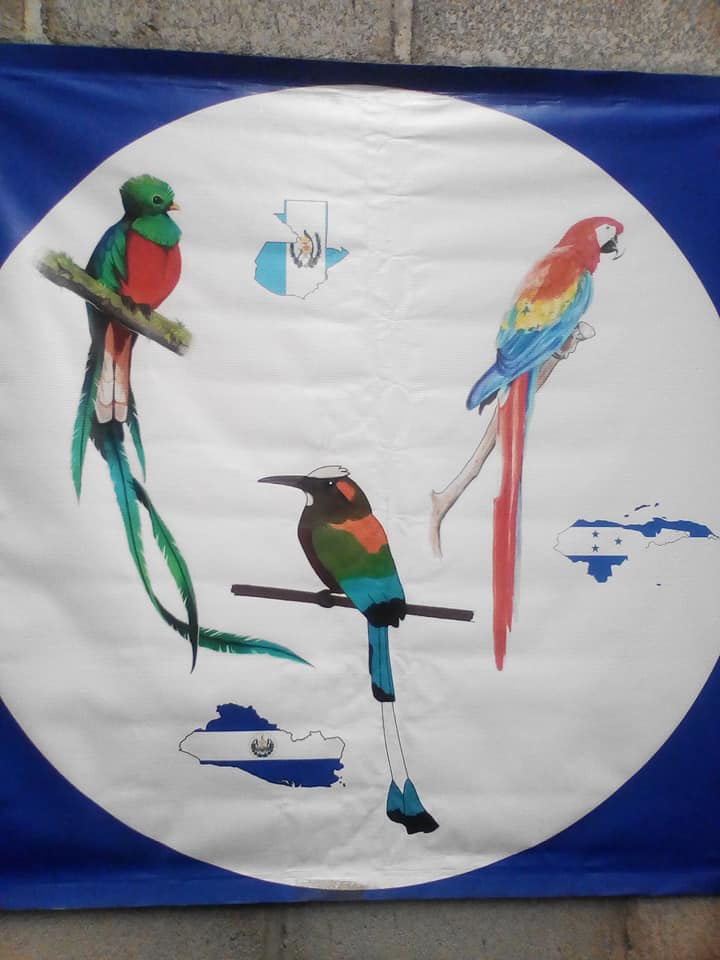
Ficho Caravana: birds of central America at FM4 Paso Libre migrant centre in Guadalajara

Ficho Caravana: birds of central America at FM4 Paso Libre migrant centre in Guadalajara


When we take the Ficho Caravana to FM4, I get to meet administrative director Angelica Gonzales Villalobos, who is running the session that afternoon. She says it is a fairly quiet day – around 35 people. Sometimes it can go up to 80. I ask her where people are from, and she says Panama, El Salvador, Guatemala, and Honduras. This is born out by the maps and drawings on the walls featuring these four Central American countries, and the wildlife and geographical features of each country. Some will stay in Mexico, hoping to make a life here, and some will rest a while then continue on their quest to get the the USA. ‘It’s all about the American Dream,’ says Angelica, barely containing her contempt. ‘They have been sold an idea that there is this land of golden opportunities, where people have well-paid jobs and houses with nice yards.’ The chances are, even if they do make it to the States with little more than a photo of their mother and a few dollars hidden in a shoe, this golden dream will not be the life they lead as low-skilled Central American migrants. I’m reminded of the Calais Jungle occupants I met in the research process of Bridges y Puentes, my company Ragroof’s show about migration – people who had made the perilous journey from Afghanistan or Sudan or Eritrea and who saw England as the only worthwhile destination, rejecting the notion of seeking asylum in France. They leap onto Channel Tunnel trains or climb into lorries, risking their lives in pursuit of the dream, to find the place where, surely, the streets are paved with gold. Here, the dangers are even greater than for the Calais migrants trying to reach England. La Bestia claims thousands of lives a year, and even more horrifying than the accidental falls is the fact that some migrants are pushed off the moving trains by guards – I’m told by one volunteer that the Mexican police have carte blanche to dispose of people in this way.


Hopeful migrants riding La Bestia

Hopeful migrants riding La Bestia


I look over at the smiling faces of the people we are here to entertain, and wonder (as I have done on many previous occasions, in other parts of the world) at the strength and persistence of people who take such risks in the hope for a better life. As is the case in the refugee centres I’ve worked with in England or France, the vast majority of this centre’s users are young men, most falling within the 18 to 35 age-range, with a few older men. There are also some young women in the group, one of whom tells me she is from El Salvador, where life can become intolerably dangerous for female teenagers who are often subject to rape and murder by the gangleaders who decide on them as ‘girlfriends’ (in other words, sexual property). I observe the usual working with refugees rules of not delving too deeply into people’s life stories unless invited to, and many questions are left hanging in the air. Looking at this young woman with the broken-toothed smile, sitting here in her pink tracksuit top and silver crucifix necklace, holding hands with the friendly young man sitting next to her, I hate to think what she might have escaped from in El Salvador, and hope that life has got something good to offer her in the future.


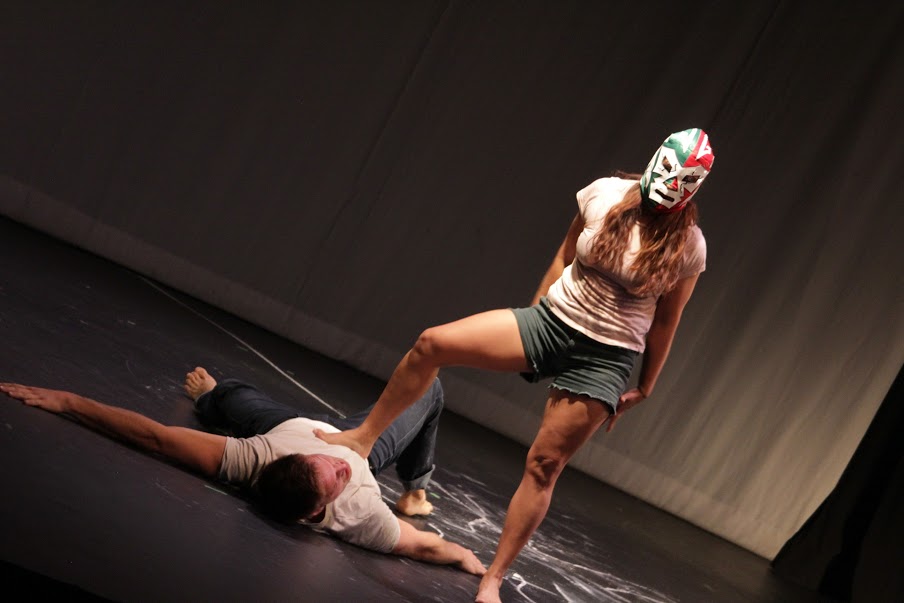
Blanca-Seb: Borderless. Presented at Ficho Festival 2017, with excerpts on the road for Caravanas Ficho

Blanca-Seb: Borderless. Presented at Ficho Festival 2017, with excerpts on the road for Caravanas Ficho


But for now the talking is done, and the show must go on. On this occasion, it’s not a street show. We set up the circus equipment and sound system in a big, high-ceilinged indoor hall. The Naga Collective girls have their Chinese Pole with them today, which is the subject of a great comic act circling around a race to get the pole erected, and then to see who will reach the ceiling first. Juggler and swing dancer extraordinaire, Paula Aviles, does a neat act that involves Charleston dancing whilst manipulating numerous objects. Also on the bill are Montreal hand-to-hand stars Julius & Cesar, who, after performing some jaw-dropping acrobalance moves, seemingly oblivious to the threat of the concrete floor below, get a couple of the young men in the audience up and involved in the act; and double act Blanca and Seb, who perform a section of their marvellous show Borderless, which explores and satirises their cultural heritage (she is Mexican, he is from the USA), and lampoons the current Trumpian rantings about walls and borders.  As before, I open the show with my gentle little musical clown piece that ends in a collective waltz. Before I go on, someone says ‘I think you’ll have trouble getting these people up to dance with you’ but far from it – many are very happy to join in.


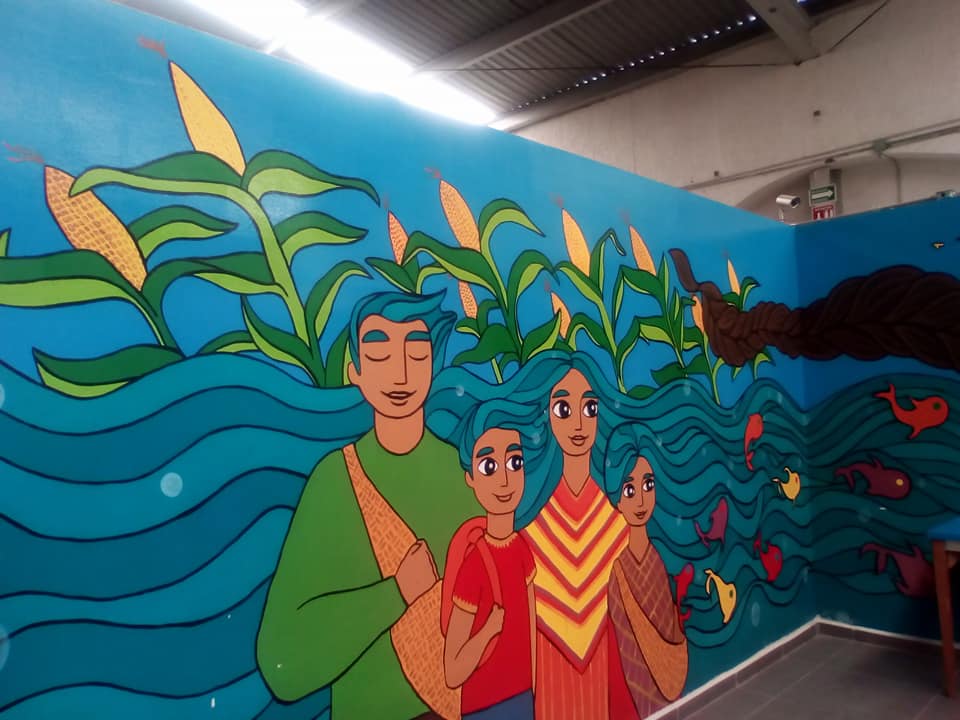
FM4 Paso Libre migrant and refugee centre of Guadalajara

FM4 Paso Libre migrant and refugee centre of Guadalajara


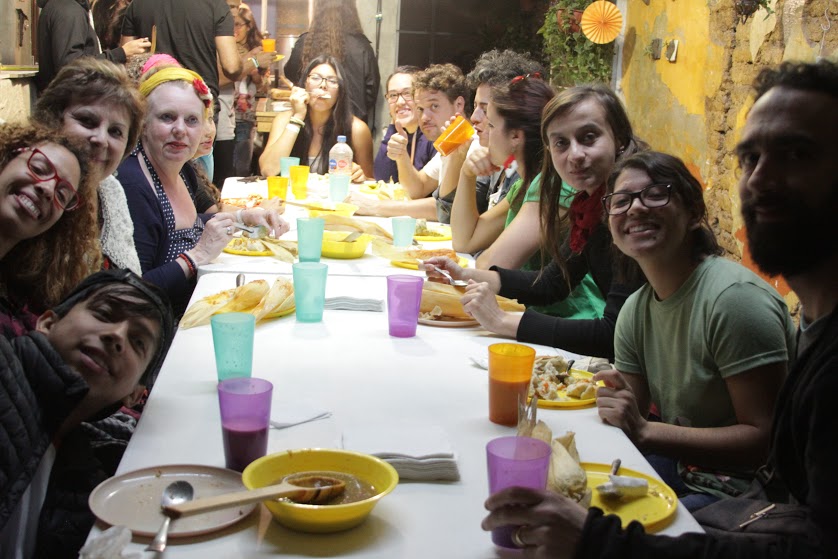
After the show, we’re invited to stay to eat a late lunch. It is an orderly, communal affair. Angelica gathers everyone – artists, volunteers, workers and centre users – into a big circle and does a short welcome to the centre, and a rundown of the ‘house rules’ which include the direction that women must always be treated with respect. She explains that she needs a number of teams of people. People volunteer to join the serving team, or the washing-up team, or the floor-sweeping team. That sorted, we queue up to get a hearty plate of meat, beans, rice and salad. Everyone plays by the rules, and we all happily work together to make the dining and clearing up go with a swing. After the meal, some head off, and others hang out in the small garden, smoking and chatting. I go to say goodbye to Angelica, and pick up a swathe of postcards bearing individual migrant’s stories. With the photos on the front of the card is the phrase Migrar es un Derecho. To migrate is a right.


FM4 Paso Libre migrant and refugee centre of Guadalajara

FM4 Paso Libre migrant and refugee centre of Guadalajara


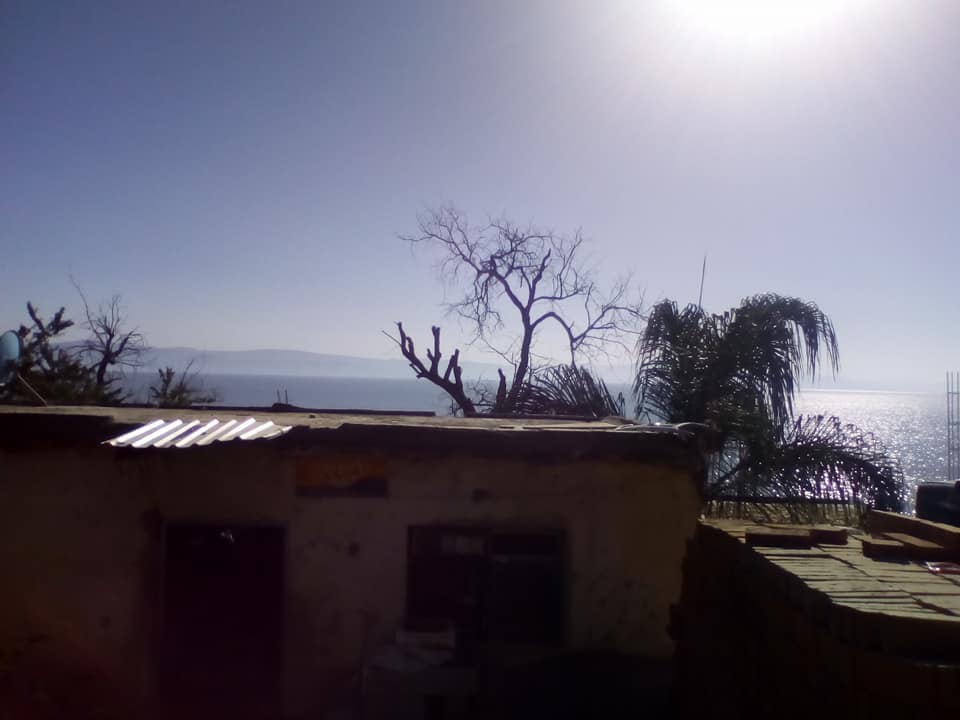
Free movement, the right to work, the right to live without persecution… Well, of course! On our next Ficho Caravana road trip a few days later, we come up against a harrowing example of a human right I would never have expected to see denied. Water. We travel for a couple of hours out of Guadalajara to the Chapala lake, a popular tourist destination, then turn off the highway to take a steep and winding road up a hillside overlooking the lake. We are heading to the ironically-named Agua Caliente. This small village overlooks the sparkling blue lake, and traditionally has relied on the lake for its water supply. It takes its name from the hot springs next to the lake. Now, though, the lake water – which looks beautiful and inviting – is so polluted by industrial waste, including highly toxic metals, that it is dangerous to drink, even if boiled. But as there is no other water supply to the town, the people who live there have to use the lake water. The pueblo is well off the beaten track, with an Indigenous population who are mostly in the lower socio-economic group, so they have no real choice. We are travelling there in a convoy of cars, and the one I’m in includes an environmental scientist and political campaigner, who passes around a swathe of photocopied sheets and newspaper cuttings which expose the scandal of the water-less Agua Caliente, Unsurprisingly, the town has has seen a spate of cancers and birth defects as a result of drinking polluted water. Apparently, we’re told, nothing gets done about this because of the corruption of local officials, who accept bribes to rubber-stamp the industrialists’ polluting bi-products pouring into the lake, passing them as within agreed limits, which they obviously are not.


Agua Caliente:  a poor pueblo, a polluted lake

Agua Caliente: a polluted lake sparkling in the sunshine


So here we are in Agua Caliente on a very sunny Sunday afternoon. Once again, we are parked up outside a church, where the street show will be. We are told by our community contact that one of the villagers has kindly agreed to the performers using her house as a changing room. We carry our bags down the steep concrete steps and enter the house, which is just one room divided into a living/sleeping area and an overstuffed storage space filled with packets of tostados, bottles of red chilli sauce, and cans of Coca Cola. We gather that this is the local store. Who needs water? Let them drink Coke! The woman of the house tells a troupe of small boys to go outside to play, which they do, staring at us wide-eyed as they leave. One sickly toddler stays dozing on the sofa, cuddling up to an even sicker looking dog. We are told we can use the bed to put our things on, so we push aside the bundle of threadbare sheets and well-worn T-shirts to make some space. Asking to use the bathroom, we are shown outside to the back of the house, overlooking the glistening lake, and carefully go down another steep set of concrete steps to a tiny curtained-off outhouse boasting an ancient toilet bowl with no water supply…


Mariana Gabriel in Agua Caliente

Mariana Gabriel and local children in Agua Caliente


Once dressed in our finery, we go crowd-gathering, processing through the one-street town, up a winding dusty track lined with houses, some poorer than others. The lake is never out of sight for more than a few seconds, popping up between the houses on the left as we move ‘uptown’. The procession is led by Ana Cristina, from renowned Brazilian company Lume Teatro, who is beating a drum and singing. Mexican circus artist Blanca takes the baton and breaks into a lovely, repetitive, sing-song rhyme that the local children know and join in with. The rest of us sing along as best we can with the chorus, shaking tambourines, juggling clubs, or riding on each other’s shoulders. Clown and acrobat Daniel Salvi (also from Brazil) brings up the rear, standing in the back of a requisitioned pick-up truck with a bunch of young men from the town, calling on the driver to sound the horn, and shouting merrily at onlookers. We go right to the top of the town, where the houses stop, turn around and process back – by now we have a big gang of children with us, and people are lining the narrow street to cheer us on. Come to the circus, outside the church, we shout – and by the time we get back to our starting point we’ve gathered up a healthy sized crowd. We start the show. Mother Ginger and her Little Birds, Dulce with her ever-popular juggling act, Blanca and Seb’s beautiful acrobalance, an excerpt from Daniel’s lamp-post show O Poste (this particular scene a clever comic sketch involving a trick ladder), and Mariana Gabriel’s lovely, gentle clown Birota. Then, something odd happens. Mariana has the entranced crowd eating out of her hand when suddenly there is a disturbance and the children surrounding her speed off like a flock of starlings. They’ve headed towards a car with an open boot – the children have spied the bottles of water in the boot, and have gathered around the car to beg for water, in the way that children would perhaps beg for sweeties in a different setting. It is heartbreaking, and I just wish we’d been able to bring them gallons and gallons of water.

Ficho Caravana number 4 goes to Magdalena, near Tequila, Jalisco

Ficho Caravana number 4 goes to Magdalena, near Tequila, Jalisco


My fourth and last Caravana trip is also the last of the season, coming on the first of December, after the close of the Ficho Festival. Most of the international artists have already departed from Guadalajara, so for this one it’s me and the Mexicans: a group of core artists from Les Cabaret Capricho – the aforementioned founder members Cesar and Violeta (and how lovely to be working alongside them as artists, as well as producers!); regular collaborator Valeria Estrellas, a brilliant musician and clown; and contortionist-juggler Erándeni Nava Galindo, runner-up in the Concurso Nacional de Circo de Creacion (Mexico’s premiere competition for emerging contemporary circus performers), which had recently been presented as part of Ficho Festival.

This one is also outside of Guadalajara, in the mescal-brewing region of Tequila and Magdalena. Just as only sparkling wine made from grapes grown in Champagne can bear that name, so also only mescal made from the blue agave plants grown in the designated area circling the town of Tequila can bear that name. Magdalena is a few miles along the road, and boasts its own mescal, which is allegedly better than Tequila’s. We are here to perform outdoors (yes, outside the church) at 7pm, but have arrived much earlier in order for Cesar and team to meet with the workers and users of the local arts centre. I decide to take an afternoon stroll.


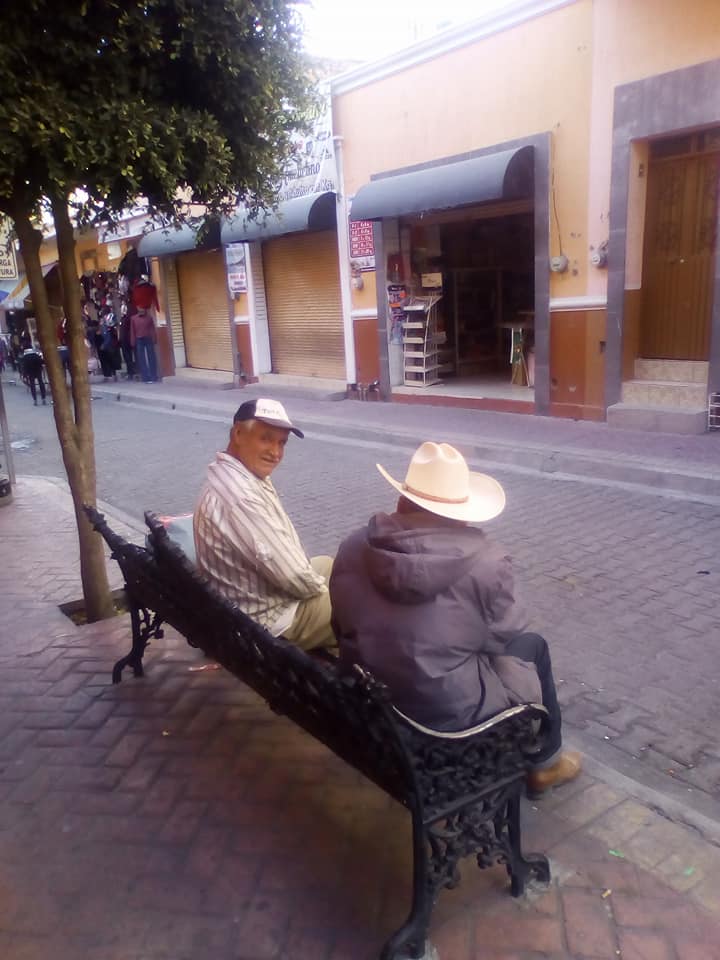
Magdalena: men passing the time of day outside the cultural centre

Magdalena: men passing the time of day outside the cultural centre


Magdalena is a pretty little town with a mixed population, neither rich nor poor. Its high street is a provincial mix: clothes shops selling garish Disney T-shirts, rainbow-striped ponchos and Barbie pink leggings; a cafe-bar keen to keep up with the times by offering cappuccino on its menu; and, because it’s December, hardware shops that have added flashing LED Christmas lights and plaster nativity sets to the displays of cheap Chinese kitchen appliances, bristly brooms and porcelain knick-knacks. At the far end of the main drag, beyond the church where our performance will be, is a town square with a bandstand in its centre. Old women sit out on benches, chatting and enjoying the last of the day’s sunshine; a group of men sporting white cowboy hats play a game of cards; and a few traders stop gathering up their wares as I pass by, hoping that the gringa will make a purchase of a bead bracelet or a leather handbag. As I return to the arts centre, it is dusk, and I peer in through the open windows to watch a dance class – it’s a form I’ve seen before and don’t know the name of, a kind of folkloric tap that has echoes of Flamenco (not least in the Fandango style lilt of the music), which I’d witnessed in full flight a week earlier at a Ficho Festival gig in a traditional Guadalajara cantina by a fabulous group of Mexican musicians who go out under the name Los Soneros de Tesechoacan. I learn that the Magdalena arts centre promotes participatory performance work and activities of all sorts, from folkloric music and dance to martial arts and contemporary circus.


Cesar Omar Barrios of Les Cabaret Capricho

Cesar Omar Barrios of Les Cabaret Capricho


Talking of which, here we are – ready for our last Ficho Caravana show. After dark, the space to the side of the main church, which was earlier being used for a basketball match, is now floodlit by bright lamps, which vie with the light from three brightly coloured crosses atop of three surrounding churches, not to mention an almost-full supermoon blazing in the night sky. An enormous crowd has gathered: the whole town must surely be here. Cesar, in his role of Omar the Impresario, moves those who are sitting along the back wall onto one of the other three sides. And on we go! Mother Ginger does her thing. Erándeni starts her fabulous contortion and object manipulation act by being carried on in a suitcase, out of which her feet, legs and eventually whole body gradually appear. Cesar/Omar charms the crowd with his juggling and clowning. Violeta and Valeria perform extracts from their two-woman Cabaret Capricho show Bruta, including the marvellously competitive getting-ever-drunker skit to I Put a Spell on You. Valeria the singing clown does a lovely solo piece in which she takes an audience member as her lover, and Violeta presents an eccentric dance with a coat, which she manages to wear in every way you could imagine, and some you couldn’t. And, after a fun-filled hour, it’s over. The crowd is happy, the booker is happy, we’re happy – and it’s time to take a bow. The Ficho Caravana ends on a high, and we pack away our frock-coats and net petticoats, remove the pancake from our faces, and set off on the road, back to Guadalajara.


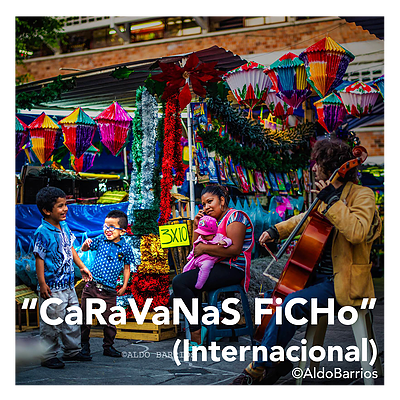
Caravanas Ficho brochure image


Ficho Festival Internacional de Circo y Chou en Mexico took place  in Guadalajara November 2017. The linked Caravanas Ficho programme took place in tandem to the Festival in Guadalajara, and also in other parts of Jalisco state, Mexico in November–December 2017.  www.fichofest.com


Seres de Luz: Travesias

Bring on the (Women) Clowns!

Brazilian clown and film director Mariana Gabriel’s heartwarming and inspiring documentary, Mi Abuela era Payaso (created with Ana Minheira), contains much food for thought – not least, the statement from a key interviewee that much of the documented history of circus is White, male and European. So to redress the balance a little, enter Mariana with a portrait of her grandmother Maria Eliza – a Black Afro-Brazilian woman who was born in 1909 into a circus family, and went on to become Brazil’s first woman clown of renown.

It is hard to translate the title of the film into English. Literally, My Grandmother was a Clown – but the point is the use of the masculine form, payaso (in Spanish, or palhaço in the original Portuguese), not the feminine form payasa – Mariana’s grandmother was a gentleman clown, called Xamego. In the early twentieth century, being a Black female circus performer was enough of a bucking of trends without also trying to persuade the world that women could be clowns. Maria Eliza thus hid her femininity behind her male clown. As a teenager, she formed a singing duet with her sister, starring on the radio shows of the day. We see Mariana in the documentary listening intently to a retro radio set playing one of her grandmother’s favourite songs. Maria Eliza then went on to develop her clown persona, who is (inevitably) a musical clown – the name Xamego means caress or rhythm. Cue close-up on the keys of the accordion.


Mi Abuela era un Payaso: Maria Eliza as Xamego

Mi Abuela era un Payaso: Maria Eliza as Xamego


The story unfolds through old photographs, playbills and first-person reminiscence, including some wonderful interview material with Mariana’s mother/Maria Eliza’s daughter, Daise – herself a renowned acrobat and hair-hanger. This is juxtaposed with footage of contemporary circus acts that retain the aesthetic and metaphor of traditional circus – clowns, jugglers, and aerialists showing us that the show must and will go on. We see big tents, and tiny model tents. We hear music boxes and grand fanfares. Roll up! Roll up!

The filmmaker places herself firmly within the story: we see her in her own clown persona, all made up and ready to perform. We see her talking to her mother, her uncles, and her cousins – delving into the family history, and sharing stories. Most movingly, we see the only small fragments of film documentation that exist of Maria Eliza herself, gorgeous 8mm footage of a tiny old lady dancing with her granddaughter and gurning to the camera: once a clown, always a clown… There is also a lovely short film of Mariana’s mother very evidently pregnant, her father and grandmother goofing up the scene with pillows and footballs.

The glimpses of Maria Eliza are fleeting. We build our picture of her mostly through talking head reminiscence and anecdote, not only from family members but also from her contemporaries: the circus artists, producers and other professionals of the twentieth century who knew and worked the traditional circuses. And, my oh my, how poignant it is to hear these voices and see these faces, as inevitably they won’t be around for very much longer, and their stories, alongside Maria Eliza’s, are crucial to the history of circus.

Xamego paved the way for the strong army of Brazilian women clowns that followed in her wake, including (amongst many others) the women of the acclaimed LUME Teatro company, Silvia Leblon, and Angela de Castro who has been resident in the UK for many years, and whose How to be a Stupid workshop is an annual highlight of the London International Mime Festival.

Following the film showing (seen in Guadalajara, Mexico, as part of FiCHO Festival 2017), Mariana is here in  person to present a short clown numero – a duet between her clown persona Birota and her grandmother.

Birota enters from a little red velvet sideshow-tent that sits centre-stage. With her is a music stand with tiny red curtains that open to reveal a photo of Xamego. She goes on to sing the song that her grandmother always sang to and with her: ‘Canta y no llores’ – otherwise known as the ay ay ay ay song. And of course, we all join in. Not a dry eye in the house…


Seres de Luz: Travesias

Seres de Luz: Travesias


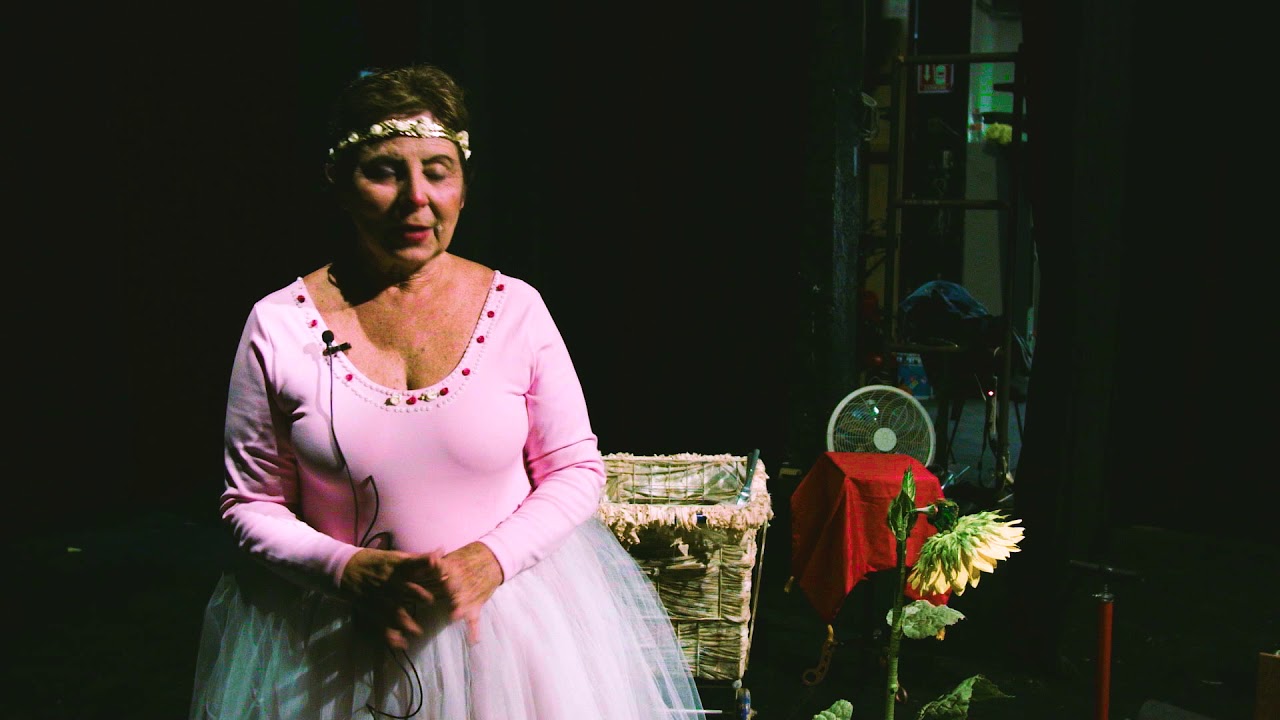
The next day, in the same space (the theatre of the Alliance Française, which is one of the key venues for FiCHo Festival), we get to meet another great South American clown, Lily Curcio from Argentina, whose company Seres de Luz are presenting Travesias. This is a solo clown-theatre show, although created in collaboration with Mexican director Aziz Gual, and enacted with the technical help of Lily’s Brazilian associate Daniel Salvi, who does the offstage work; and Eduardo Brasil who created the technical marvel that is the dancing sunflower, the other ‘character’ in the show, who shares the stage with Lily’s clown persona, Jasmin.

We first see Jasmin pulling a cart onto the stage – the sort of cart that ice creams or drinks are sold from at Carnival time or at festivals. After much playful interaction with the rope, the cart is finally in place. A little backdrop is pulled down, and up pops the sunflower. The wind howls, and we understand that we are in a desert. A storm threatens, but the rain never comes. Our little dancing sunflower is thirsty. Cue an elaborate section in which dear Jasmin tries her best to get a bottle of water open using an ever-increasing number of trick hammers, and finally a detonator. Which fails, naturally. But never mind, plenty of audience members have water with them…

The scene switches; two little tables draped with red cloth are brought on, along with a violin case. There’s an amusing musical interlude with a twist as the (miniature) violin turns out to be something other than it purports to be. Away with the tables, and out comes Jasmin dressed for a ballet performance, in a magnificently ludicrous pink leotard and tutu. The following scene shows Lily’s clown skills to best advantage as the grace and elegance of the dance inevitably disintegrates. In some ways, these two scenes feel a little out of place with the world created at the beginning of the show – we have jumped from outdoors, in a desert, watching the race for survival of the world’s last ever flower, to indoor vaudeville parlour or stage scenes – but Lily’s presence carries it all off magnificently. It is a pleasure to witness her at work, even with reservations about the dramaturgical logic of Travesias. Jasmin is an endearing clown – and she wins the heart of the audience.


Dulce Duca: Un Bello Dia

Dulce Duca: Un Bello Dia


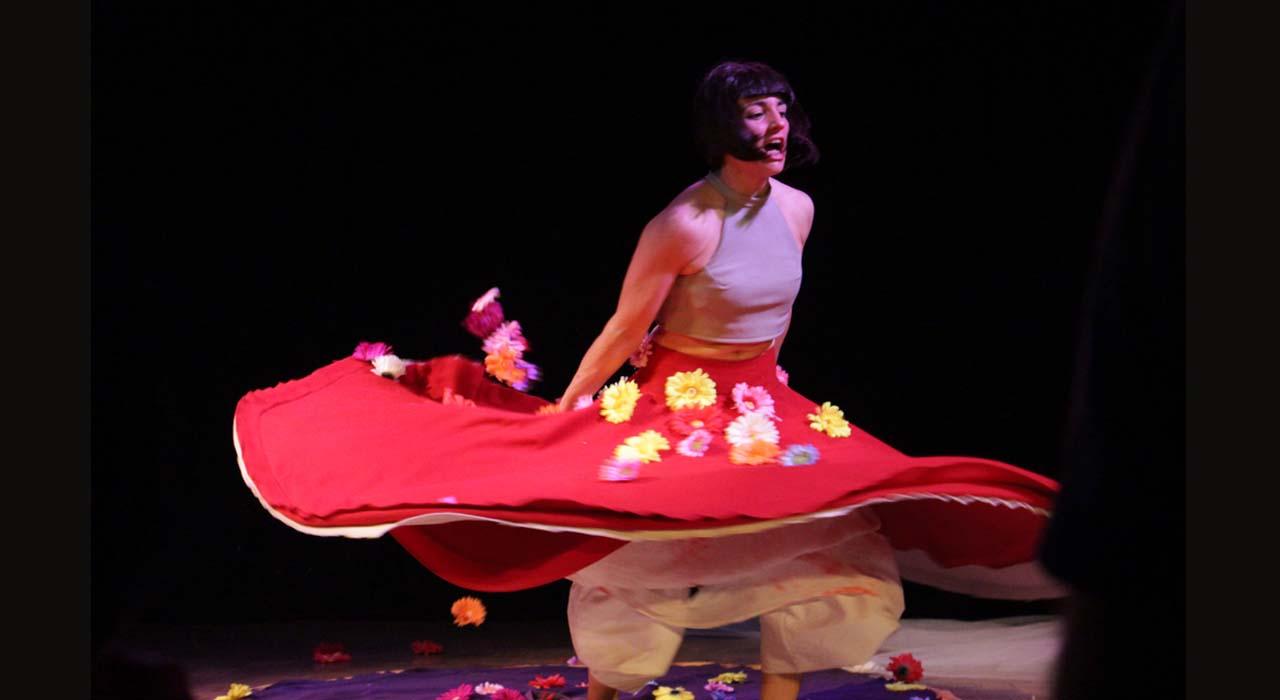
Not exactly a clown, but certainly someone adept at clowning, is Dulce Duca from Portugal. She is, in essence, a juggler – but that label does little to explain Dulce’s show, Un Bello Dio. It is a whimsical, lyrical and totally endearing piece which creates a series of beautiful stage pictures, through the manipulation of a variety of objects: she uses not only her juggling clubs but also an ever-evolving combination of whirling circular skirts that transform themselves into capes, cloaks and spiralling umbrellas; colourful flowers which are plucked from the skirts and toyed with; and a great mountain of snowy white net that lifts and falls on pulleys or at the whim of Dulce’s girating body, transforming itself into mountain, Moomin, bridal dress, veil and more – the images and associations pour out continuously, morphing with each shift in scenography. At times, the multi-layered and multi-coloured skirts look folkloric; at other times, like a living rendition of a Bauhaus costume-sculpture by Oskar Schlemmer.

As Dulce whirls around and around the stage, flowers flying in every direction, she is at once a dancing diva, a dervish, and a playful child delighted with the world she finds herself in. A sense of wonder and discovery pervades the piece, and some particularly strong moments come when she invites an audience member to join her on stage. She picks the perfect partner (a middle-aged gentleman in a suit, whose choice is greeted by delighted cries of ‘papa! papa!’ from the front row), and she treats him with care – flirting gently, waltzing with him, and enveloping him in the bridal tulle. Un Bello Dio is a total delight – a very interesting feminine take on what is too often the masculine world of juggling and object manipulation.


Paola Aviles: Ballhaus

Paola Aviles: Ballhaus


Also female, also a juggler who clowns, is Paola Avilés of Mexico. She is a renowned cabaret artist, circus mover and shaker, and swing dancer who runs a performance space in Mexico City called Cracovia 32. Her show Ballhaus is an interesting mix of object manipulation, clowning, eccentric dance, shadow theatre and film. In other words, there is a lot going on! We first see Paola dressed in a vintage-style jumpsuit with a 1940s hair turban arriving with an old-fashioned brown leather suitcase. On comes a trolley, up goes a poster proclaiming the name Lola. Who is Lola, what is she?

On screen, we see 1920s flappers, 1930s Lindy-hoppers, and scenes from Berlin in the 1940s. On the soundtrack, Louis and Ellie sing Summertime, Della Rees belts out Whatever Lola Wants, and Marlene Dietrich is Falling in Love Again. Like Bob Fosse’s film Cabaret, there seems to be some intention to draw parallels between the carefree live-for-today world of burlesque and vaudeville, and the painful realities of a world torn apart by war… Although the piece only touches on this, and it is not 100% clear (to this writer, anyway) what the artistic intentions are, beyond the stated aim to juxtapose fantasy and reality. Moments like World War Two (i.e. circa 1940) air raid sirens blasting over 1920s nightclub footage added to my confusion. I also found the silent film subtitles impossible to read, even from the second row, so there may have been elucidations there that I missed.

But although, overall, there is an unresolved question about how all the elements of the piece slot together, and why, the individual scenes are delightful. Footage of Josephine Baker’s famous dance with her shadow self provides a link into some very lovely live shadow work by Paola, who stands behind the screen with an illuminated juggling club, the shafts of light crossing the gently undulating shadow body most beautifully.

Clubs, balls, wine bottles, a rubber chicken and a whole lot more are manipulated expertly – often whilst Paola dances. There is a full-on Charleston with glowing balls, and a particularly nice ‘drunken showgirl’ number with the bottle, our head-dressed and sequinned Lola staggering and swaggering tipsily around the stage as she juggles with experienced ease.

So nothing but praise for the clowning and juggling talents of Paola Alvilés – this show is a beautiful catalogue of brilliant cabaret numeros – but some reservations about the unity of the show as a whole.

Viewing this selection of work together, over a few days, at FiCHo Festival, it is clear that there is a great deal of wonderful female clown talent on both sides of the Atlantic Ocean. Congratulations to the festival for bucking the trend and programming so many magnificent female performers: alongside the four profiled here, the festival also presents LUME Teatro’s Ana Cristina Colla with Ser Estando Mujeres (Brazil); and the all-woman contemporary circus company Naga Collective (an international mix based in Belgium, whose work Persona is reviewed here).

What a joy to encounter them all here. Bravo, FiCho – and bravo women clowns of the world!


Featured image: Lily Curcio as Jasmin in Seres de Luz: Travesias

All shows seen in FiCHo Festival, which takes place in Guadalajara and other cities in the state of Jalisco, Mexico, November 2017. 

See www.fichofest.com for the full programme of shows, events, talks and interventions.


Naga Collective: Persona

Persona. Your public face. The sum of your external behaviour traits. The way you talk to other people that causes them to see you as a particular kind of person. The image or personality that a person presents to other people. An assumed character for a fictional representation…

Four people – four personae – present themselves on stage. Who are these people? They offer themselves and their tricks to us, and to each other. Do you see me, they ask. This is just for you, they say to each other. Do you love me, they ask. Do you see me, they ask again. Yes, I see you.

What do I see? I see, hear, meet, learn to love, four women of different nationalities – Mexican, Italian,  Finnish, Norwegian – speaking a babel of languages. I see four highly-trained bodies embrace the space, own the space, using the floor, the air, their own and other’s bodies, the equipment. I see circus tricks and turns – Chinese pole, contortion, hair-hanging, acrobalance – but more, much more. I see the playing out of female identity and human  relationships; I see an exploration of the joys and challenges of circus; I see and feel and respond to the humour in the game-playing we are offered, and the observation of what it is that makes us human.

The four are onstage as we enter the auditorium, grouped around a small table, downstage left. We are cast as Alice about to enter the Mad Hatter’s Tea Party, observing an endless round of clattering crockery and place changing, one high-pitched chattering voice (in Italian) dominating. The group disperses, and we are onto the next hallucinatory scene. A strong Chinese pole act (by aforementioned Italian Viola Baroncelli) offers the usual thrills of the form, with a neatly executed fast drop finishing the routine – but then the act subverts itself as the pole careers over and ends sitting at a rakish angle, ropes akimbo.

Enter contortionist and handbalancer Jatta Borg (Finland), who is dressed in a crab-pink playsuit – appropriately enough, as she crab-walks at a rate of knots around the stage, presenting the illusion that she has eyes in the back of her head, and limbs that know no limits of mobility. Perhaps she has. Her breathtaking strength and agility is matched by a softness and humour in the twists and turns and balances her body makes. She is joined by a second contortionist, Maria José Cåzares (Mexico), who describes her practice as ‘acrodance’. Which seems totally appropriate. Her energy – her persona – is a little tougher and harder, and bears the marks of a training in gymnastics and dance. The two bridged bodies scuttle around the stage then meet, face to face, upside down. It is a lovely moment, a skewed encounter. I’m reminded that eyes never seem to be upside down…

Our fourth performer/persona is Mari Stoknes (Norway), whose speciality is vertical rope and hair-hanging. And oh my Lord what hair! Waist-length and honey blonde, this magnificent head of shining and shimmering hair is hung from, tossed, shaken, hidden behind, manipulated in every which way. And later her comrades join her in a  head-banging freak-out of hair-dancing – a fabulous statement of feminine wildness and exuberance. In these days of more and more modest dressing and hair-hiding, it is a pleasure to see these four wild women celebrating their hirsuteness on stage unfettered. Rock and roll!

In the second half of the show, spoken text takes on more importance, in a reflection on the act of seeing and being seen, and on placing yourself in the gaze of the world (aka celebrity). Who do we see? Who do we really see? Who do we remember? The Spice Girls become the subject of contemplation. Which Spice Girl are you, they ask each other. Who can name all the Spice Girls? Baby, Posh, Sporty, Ginger – and the one no-one can remember. ‘I just remember that she is Black’ someone says, in a moment that induces discomfort (in this audience member anyway), which I am sure is deliberate – Black bodies are often overlooked. ‘I don’t want to be the one that nobody remembers,’ they say. There are times in this section when the spoken text (in English) feels a little forced, and I long to hear the women’s voices in their native tongues.

When our not-the-Spice-girls foursome return to the Mad Hatter’s Tea Party, their hair is in front of their faces, obscuring their features. A comment on veiling, on hiding behind a mask?

The show’s exploration of identity and relationship gives more than a nod to the Jungian ideas of id versus ego; the play between the self and the shadow-self. We are what you see, but we are so much more too. Persona prompts us to reflect on whether we can ever really ‘know’ another person; and urges us to allow ourselves to be loved, warts and all.

Naga Collective are based in Brussels, having met at ESAC circus school – although some of them also met and trained at the Lido school in Toulouse. They describe their work as embodying the spirit of Brussels: ‘plural, mixed, vibrant… a melting pot of heritages.’

Persona is a superb piece of contemporary circus-theatre, exploring identity, challenging gender stereotypes, and celebrating femininity in all its complexity. The circus skills are top-notch; the scenography and theatrical staging of those skills inventive; and the onstage combination of all elements of sound, image and physical action carefully thought through – although by no means a linear narrative, Persona has a dramaturgical logic which is pleasing: it is far more than the sum of its very able parts. The piece was created collectively by the four women performers, joined offstage by director/dramaturg Virginie Strub (who also co-designed the show with Viola Baroncelli).

Yes, Naga Collective, we see you. We see you and we love you, and we hope to see a lot more of you.


Featured image of Naga Collective‘s Persona by Bernard Boccara.

FiCHO Festival runs in Guadalajara, Mexico 18–26 November 2017, and then tours to other towns in the state of Jalisco, Mexico. See www.fichofest.com  

Social media: @FichoFest, #FiCHOFeST


Textear el Circo

Buenos dias! Total Theatre Magazine is in Mexico, taking part in FiCHo, a festival of circus, clown and physical theatre, which stretches across the sunny city of Guadalajara for ten days in November (then steps out to other parts of the country).

Your trusty editor was invited to take part wearing a number of sombreros – workshop leader, cabaret artist and community performer, and facilitator of critical writing workshops. And it is this last that is the subject of this post…

The 20-strong writers’ forum gathered by the festival includes established journalists and critics, young writers, circus artists, poets, short fiction writers and lyricists. The intention is to look at not only the conventions of arts journalism (the usual reviews, interviews and artist profiles or puffs) but also at ways in which text of any sort – tweets, poems, fiction, essays, long-form magazine articles, raps and rhymes, bon mots scrawled on post-it notes – can interact with live performance, creating an intertextuality of creativity.

In my opening talk, I used a batch of Total Theatre print mags (oh blessed artefacts, how we miss you!) as a springboard to discuss such things as:

The importance of writing about performing arts: Who is the writing for? How and why do we write about performance? We talked about different outlets for critical writing: the local newspaper, the specialist arts press, the proliferation of blogs and online magazines. We discussed Total Theatre’s founding principle of existing mostly for the artists and the arts industry, whilst acknowledging that the general theatre audience have to be considered too, as they might not have bought the print magazine, but certainly read the online magazine, particularly at peak times , such as during the Edinburgh Fringe.)

What other roles are possible, other than professional critic? For example, artists writing about their own work, or writing about other artists’ work. (Plenty of examples in Total Theatre  of this, including the time Theatre Ad Infinitum’s co-directors, Nir Paldi and George Mann, interviewed each other.)

We also looked at how to give constructive criticism and helpful feedback when writing about performance; and the notion of the ‘creative response’: ways to respond to live performance that are beyond the usual critical writing format. (I cited some examples in TT that included the time we commissioned a visual artist to draw their response to a Pina Bausch show; and street arts and clown photoessays.)

But I particularly wanted to think and talk about how best we write about performance work that is non-text-based and is predominantly physical and visual: contemporary circus; mime, clown & physical theatre; visual arts performance, live art and installation. The stuff that has been at the heart of Total Theatre’s work for these past 30+ years, in other words.

Total Theatre has always been an artist-led project. We have pioneered the practice of artists writing about their own work, through creation or rehearsal diaries, reflections, our reworked interview format Voices, and multi-voiced review formats such as the Being There series (alongside more traditional formats such as regular reviews, company profiles and interviews).

We have always, in our reviews and in feature-reviews such as The Works, or in observational ‘outside eye’ reports on the creation process, championed critical writing that aims to understand and support the work artists have made, finding ways to both document and to offer constructive rather than destructive criticism. This I feel is a vital point: our maxim is: how can our writing HELP artists on their chosen path, not hinder them!

For many people who write for performance, writing about performance makes for a great counter-balance. It is good to learn how to witness your own work, through keeping an artist diary, or writing a critical evaluation of your own project, or an artists’s blog; and it is good as an artist to learn to write, critically and kindly, about other artists. Having multiple roles and perspectives can be a positive thing. As someone who does both – writing for performance, and writing about performance – I feel that the two can sit very happily side-by-side. I don’t actually feel that the skills are that different. All writing – be it journalism, prose fiction, poetry, drama – is based on and grows out of observation of the world. An ability to witness, report, notice, engage… To really see and hear what is out there. All good writing is the same in that it speaks of human life truthfully.

I feel that the main role of a reviewer is not to be a fireball of opinion, but to be a good witness. The good witness asks: what did I see/hear/feel/understand? What was given to me, and how did I receive it? How did it make me feel? What thoughts do I have about it that go beyond ‘oh I liked it’ or ‘oh I didn’t like it’. Just to have a reliable, non-judgemental witness who is there to try to understand and appreciate, there with an open heart and mind, can be fantastic for the artist who is presenting the work: to place work out there, and have it truly SEEN and HEARD and ACKNOWLEDGED is fantastic!

This type of writing about performance has much in common with the dramaturg or the ‘outside eye’. I feel that if I am invited to see a show (whether as critic or outside eye), my job is to try to get under the skin of the work, to give constructive criticism and helpful feedback.

It is also very important for physical/visual theatre and circus to be written about because if there is little or no spoken word in the show, there is probably no written play-script. Live performance is an ephemeral artform, it exists in the moment and then it is gone, so it needs to be written about, so that others (here and now, or in the future) can learn about it and have some sense of the work, even if they weren’t there. A few shaky photographs is not enough – and anyway, the written word is a technology that will survive. How do we know about non-text-based performance from 50 or 100 years ago? We know from witness accounts. So writing about performance is a form of documenting work; creating an ongoing, living archive.

Inevitably, in our opening session, we went on to discuss a question often posed by regular theatre critics: How exactly do we write about performance work that is non-text-based and is predominantly physical and visual? (i.e. forms such as contemporary circus; mime, clown & physical theatre; visual arts performance, live art & installation.)

Developing our ability to witness is vital here! If there is no spoken text to understand and report back on, no written play text to consult, then we must develop our skill in truly SEEING the visual pictures presented, and reflecting on visual imagery and association. We can develop these skills through repeatedly seeing as much work as possible – and by going to see painting, photography, installation work and other visual forms to teach ourselves to look, really look, at what is in front of our eyes. The more we see, the more we learn. Look at the way children look at things, really look. At leaves, at dogs, at the sky, at people. We honed our observation skills as children, but often then forgot that these skills need to be kept fresh.

And it had to be said too that you don’t need to ‘understand’ everything! Visual images are complex, multi-layered, often operating on a subconscious level, evoking what Artaud called ‘the truthful precipitates of dreams’ – it is not your role as the writer/reporter to explain everything – you can just say what you saw and heard, and how it made you feel. Write from your heart as much as from your head.

Other sessions in the week of roundtable workshops included a performative intervention by poet Miguel Asa who talked of butterflies and beards, in a reflection on the inter-relationship between reality, dreams, memories, and imagination, and issued us with stickers saying ‘Por favor lea a poesia’ (Please, read poetry), a directive I’ve also seen stencilled on the streets of Guadalajara. Established Mexican critic Ivån Gonzålez Vega presented a talk in which he posited the view of the critic as the eye of the audience. FiCHO hosts Cabaret Capricho ran a humorous performance-lecture on circus equipment and terminology (fear of not knowing what things are called often stops theatre critics writing about circus). Later in the week, I ran some creative writing exercises focusing on first-person reminiscence of early memories of circus (these then crafted into prose pieces, essays or poems), and we worked in pairs on interviewing skills.

As FiCHo Festival launched, so to did the writers’ forum blog, Textear el Circo. There was also a plethora of post-its at the first weekend of performances, including one-word audience responses to the shows, and a whole swathe of  posts on social media with the hashtags #textearelcirco and #FichoFest

The message is: whether you choose to write in the conventional review format, use instant response media such as Twitter or Facebook, or forge a creative response to what you’ve witnessed in the form of a haiku, song, poem or short story – get out there, see work, get writing. Por favor.


Dorothy Max Prior is a guest of FiCHo Festival, which takes place in Guadalajara and other cities in the state of Jalisco, Mexico, November 2017. 

See www.fichofest.com for the full programme of shows, events, talks and interventions.