Author Archives: Dorothy Max Prior

Dorothy Max Prior

About Dorothy Max Prior

Dorothy Max Prior is the editor of Total Theatre Magazine, and is also a performer, writer, dramaturg and choreographer/director working in theatre, dance, installation and outdoor arts. Much of her work is sited in public spaces or in venues other than regular theatres. She also writes essays and stories, some of which are published and some of which languish in bottom drawers – and she teaches drama, dance and creative non-fiction writing. www.dorothymaxprior.com

This is not a review: Wild Bore and more

What are reviews for, that is the question?

It’s something that comes up all the time here at Total Theatre Magazine central, especially at the moment, as we struggle to re-establish ourselves, and work out what we are doing here and why.

There are some of us who believe passionately in maintaining a reviews section, and some who think we should ditch reviews altogether – in an era in which every Tom, Dick and Jane is running an online theatre magazine and posting reviews within hours of seeing shows, perhaps Total Theatre just doesn’t need to? Especially now that so much of the work we were set up to cover – physical and visual theatre, mime and clown, contemporary circus, live art et al – is no longer outré and ignored, but is covered not only by the small-scale specialist press but by mainstream magazines and newspapers. The Guardian, The Times, Whatsonstage, Time Out, and The Stage are all pretty likely to cover the same work as Total Theatre Magazine, at least some of the time. Then there are the hungry new upstarts such as Exeunt and A Younger Theatre…

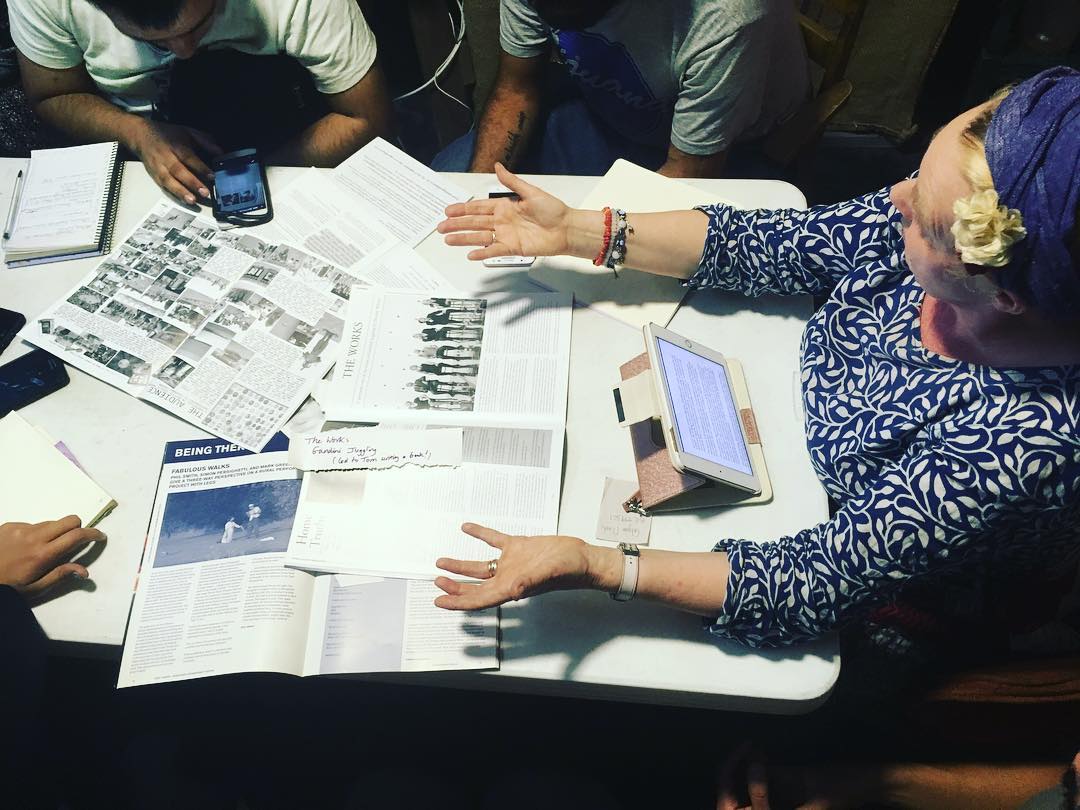
What do we offer that is different? We’ve tried! Over the years, we’ve pioneered alternative approaches to reviewing, such as the Being There feature in which at least three voices – including the theatre-maker and the reviewer – each, independently of each other, write about the event from their perspective. We’ve also often run reviews as conversations between two writers, as an example, a piece on Pina Bauch’s Kontakthof reflected on by an old-hand who’d seen lots of her work (me) and a young reviewer who was seeing Bausch for the first time (Alexander Roberts).

Total Theatre Magazine was set up and continues to be ‘staffed’ – if we can use that word of people who work very part-time and usually unpaid – by artists who also happen to write about the artforms that they and others around them practice: theatre and performance. We are not ‘critics’ in the traditional sense – although even that statement is problematic as many very famous traditional critics – take the mighty Kenneth Tynan, for example – also worked in theatre as writers, dramaturgs or whatever. Anyway, to follow this train of thought, Total Theatre Magazine (and its sister organisation Total Theatre Network) exists to celebrate and support the artists making the work. It’s a trade mag, and insider’s voice.

Does that mean we don’t publish ‘bad reviews’? The jury’s out. As editor, I tend to prefer not to. Reviews editor Beccy Smith often disagrees on that one. But this is my blog so I’ll state my case: I can’t see the point in bad reviews. It’s fun to write them, but it’s usually more about the writer than the show reviewed – an excuse to wax lyrical and pun gleefully, enjoying the creation of witty words and humorous jibes. If Total Theatre Magazine exists to support the artists making the work, aren’t we doing the artform a disservice, causing harm even, by publishing a bad review? Up against that is the idea that we have a duty to review work seen, and the best way to support an artist’s development is by giving them hat we believe to be a fair critique. In which case, I’d argue, write it and send it to them, don’t post it publicly.

The next problem is the issue of subjectivity. I recently taught a Critical Writing course at Evolution Arts Centre in Brighton, and it was one of the first questions asked: as a critic, am I expected to be objective? My answer? Try to be a good witness, being as ‘objective’ as you can about what is presented on stage – describe what you see and hear. Open your eyes, open your ears, open your heart and try to experience, really experience, what is being offered to you. Try, initially at least, to remove any need to ‘have an opinion’. But once it moves onto the part of the review where you are writing what you feel and think: be aware that these are subjective responses, inevitably informed by who you are and where you’re at in this particular moment in time. Some things I’ve asked fledgling reviewers to think about include: how much is your age, ethnicity, personal life experience affecting your response and judgement? If the show irritates you, what buttons are being pushed and why? What do you think the artist was trying to communicate, and why is it not reaching you? I don’t for a minute feel that everyone has to love everything, or pretend they do – just to flag up that if we respond with a strong reaction – love or hate – to a show, we should at least try to see why it is provoking that response.

And more on subjectivity: how often have I heard a journalist or awards judge say, oh it’s not down to personal taste – it’s not because I didn’t like it, it’s just that it’s a bad show. But that argument is easily challenged by looking at the very disparate reviews that almost any show will garner. It becomes clear very quickly that intelligent and well-informed people can see the same work and disagree strongly about its ‘value’. This is particularly true of anything that involves humour. I’ve sat completely stony-faced through shows that other people have howled in laughter at from beginning to end, and I’ve laughed hysterically at things that have left other people cold.

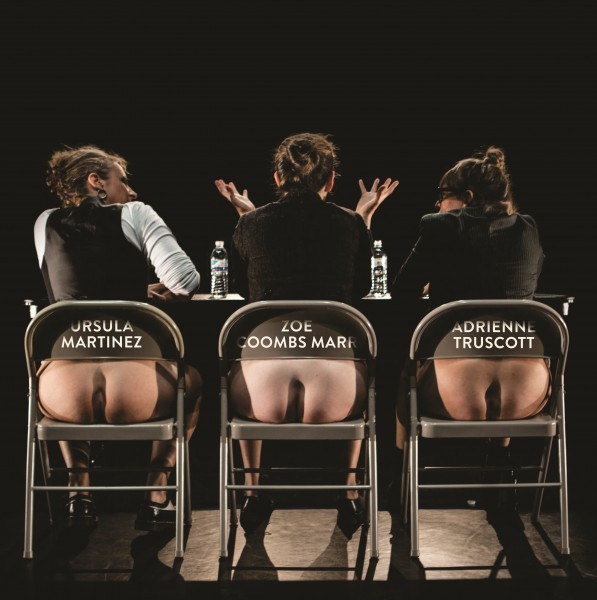
Let’s take Wild Bore, for example – a very funny (in my opinion) show created by three female theatre-makers/comedians, who have all seen a great deal of commercial and critical success, and simultaneously a great deal of slamming of their work. The three women are: Zoe Coombs Marr (Australia), the winner of the Barry Award at the Melbourne International Comedy Festival (MICF) for Trigger Warning; Ursula Martinez (UK), theatre writer and performer of shows such as Free Admission and My Stories, Your Emails, and cabaret diva (the famous Red Hanky lady of La Clique/ La Soiree, and star of Duckie’s C’est Vauxhall);  Adrienne Truscott (USA), choreographer, circus performer (one half of the acclaimed Mau Mau Sisters), writer and comedian, creator of the controversial (value judgement or fact?) Asking For It: A One-Woman Rape about Comedy Starring Her Pussy And Little Else.

 Wild Bore, created collaboratively, has caused a stir wherever it has played because of its unusual subject matter. It takes negative reviews – of the three artists’ previous shows and of theatre shows by other people – and makes this the text of the show. Or at least, this is one aspect of the text – the performance text consists of the words staged inventively within a series of comic vignettes and increasingly complex visual tableaux and physical actions. The first scene, famously, notoriously we might say, featuring the women’s talking backsides sitting atop of a trestle table. ‘Opinions are like assholes,’ says one of the bare bottoms. ‘Everyone’s got one.’

We go on to see each of the performers debunking their least-favourite review of their work. When a critic says that something on stage (be it a grown woman running around in circles tearing off her clothes or a teenage boy holding up a skull called Yorick) happens ‘for no apparent reason’ because they cannot fathom out what that reason might be, or muses on whether something presented to them on a stage is by ‘dramaturgical design’ rather than a happy accident (of course it is – duh!) it is obvious, now this is shown to us, that those sort of critical statements are pretty dumb, and say more about the critic than the artist’s work.

Almost everyone who has reviewed this show has stated that it is almost impossible to review – it’s a show about theatre criticism that cleverly second-guesses almost any response anyone might make to it in its debunking of the role of the critic. Some have thus chosen not to review the show, but some have taken up the challenge. We can note here that Wild Bore has garnered two-star, three-star, four-star, and five-star reviews. It’s a matter of opinion. Divides the critics, as they say.

The Guardian hedges its bets and eschews its usual reviews-with-stars system by publishing two responses side-by-side, from comedy critic Brian Logan and theatre critic Lyn Gardner (yeah, yeah – we’ve been doing that for years at Total Theatre). Rupert Hawksley, in the Telegraph, decides that he will respond as a bull to a red rag (or is that a red hanky?), saying in his two-star review: ‘This attack on theatre critics falls squarely on its bottom.’ What a gift! Into the show it goes! Two stars also from The Scotsman, this time a female critic, Joyce Macmillan (not all the flak is from middle-aged white men): ‘ [Wild Bore] is not much more than an hour-long demonstration of thespian self-obsession, taken to vaguely obscene, although occasionally entertaining, extremes.’ Hmmm. Not so obviously quotable but ‘occasionally entertaining’ is a good example of damning with faint praise. Exeunt’s Joy Martin gives it a good review, buying into the notion that it is a patriarchal question (ie most critics are privileged white men) saying: ‘The three naked asses and genitalia on prominent display are female, which to me felt like a deeply feminist symbolic rebellion against the broken elements of a traditional style of theatre response that we have inherited from the patriarchy, which is struggling to see, accept and understand the unfolding edges of theatre, and which defaults to superiority and derision as a response to anything it doesn’t get.’ (Fair enough, but what about Joyce? Is she then cast as the Theresa May of theatre criticism in this story?) Five stars from Broadway Baby’s Charlie Ralph: ‘Wild Bore is a show that is sometimes difficult to watch, frequently difficult to understand and almost constantly difficult to critique. What makes Wild Bore fascinating is that it is a show about all three of those things and how key they are to theatre, it is this nesting doll of metatextuality that makes Wild Bore such a unique, impossible experience.’ Metatextuality – cor blimey, that’s a word I’ve never used in anything I’ve written. Must try harder.

So, what do I think? Here goes: Wild Bore is a witty and entertaining Fringe show easily received and enjoyed. But it is a whole lot more. As the show progresses it raises increasingly complex ideas – not just about the nature of criticism but about the act of making and viewing theatre. What do we really see, hear, feel, think? And if this applies to theatre – the need to constantly re-evaluate what we are witnessing and what it means to us – then it also applies to life. We have nothing other than ourselves through which to filter our theatre-making and theatre-witnessing or indeed any of our life experiences – our sensory impressions, emotional responses, intellectual judgements are, inevitably, our own. There is no objective gaze; there is no neutral performance body. This last point is beautifully (value judgement!) demonstrated by the unexpected arrival on stage of a Deus Ex Machina – a previously unseen fourth character who calls out the women for making work that is a product of their cis-female, white, educated, privileged selves. This coup de theatre makes the play. It is – to offer a totally subjective opinion – a stroke of genius.

We don’t give stars, but if we did I’d give it – lots.


Wild Bore was shortlisted for a Total Theatre Award 2017. It played at the Traverse Theatre throughout August as part of the Edinburgh Festival Fringe, and can be seen at Soho Theatre in London from 21 November to 16 December 2017. www.sohotheatre.com/whats-on/wild-bore/ 


Selina Thompson: salt.

Winning Hearts and Minds

Summerhall are all-victorious in the Innovation, Experimentation and Playing with Form category of the Total Theatre Awards 2017 

There is an irony, says Rachel Mars, picking up her Total Theatre Award, in making a show about competition and envy that goes on to win an award…

Her show, Our Carnal Hearts, is a total delight. The ‘thou shalt not covet’ commandment is investigated thoroughly: everything from the relatively harmless #humblebrag (let’s all sing a long to the Humble Waltz!) to the deeper, darker nastier parts of our psyche that wishes ill upon our dear friends and family when they are perceived to be doing better than us. This isn’t just a theoretical musing: Rachel bears her heart, revealing her own ‘spiky, sticky, shameful bits’ – including her hatred of her pretty blonde cousin with the angelic singing voice and her envy of artist friends who win cushy awards or commissions. The audience are implicated too: we are asked to picture a moment when we heard some good news about someone close to us, and wished them ill. We are then asked to share, which most refuse to – but a brave young man sitting next to me offers up his envy of his sister, who quits a challenging job in order to pursue a spiritual path. We are all asked to join in with him in shouting our congratulations.

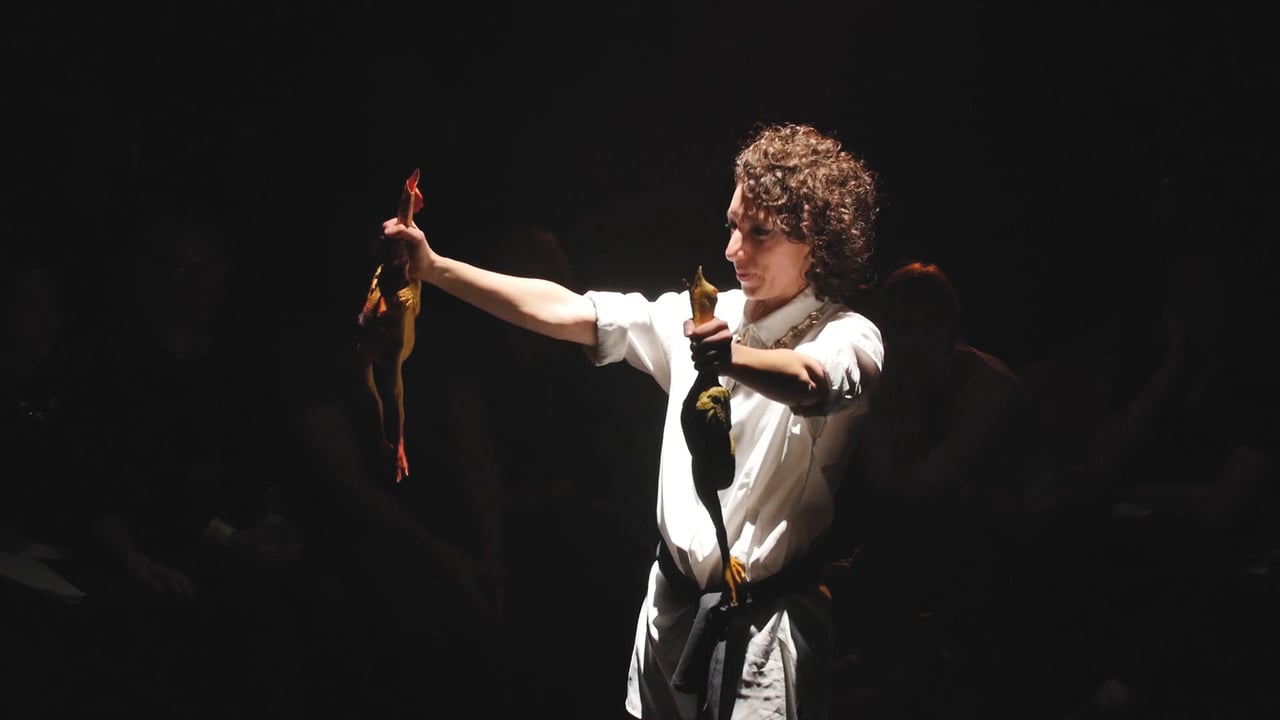
Two narrative motifs weave through and eventually merge: the old Yiddish joke about a fairy who offers to grant a wish, but with the proviso that whatever you wish for, your neighbour gets double (it doesn’t end well); and the story of a high street plot that morphs from community park to car valeting shop to upmarket jewellers to nespresso boutique… Oh envy, thy twin sister’s name is aspiration. The text is marvellous – wise and witty and deliciously wicked – we wouldn’t expect anything less from Rachel Mars. But what pushes this show up from great show to award-winner is the eloquent way that the in-the-round staging, spoken word, and live music (composed by Sh!t Theatre’s Louise Mothersole) interweave. The piece is set to resemble a church service, with a choir of singers placed within the audience, and sermon mics on stands placed in each of the four aisles. The central space is used for ritualistic actions in this unusual service – these including the laying out of a geometric pattern of coffee grounds (Aleister Crowley eat your heart out) and the beating out of sins with a couple of rubber chickens. Hallelujah! We are saved!


Rachel Mars: Our Carnal Hearts

Rachel Mars: Our Carnal Hearts


Our Carnal Hearts was presented at Summerhall, and I saw it immediately after seeing what was to become another Total Theatre Award winner,  Palmyra, which is also, in a very different way, an investigation of the sinful side of human behaviour. In this case, Thou Shalt Not Kill (not bully, nor beat, nor terrorise) is the commandment up for investigation.

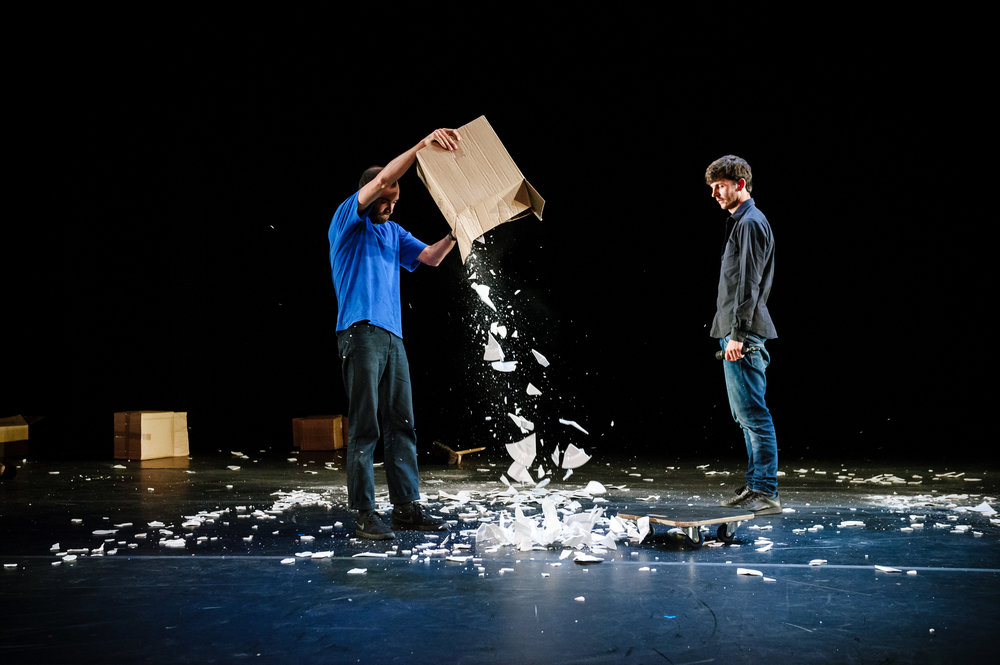
The show is made and performed by Bertrand Lesca and  Nasi Voutsas, who we could see as a next-generation Ridiculusmus (similarly a two-man outfit combining intense physical performance, spiky spoken text, and darkly comic clowning).  Palmyra takes no prisoners. The scenography and choreography are totally intertwined, and there is a fantastic build of energy as our two protagonists spar and bully their way through an intense hour of crockery smashing, hammer wielding, and whizzing around on 4WD skateboards, in an exploration of ‘revenge, the politics of destruction and what we consider to be barbarian’. The audience are not allowed to remain neutral, and are coerced into taking sides: take the hammer, hide the hammer, give the hammer to him… Let’s call the whole thing off!


Palmyra: Photo by Alex Brenner

Palmyra: Photo by Alex Brenner


Palmyra provoked an interesting discussion at the judging meeting about who owns stories and who has the right to tell them, with some feeling that Syrians and those living close to ISIS-held territories might perhaps have a very different response to this show, which takes the destruction of the ancient site of Palmyra and its use as an execution arena as its starting point. There is also the question of whether, without the title and programme notes, the audience would even get the connection. But it won out in the end because the majority view was that this is a dramaturgically complete, beautifully structured and brilliantly performed piece of theatre. My own view? Humour and satire are vital tools in the fight against violence and terrorism. And the message of Palmyra is a sound one: Let him without sin cast the first stone – we all have the capability for violence within us, it’s how we handle it that counts. This is a show I had some reservations about when viewing but which has stayed with me, provoking new thoughts and responses long after the last piece of crockery has fallen. And ‘What’s happened here, then?’ could qualify as the best opening line of the 2017 Fringe.

Both of the above won Total Theatre Awards in the Innovation, Experimentation and Playing with Form category. There was a third winner here too: Selina Thompson’s salt. Which also involves things getting smashed – but this time it is an enormous block of Himalayan rock salt.


Selina Thomson: salt.

Selina Thomson: salt.


salt. is an autobiographical piece – but that tag doesn’t do it full justice. It is a piece that weaves together stories from a personal journey (a literal journey at sea and a metaphorical journey into the self) with an investigation into the legacy of colonialism and the African slave trade, via a journey tracing the route of the Transatlantic Slave Triangle that joins Britain, Ghana and Jamaica. Selina’s story of her sea journey, a quest to sit inside the history of the people – Selina’s ancestors – ends up being extraordinarily difficult, but provides an extra dramatic element to the artwork, in that something that could have been dismissed as a reflection on a long-gone past takes on a contemporary immediacy due to the artist’s appalling experiences of still-with-us racism.  In an article Selina Thompson wrote for Total Theatre Magazine last year, in the early days of making the piece, she had this to say, by way of introduction:

‘On 12 February, I got on a cargo ship, and sailed from Antwerp in Belgium, to Tema in Ghana. I left there, and flew to Kingston in Jamaica, before sailing back to Antwerp via North Carolina. I returned on 12 April…

While I was away, myself and my film-maker had to split up, my grandmother died, my biological sister got in touch. While I was away, my hair was searched in customs, I tore the cartilage in my left knee, I listened to people stand outside my door and comment on the fact that I was “already as black as one of the niggers”. While I was away I showered outside while hummingbirds flew above my head, a French bulldog burst into my room and stole my luggage tags, and a load of flying fish jumped too high and landed on the ship I was sailing in.’ 

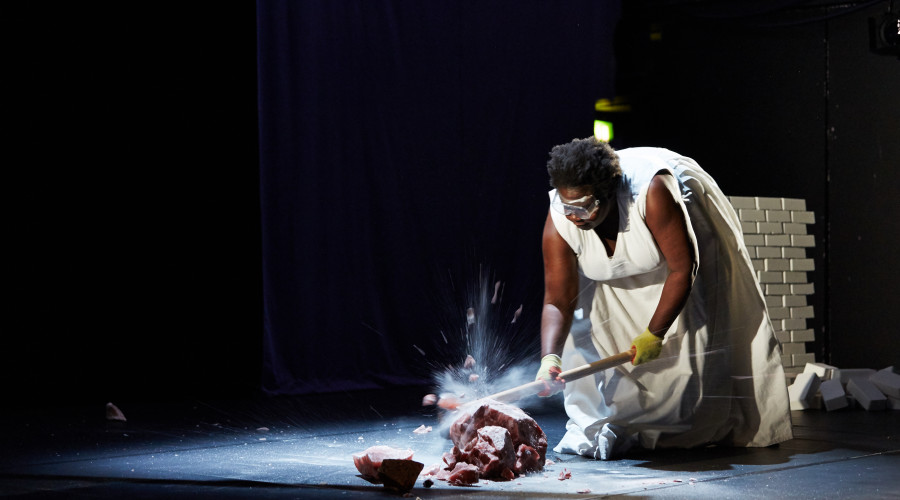
The show (which I saw in preview at the Attenborough Centre in Brighton) is a revelation. Selina Thompson, in her ‘act of remembrance and grief’   demonstrates a phenomenal ability to combine sharp writing with a winning personable delivery that breaks the fourth wall: embodied in the fact that we need to wear goggles when the salt rock is smashed; we are most definitely here together in this shared space.

In one of the most harrowing moments in the piece we stand with Selina before the Gate of No Return at the former trading fort Elmina Castle, Ghana, facing the Atlantic ocean and seeing with her the thousands of men, women and children forcibly removed from their homeland to work and die in the New World plantations. These moments of gravity are counterbalanced with gently humorous accounts of her telephone conversations to her Dad back in Birmingham, who takes some of the stories of the journey with – well, I’ll not resist the obvious and say with a pinch of salt.

Beyond the strength of the script, the scenography of the piece (with design by Katherina Radeva) provides a staging that is perfect for the story. A neon sign, a few plants, a simple and elegant white dress  – it doesn’t take much, but it is all more than enough, a deceptively simple and elegant design. The enormous rock of salt is centrepiece, broken up with a pick-axe as the show progresses,the larger chips off the block to be laid out in representation of the people populating the story. We are one, it says to me – one race, the human race, united in our mineral essence, drops in the ocean.

All three of these winning shows are by young artists, and all were presented at Summerhall – which perhaps merits some comment.


Julia Croft: Power Ballad

Julia Croft: Power Ballad


Summerhall continues to be the venue that is the most likely to host the more experimental work being made, with the door always open for innovative international theatre. They do not shy away from the phrase ‘avant garde European theatre’ in their programme notes. The ever-enterprising Big in Belgium programme can be found there (Ontroerend Goed’s Lies making it on the the Awards shortlist), and the Northern Stage programme of new writing (which include Selena Thompson in its line-up) is to be found there, as it has been for a number of years. The future is taken care of in the form of a four-year residence at Summerhall for Rose Bruford College of Theatre and Performance.

This year, Summerhall also hosted the CanadaHub programme in its sister venue the King’s Hall, which included the brilliant Mouthpiece (reviewed here) and a very lovely piece of music-theatre featuring multi-instrumentalist Ben Caplan – Old Stock: A Refugee Love Story.

The 2017 programme also featured many companies dear to the hearts of Total Theatre Magazine’s editorial team – including many previous Total Theatre Award winners or shortlisters: Ridiculusmus, Sh!t Theatre, FK Alexander, Dancing Brick, Richard Gadd, Action Hero, RashDash, Orkestra del Sol, and Julia Croft (whose Power Ballad was shortlisted for the Total Theatre Emerging Artist Award 2017). Which is quite a list – and only a fraction of the shows on offer.

On the day that the Fringe closes, I sit at home, well away from Edinburgh, with my Summerhall programme and I grieve for all the shows I didn’t get to see there in the brief two weeks I spent in the Burgh during August 2017. Never mind, there’s always next year…

 Summerhall is a year-round venue and gallery, housed in the former Royal (Dick) Veterinary College in Edinburgh. www.summerhall.co.uk 

Selina Thompson’s salt. was seen in preview at the Attenborough Centre for Creative Arts (ACCA) at University of Sussex. www.attenboroughcentre.com 

Featured image (top) is Selina Thompson: salt.


Total Theatre Awards 2017 Announced!

Total Theatre Awards 2017 have been announced!


The Total Theatre Awards, which have been running since 1997, recognise ‘innovative and artist-led performance at the Edinburgh Festival Fringe’. 28 peer assessors, who looked at 538 shows across the first 11 days of the festival. The nominees shortlist was announced on 17 August. The nominated shows were then viewed by a panel of 20 judges who gave seven awards across five categories, together with two special awards: the Judges’ Discretionary Award to Liz Aggiss, and the Significant Contribution award to journalist Lyn Gardner.


Awards were announced on Thursday 24 August at the Out of the Blue Drill Hall, and the ceremony was supported by Edinburgh Playhouse and hosted most admirably by Figs in Wigs.


Co-directors Jo Crowley and Becki Haines said: ‘This year’s awards recognise exceptional artists creating gentle, bold, risk-taking and visionary work that is diverse, inclusive and accessible. It highlights the vital role theatre plays in communicating, engaging and opening up space for shared experiences. The artistic voices across this festival continue to provide a lens for audiences to understand one another better in an increasingly divided world.’


The judging panel for this year’s awards included Donald Hutera (The Times dance critic), Adrian Berry (director, Jacksons Lane), Dorothy Max Prior (editor Total Theatre Magazine), Matt Trueman (writer and critic), Jessica Bowles (Royal Central School of Speech and Drama), Andy Roberts (Bootworks/University of Chichester), and a whole team of producers and programmers from venues, festivals, and arts organisations across the UK, including Home Manchester, and The Place London; together with a number of overseas judges, some of whom were there with support from the British Council.


The Total Theatre Awards are managed independently to Total Theatre Magazine.

For more information on Total Theatre Awards see: www.totaltheatrenetwork.org


Full list of Total Theatre Award winners as follows:


Total Theatre & Farnham Maltings Award for an Emerging Company / Artist


Five Encounters on a Site Called Craigslist

YesYesNoNo (England)

ZOO


Physical / Visual Theatre

Sigma

Gandini Juggling (England)

Assembly


Total Theatre & Jacksons Lane Award for Circus

Fauna

Fauna in association with Aurora Nova and Follow the Rabbit (Sweden)

Assembly


Total Theatre & The Place Award for Dance

Hope Hunt and the Ascension into Lazarus

Oona Doherty (Northern Ireland)

Dance Base


Innovation, Experimentation & Playing with Form

Palmyra

Bertrand Lesca & Nasi Voutsas (England)

Summerhall


salt.

Selina Thompson Ltd (England)

Northern Stage @ Summerhall


Our Carnal Hearts

Rachel Mars (England)

Summerhall


Judges Discretionary Award

Slap And Tickle

Liz Aggiss (England)

ZOO


Significant Contribution Award

Lyn Gardner


Featured image: Gandini Juggling: Sigma

Quote Unquote Collective / Why Not Theatre: Mouthpiece

‘My mother always told me you can cure almost anything with a hot bath.’

Two women in identikit white body suits sit in a white bath tub. Except it’s not two women, it’s one woman. A woman and her subconscious self. A woman and her inner child. A woman and her mother’s voice, which follows her around constantly, not just heard but also felt.

This woman is a modern woman of the world. She’s different to her mother.To the mother who has just died, and for whom a eulogy must be written. A eulogy written, a casket chosen, flowers ordered, a dress bought. And nylons too, perhaps. Our two-in-one woman rants against these tasks imposed upon her by her mother’s bereavement, and she rants against her mother – still the little girl who is trying to cut the apron strings. She is not like her mother. Not at all. Her mother was always neatly coiffed, immaculately dressed, beautifully made up. She has never, never ever, seen her mother eat French fries. Never, not once. She struggles to understand who her mother actually was. What did she do? What did she love?

Running through the show are continuous references to the white wedding that her mother never got to host. Maybe she’ll wear white to her mother’s funeral rather than black? Her mother was desperate to see her in a white dress in a church. Even as she plans the flowers for the funeral, bride’s bouquets seem not too far from her mind. Lilly of the valley. Baby’s breath.

The grief-stricken and angry and sulky and often hilariously funny rants and raves explode outwards, morphing into sobs and songs and screams. The two voices speak or sing as one voice, or in cannon, or in call and response. They mirror each other precisely, or overlap, or run just slightly out of synch, or in counterpoint. There is harmony, and there is dissonance. Much of the piece is a cappella, but there are interludes of recorded music with a rock or jazz or gospel vibe sung over or against.

The relentless outer-inner dialogue about the funeral arrangements is complemented by a number of set-pieces of feminist critique, for example, a great monologue on women’s voices and how high and low pitches are perceived and interpreted.

Mouthpiece is written and performed by Amy Nostbakken (who many UK audience members will know as the musical director of Theatre Ad Infinitum) and Norah Sadava, who are based in Toronto, Ontario in Canada. The women complement each other perfectly. Different heights and colourings, different talking and singing voices, very different performance qualities. It’s a physically robust show – exhausting just to watch these two excellent performers whose vocal gymnastics are matched by a gruelling choreography of physical actions in and around the bath tub – movement director/dramaturg Orian Michaeli, working with director Amy Nostbakken (who also composed the music), has done an excellent job in physicalising the voicework. The two women mirror, shadow, and see-saw; pushing, pulling, gyrating, supporting.

It’s not an easy ride, for performers or for audience: Mouthpiece is cathartic, disturbing, unnerving – but there are many moments of humour to counterbalance the intensity. It tackles a number of difficult subjects head-on: bereavement, especially when there are conflicted feelings about the dead person; the nature of the continuing insidious oppression of women in a hundred different small ways day in and day out; and the way that women collude in that oppression. Most of all, it tackles the one subject that many modern women find so immensely difficult to deal with: how do we make peace with our mothers, whether they are alive or dead?


Mouthpiece is presented at Edinburgh Fringe 2017 under the auspices of the Canada Hub programme at King’s Hall, in association with Summerhall and Aurora Nova.

Kneehigh: The Flying Lovers of Vitebsk

Bella with White Collar, I and the Village, The Fiddler, The Praying Jew, The Birthday… We know and love these Chagall paintings – they feed our souls and invade our dreams – and here they are recreated live on stage in Kneehigh’s The Flying Lovers of Vitebsk, which charts the great love story of Marc and Bella Chagall in glorious pictures, words and sounds.

The painting are presented to us not as facsimiles in paint on canvas – nothing so crude and obvious – but as human bodies singing, dancing, making music, making love. Inevitably, in a show about a great visual artist staged by a great visual theatre maker, the scenography and dramaturgy are completely and harmoniously intertwined. The raked stage is patterned with painted swirls and dribbles; the screen to the rear serves as a canvas for a constantly evolving painting in light; and the four performers – two musicians, Ian Ross and James Gow; and  a pair of perfectly paired actor-singers, Marc Antolin as Marc Chagall and Audrey Brisson as Bella  – create a succession of tableaux vivant and moving pictures that constantly delight. The only time that director Emma Rice and designer Sophie Clist choose to have an actual Chagall reproduction on stage it is when we encounter the Praying  Jew (the Rabbi of Vitebsk) – but this is very much tongue-in-cheek as the Rabbi’s portrait is ‘puppeteered’ with human arms sticking out to the side – one of many lovely comic moments in the show.

The action takes place on a stage within the stage, the audience on three sides – this stage supplemented with a musician’s station, which is centred around a piano bearing an old-fashioned lamp; and a comfy armchair placed downstage, which is often Bella’s place of refuge. The back screen also serves as a shadow theatre screen, and the space around the sides of the stage is also a performance space – used most effectively, for example, when Bella in wedding dress steps down to address us as her wedding guests: ‘People offer doubts as gifts,’ she says, referring to her family’s reservations about her marrying a poor painter. A Jewish painter who wants to waste the rest of his life with her!

As is always the case with Kneehigh, music plays an important part in setting the scene, conveying the mood, and driving forward the narrative.  The two musicians play piano, cello, accordion, fiddle, trumpet – sometimes from their off-stage station, and sometimes taking centrestage – perhaps donning papier-mache headresses. (The cockerels, cows, candles and clocks of Chagall’s paintings find their way into the stage pictures in many and various ways!)  Audrey Brisson sings like an angel in Yiddish and French.The choreography embraces bright and breezy Jewish Russian wedding dances and delicate moments of love and romance – the lovers fly from the ground not on harnesses or pulleys, but using the simple effect of a well-held acrobalance pose on a chair, or dangling gently from a short rope hanging from a wooden beam. Less is more, and it works beautifully.  Emma Rice does stage sex very well: as we saw in Tristan and Yseult, and other earlier Kneehigh productions, she has an excellent knack of creating breathtakingly tender and erotic duets between her main characters.  Here, when Bella softly rolls over the length of Marc’s body, or straddles him on a chair, or literally leaps into his arms from across the stage.

The lovers’ story takes them (and us) on a breathtaking journey through twentieth-century history. The pogroms, the Russian Revolution, the renewed animosity towards Jews, the rise of Nazism, life in exile in Paris or Berlin or New York… At times, we are subjected to slightly too much information, and scriptwriter Daniel Jamieson puts rather too many words in Marc’s mouth: a heavy burden is placed on the character of Chagall to constantly carry that story, and perhaps there could have been a little more transposing of narrative into physical or visual narrative.

Jamieson and Rice do not shy away from presenting the occasional difficulties in Marc and Bella’s marriage and the conflicts between them, nor the flaws in Marc’s character – some of which we could see as of-its-time masculine attitudes to the woman’s role in a marriage, and some of which as the acting out of the eternal (and ongoing) Romantic view of the life of an artist as something separate from and above the domestic. Bella’s hurt when Marc doesn’t come to visit his newborn daughter because his painting had taken an inspirational turn is raw and harrowing – she tries to tell him how painful the birth was, and he replies: ‘Do you thing what I do happens painlessly?’ Yet if those were the days that produced paintings we see as masterpieces, was that justified? There are no answers. It is a dilemma we still tussle over in the 21st century.

We do, though, see Marc change and grow. Throughout their marriage, he mocks and dismisses her interest in theatre, and her desire to write and to act. ‘I wish actors would just stop moving around so we could get to see the scenery better’ he says dismissively. (This of course raises a big laugh in the auditorium.) After Bella’s premature death – he lives on for many decades after her – he finds her notebooks, filled with her memoirs in Yiddish of her  and their life in Vitebsk, and says wonderingly: ‘We saw the same things, but with different eyes’ – finally acknowledging that rather than being an appendage to his creativity, she was a creative person in her own right.

The Flying Lovers of Vitebesk, which premiered in Bristol in 2016, is Emma Rice’s final production as artistic director of Kneehigh, and a fitting and fulfilling end to that particular chapter of her life. Having played at Shakespeare’s Globe (where Rice is currently artistic director, a role she will rescind in 2018) it is presented at the Traverse as part of the British Council Edinburgh Showcase 2017.