
Author Archives: Dorothy Max Prior

Dorothy Max Prior

About Dorothy Max Prior

Dorothy Max Prior is the editor of Total Theatre Magazine, and is also a performer, writer, dramaturg and choreographer/director working in theatre, dance, installation and outdoor arts. Much of her work is sited in public spaces or in venues other than regular theatres. She also writes essays and stories, some of which are published and some of which languish in bottom drawers – and she teaches drama, dance and creative non-fiction writing. www.dorothymaxprior.com

Mime and So Much More: LIMF’s 40th Anniversary Edition

A magical merging of choreography and film-making, puppetry of every persuasion, Beckettian clowns, the body as manipulated object, and circus shows that deconstruct and re-asssemble the traditional skills into new forms:  this and more was seen at the London International Mime Festival by Total Theatre’s team of writers. Dorothy Max Prior reports on shows seen and post-show talks facilitated… 

The 40th anniversary edition of the London International Mime Festival saw a whole raft of world and UK premieres, but also a number of returning shows. There was a special edition of Gandini Juggling’s worldwide hit Smashed; Familie Floz with what is perhaps their best show (although all are great), Teatro Delusio; and Charleroi Danses from Belgium with Kiss & Tell (read Donald Hutera’s interview here).

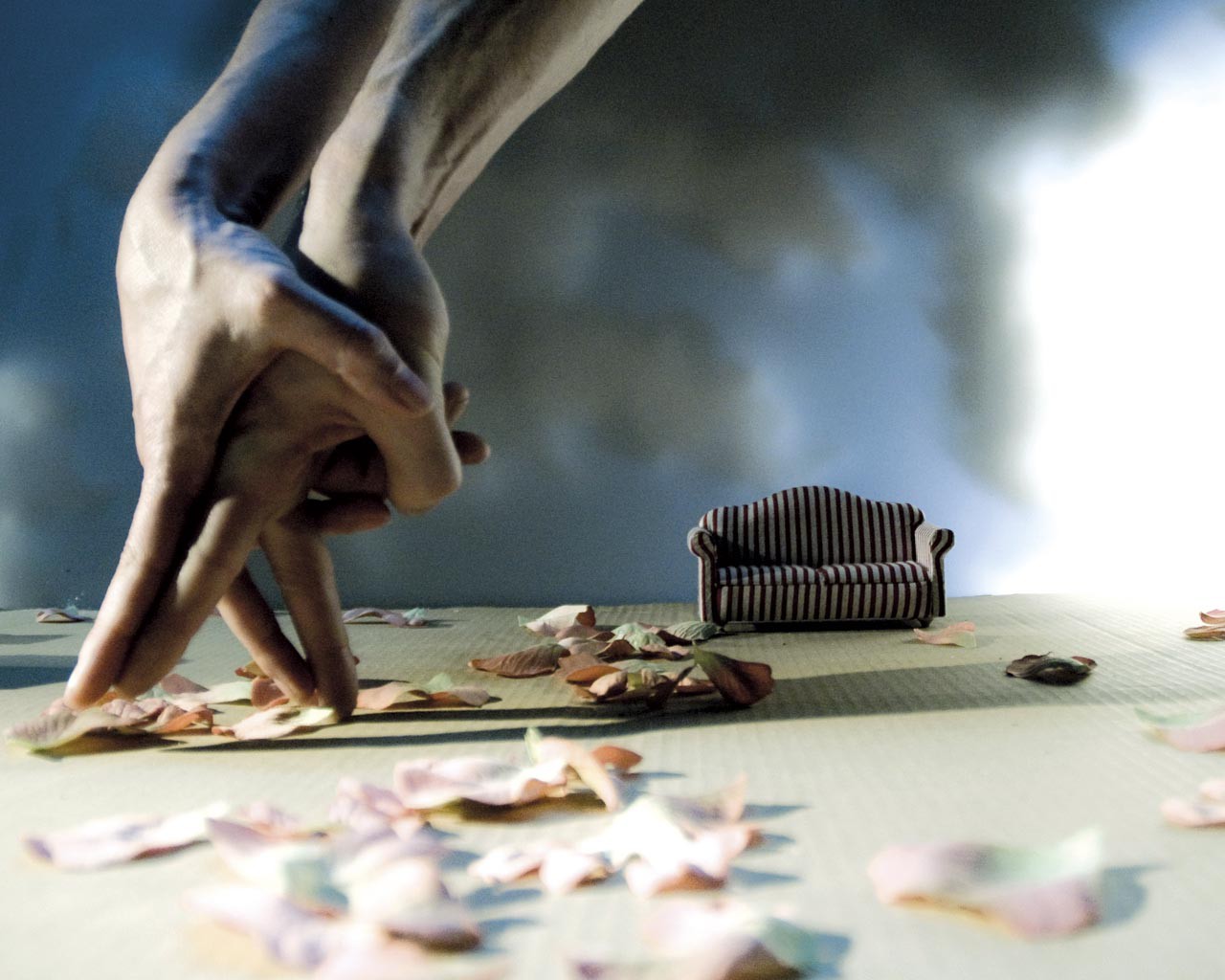
Kiss & Tell was (unusually) first presented out-of-season by LIMF, who brought it over to the Barbican in June 2014 (reflected on by Beccy Smith, in the feature I Am a Camera). This collaboration between renowned filmmaker Jaco Van Dormael and choreographer Michele Ann de May is an extraordinary piece of work, blending object animation, live action and film – the onstage cast and crew creating a film live onstage,the audience seeing both the creation of the scene and the film simultaneously. Scenes are enacted using ‘puppeteered’ hands, tiny model figures, dolls houses, tanks of water, clouds of coloured smoke – and an entrancing miniature train that whizzes round and round throughout the show. Performers, cameramen, lighting technicians and object manipulators scurry around in the semi-darkness, between half-a-dozen or so on-stage sets, the filmed action appearing on an enormous screen on the back wall. It is a technically stunning show – but it is far more than a show of techniques, as the story is a tender and moving one about memory and what one values most in life, focusing on a woman nearing the end of her life who remembers her five truest loves – she can count them on the fingers of one hand – starting with the boy whose hand she touched on a train when she was just 12 years old. It is exactly the sort of show that has made the reputation of LIMF: a merge of awe-inspiring form and soul-nurturing content to create a magnificent example of visual theatre.

Festival firm favourites who were back in 2017 also included the terrifically talented Moussoux Bonte with Whispers, reviewed by Thomas Wilson; perennial favourite Mathurin Bolze/ Compagnie MPTA with Barons Perches (which I’ve reviewed, on its opening night at LIMF 2017) and marionettist Stephen Mottram with a double bill, The Parachute / Watch the Ball (reviewed by Darren East). I say marionettist, but there was hardly a string in sight…


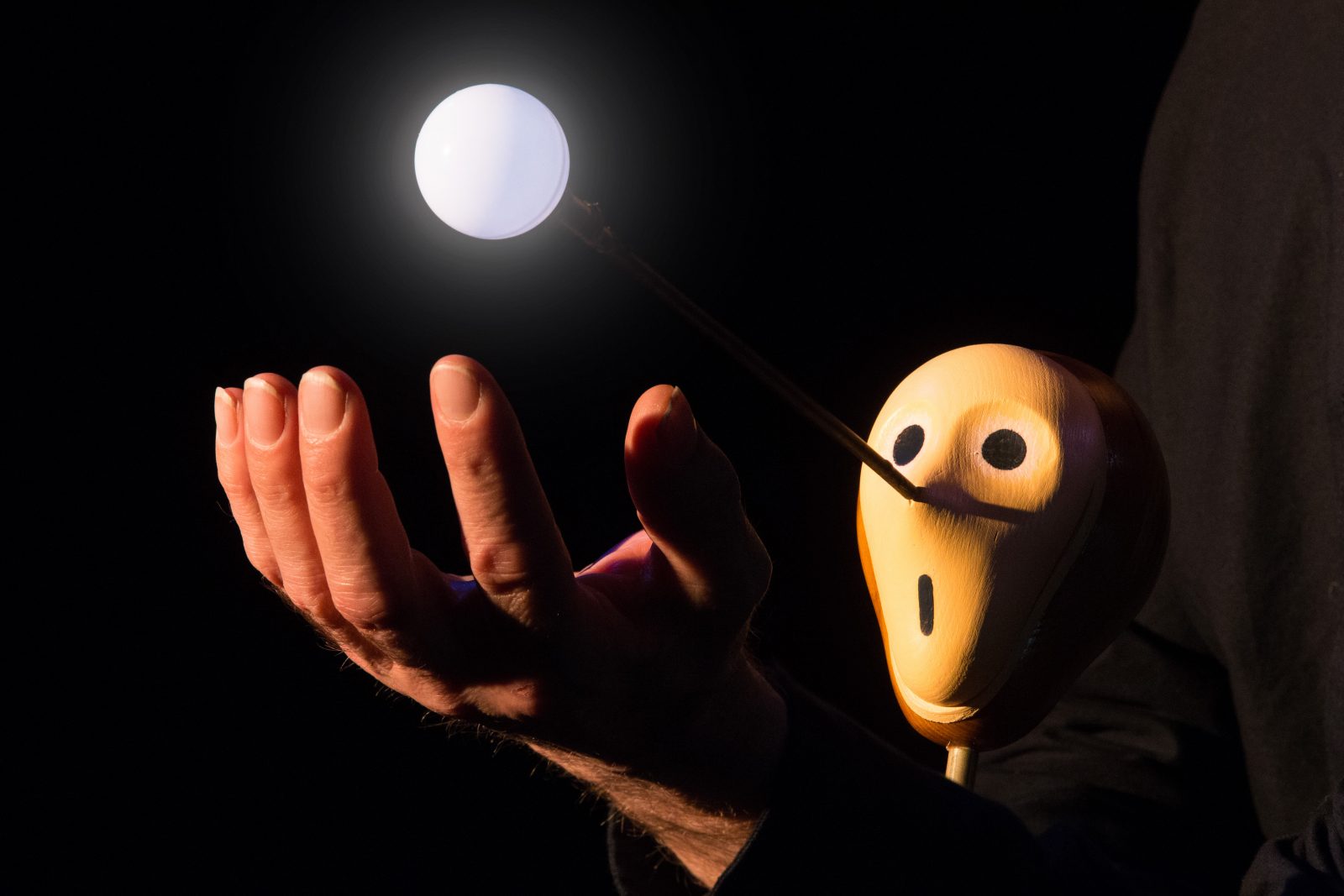
Stephen Mottram: Watch the Ball. Photo David Fisher

Stephen Mottram: Watch the Ball. Photo David Fisher


Stephen Mottram’s was one of five LIMF 2017 shows that I attended as facilitator of the post-show discussion. In this case, almost all the sold-out audience at Jacksons Lane stayed on for the talk – and (in puppetry terms) it was a pretty heavyweight audience, with such luminaries as Lyndie and Sarah Wright of Little Angel Theatre, Ronnie LeDrew (manipulator of Muffin the Mule, Sooty and Sweep, Zippy and so much more), and Indonesian Wayang Kulit shadow puppetry expert Matthew Cohen of Royal Holloway – all facing front expectantly. And I’m pretty sure they weren’t disappointed! Stephen talked eloquently about the interchange between science and art in general (I once took part in one of his workshops and learnt a lot about physics from his explorations of pendulum swings!), and the work of Swedish Psychologist Gunnar Johansson in particular. Johansson’s research was the catalyst for the creation of The Parachute, as well as leading the film industry to the techniques of motion capture. Stephen explained how, in the 1970s, Johansson had attached white markers to a few key points on a black-costumed actor’s body and then filmed the actor walking against a black background. When the film was played back, he was surprised to find that the white spots seen moving relative to each other on the screen contained so much information that not only could the viewer immediately identify a human walking, but also the gender, age and mood of the person. In The Parachute, Stephen Mottram uses the idea in reverse. The white tips of his multiple magic wands (ten at a time, imagine!) reveal ephemeral characters – characters that within a minute of the piece starting we completely believe in. The second of the two pieces, Watch the Ball, cleverly plays with the nature of puppetry. A puppet assembles itself from a piece of cloth and a pair of human hands, chooses itself a head, and then the puppet goes on to make itself another puppet. Meanwhile, the puppet master, wearing dark glasses, looking away, appears to have nothing at all to do with all this. Discussing it afterwards, Stephen talked of the puppeteer’s task being to manipulate the audience rather than the objects – it’s all an illusion, that’s the magic of puppetry.


Les Antliaclastes: Here Lies Shakespeare

Les Antliaclastes: Here Lies Shakespeare


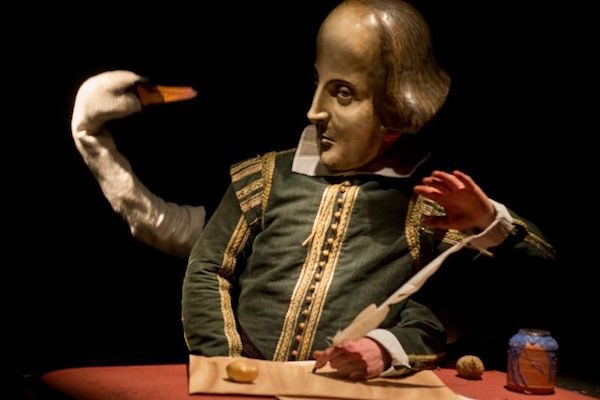
Also a puppeteer (although of a very different ilk); also at Jacksons Lane: Patrick Sims, formerly creative director of  Buchinger’s Boot Marionettes, who in recent years has been working under the name Les Antliaclastes. He was last seen at LIMF in 2011 with Hilum, a micro comic-tragedy, based on the cycles of a washing machine and set in the basement of a rundown museum of natural history. Previous shows for Buckinger’s (Vestibular Folds, and Armature of the Absolute) have been a similarly mind-blowing blend of surreal dreamscapes – with influences ranging far and wide, but usually with some traceable lineage to Alfred Jarry. His new show is called Here Lies Shakespeare, and it lives up to expectations – a cornucopia of extraordinary ideas and images enacted by grotesquely masked humans and taxidermied puppets. Some of the images are still haunting me weeks later, not least the terrifying larger-than-life Potato Man with the swivelling eye who leaps out of nowhere to appear just inches from me. Perhaps I won’t sit in the front row next time… The show is loosely based on Mark Twain’s provocative text Is Shakespeare Dead? which heralded the still-ongoing heated discussion about the existence of Shakespeare, the authorship of the plays, and the Stratford-upon-Avon tourist industry. Sims is something of a Renaissance man – he writes, directs and performs in his shows, and all the puppets and masks are designed and made by Sims and his wife, Josephine Biereye. He talks intensely about the creation of the show, saying that he has no fixed opinion on whether Shakespeare did or didn’t exist, but is fascinated by the controversy and the notion of a whole culture based on what is possibly a fraud. He seems at his happiest not when he is talking about his doctorate on Jarry’s work, or his take on the authorship question, but when he is sharing the discovery that the Shakespearean tourist industry at Stratford was kickstarted by no less auspicious a name as circus proprietor PJ Barnum; or when answering questions about the functionality of the eye mechanism in Potato Man. Detail is everything in Patrick Sims’ world.


Plexus Polaire: Ashes

Plexus Polaire: Ashes


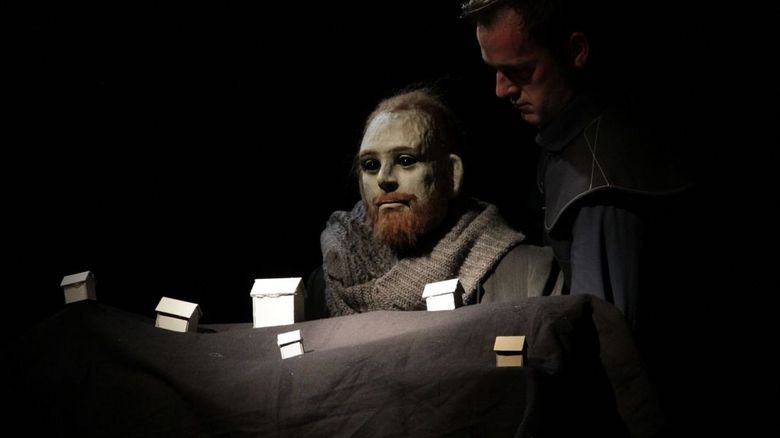
Whilst we are talking puppets, a shout out to Nordic Puppet Ambassadors from Finland, whose Only One Suitcase Allowed is a small-scale (miniature, even) one-one-one tackling an enormous subject – the Holocaust. (This was presented in the basement of the Southbank Centre’s Festival Hall.) It was beautifully done – one of my favourite shows in this year’s programme. Another firm favourite was Plexus Polaire’s Ashes, the brainchild of the eloquent writer, director and puppet-maker Ingvyld Aspeli – also Scandinavian, but in this case from Norway. The post-show for this one saw the whole international company on stage – three puppeteer-performers, a video maker, a lighting technician, and Ingvyld herself. It turned out to be a good call – we had a very sparky exchange on all aspects of the work, discussing the original inspiration, a Norwegian novel about arson; the writing and devising process when creating a visual theatre work about the process of writing (there’s a challenge!); the challenges of human v puppet wrestling matches; how to light puppetry of different scale effectively; integrating video, object and live action; and the argument for making one’s puppets as beautifully crafted and honed as possible. Yes, Ingvyld is also obsessed with detail. It is a puppetry thing, no doubt.


Thomas Monkton/Kallo Collective: Only Bones

Thomas Monkton/Kallo Collective: Only Bones


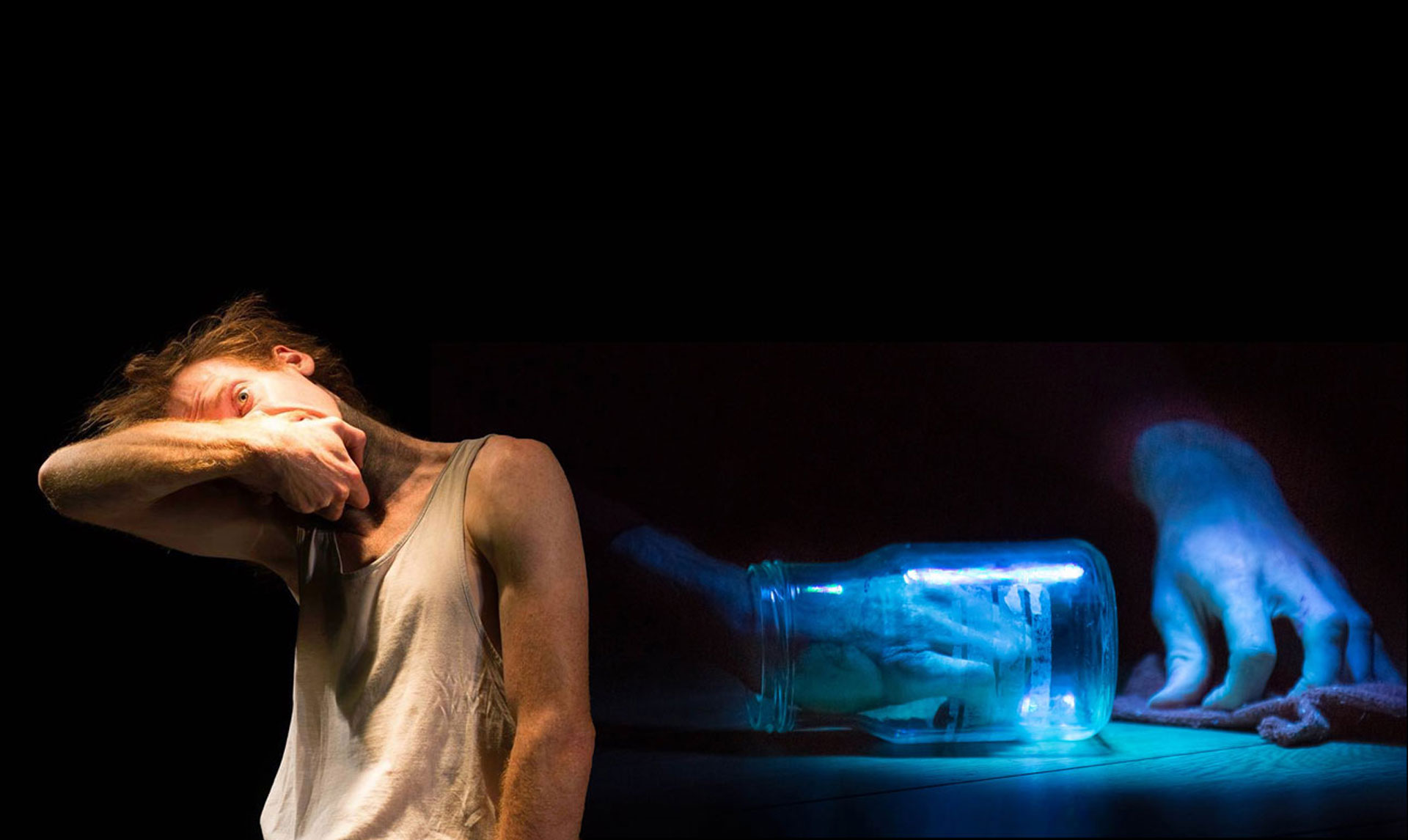
Another post-show to lead – this time at Soho Theatre, for Thomas Monckton/ Kallo Collective’s Only Bones. In contrast to previous show The Pianist, which featured a grand piano, a chandelier, and numerous other props that fought back at every opportunity, Only Bones sees this very able physical performer strip things back to just the human body (albeit an extraordinary one, his), a hanging light, and a couple of small props – including a bottle of red nail polish used to extraordinary effect. I saw (and reviewed) this one at the Edinburgh Fringe 2016, and it was a delight to see it again – just as proficient but if anything funnier, as the relationship with the audience had really grown and developed. The show was created in collaboration with Gemma Tweedie, whose onstage presence (both in the show and the post-show discussion) is as an interesting almost-still and almost-silent foil to Thomas’s exuberant presence. They make a great double act!


Silver Lining: Throwback

Silver Lining: Throwback


Vibrant UK-based circus talent continues to be supported at LIMF, with the 2017 programme including the charming, feel-good circus show Silver Lining: Throwback, which had Circus Hub audiences eating out of their hands at the Edinburgh Festival Fringe 2016 (where it was reviewed). The LIMF 2017 version, presented at Silver Lining’s home, Jacksons Lane, saw regular company performer/co-creator Niamh O’Reilly off duty and hand-balancer extraordinaire Alice Gilmartin filling Niamh’s shoes – and balancing canes – with aplomb. Joining a pre-existing ensemble at short notice is never easy, and the show, as seen on the first night of the run, was not quite as slick as it had been in Edinburgh – but it was just as bright and breezy and the (mostly young) audience loved it. The post-show talk was equally lively, with the cast of six (including company founder Tom Ball) joined onstage by Tom’s brother Simon Pollard (one of two co-directors of the show, the other being Paulette Randall). What a lovely bunch of people they are! We chewed over issues around safety – both in the sense of physical safety, putting your life in someone’s hands once you start training with them; and emotional safety, with reference to the inclusion of the piece of so much sensitive autobiographical material. We talked about the UK circus family; the training offered at the National Centre for Circus Arts (aka Circus Space); the relationship to audience in a show with no fourth wall, in which performers often step down into the auditorium; the involvement of a non-circus-trained director (Simon’s background is musical theatre); and the process of co-creation of circus work that has an over-arching theme rather than the usual linear narrative of theatre. This led to a very interesting discussion about the difference between the circus performer and the actor – everything we do and say is real, we are not actors, say Silver Lining – although they agree that they are employing the techniques of theatre in the construction of the work….


Leandre: Nothing to Say

Leandre: Nothing to Say


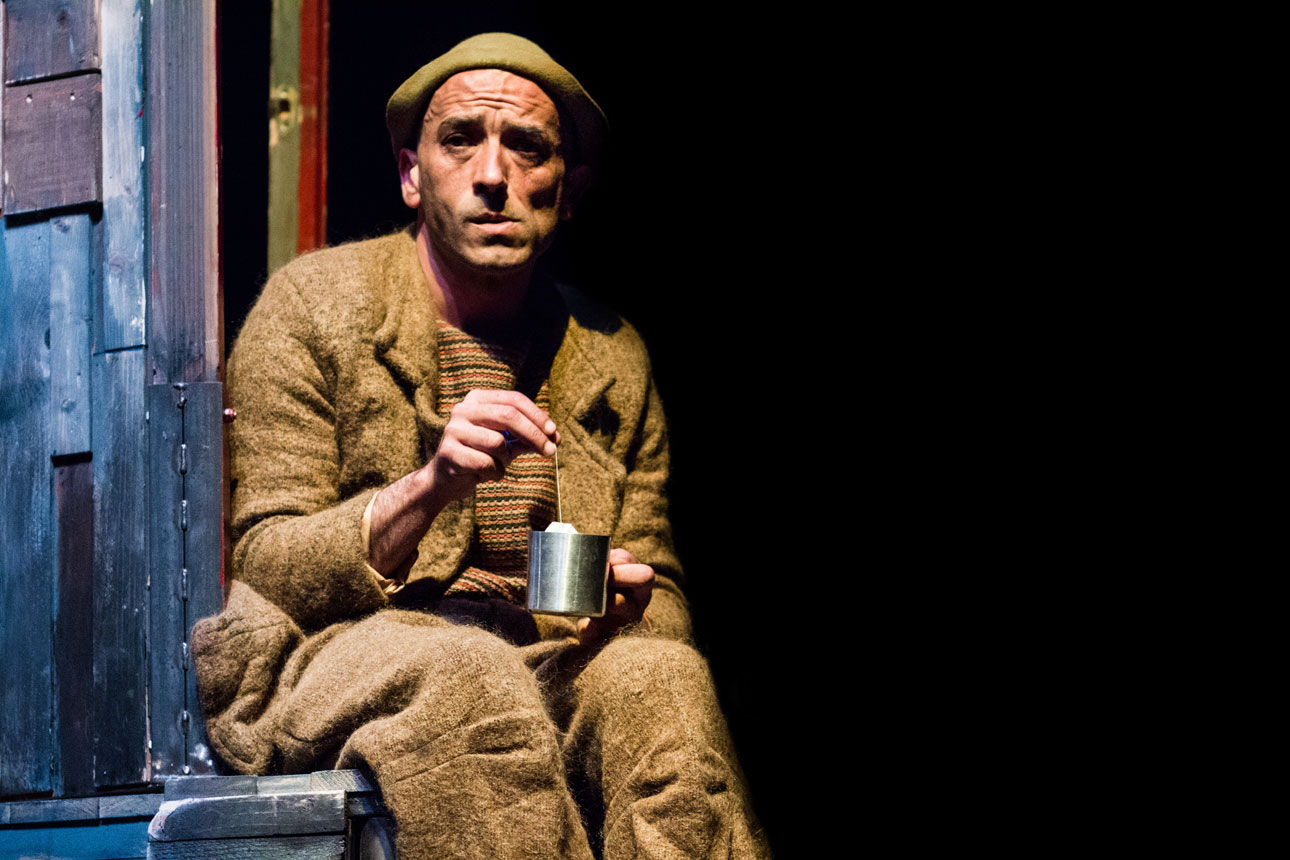
As always with the Mime Festival, there are shows that you’d love to see but just can’t fit in. My one that got away this year was Spanish/Catalan clown Leandre, who presented the UK premiere of Nothing to Say. Next time, hopefully. I would also have liked to have gone to the Clowns and Power Symposium, hosted by Bim Mason. Or indeed, the legendary Angela de Castro’s workshop How to be a Stupid. I did, though, get to see French clowns Sacekripa, whose Maree Basse (Barbican Pit) explored downtime and the ‘odd couple’ dynamics of male relationship with an intriguing mix of apple paring, wine drinking and knife-throwing.

I also missed Theatre Re’s Kantor-inspired ensemble work The Nature of Forgetting, but hopefully this world premiere show (presented at Shoreditch Town Hall) by a young UK-based company that LIMF have nurtured and supported for the past few years will make a return visit, or will tour.

The Festival also included Jolie Vann’s Imbalance, which Adrian Berry saw at Ed Fringe 2016; Dewey Dell’s Manga inspired Marzo, reviewed by Rebecca Nice; and Euripedes Laskardis’s intriguing-looking Relic (previewed by Donald Hutera).

So that’s it for this year – another London International Mime Festival done and dusted… and 40 years of magnificent Mime Festivals marked.

Congratulations to LIMF’s co-directors, Joseph Seelig and Helen Lannaghan, for another great edition, and to everyone who works for this extraordinary organisation. For one month of the year, you make London buzz and hum. You make us think, you make us feel, you make us laugh, you make us cry.

Long may LIMF continue to enchant and entertain us!


Featured image (top); Charleroi Danses: Kiss & Cry. Photo by Marteen Vanden Abeele.

Dorothy Max Prior is writing /co-editing a celebration of 40 years of the London International Mime Festival, which will be available later in 2017. Further details soon on www.mimelondon.com


Nordic Puppet Ambassadors: Only One Suitcase Allowed

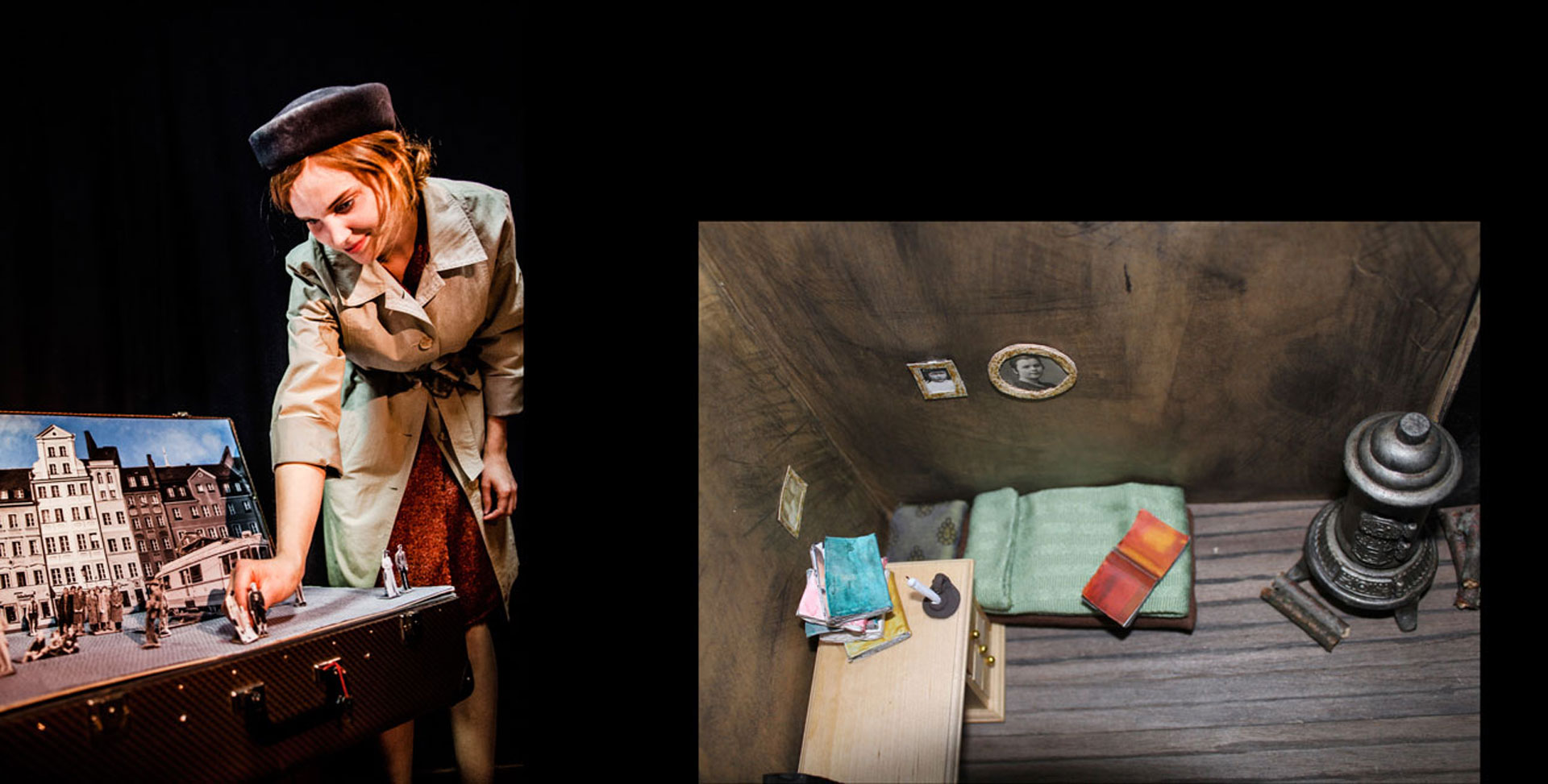
A world within a suitcase – tall town houses, a tram, and little paper-cut people happily going about their business. A mother and daughter holding hands. A group of adults waiting at a stop. Children sitting on the pavement. A man taking a stroll. Everyday life. The female performer manipulating the little people provides an underscore of  small murmurings in French, and a vintage jazz tune plays in the background. The music stops. A pair of giant hands clad in black leather gloves descends on the scene, snatching up the little people carelessly, counting them as they are thrown into a truck. Who knows where they are going.

But of course we know. We know too well. It’s a story we all know, and a story that has to be told, again and again, lest we forget.

Only One Suitcase Allowed opened at the London International Mime Festival on Holocaust Memorial Day, 27 January, a date that marks the liberation of Auschwitz-Birkenau, the largest Nazi death camp. It is inspired by the story of Anne Frank, but it is also the story of the many millions – millions, it is still almost impossible to compute what happened, here in Europe, just one generation ago – millions of people who were taken, hounded, hunted, transported, murdered by Hitler’s fascist regime. Jewish people, gay people, Roma people. Anyone who was seen as an ‘undesirable’.

The show takes its title from the many documented stories that state that when people were rounded up to be taken to the camps, they were told they could take only one suitcase. They fearfully, but perhaps hopefully, packed – what? What would you take? Your mother’s jewellery? Your best dress and shoes? Photographs of your children? Or perhaps something more practical? Of course, these suitcases were taken off them at the door of the camp – their valuables stolen from the victims along with their lives. The suitcases can still be seen today at the Auschwitz and Birkenau camps.

So suitcases are the central metaphor of the show – the objects that form the scenography of the piece and its core dramaturgical device. A great pile of suitcases confront us, accusingly. Inside the suitcases, there are many tiny worlds – mostly viewed through little peephole lenses. These worlds are beautifully crafted, showing us interiors that become ever more restricted and oppressive. A comfortable living room, a small hidden room behind a bookshelf, doors that open to show other doors that open, a dark van interior, a discarded teddy bear…

It is a straightforward story, and there are no surprises in the narrative – much as we would like it to end differently – although how the story is told is novel. The design is exquisite, and would appeal strongly to anyone interested in Toy Theatre, paper cuts, or peepshow booths. Attention to detail is admirable. The tiny suitcase worlds are the perfect metaphor for the ever-diminishing worlds of the victims, trapped like dolls in a dolls house, always under surveillance. The performance is strong and sound – we are guided efficiently and lovingly through this carefully crafted landscape.

Another important aspect is who is choosing to tell this tale. Nordic Puppet Ambassadors are director Outi Sippola and performer Linda Lemmetty (the two also co-designed the show). They are Finnish, and say in their programme notes that although some people in other countries might feel that they have Holocaust fatigue, their generation in the Nordic countries feel far removed from these horrific events, and thus the creation of the show involved extensive research, including a visit to the camps.

Those who cannot learn from history are doomed to repeat it, said George Santayana. One cynical response to that is that history repeats itself because no one was listening the first time. It is our duty to listen, to look and to listen. To remember, and to stay alert.

We are grateful, therefore, that these young artists have seen fit to investigate this story, and to present it to us with fresh eyes. It is just 15 minutes long, a one-on-one, and it is both beautiful and heartbreaking.


Sacekripa: Marée Basse

Marée basse – low tide. Downtime. The waiting time.

On stage, there’s a house, or at least, a kind of shack. Inside its wooden boundaries, a kitchen table, a couple of chairs, a small enamel cooker, tin pots and pans, a TV.  As we enter the auditorium, a nasty waspish synth line repeats and repeats ad nauseum. We sit down. We wait.

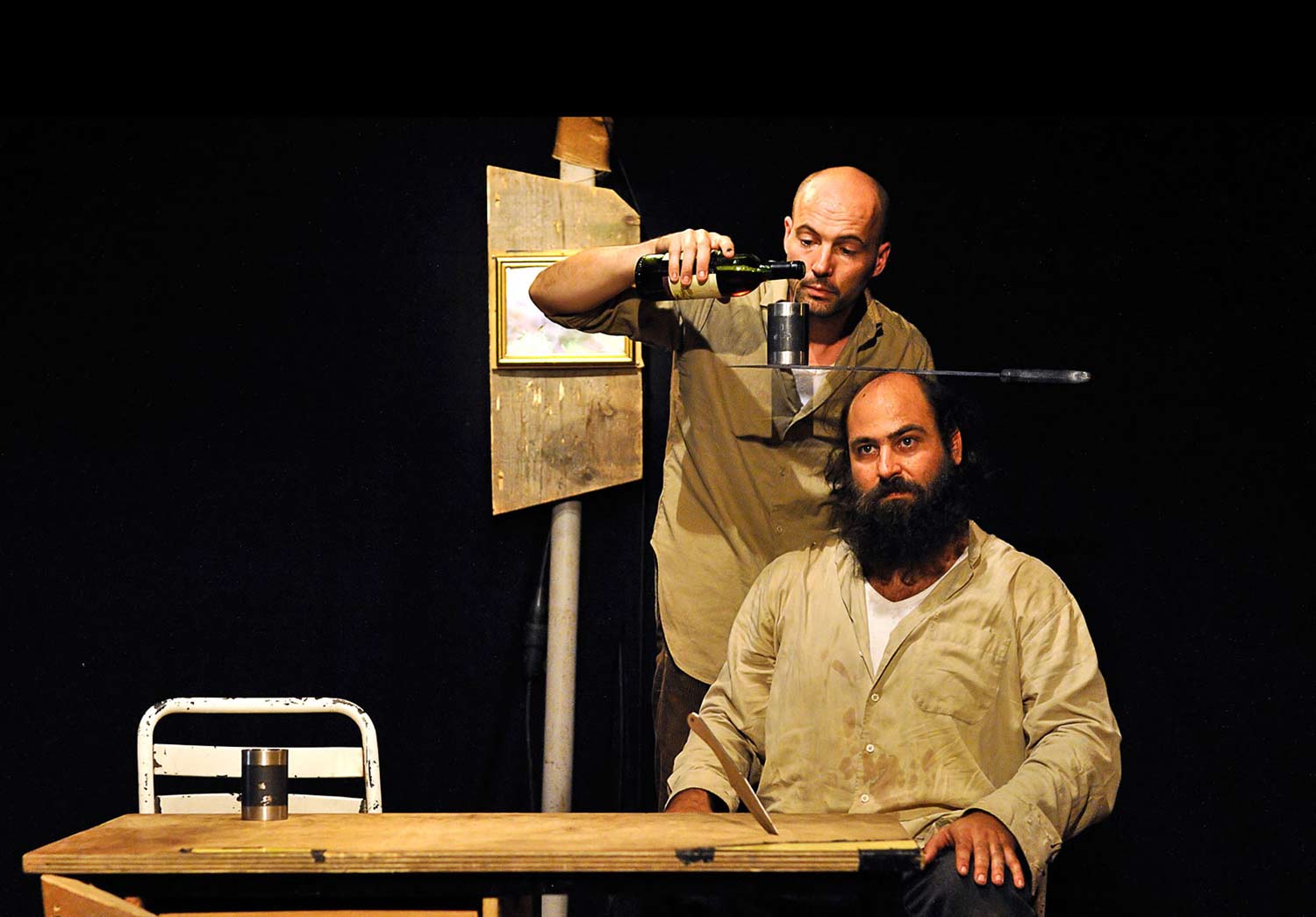
A stubbly bald man in a brown shirt and overcoat shuffles on, sits – or tries to, ending up painfully (for us if not for him) tangled up with the chair. Another man comes on, bulkier, fully bearded. He trips over the edge of the flooring, gets into a flap trying to locate an invisible hook for his coat, ends up sitting next to the other man. They sit, they wait, they pass the time, time passes. Who are what are they waiting for? Godot only knows.

It’s dinner time – kind of. There is a slow paring of an apple, a few slugs of wine, a rattled pot. Things turn freaky as knives are thrown. A great scary cleaver is stuck into the table. There is some rather clever business – Lazzi tricks and turns – as men and table and chairs and knives and metal mugs are thrown or balanced or juggled in unconventional ways. It is all about the game between these two, and we are observers but not recognised as present. There is no music, and no spoken text – just some grunts, and bangs, and popping corks. And most unnervingly, the sound of that meat cleaver as it connects to a great many different surfaces.  I find myself shifting a little uneasily in my seat.

Just as I’m starting to feel a little bored – bang! The tussle intensifies and the thinner man ends up falling through the back curtain and off the wooden flooring of the shack, immediately alerting us to the fact that this is a theatrical setting. I wake up a little more, interested. He reappears in the auditorium – heralding the start of a new dimension to the piece. Now we are acknowledged, and played to. Two red waistcoats are brought out (inevitably, the big man’s waistcoat is too small for him). They stand outside the perimeter of their shack, fully downstage, and show us their acrobalance act – old-timers who are trying to relieve the glory days in vaudeville. The TV is switched back on to provide an unsuitably grandiose soundtrack. They are seeking our approval with ‘ta da’ endings and desperate puppy-dog eyes. The turning on and off of the TV – the blank blue screen, the white ‘snow’, sound or no sound – is a key element to the show, acting as a kind of scene-setter or marker. Eventually, they watch the TV and ignore us, other than for an occasional glance over the shoulder…

The clowning skill of the deviser-performers (Benjamin de Matteis and Mickael Le Guen) is beyond question – they trained at the Lido Circus School in Toulouse and the show bears the mark of that heritage. That Le Guen was, as a youth, an award-winning apprentice chef is no doubt a factor in the subject matter and setting of the show.

Marée Basse is a show that I enjoy rather than absolutely love. I feel a little unsure when watching it, rather unsettled, but appreciate it more and more afterwards, as I remember a small detail cleverly played – particularly the extraordinarily nerve-racking knife throwing and object balancing scenes – or muse on the relationship to the audience and to the performance space that is explored and acted out here. I believe it was originally devised for and performed in a tent, and I have the feeling that I would have enjoyed it more in this setting. From my seat on the end of an aisle a few rows back, I felt a little detached from the stage action.

Not my favourite ever clown show, but a good and interesting show by a pair of very talented performers.

 Featured image (top) by Vincent d’Eaubonne

Compagnie MPTA / Mathurin Bolze: Barons Perchés

An elaborate construction of scaffolding and timber, an open-fronted house, sits on a high stage in the centre of the performance space. Lights dim, other low-lights glow. The house seems to have a life of its own, flickering and humming. A man – dark tousled hair, black jacket, white shirt – comes in, makes himself at home. He turns off some lights, turns on others, shakes a cloth out of a ‘window’, turns on the radio. French voices burble, the sound quality of an old-school transistor radio, slightly incoherent yet filling the space. The man’s shoes clatter on the wooden floor as he walks the length of his house and back again. He sits slumped in a chair with his back to us in the dim light, silhouetted. This low-key scene setting the mood of the piece is long, but we stay engaged. We know something is about to happen. Tension builds.

The change comes as the man opens up a trapdoor and disappears below the floor, and at that exact moment his doppelgänger bursts from a door high up on the wooden wall stage-left, careering down and bouncing up again to disappear back through the door. So yes, the floor is a trampoline. Well, this is a Mathurin Bolze show, so it would be, wouldn’t it?

The man and his shadow (or is it the shadow and his man?) are then engaged in a game of hide-and-seek or call-and-response. There are many ‘blink and you’ll miss it’ moments. One appears, the other disappears – through the trapdoor, or through one of the many doors and windows built into the set. One stands by the back wall window, and we see his shadow outside. As Man One (or is it Man Two?) moves, and his shadow remains outside, we do a little double-take, our brains tricked even though we now know that there are two performers. Each in turn flies through the air, bouncing off the trampoline floor to take up a different vantage point on the set. As they move through the space, jackets go off and on seamlessly. We lose track of who is man and who is shadow.

The two men move into a different game. Now they are brothers, twins. They fall onto the trampoline in tandem, their moves synchronised perfectly. Now there’s another shift. One is shirtless, limp, lifelessly slumped, then cradled in the arms of the other, a Pieta moment. It turns nasty as the shadow is bundled away through the trapdoor. In one of the most beautiful images in the show, we see a figure trapped underneath the trampoline, struggling to escape – seen as a body shape pushing against the resistant fabric, then seen as a black shadow, legs flexed like a frog, as an intense light trained onto the trampoline transforms the image.

And so it plays out – the man and his shadow, the shadow and his man, sometimes rivals, sometimes brothers, but always two parts of one whole. Hans Christian Anderson’s eery story The Shadow – in which a man’s shadow replaces him in his life – seems to be an obvious point of reference, although not cited as such in the programme notes, which mention Dostoevsky’s The Double (which was published around the same time as Andersen’s tale – something obviously in the air in 1846) and Edgar Allan Poe. We are also told in those notes that Barons Perchés is a sequel to Mathurin Bolze’s seminal show Fenêtres, which was based on Italo Calvino’s novella The Baron in the Trees – a text which has inspired many circus-theatre creators over the years. Apparently, Bolze is now imagining his hero (a young nobleman who has decided to leave his family and live alone in the trees) split into a younger and older self. I didn’t see Fenêtres, but have to say that witnessing this sequel, I struggle with marrying up my knowledge of Calvino’s text with what I’m seeing onstage, although the doppelgänger, or shadow, or two-sided man motif is perfectly embodied. Let’s be clear – my quibble is not with the show itself, just with how it relates to the stated artistic inspiration. Best not to worry about such things, perhaps, and focus on what we see onstage!

And what we see is truly inspiring. The physical skill of both performers, Mathurin Bolze and Karim Messaoudi, is of the highest quality. Theirs is a delicious dance of bodies exploring every possibility of gravity, levity and resistance, using the trampoline, the set, and of course each other. In one minute they are hurtling on and off the trampoline at breathtaking speed, in another they are walking slowly along at ceiling height on top of the scaffolding, or poised in stillness like lizards on the open front wall, seen in silhouette.

The moodiness of the piece is broken up with the obligatory (in contemporary circus-theatre) loud and brightly-lit clowning moment – in this case, as the performers become a pair of rival birds, cockerels strutting and crowing. It feels a little like it is there to give the men a few minutes respite from the intense demands of trampolining rather than having any sound dramaturgical purpose, but we’ll allow them that!

The sceneography is beautiful – set design, lighting (which exploits the ‘shadow’ metaphor in every way it can) and the limited but effective use of video projection all working harmoniously to tell stories using pictures rather than words. And the sound design, by MPTA company member Jerome Fevre, is brilliant. How marvellous it is to see – and hear – a show in which sound, vision and physical action work so harmoniously together. The soundscape includes creaking cellos and melancholic piano lines mulched in with tweeting birds, chirping crickets, and the drone of the radio station. There is also live sound – a swanee whistle here, a dash of harmonica there – and the sound of the set itself features, as a clever mix of contact mics and one large ambient mic hanging from a light pendant pick up the bangs and thumps of bodies and objects hitting the trampoline or the scaffolding, turning the impact sounds into crashing cymbals or chiming bells. Throughout, the house feels to be as much of a character as the man and his shadow – but at this point in the show it really shouts its presence.

Barons Perchés is not a perfect show – there is the occasional slip in pace or tone, and I’m left with a few dramaturgical conundrums that bother me, such as: Why does the house appear to be moving through the landscape? Why are the men now wearing brightly coloured sports clothes? It is conceived, directed and performed by Bolze and could perhaps have benefitted from an outside director. Nevertheless, an excellent show. A marvellous merging of sound and vision, fantastic physical performance, and a thoughtful exploration of the ever-appealing doppelgänger theme.


Photo: Christophe Raynaud de Lage


Carnesky Productions: Dr Carnesky’s Incredible Bleeding Woman

What’s the time, Mr Wolf? Oh – it’s that time. Time of the month. Lady time. Time for your little monthly visitor. Dr Carnesky eschews these euphemisms, preferring to explore the metaphor of the snake shedding its skin, to emerge renewed. The mythology of menstruation is her subject, and we are treated to a potted version of her PhD thesis, slide-show enhanced, which rattles us through musings on female icons Medusa, Hydra, and Kali, to confront the conundrum of the stainless Virgin Mary, taking us eventually to the notion of the crucified, bleeding Christ as a prime example of womb envy. Blood, death, resurrection. Move over, Jesus – it happens to us all the time. We learn along the way that make-up – rouge, red lipstick – can be traced back to the symbolic smearing of menstrual blood on the face, at which point Carnesky suddenly, as if by magic, has a bloodied face and hands. ‘Wearing make-up, we are all menstruants,’ she says.

And, bloody Nora – she’s not alone. Bleedin’ women, all over the shop. One (Fancy Chance) with a lipstick hidden in her fanny, conjured up to enact a ritualistic rouging of her body. One (MisSa Blue) a sword-swallower who injured herself a while back when performing whilst menstruating – the oesophagus swells in sympathy with the womb, it would seem. One (H Plewis) who performs a flowing dance with blobs of her own frozen menstrual jelly as a prop, reappearing later with the ultimate fertility symbol, her baby daughter Sula. One (Molly Beth Morossa) draws witchy circles of salt that she writhes within, whilst the screen behind her shows an image of a full moon. One (Rhyannon Styles) is seen on screen performing a rite of passage ritual on Southend beach, as her live self tells us that as a transwoman, she may not bleed monthly but she certainly experiences a cycle. One (Nao Nagai) who appears in a whole-body mask as a Yokai, a comedic phantom from Japanese folklore. Carnesky herself is seen on film bathing in blood as she tells us that she has experienced four miscarriages, and needed to find a way to work through the disappointment of the arrival of the blood that signified that the pregnancy was ending. Voila – the Menstruants! Or is it the Menstronauts? They seem to be both. Regardless, this group of women (which also includes Priya Mistry, who is not performing this evening) have met regularly at Dark Moon – the time of the birth of the new moon – over many moons to research the lore of menstruation, to enact ritual, and to create performance.

The resulting research is presented to us by Dr Carnesky, resplendent in a midnight blue gown with red-sequinned cape, who uses a form familiar from many of her previous shows, a performance-lecture that is both serious and tongue-in-cheek at one and the same time, interspersed with contemporary sideshow vignettes that both celebrate and subterfuge the popular theatre, circus and cabaret traditions of the show-woman making a spectacle of herself. ‘Do you believe in menstrual magic?’ she asks the audience. Yes, we shout – the loudest shout coming from a very young girl in the gallery.

The Doctor is on great form – her voice dips down into Thatcher-esque depths, then rises into girlish cheekiness. She moves from university lecturer mode to music hall entertainer with ease, addressing the audience directly: How many of us are on the rag tonight? Hands are raised. More than last night, Dr Carnesky observes with a twinkle in her eye – by the end of the run she predicts that the whole audience will be menstruating in synchronised harmony, and that includes the men.

Sometimes the performance mode moves into a poet’s declaiming rather than a professor’s explaining. The screen behind returns many times to the image of the moon, as we are reminded that observing its waxing and waning was the original means of calculating the passing of time.

The ‘lecture’, the live performance vignettes, and the still and moving images segue together seamlessly, for the most part – although some of the film work is not of the best quality. The music is a lovely mix, embracing fairground waltzes, sultry foxtrots, and Pierre Henry-sounding vintage electronica. All of the performance pieces are strong: I’m particularly blown away by Carnesky regular H Plewis – and let’s face it,  you can’t beat a hair-hanging finale number (Veronica Thompson aka Fancy Chance on fine form).

It’s great to see this usually taboo subject bursting onstage in all its bloody glory, Dr Carnesky continuing in her ongoing quest to use sideshow, magic and popular entertainment forms to explore serious subjects. Here, not just menstruation and menstrual rights, but also female body shame, what it means to be ‘female’, issues around fertility, and the lost herstories of our matriarchal past. Yes, the revolution will be bloody – prepare to be cleansed and regenerated, shed your skin, and emerge born anew with the new moon.


carnesky-group