Author Archives: Lisa Wolfe

Lisa Wolfe

About Lisa Wolfe

Lisa Wolfe is a freelance theatre producer and project manager of contemporary small-scale work. Companies and people she has supported include: Thirunarayan Productions, A&E Comedy, Three Score Dance, Pocket Epics, Jennifer Irons, Tim Crouch, Liz Aggiss, Sue MacLaine, Spymonkey and many more. Lisa was Marketing Manager at Brighton Dome and Festival (1989-2001) and has also worked for South East Dance, Chichester Festival Theatre and learning disability arts charity Carousel. She is an occasional performer and installation maker in collaboration with other artists, and is a Trustee at Brighton Open Air Theatre.

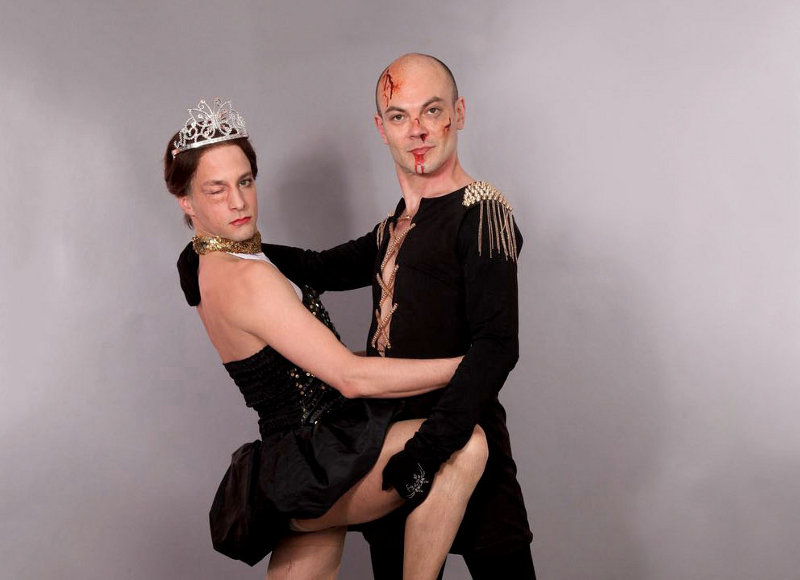
Martin Schick and Damir Todorovic, Holiday on Stage – Last Days of Luxury

Martin Schick and Damir Todorovic: Holiday on Stage – Last Days of Luxury

Martin Schick and Damir Todorovic, Holiday on Stage – Last Days of Luxury

Dear Martin and Damir,

I am writing to congratulate you both on winning the Nefertiti Award for your performance Holiday on Stage at the Basement last night. It was well deserved, though I know lots of other companies who should have won it instead. Yours sincerely, a fan.

Wrong-footing, double-crossing, provoking and mollifying, Martin Schick and Damir Todorovic enjoy testing the moral high ground. They play with themes of celebrity, cliché, politics and the nature of theatre in a delightfully deadpan double-act. They pitch competition against cooperation, constantly undermining their words and their actions.

Having received their award, the pair bring on a wonky door – the stage door – a sofa and a clothes rail. The makeshift screen at the back is projected on with logos of the show’s funders. ‘This union promises hope’ and ‘art is a universal language’ are a couple of phrases that are lifted from real famous people’s pronouncements and formed into a conversation that somehow makes sense.

‘Let’s do something beautiful,’ says Martin, so they strip down to their buff coloured pants and strike a contemporary dance pose across the front of the space. They then try to look at themselves from a distance, to see what we are seeing; they are not impressed.

It is the non-stop inventiveness that is so compelling. They make everything seem simple and slapdash, but in fact it is clever and thoroughly prepared, in a pleasantly loose way. The element of competition builds when Moonsuk Choi knocks on the door. He is a tall Korean who wants to be an artist. A series of questions are asked of him to see if he qualifies for such elevated status, and he dances to prove his worth. This sudden placement of pure contemporary dance is at first troubling. Is this meant to be funny or serious? Is it pretentious or beautiful? It’s another square in the patchwork of Holiday on Stage, questioning our preconceptions. Another two wannabe artists join: Rosalind Wynn, who can’t do much so is asked to clean-up, and does so through a remote control vacuum cleaner; and Karoki from Iran, an illegal immigrant who can dance a bit.

The sofa being too small for all of them, they have a competition to judge their value, with the audience asking questions. ‘Who has the biggest feet?’ ‘Who can speak more than three languages?’ ‘Who is wearing a Christmas jumper?’

Holiday on Stage – Last Days of Luxury was extraordinary. It managed to be lavish yet frugal, funny, meaningful and engaging. It was the first piece that Martin and Damir have made together; their chemistry is remarkable and their physical differences make for a great stage picture, whether they are in pants or tutu’s or rabbit-head tops. They use their dance ability limitedly; they are a bit of a tease. The company as a whole is great, and hats off to Karoki who had only joined it the day of the performance.

I would like to meet the woman who supplied the final question; it summed up the essence of the show so well. As the performers competed for a glass of champagne, she asked, ‘Which of you likes to share?’ Rosalind stepped up to the glass, and shared it. And the list of credits rolled on and on, and the mess on the stage remained, and that was a great little holiday we shared.

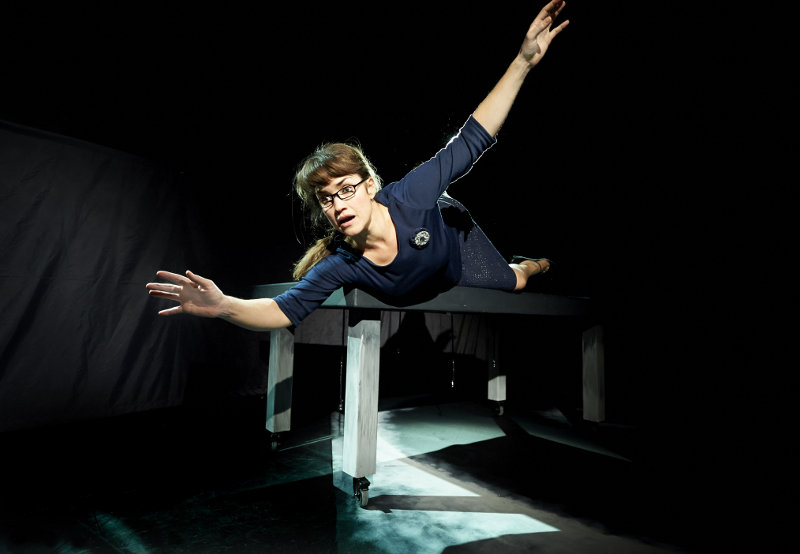
Stillpoint, Moon Project

Stillpoint: Moon Project

Stillpoint, Moon Project

In Stillpoint’s Moon Project there is good chemistry between Rachel Blackman’s character Leilah, and Jules Munns’ Shahab, demonstrated through language and physicality. He is soft and languid, she is tense and jerky; the way they move illustrates their differences and is a strong visual metaphor for the ensuing action.

Moon Project is about a collision and the effects that it has on those involved. It is also about being far from home and family, the nature of love, and what a person wants from life.

Leilah works in the bowels of a building, a museum, and in her black two-piece and glasses seems yearning to find light and flight. She has attempted that – a hang-gliding class – but couldn’t take the leap. Shahab has travelled widely, leaving family in Iran and settling in Britain for reasons he can’t explain, even to himself. He seeks companionship, through a series of women, but can’t find love.

When he flings Leilah into the universe via the bonnet of his car, he does a runner. That’s what he does.

Stillpoint puts movement at the centre of its productions; it’s the form through which narrative and character grow. At times it is a great shorthand and captures an idea or conveys a thought with graceful economy. But it can shift into unnecessary mime. Not every gesture – phone calls, eating – needs to be so sharply defined. It becomes a distraction, largely because the acting is so good. Rachel Blackman is compelling as Leilah, releasing her pent up knowledge and passion without entirely letting go. Jules Munn is convincing too, making a hit-and-run driver a sympathetic character.

The dialogue is cracking; witty and natural and not over-explanatory. There is a lot to explain, rather too much in fact. Moon Project is multi-layered and struggles a bit to get everything in; Leilah’s metallurgist father, Shahab’s mixed parentage, his poetry and her obsession with space travel. Whilst this keeps an audience on its toes, some of the backstory feels superfluous.

Structurally the piece works well, first defining the characters then gradually bringing these two very different people together. The hospital scene, whilst pivotal, is over-long. It provides a change of pace but creates a dip. Greg Mickelborough’s lighting in this scene is very effective, and is good throughout. There is a good choice of songs and sounds by the company.

It’s the relationship of the two that forms the heart of the play. As they inch towards a relationship, we kind of want Leilah to let her hair down, but Moon Project has others ideas. It fast forwards to 2019, to Leilah and Shahab as friends leading separate lives, each having found what they needed from life, each still looking to the stars.

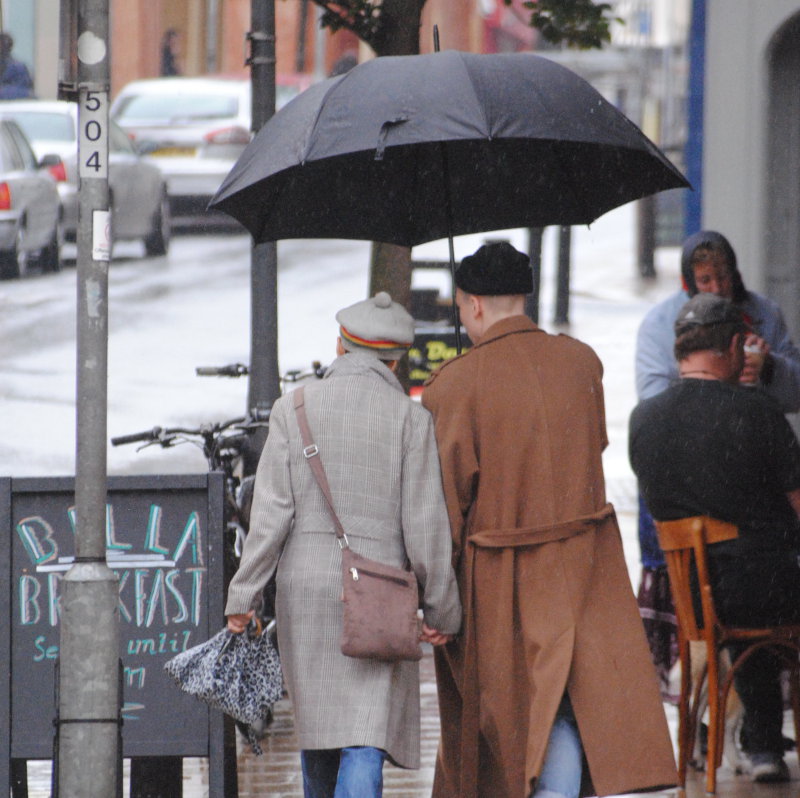
Rosana Cade, Walking : Holding

Rosana Cade: Walking : Holding

Rosana Cade, Walking : Holding

It is a pleasant enough way to spend forty minutes on a wet Saturday afternoon, walking around town holding hands with a succession of people of undetermined sexuality. Conversation could, as the creator of the piece Rosana Cade said at the outset, come from either of us, or not come at all. As we set off under a big black umbrella, Rosana explained that she liked holding hands with her ex-girlfriend in public, but the effect that had on the public in Glasgow was less appealing. So how do I feel about walking around with her as my partner? I feel fine. We do a quick turn round a male gay sex shop, stop and read some ‘proud’ graffiti and agree that Brighton is a wonderfully liberal place to live.

That’s the nub of the problem with this piece. As I am passed on from person to person, there are no hostile glances, no raised eyebrows. In Ipswich and in Cork, the effect on the participant must have been far more profound.

The journey is a somewhat random stroll through parts of Brighton; arcades feature but without an explanation of why, and there are a couple of stops to look at our reflections in windows. At one point, the enigmatic Marta asks me to close my eyes and walk for a while, listening to the noises of the street. That’s the only piece of instruction I get on the journey and I am not sure what it is meant to make me feel. For most of the time the walk is a series of conversations, mainly instigated by me. A couple of the guides, some of whom were young students, were very nervous and their hands shook in mine. It was almost as if I was the performer here. I felt that some kind of narrative should have been threaded through the experience rather than just walking, particularly if the main idea behind it – of facing a hostile or curious public – is missing.

It ended on the beach, waves murderously high, with B.A. from Chicago. She has been in Brighton for four months and is happy as a bird can be. We paddle. She is warm and open and lovely. They have all been nice people, if rather uncertain of their role in this. I wonder what they thought of me?

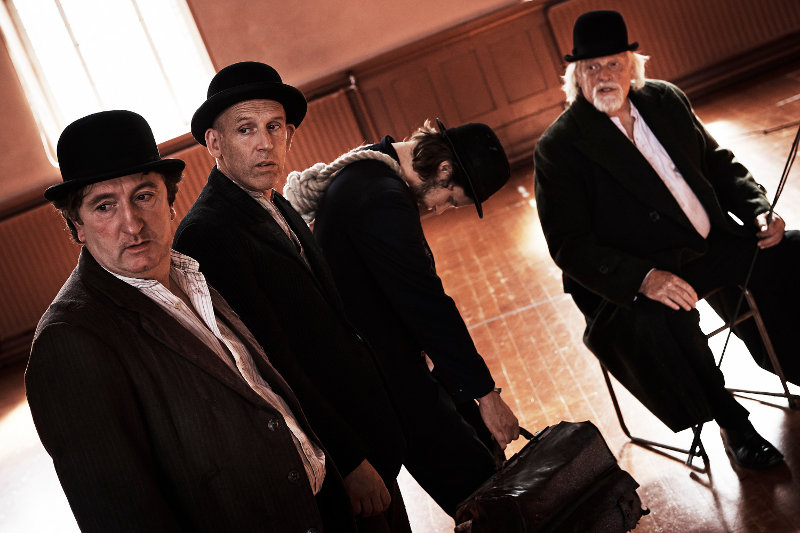
Gare St Lazare Players, Waiting for Godot

The Gathering

 Lisa Wolfe reports from the Dublin Theatre Festival 2013

Ireland 2013 is branded by a concept called The Gathering. It calls for the international diaspora to come home to the old country for while. It encompasses sport, aviation, business and the arts. There is the Garda versus the NYPD Boxing Tournament, The Irish Global Pub Owners Gathering and Cork Rebel Week. It is a great hunk of tourism marketing.

I’m not at all Irish, despite my surname, but hang it, I’m coming too.

Dublin Theatre Festival’s contribution to The Gathering is to feature Irish writers who lived outside the Emerald Isle. There is Eugene O’Neill (America) Samuel Beckett (Paris) and James Joyce (Zurich, Trieste, Paris and er, Bognor Regis). I travelled with my personal James Joyce and Irish history expert Peter Chrisp and discovered further ‘exiles’ during my three days in the City.

Day One: Friday 4 October

From the airport bus, through the new tunnel, past the new James Joyce Street and down to O’Connell, a stop right by Wynn’s Hotel. It looks Victorian, but was bombed in 1916 during the Easter Rising and was rebuilt a few years later. Wynn’s seeps history; it’s mentioned twice in Ulysses and three times in Finnegans Wake, and last month hosted an exhibition about the Irish Volunteers, the nationalist military organisation which was founded here.

But there is no time for complimentary tea or coffee – it’s straight round the corner to The Abbey theatre for play number one.

Written and Performed by Eamon Morrissey, Maeve’s House is an Abbey Theatre and Dublin Theatre Festival commission and world premiere.

His mother had often told him that the writer Maeve Brennan – an Irish exile, had lived in their house, boasted of it, kept clippings about her, but it wasn’t until he was in New York in 1966 as a young actor that Eamon Morrissey fully understood the novelty of the link between them. For many years, Brennan had been writing short stories and prose pieces which she set in that same Dublin house and described fondly and in great detail.

When he first discovered the writing about 48 Cherryfield Avenue in a story in the New Yorker, Eamon says ‘my entire background and childhood came leaping out at me’ and it’s easy to appreciate how strange that would be. Decades later Morrissey has pieced together excerpts from Brennan’s stories and reflections on his own history.

Maeve Brennan wrote stories about relationships that were often stagnant and bereft of affection: she had married and divorced a wrong-un, and had a hard life, ending up destitute, deranged and alcoholic. Her articles were more lively and entertaining, with sharp observation and a pleasing curiosity. This is great material for the stage. Here though, Morrissey doesn’t quite nail it and the performance falls somewhere between a conversation and a play. The writer’s own story is told anecdotally and Brennan’s more theatrically. Yet it stays at the same emotional level except for one episode, a fairly brutal story of man unable to grieve for his dead wife, where Morrissey shows his acting chops.

The staging is simple with a curved pew, a stool and pools of light. A backdrop evokes the New York skyline. There are some unnecessary sound effects – a ringing phone, kitchen dishes clattering – that reinforce the lack of an overall vision for the show.

It’s an easy hour, and Morrissey is always watchable, but it is like a soothing shade of grey. The Technicolor version of Maeve Brennan’s life has yet to be told.

Time for dinner and a refresher in the Stag’s Head (boy was that a big stag whose head is on the wall) then into Temple Bar and the Project Art Centre.

Next came Riverrun: presented by TheEmergencyRoom and Galway Arts Festival; adapted, performed and directed by Olwen Fouéré.

There is a low, electronic rumble in the room. Olwen Fouéré stands at the front of the stage, hands clasped together, smiling at us. Once everyone is seated and silent she takes off her gold shoes, steps over the elegantly trailing mic stand onto salt crystals, and becomes water.

So begins the most exquisite and captivating performance that I have seen for a long time. Joyce’s notoriously tricky language is sometimes completely opaque, sometimes ringing clear. Fouéré embodies all of its musical texture and character, capturing nuances, exaggerating sounds, riffing on the poetry of Joyce’s playful text. ‘Into the wikeawades warld from sleep we are passing. Four. Come, hours, be ours!’ The sound design (Alma Keliher) is beautiful, underpinning not overwhelming the voice which, whether in words or noises – Bulgarian style throat singing no less – is a joy to hear.

Most of the piece is done stage front and into the microphone, so when, at one point, Fouéré moves upstage, takes off her steel grey jacket and swings it around her head, side lit and majestic, well, that’s quite a moment. The lighting (Stephen Dodd) is stunning throughout, providing just the right level of grandeur to this wholly toned and tonal piece.

In an interview Fouéré said that she chose her text so as not to be too easy on herself or her audience. Had she just done the final monologue, of Anna Livia’s flowing out to the sea, it would have been ‘a bit too Molly Bloom’. So the play begins with the more difficult narrative voice from the first part of the chapter. It is a mind-boggling feat of memory and interpretation. Then we launch into Anna Livia’s journey – flowing into the sea is death for a river: ‘My leaves have drifted from me. All. But one clings still.’ Here Joyce conflates the autumn leaf with the page of the book – itself a leaf. Fouéré is now more female, constantly in motion, almost ululating, using her breath and her body in a gorgeously rich theatrical climax. A final word, from this circular novel, is left hanging, from an unforgettable face in a crystalline light: ‘the’.

After the show, Olwen Fouéré and some of the audience walk to the Millennium Bridge to raise a dram in a paper cup to the Liffey. Asked how she memorised so much of the chapter, Olwen says, ‘I read it aloud a few times, as I was compiling the piece. Then I found I just knew it.’

Day Two: Saturday 5 October
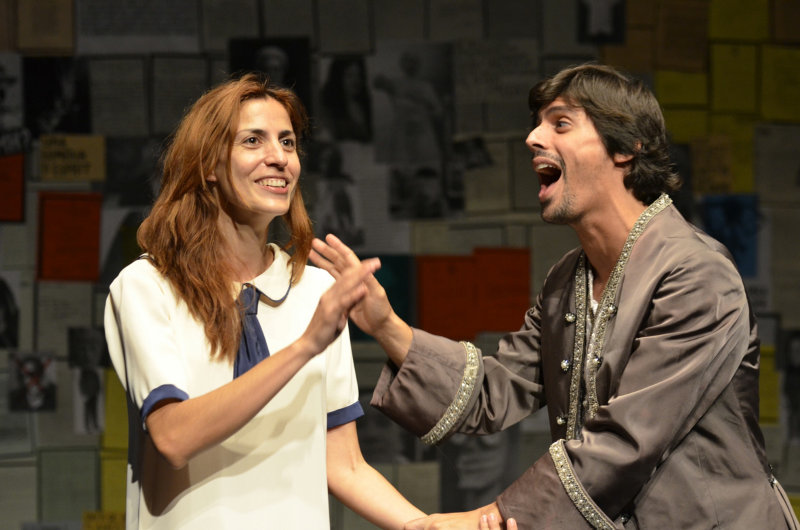
Mundo Perfeito, Three Fingers Below the Knee | Photo: Magda Bizarro

Mundo Perfeito, Three Fingers Below the Knee | Photo: Magda Bizarro

A swish tram to the Irish Museum of Modern Art near Heuston Station for an exhibition of work by Leonora Carrington. Leonora was another exile of Irish extraction; she ran off with Max Ernst and moved to Paris, but lived most of her long life in Mexico. An extraordinary artist and a key figure in the Surrealist movement, she painted intricate myths and visions, printed, wove and sculpted. It is her writing that captivates me most though – haunting, dark and hilarious stories from a hugely imaginative mind.

It is a glorious day and walking through Phoenix Park I spot a big fallow deer in the trees. There are lots of people jogging in a Guinness Triathlon. On a hill is the Magazine Fort, which features in Finnegans Wake. As does the village of Chapelizod down below with a pub called the Mullingar Inn which claims to be the setting for ‘all the characters and elements of Finnegans Wake’. It has a James Joyce Bistro – closed.

This evening I am seeing something not Irish, again at Project: Three Fingers Below The Knee which is written and directed by Tiago Rodrigues, produced by Mundo Perfeito, and performed by Isabel Abreu and Gonçalo Waddington.

On 25 April 1974, the Carnation Revolution overturned forty eight years of fascist dictatorship in Portugal. In the national archives theatre-maker Tiago Rodrigues found a mountain of documents relating to theatre, as it existed under that regime. He was particularly taken with accounts by the censors of what they would or, more frequently, wouldn’t allow on stage. Unsurprisingly, several modern dramatists were immediately censored – O’Neill, Max Frisch and Brecht – but also plays by Shakespeare and Moliere. In Three Fingers Below The Knee, Rodrigues casts the censors as playwrights. ‘Let’s see how you cope with this,’ he seems to say.

The stage furniture, a chaise-longue, other fin-de-siecle chairs, is covered in polythene as if to suggest the newness or cleanliness of this artform called drama. There is a clothes rail from which the two actors, in their undies, select costumes.

Surtitles switch between translation of the spoken text and quotations from plays. It is theatre about theatre, and to a theatre festival audience amusing to hear the denigration of several playwrights whose work is being shown this year.

The performance style is parodic and direct to the audience. They go into comic raging over Beckett, they re-write a censored Shakespeare play, they fight over Desire Under the Elms – the play was banned but the film wasn’t. Much of the censorship is against women (from Iphigenia to Masha) and this is illustrated graphically with Abreu writing on her body with blood red lipstick.

It is clear that the regime of Antonio de Oliveira Salazar considered his citizens so totally ignorant (‘the public is Catholic and simple’) that they wouldn’t understand Brecht, so why stage it? One determined director submits Max Frisch’s play Andorra to the selection panel five times. It is rejected each time, even with the necessary changes made.

The text is constantly playful and thought provoking and the performance style has a refreshing openness to it. The surtitles become part of the questioning process, the staging undermines the action, the film sequences are bizarrely static – yes, that’s what we want!

The Festival club is an upstairs room in a glamorous nightspot called Odessa. Unfortunately it is rather sparsely populated tonight and there are other drinking sheds in the city with more appeal.

Day Three: Sunday 6 October
Gare St Lazare Players, Waiting for Godot | Photo: Eliott Erwith

Gare St Lazare Players, Waiting for Godot | Photo: Eliott Erwith

Looming over the skyline from a huge tower is an advert for The Dublin Lockout exhibition. It’s on at the Hugh Lane gallery (which also houses Frances Bacon’s original Soho studio). The Lockout 2013 was a pivotal event in Irish history; a stand-off between the bosses, notably William Martin Murphy, owner of the Dublin Tramway Company, and the unionised workforce. It resulted in the infamous Bloody Sunday. Looming over O’Connell Street is the statue of the workers’ hero, James Larkin, arms aloft as if in proclamation. Larkin is Liverpool Irish and another exile; he moved to America to try and galvanise the unions there.

A matinee at the lovely jewel box Gaiety Theatre – Waiting For Godot by Samuel Beckett, in a production by Gare St Lazare Players Ireland and Dublin Theatre Festival.

Here’s a Pozzo that has been dividing critics, and perhaps audiences, during its run.

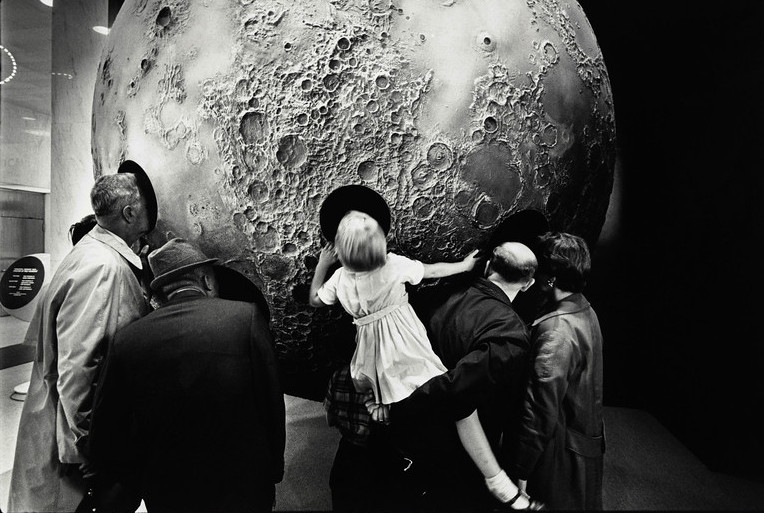
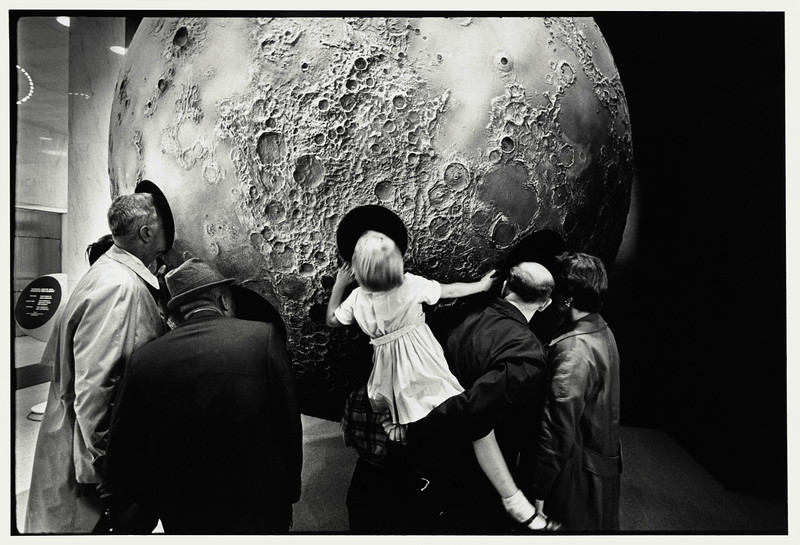
This Godot is set on a circular stage, a lunar landscape reflecting the huge moon that hangs at the back, waiting to rise. The tree looms starkly down from above. Estragon (Gary Lydon) and Vladimir (Conor Lovett) a fairly sprightly pair, are natural clowns with a warm rapport and at ease with the language and rhythms of the text. Pozzo enters, with Lucky in tow, and we are further thrown into the world of the circus. Gavan O’Herlily has the looks of Wild Bill Hickok and the voice of Orson Welles. He is huge and ebullient, bellowing out commands to the luckless ‘pig’ yet showing the weakness of his class: he is unable to sit down unless invited.

Lucky (Tadgh Murphy, last seen with a very bad haircut in The Walworth Farce) gives a tour de force gallop through his speech which draws applause.

There is beautiful lighting by Sinead McKenna and the costumes and design is exemplary. Director Judy Hegarty Lovett has many productions of Beckett under her belt with this company, and it bears their trademark purity of vision and economy of movement. To see Vladimir skip about, doing his exercises, is quite a coup de theatre.

In the second half, with leaves on the tree, a blind Pozzo and ever more frustrated pair of Godot waiters, the action dips slightly. But overall it’s a really effective and effecting production, finding lots of humour in the text without distracting from the mystery and misery of the story.

Back to the Project for the final show of the weekend: Dusk Ahead by Junk Ensemble.

The dance space is patterned by strings of wire and elastic, glimmering in crepuscular light (designed by Sarah Jane Shiels). Three blindfolded dancers enter, their passage led by a couple ringing hand-bells. It is apparent that all is not well in this silvery place, in this hour before darkness that we call twilight or dusk.

Episodes follow to illustrate this tension. Couples are tied to each other by their hair, by a lasso, by their mouths. This kissing duet is accompanied by the noise of a pomegranate being squelched. There is much grappling after each other, sometimes in a state of blindness, at one point framed by a waft of green smoke. The space is well used and the choreography, by Megan and Jessica Kennedy in collaboration with the dancers, is quirky and occasionally dangerous. At times, over-used devices distract from the originality of the piece, a dancer walking across a row of upstretched hands, or falling backwards in the arms of others for example. But all the performers are highly watchable and skilled.

There is a fabulous composed score by Denis Clohessy that perfectly matches the eerie fairytale atmosphere of Dusk Ahead. Live cello by Zoe Ni Riordain, accompanied at times by the whole cast on a variety of instruments and in song, is subtle and effective.

It is a shame that it goes on for too long; an episodic piece like this says what it set out to say after about forty minutes. We don’t need to see the wolf twice. We don’t need so many varieties of containment and release. The ending, when it comes, is beautifully simple and stark. One dancer, one light, the small hand gestures that opened the show. Sometimes, less is more.

Leaving Dublin on a fine Monday morning, knowing the Festival is still going full throttle, is quite a wrench. But memories have been gathered, and will endure.

Gare St Lazare Players, Waiting for Godot | Photo: Eliott Erwith

Gathering the Threads of Irish Theatre

Gare St Lazare Players, Waiting for Godot | Photo: Eliott Erwith

Lisa Wolfe previews Dublin Theatre Festival

It will be interesting to see, in perhaps a decade from now, if the current density of productions of Samuel Beckett’s plays and stories have influenced a younger generation of writers. Will there be a fashion for plays about loss, failure and regret? Will stages be populated with curious singletons, living in their own oddly coded worlds?

For now, we can enjoy the clarity of Beckett’s language and his characters at just about any theatre festival in the world. Edinburgh International Festival overflowed with Beckett on stage, in film, in books and discussion. Brighton Festival commissioned a Beckett and music combination from Gare St Lazare Players back in May. London has hosted major revivals and Lisa Dwan’s record breaking performance of Not I at the Royal Court. The Happy Days Enniskillen International Beckett Festival took place in August. Shall I go on?

Dublin Theatre Festival, which opens 26 September 2013, continues the trend with a new production of Waiting for Godot, also by Gare St Lazare, starring Conor Lovett. Lovett is my favourite interpreter of Beckett; he just becomes the character and with minimal gestures lets the words do their work.

There is also plenty of James Joyce available to theatre-goers this year, thanks to the relaxing of copyright on his writing, wrestled at last from the unholy clutches of Stephen Joyce.

Beckett contrasted his own approach with Joyce’s:

‘I realised that Joyce had gone as far as one could in the direction of knowing more, [being] in control of one’s material. He was always adding to it; you only have to look at his proofs to see that. I realized that my own way was in impoverishment, in lack of knowledge and in taking away, in subtracting rather than in adding.’

I recently reviewed the Tron Theatre and Project’s co-production of Ulysses (at Edinburgh Fringe). Soon I will tackle more the opaque waters of Finnegans Wake, courtesy of Olwen Fouéré’s Riverrun. It’s a good progression. Ulysses is the book of the day (16 June 1904) and Finnegans Wake is the book of the night.

At the end of Anna Livia Plurabelle, the ‘Wake’ chapter about Dublin’s River Liffey, who is also the great Mother in the book, Joyce writes:

‘Wharnow are alle her childer, say? In kingdome gone or power to come or gloria be to them farther? Allalivial, allalluvial! Some here, more no more, more again lost alla stranger.’

It’s a dialogue between two washerwomen over the Liffey. The first asks, ‘Where now are all Anna Livia’s children?’ The second replies, ‘Some remain here, more are dead, more again are lost to foreign lands.’

Beckett and Joyce both left Ireland in order to write. Curious then that this year Ireland is staging a nationwide series of events called The Gathering, a call-out to Irish people the world over to connect with their roots. People and communities throughout the country are creating Gatherings and inviting friends and relatives back home. It covers science, aviation, politics and the arts.

Willie White, artistic director of the Dublin Theatre Festival, explains what The Gathering is, and the part the Festival is playing in it:

‘The Gathering is a year-long celebration of all things Irish. For Dublin Theatre Festival it’s an opportunity to recognise the international range of Irish theatre and theatre artists. We’ll be celebrating writers such as Eugene O’Neill and Samuel Beckett, producing work by Irish artists who have made their home in other countries, like Desperate Optimists and Gare St Lazare Players Ireland, and convening a symposium on the Irish theatrical diaspora, with a guest lecture by Fiona Shaw.’

It’s White’s third year in the role, and I asked him what has made him most happy since he took over in 2011 and what would be his dream commission.

‘The thing I am most happy about since I took over in September 2011 was the success of my first programme in 2012. We had the biggest representation from Irish artists in years, presented The Wooster Group in Ireland for the first time, and ticket sales were up. Each festival presents different opportunities and this year the programme has a different complexion. There’s still plenty of strong Irish work but there are many more international productions on offer. We’ll be introducing our audiences to exciting artists from India, France, Japan, Portugal and Canada, amongst other places, and bringing Actors Touring Company, Lone Twin and the RSC from the UK. I will be happy if this programme elicits a similarly positive response.

If money, time and international boundaries were no obstacle my dream commission would be to invite Royal de Luxe to make a piece akin to The Sultan’s Elephant in Dublin. It would be called Wake the Tiger and like St Patrick drove the snakes out of Ireland we would symbolically (and humanely) purge the country of the ravages of a giant Celtic feline.’

Check out the programme at www.dublintheatrefestival.com and watch this space for my round-up of some the plays taking place.


Dublin Theatre Festival runs 26 September – 13 October 2013 at locations around the city.