
Author Archives: Lisa Wolfe

Lisa Wolfe

About Lisa Wolfe

Lisa Wolfe is a freelance theatre producer and project manager of contemporary small-scale work. Companies and people she has supported include: Thirunarayan Productions, A&E Comedy, Three Score Dance, Pocket Epics, Jennifer Irons, Tim Crouch, Liz Aggiss, Sue MacLaine, Spymonkey and many more. Lisa was Marketing Manager at Brighton Dome and Festival (1989-2001) and has also worked for South East Dance, Chichester Festival Theatre and learning disability arts charity Carousel. She is an occasional performer and installation maker in collaboration with other artists, and is a Trustee at Brighton Open Air Theatre.

Clerke and Joy: Volcano

Clerke and Joy: Volcano

Clerke and Joy: Volcano

The length of the space is full of dark brown earth. There are little illuminated cities and towns across the landscape. Stage left stands a pilot. ‘We know he is a pilot because of his uniform’ is a repeated refrain in this story of eruptions and explosions, environmental and emotional. From the muddy mounds emerge Clerke and Joy, followed by volcanologist Dr Mike Cassidy, the three of them taking us on a journey through the formation and effects of some of the world’s key volcanoes.

The performance combines wild, naïve dancing, sharp text, experiments and scientific fact. There is filmed imagery as a backdrop and an eclectic mixture of songs old and modern.

Clerke and Joy combine these disparate elements whilst maintaining a strong through-line and friendly conversational tone. The pilot (Adrian Spring) is the pivot around which the story revolves. He has been grounded by Eyjafjallajökull, the Icelandic volcano whose ash-cloud caused enormous air-traffic control issues and blighted the lives of thousands in 2010. A sad, solitary figure, bearing with grace the sorrow of those affected whilst dealing with his own life troubles.

Volcanoes are given personalities: Mount Pelée is a sad comedian with bad Icelandic jokes, Yellowstone is represented by a balloon blowing up competition that ends in the inevitable pop, and Vesuvius is a begrudging Italian (‘It’s all Pompeii this, Pompeii that…’). The ash-cloud itself is talcum powder, a pungent and familiar smell, linking childhood with old age and adding to the general chaos of the set.

As a world premiere, and a one-off performance, it’s a cracking start and very enjoyable. Clerke and Joy’s intention is to view big global events through the lens of the everyday. Volcano succeeds in this. It evokes disasters with feeling but not sentimentally; it is funny and moving and the performers have an appealing and sisterly warmth.

The show ends with the Northern Lights and some witty film credits. It is a hard balance to strike to not make light of disasters that have affected millions of lives, but Clerke and Joy’s lo-fi show manages to make us think and enjoy ourselves.
www.clerkeandjoy.com

Hunt & Darton / Future Ruin / The Honest Crowd: Table Manners

Hunt & Darton / Future Ruin / The Honest Crowd: Table Manners

Hunt & Darton / Future Ruin / The Honest Crowd: Table Manners

Table Manners dished up three courses ‘exploring the rituals of food and dining that enshrine our social hierarchies and hang-ups’.

First comes the buffet, Delia – We’ve Been Thinking, presented in lavish colour by Hunt & Darton. Seating is placed around the fully laden and largely inaccessible buffet display. We are given name tags so that the hosts (performing as Jenny and Holly) can call on us for comments, assign us tasks, and comment on our appearance or life history. It is a playful riff on the hosting of parties, interaction between strangers and the role of the guest – should we really crawl under the table to get at the Twiglets? Participants are asked to read out conversations, or recipes, or shout for more Babysham. There is a wine and cheese tasting event and forced laughing and some slightly inappropriate dancing on the tables, delivered with deadpan and strict authority.

Such a format depends on the engagement of the audience, and my group was a fairly reluctant bunch, less eager to respond and join in than Hunt & Darton’s regular followers. What should have been an ‘amuse-bouche’ felt like a bit an ordeal for the performers and for the audience – whether they wanted less of it, or more.

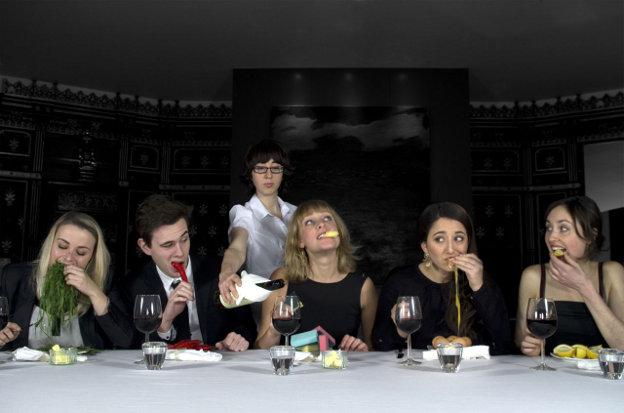
The second course, Future Ruins’ Exterminating Angel, is similarly hostage to particular circumstances, but this time because the majority of the content is improvised. The audience is now totally passive. We are viewers of a dinner party without end (inspired by the Buñuel film of the title) as five friends chat, play, fight and test each other over a meal where nothing is eaten and nothing is drunk. It ebbs and flows, as conversation so often does, at times banal and then searingly personal. There are interruptions that are probably prompts to move the story along – a very loud scream for example. A key episode deals with confessions, each in turn detailing something they have done of which they are ashamed. It was painful to witness. Director/deviser Jack McNamara has shaped the piece well. The cast is extremely accomplished and naturalistic but I didn’t fully believe their relationship as friends, nor did I particularly like any of the characters, which reduced the emotional pull. Despite being the most fully formed and theatrically testing of the trio, it felt like a long hour and never quite reached full boiling point. Another time it might be startling and unforgettable; it certainly has that potential. But that is the issue with improvisation. It so often appears more challenging, rewarding or enjoyable for the practitioners than the audience.

Finally comes a fine dining experience, Glasshouse, courtesy of The Honest Crowd. Another large table, around which the thirty or so of us sit, behind a glass of red wine and a slice of French stick on a plate. Five performers are sat amongst us, and a deadpan waitress serves them each in turn. A conversation starts and crosses the table. It is a fun one; they are chummy and convivial. Gradually the control slips, sentences get mangled, the food gets absurd. They are fed grass, and chillies, washing-up sponges and raw eggs and more wine which overspills. Throughout it they maintain a semblance of balance, even when blindfolded and sprayed with water. A blackout and flashing lights provides cover for the letting rip of polystyrene balls. Glasshouse is a fun metaphor on the way friends can behave when the wine grabs hold and people no longer notice what they are eating or talking about. The young cast is rehearsed to perfection in a slick and engaging piece, and if at first the audience was kept at arms length, it soon became part of the action. Glasshouse was not deep or life-changing theatre, but it was a charming, messy pudding of a show with which to end Table Manners.

Produced by The Basement for Brighton Festival, the event was well linked in terms of content and the audience was led through the three spaces of a dining experience with care and attention. Whilst the companies were self-contained, with their own technical teams, the production values throughout were high, with crisp tablecloths, sparkling glasses and fresh ingredients. No easy task for three two-hour performances each day. Less successful perhaps was the adjustment the audience had to make moving from participation, to passive voyeur, to communal experience. The rhythm of it didn’t quite work for me, but maybe I am a greedy consumer… I did crawl under the table to get at the Twiglets after all.

www.huntanddartoncafe.com / www.futureruins.co.uk

Voetvolk: It's going to get worse and worse and worse, my friend

Voetvolk: It’s going to get worse and worse and worse, my friend

Voetvolk: It's going to get worse and worse and worse, my friend

Rhetoric has the power to persuade and a good speech takes its listeners on a journey, often leading them to a place of rapture – and no more so than with evangelist preachers like the American televangelist Jimmy Swaggart.

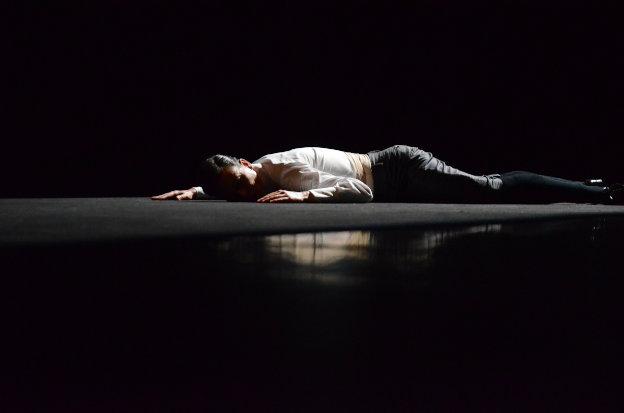
In a fifty-minute dance piece, Lisbeth Gruwez embodies this disarming process. She first appears backlit, standing on a square of grey carpet in luminous outline, a neat figure in grey trousers, white shirt and gleaming patent leather shoes. Her gaze is bold, a slight smile now and then. She is like a male flamenco dancer, head slightly down, back straight. Her gestures are minimal and conduct the broken text and sonic sounds, fragments of Swaggart’s preaching, that seem to come from behind the audience. She is master of the text and our guide to it.

There is a beautiful, slow pace to this opening section. It teases. It repeats almost to the point of ‘OK, enough’ and then it changes tack just at the right moment. Swaggart’s sentences build and the movements get fuller, richer and more expansive. Just when we think it is going to break into really strong vocals, it cuts out and Lisbeth falls to the floor, where she stays. Just that little bit too long for comfort. Teasing us again.

Now, with socks and pants pulled up like those of a matador, the piece shifts into another gear and we get the pay off. Shuddering, filled with light, the dancer and the speech become dynamic. It’s a perfect marriage of form and content; the figure bouncing higher and higher as if driven by an inner ecstasy, and Swaggart urging it on with his breathless booming, encouraging a trance-like state. The sound comes from somewhere else; it is omnipresent, surrounding us and Lisbeth. The puppet master has become the puppet. She beams with joy and is lifted. Blackout.

Lisbeth’s training in classical ballet is evident in her poise and control. Her subsequent career with some of the leading contemporary dance companies in Europe shines through the choreography: sharp, swooping and adventurous – it takes a really disciplined body and mind to pull this off without loss of breath and with such assurance. The accompanying sound and cut-up speech (by musician and composer Maarten Van Cauwenberghe) is similarly exquisite.

In contrast with the show’s title, it doesn’t get much better and better than this, my friend.

www.voetvolk.be

1er Stratagème: Forecasting

1er Stratagème: Forecasting

1er Stratagème: Forecasting

Stage presence is an ineffable quality. As soon as Barbara Matijevic enters the space you know she has it and that you are going to be in safe hands. The Basement is bright but warmly lit, with a white background wall.

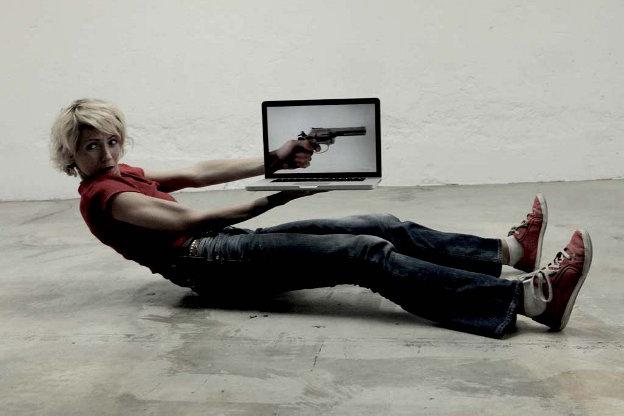
The piece has started before this defining moment, with a MacBook on a stand first swirling with corporate logos, then a male voiceover describing how he has had to buy a new hard-drive to upgrade his capacity and that he going to show us how to install it, if he can find the right size screws.

Barbara appears and begins to interact with the on-screen demo, and then things start to change. Her hands become those on screen and in quick succession the screen image becomes a gun, a carrot, a car battery, shoelaces. Her body language perfectly mirrors the on-screen action. Sometimes the voice is from the film footage, sometimes it’s Barbara’s commentary. She has a cool, sassy presence, beautifully underplayed but full of subtle emotion and expression. The quality and precision of movement is evidence of her dance training (she teaches dance in her home city of Zagreb).

Gradually sequences on screen build and become longer, or more thematic. They veer from comical to gruesome. The Mac is moved around the room and is used dramatically, for example at floor level for shooting practice, as a stomach, and on the head (with a monkey sitting atop picking at Barbara’s scalp – ‘it’s like a head massage,’ she says, smiling).

The film clips, sourced from YouTube, are very cleverly linked and keep the attention throughout – you cannot second guess them. At one point the screen goes blank and just has colours, which Barbara attempts but fails to control. There is off-screen music and sound-effects at points, used effectively to underline some sequences but never distracting from the performer and her communicative tool.

To break from the format, Barbara describes how the concept of ‘visualization’ can help people with panic attacks. You imagine calming things like a fire in a grate, or clear blue sky. ‘This doesn’t work for me,’ says Barbara – the fire always burns the house down. Cue on-screen hands moving over moss then picking an apple. ‘I’ve never grown an apple before,’ says Barbara, the apple in her on-screen hands, then adding perkily, as if we had never seen one before, ‘Isn’t it pretty!’

Towards the end she narrates the making of a Damien Hirst style jewelled skull, using really shoddy materials and marvelling at the craft of it, the hours it took, and declaring that it is best thing we will ever see.

So a final punch at the value of art, whilst bringing home the way in which we communicate now, filming everything (from S&M to childbirth, cookery to pointing one’s toes correctly) and putting it all in the public domain.

Forecasting is an excellent example of idea married to imaginative form. Neat in structure, crisp in presentation, thought-provoking, funny, tough and expertly done. It is the third part of a trilogy from this ingenious company; I look forward to seeing more from them.

Giulio D’Anna: Parkin’son

Giulio D’Anna: Parkin’son

Giulio D’Anna: Parkin’son

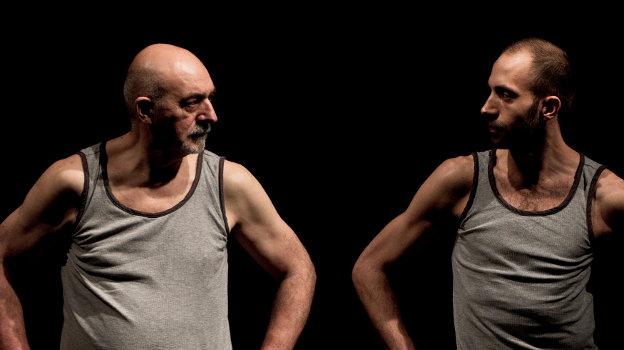
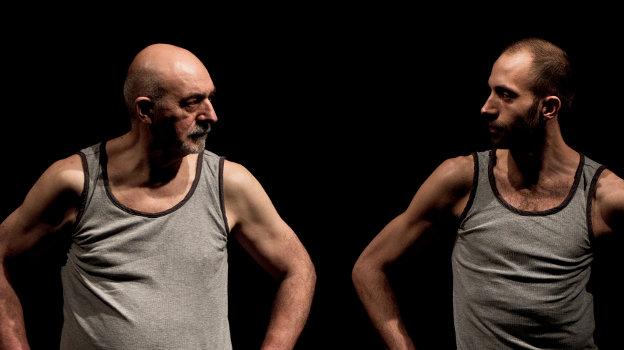
The classic conventions of the father and son relationship are explored in this dance-based performance by Giulio (31) and Stefano (62) D’Anna. Dramatic and emotive piquancy is added due to Stefano being recently diagnosed with Parkinson’s disease.

Father and son are both therapists, but only Giulio is dance trained. He has created and choreographed this piece to tell their story and to present a manifesto for dance as a method of expression and of healing.

The white dance-floor is covered with round carpets, like bath-mats, all white except one red one – the rogue gene perhaps. A big screen slants above the performance space, glowing with and reflecting light. Further lights at floor level define the stage. There is a strong aesthetic in the style of presentation: whites, greys, flashes of red, matching vests and shorts. There are key songs and subtle music (by Maarten Bokslag) that provide a good balance of aural punctuation and atmosphere, alongside several welcome periods of silence.

Giulio plays up the difference in their body types. He is wiry and athletic, despite a spinal abnormality, and Stefano is more macho, sturdy and a bit wobbly bellied. This illustrates the core of their relationship – the small child and the big, strong father. It is a theme that the choreography makes much of, as the tables turn and son becomes the supporter of and carer for his ageing parent.

The piece starts with verbal exchanges between them, relayed through speakers, in Italian and English. There are commands – ‘Please make it louder’, ‘Stop!’ – and questions – ‘Why is there no dancing in this?’ – but the main form of expression is through the movement. The choreographic language is one of shapes made through the combination of bodies, of holds, rolls, stretches. These are tests of strength, of will and trust. They wrestle and spar then are tender and supportive. They mirror and they improvise.

It is not highly distinctive choreography and there are too many familiar dance tropes. I felt the piece came very much from Giulio working through his own feelings about his father’s disease, and how it would affect his future life, hence his plotting out the years ahead at the end of the show. I would have liked to see more of Stefano’s view of his prognosis and of him as a dancer. His movement ability wasn’t given a sufficient chance to shine.

At the end, the screen descended and childhood photographs of father and son in earlier years were flashed up. Poor screen, to be so poorly used.

Parkin’son, whilst interesting to watch and having moments of tenderness and tension, of humour and challenge, for me became an exercise in expression, rather than a pure and emotional journey through this relationship.

www.giuliodanna.com