Author Archives: Lisa Wolfe

Lisa Wolfe

About Lisa Wolfe

Lisa Wolfe is a freelance theatre producer and project manager of contemporary small-scale work. Companies and people she has supported include: Thirunarayan Productions, A&E Comedy, Three Score Dance, Pocket Epics, Jennifer Irons, Tim Crouch, Liz Aggiss, Sue MacLaine, Spymonkey and many more. Lisa was Marketing Manager at Brighton Dome and Festival (1989-2001) and has also worked for South East Dance, Chichester Festival Theatre and learning disability arts charity Carousel. She is an occasional performer and installation maker in collaboration with other artists, and is a Trustee at Brighton Open Air Theatre.

Catherine Ireton - Leaving Home Party

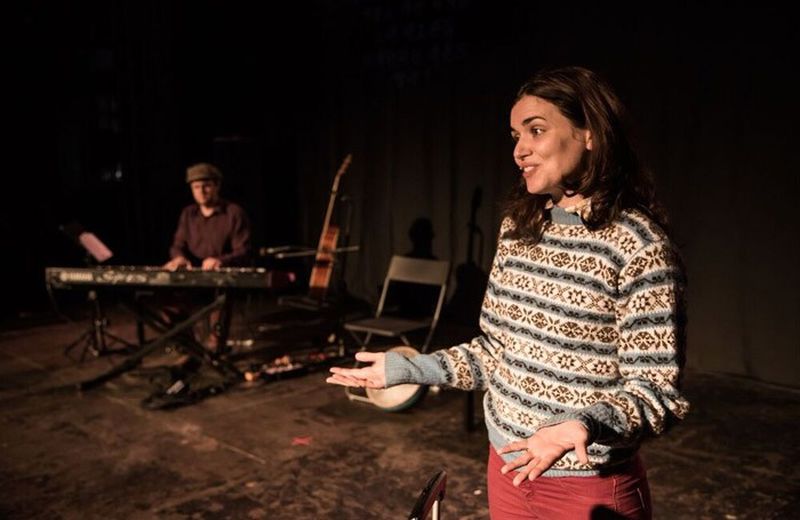
Catherine Ireton & Farnham Maltings: Leaving Home Party

Catherine Ireton - Leaving Home PartyBrighton Festival and the HOUSE Festival of visual arts are both themed around ideas of home and place this year, and Catherine Ireton extends the theme to the Brighton Fringe, in a pleasing convergence of festival activity.

Leaving Home Party is a song cycle that explores what it’s like to leave your verdant, comfortable but restrictive home, in this case Limerick, and move somewhere new, such as Edinburgh. Not a huge leap geographically, or culturally, but for a young Catherine in 2005 it was a journey and experience that disturbed her soul.

Catherine uses her pure, lilting voice in a series of songs that tell her story factually while building an emotional landscape; there is a touch of Mary Hampton in the delicacy of her compositions. Using the Chinese buvu flute and hulusi pipes, along with a bodhran and Indian shruti box, accompanist Ignacio Agrimbau hints at Irish folk in a rich palette of sounds. He is very much a partner in the piece and it puzzles me, as with Groomed, that the on-stage performer isn’t introduced to us until the end of the show; to acknowledge him early would sit easily with the conversational form used here. The show was first performed at the Edinburgh Fringe 2014, directed by Caroline Byrne, and this pared down, simple staging, with just some back-wall projections, focuses attention on the performers, the limited range of movement fitting the narrative.

We do not get much detail as to what exactly happened in the four or so years Catherine spent in the UK. She leaves us hungry to know more about the boyfriends, the jobs, and her family. Instead she evokes a sense of what the Portugese call saudade and the Greeks nostalgos: a deep longing for home. The differences in Irish and British terminology initially wrong-foot her, the free contraception astounds her – ‘they’re practically encouraging it!’

Catherine sees her life as a circle, and the form of the piece is circular too; a circle that keeps to a level plane rather than a roller-coaster. I’d have liked a few more bumps. The songs loop and refrains repeat, keeping the story fluid.

The show comes to life in a song about her great-grandmother, a bold, adventurous woman who travelled the world but died ten miles from where she was born in Ireland. Catherine feels adrift having just crossed the North Sea. She knows that her passivity is not an asset and criticizes herself for it; ‘I put my plans in other people’s hands,’ she sings. She makes the point that the simplest of things can change a course of action; in her case, a mobile phone contract, a fairly universal observation. The main message from the piece, that home is where you are now, is not profound, but it is heartfelt.

Catherine is an assured performer with bags of charm and a voice that can take you places. If Leaving Home Party lacks the punch and originality of Buddug James Jones’s Hiraeth it’s an enjoyable journey nonetheless, and worthy of a home-coming party.

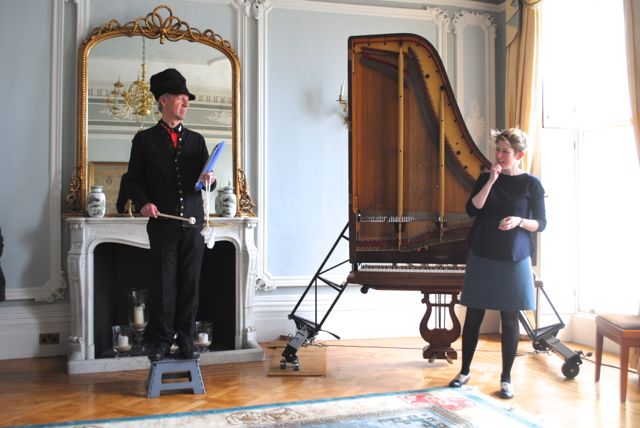
Home Live Art: At Home – A 21st Century Salon

The view through the window is stripes: pavement, road, pavement, road, pavement, beach, sea. It’s a stratified, multi-directional landscape that is flat and vertical, close and distant that both flattens and extends space.

We are encouraged by our Salon host, Anton Lemski (aka Richard Layzell) to spend time during our visit considering the space between things, the views and the architecture as well as the performance and installation on show. ‘Question your teaspoons,’ he declares, quoting Georges Perec, having first arranged us in height order for an introductory welcome. We are to feel at home here, enjoy the house, take our time, not worry about the appointments on our engagement-cards, we’ll be fine.

Curated by Home Live Art, the Salon finds perfect accommodation in Angel House, a distinguished Regency townhouse in Hove, newly restored to opulent glory. What seems like a rather large group for this adventure distributes itself easily through the rooms to make discoveries, watch set pieces, talk and wonder.

A group of thirty gather in the Morning Room for Seth Kriebel’s The Memory of Bricks. It’s a distillation of the interactive journey pieces he has been making in recent years, a key one being A House Repeated, for Battersea Arts Centre’s post-fire. This new version conjures hidden secrets and fantasy rooms in the mind, as participants choose an imaginary path through Angel House. Seth and co-host Zoe Bouras show considerable skill and patience in gently guiding our journey, the audience here is more risk-averse than the young things of Clapham. It is cleverly constructed work, delivered calmly and enabling everyone to take part without pressure. Seth and Zoe take time out to describe to each other fantastical rooms in poetic prose, and end by taking the lead themselves, hot-seating almost, to bring the story to a pleasing close. Perhaps the Morning Room worked against us journeying together as a group, as Seth had encouraged us to do; we might have had even more adventures.

We find togetherness in the Best Bedroom, where the Boy Stitchers are holding court. There are embroidered cartoonish panels dotted about, the shredded remains of 19th century Colorado farmers’ shirts (Wranglers as it happens) hanging limply in a wardrobe, a guide to knitting stitches on the wall and a green jumper whose moth-holes are being repaired in blue wool. We can sew if we want to; there are tempting silk threads on the low table. Trevor Pitt, resplendent in Fair Isle vest made by his mother, convenes a conversation by knitter Tom of Holland, illustrative embroiderer Stewart Easton, who turned to this medium when his drawn line became too perfect, and denim restorer Luke Deverall. These are slow crafts and the chat is quiet and interesting; men with beards and integrity, concerned with history and the process of making, rather than fashion per se. A pair of de-constructed gloves called Anna Karenina sit on a bedside table; Dorian Gray is downstairs, and Lady Chatterley, being man-handled by Mellors, appropriately hewn in rough twine, is on a table in the hall. Literature, yarn and abstract art weave together in Tom of Holland’s knitted series The Reading Gloves. In today’s ‘buy it cheap and throw it away’ culture we should all be encouraged to make and to mend, carefully and slowly.

But there’s an almighty banging in the Laundry Room disrupting our peace. Through a peep-hole, we see a sepia room, a sofa, a man in underwear. He seems to be wearing a gas mask. He is coming towards us, mask off, eating cake, look out! Thump. The door visibly shakes causing the viewer to leap backwards. We know it’s a film and a fiction but still we jump. Me And The Machine’s Europe’s Living Celebration is described as a kinetic sculpture about belonging, safety and paranoia. It certainly evokes the latter, but you can’t help wanting to watch it over again.

As we stroll through the house, we become more relaxed with fellow participants, more able to stop and talk, look out of windows, sip a glass of something, take a chair. If we need anything, there are staff dressed in black with signifying bright red blooms to ask. One such leads us into the Best Bathroom and pushes the button for Jonny Fluffypunk’s musical intro. The poet, storyteller and self-proclaimed armchair revolutionary tells us about growing up in Bucks where his dad had dominion over a train set in the attic, and reads a poem from his collection The Sustainable Nihilists’ Handbook. He is part Ivor Cutler, part Billy Childish but totally himself, with a sharp wit, impressive breadth of knowledge (there’s a  photo of Nestor Makhno, commander of an independent anarchist army in Ukraine, on the mantelpiece) and flamboyant delivery. Viewed through the glass chamber of the very elaborate free-standing shower, I can’t quite see if Jonny’s eyes are on us or the ceiling, but he doesn’t seem the type to avoid making contact. As a grand finale he turns on the taps so we can admire the shower’s variety of spurtings.

After this energising interlude, we repair to the calm of the Regency Room, where Sarah Nicolls is playing extracts from her show Body Clock on her swinging grand piano. The composition is reflective, melodic, delicate and twisty as glass balls twang the strings and hidden microphones amplify knocks. She plays us out, but not before Anton gives a final address, mixing a potted history of the building with a reflection on our time in it; ‘Here we are. Nice to stay. More people like you coming later. Not like you. You are the ones.’

His encouragement, to be ourselves and be ‘seekers’ (thanks Ken Campbell), frames the whole experience. This genteel, elegant live art experience, where the curation, presentation, attention to detail and management of people has made the two hours hugely enjoyable, and is a perfect fit for Brighton Festival’s theme of ‘home’ this year.

Photo by Peter Chrisp

Port in Air - Hardly Still Walking, Not Yet Flying

Port in Air: Hardly Still Walking, Not Yet Flying

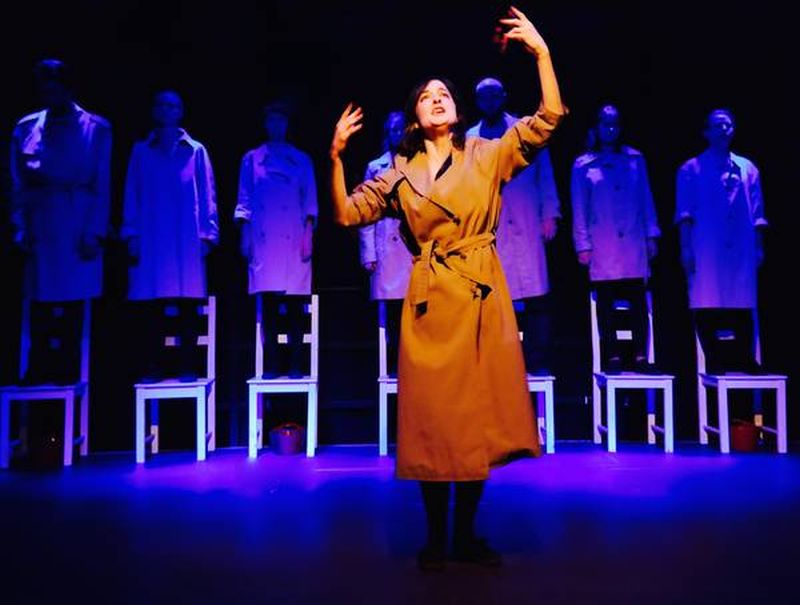
Port in Air - Hardly Still Walking, Not Yet FlyingFour women want to reach the sublime and they’ll try anything to get there: happy-clappy songs, fractured didactic arguments, and chair balancing. Theirs is both a philosophical journey, taking in Burke and Nietzsche, and a theatrical one, involving every possible performance style and form in its exhaustive quest for the mountain top. They puncture the action with a meta-refrain of ‘This isn’t working, let’s try something else!’

What looks and feels like a piece grown from a devising workshop, is in fact written and directed by University of Cologne Lecturer Richard Aczel.  He questions, ‘How, in an age that wobbles between apocalyptic pathos and brain-dead boredom, can we still hit the dizzy heights of the sublime?’ but the text and staging lack the necessary focus to engage us fully. ‘We’ve hit the end of irony!’ an actor exclaims, before I’d had chance to register any irony at all.

A dizzying, choppy piece then, with shifts of tone and content that make you question what you are seeing. Perhaps that’s the point, but the Port in Air troupe struggles to communicate such complex ideas through this frenetic mix of movement, text, songs, and games.  The four young women work hard and with commitment; they have a great deal of physical action to get through. A set built from white chairs is constantly rearranged – it’s effective but over played – whilst the lighting design is well above usual Fringe standards. The main singer’s pretty voice weaves songs through the show providing welcome moments of reflection.

Because the actors don’t own the material, the performances are occasionally uneasy and at odds with their on-stage personalities. When the text slips into German, it becomes more fluid and words are allowed to settle. As an ensemble there is a disparity in the quality of performance and some text delivery is tonally uninteresting.  When three hunky men take the stage (audience shills) it only adds to the confusion; their performances seem to spring from another play altogether.  I’m all for ambition on stage and in literature, and the writer and company are certainly going for it full blast, but despite some strong stage pictures, and two engaging performers, there are too few rewards.

As it was, this audience member left the show still at base camp, nowhere near the mountain.

Ira Brand - Break Yourself

Ira Brand: Break Yourself

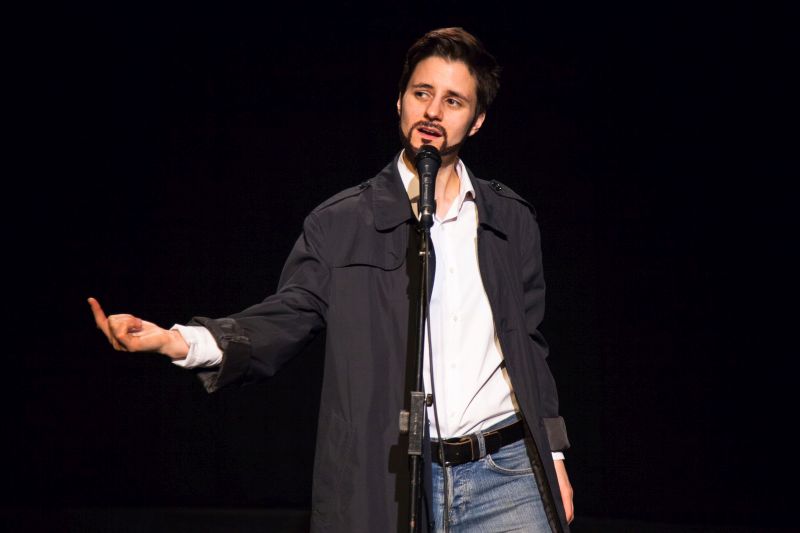
Ira Brand - Break YourselfJeepers creepers, where d’ya get those peepers? How they hypnotise…

Ira Brand’s latest show is all about looking. Looking at, through and beyond. Being looked at. And boy, are we looked at.

Having previously investigated health, ageing and fear, Ira, who is one third of producing company Forest Fringe (with Andy Field and Deborah Pearson) now turns her intense, intelligent gaze on identity and gender. It’s a great choice for the opening show of the Marlborough’s Queer Weekender, exploring female and male sexual desire in an hour of riveting, original theatre.

On stage, Ira, dressed Drag King style, preens her hair and sips her beer, then strolls louchely round the performance boundary marked in tape on the floor. She steps in, the music starts and launches into an expert lip-synching of Bruce Springsteen’s Fire before pulling up a chair to chat, in a cool Deborah Pearson-esque way, her tone level, legs wide, gaze strong. What she tells us is alarming: a sexual fantasy where the sex is ‘consensual, just.’ The man she screws in the underground carpark is the epitome of the self-possessed male, aware of his power as he looks around the bar, knowing he is being observed. For the men in the audience, there is an accusatory frisson here – are you that kind of man?

This sudden switch from entertainment to something far darker punctuates the work. Lights go up, there’s a song, lights go down, there’s a troubling encounter in an alley. Always the emphasis is on the eyes – she tries but fails to stare the teenager down – she shakes her head to suggest ‘no’ when she means yes. There is a terrifying build up of tension here, with language so vivid we can see the scene, feel the breath on her face.

We meet Ollie, a graphic designer. He is shy, diffident, he worships Springsteen – ‘those massive arms’ – and after a bit of banter with the audience, he breaks free to dance like a demon. We have heard the choreographic instructions in a voiceover; they sound strangely like moves a woman would make rather than Bruce. Ollie totally nails it, though in his soul he will always be dancing in the dark.

Break Yourself is an investigation of gender and desire, male power and masculinity, fan-dom and performance, that is both disconcerting and thrilling to watch. There are several modes of conduct at play, provided in part by the voiceovers, which serve as a way into the construction of Ira’s role. She is told to ‘gulp, not sip’; ‘don’t look so eager’ to convince as a man. She relishes her achievements: ‘you are exactly how I imagined you.’ The lighting marks the mood changes, reflecting off a wall of white squares. We are fully aware of the acting going on, and totally suckered by it. If this all sounds a bit heavy, it’s not without wit and a sly knowledge of its own ridiculous moments. The prevalence of the male gaze that dominates so much of our culture and society is skewered by the use of Bruce Springsteen, the good guy, as its symbol. A final, beautifully choreographed dance starts seated and ends in triumphant, electric guitar twanging, rock-god mode, upright, ‘big’ arms aloft, legs wide, to wild stadium applause.

Whoever is broken here, be it Ira, Ollie, Bruce, the dominant male, the questing female, or the audience’s expectations, it’s been a magnificent rupture.


Patrick Sandford - Groomed - Photo by Peter Williams

Patrick Sandford: Groomed

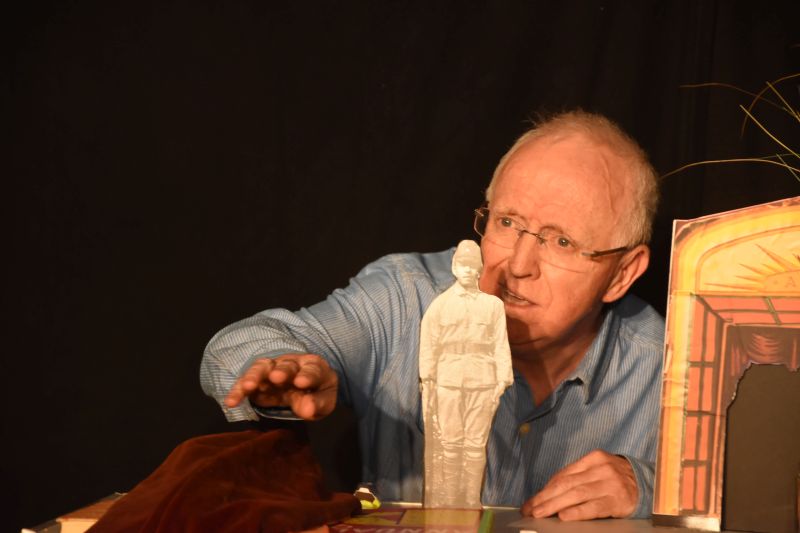
Patrick Sandford - Groomed - Photo by Peter WilliamsIf keeping a secret can corrode the soul, and revealing it liberate, Patrick Sandford must feel a sense of scorching release on performing Groomed to a paying audience for the first time.

His story of sexual abuse at the age of 10 by a manipulative but respected teacher, is not easy viewing, but is tempered by using a range of perspectives, including that of the abuser, plus the musical punctuation of on-stage of saxophonist, Tomm Coles.

Simply staged, with a table of props – toy theatre prominent – and a bunch of balloons, Patrick opens the play with vivid dramatization of scenes from his early life. Slightly impish in manner and confident in tone, he theorizes about guilt, desire, pain, and anger with heartfelt passion in language both robust and poetic. We can feel his anguish when he is held under the school-room table, eyes fixed on the grain of the wood. Given the intimacy and heat of the makeshift theatre space, we could be under it with him.

Groomed explores how a truth can be told, a secret be spoken, and how we erect barriers for shelter. Patrick used theatre as sanctuary; there he could hide behind character, find catharsis in a fictional rage. When the Japanese soldier Hiro Onoda was eventually located in the Philippines jungle, having unnecessarily held a military position for nearly thirty years, he was treated with consideration and generosity by his country. The inventor of the saxophone, Adolfe Sax, struggled through an alarming amount of injuries and business calamities but created an instrument of lasting value and immense musical power. Their experiences provide a counterpoint to Patrick’s story and allow him to reflect on decades of unnecessary defending and celebrate his own creative achievements.

There is ambivalence in the way the play is delivered, with switches from first to third person narrative, from violent anger to comic asides, that make for a rather disjointed emotional journey. Lines such as “I was living beside, not in my life” would be even more powerful if spoken straight to us, and an on-stage relationship between Patrick and Tomm could be established earlier. Further performances will no doubt iron these things out. A larger auditorium would enable Nancy Meckler’s direction to have proper impact, with movement influencing pace.

While Groomed doesn’t break new ground in terms of theatrical form, it’s an intelligent and well constructed approach to a story that, sadly, is only too common right now. Generously supported by the charity Mankind, the play works towards opening up dialogue and relinquishing blame in order to change and heal. It does this successfully, without shifting into theatre as therapy, leaving the audience thoughtful and richer for the shared experience.