Toot Tute

Why would Liz Aggiss premiere her new show Crone Alone in a former miners’ welfare institute in a remote part of Northumberland? Creative producer Lisa Wolfe explains what The Tute has that bigger and better-funded venues in the UK lack. 

“I never in a million years thought I would have my own space,” says dancer and performance maker Esther Huss. We’re sitting together in that space; an ex-miners’ welfare institute called The Tute, on a street facing the disused railway line that blocks access to the sea.

This is Cambois (pronounced Cammus) an isolated former mining village on the southeast coast of wild and beautiful Northumberland. 

Esther moved here in 2019 with her now-husband, playwright Alex Oates, not knowing anyone. He has family in nearby Whitley Bay, but for Esther this was a leap of faith. “People are very open here,” she says, “but it was lonely. I started with the feeling “today I am going to make a friend’”. That’s a hard enough task at primary school; in your early forties, and coming from a vibrant arts scene in London, it must have been hugely daunting. It was the space that spoke to them first. 

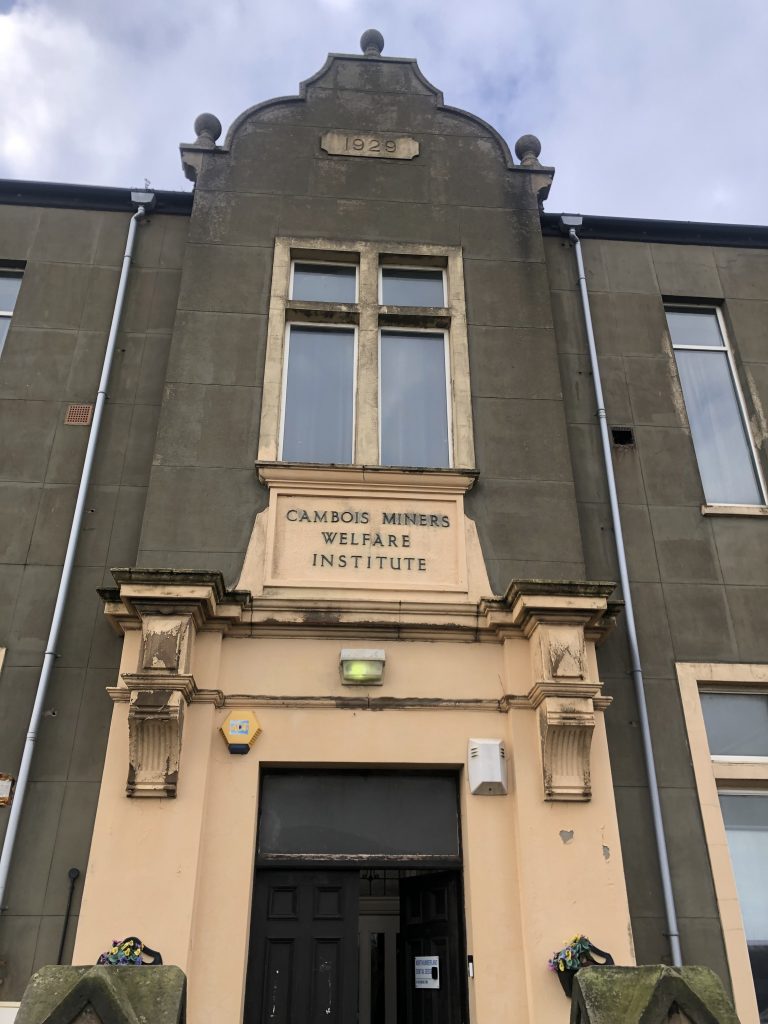
The Tute building. Photo Peter Chrisp

Built in 1929, with a decorative barrel roof, wooden floor and curious side rooms, its rough and readiness was instantly welcoming. Prior to the pit closures it hosted brass bands, film nights and no doubt some fiery union meetings. Esther began using it as a rehearsal space for her own commissioned work and fell in love with the building and the potential it held. She started a dance group, and Alex a writing group, putting leaflets through doors. Slowly interest built in what they were offering, and people began to come.

For Alex, the impetus was partly frustration at a lack of vision from the large regional organisations whose remit, and funding, is to work with communities. Cambois seemed ignored, as were his approaches for a conversation. For the first three years they raised money through community funds, working unpaid, until they could register as a charity and begin to broaden their options. Somewhat inevitably the landlord put the rent up, and raised the asking price for the lease, but the financial position, while still precarious, is at least more stable. 

Five years of hard graft – and two children – later, between them Esther and Alex have not only made friends, they have also built a strong participant base for dance, writing and art classes and a children’s playgroup. They take work into schools and connect with local groups and businesses when opportunities arise. 

The Tute’s most ambitious undertaking is the Rude Health Festival which they launched in 2024, tag-line ‘Because Creativity is Healthy’. Over two months the Festival embraces all genres of the arts, mixing classes with performances and films, with multi-cultural events indoors and in the landscape. Esther and Alex programme artists whose work they admire; those who create with integrity and who they know will surprise, delight and quite possibly challenge the audience. It’s this holding tight to their principles that sets The Tute apart, and is why I’m here this weekend, getting a full blast of Northumberland weather, art and hospitality. 

I’m here with Liz Aggiss for the premiere of her new show, Crone Alone; which came with a related workshop, and a film screening…

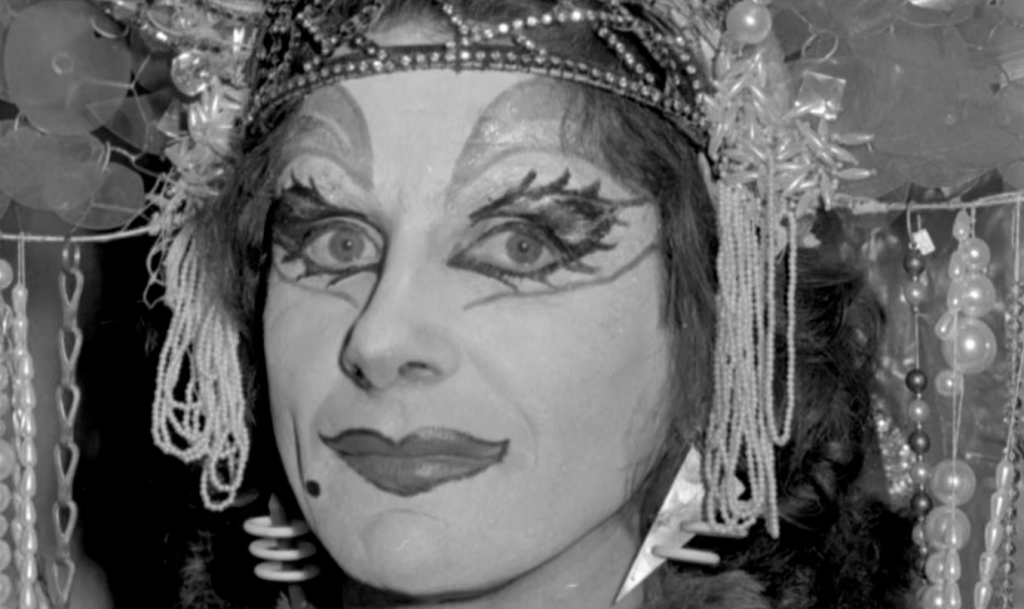
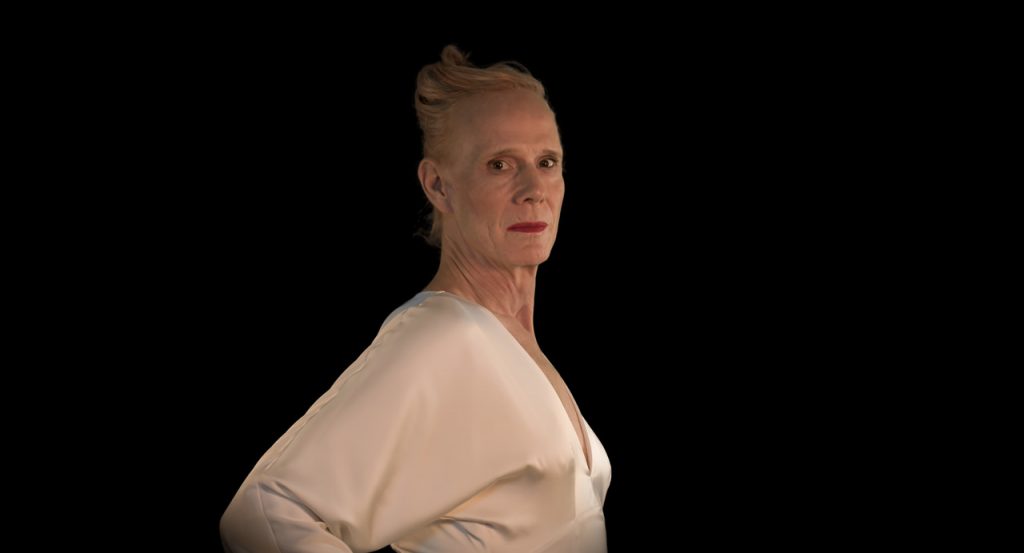
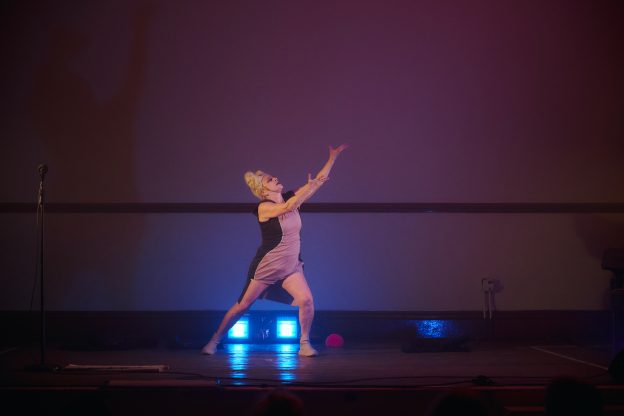
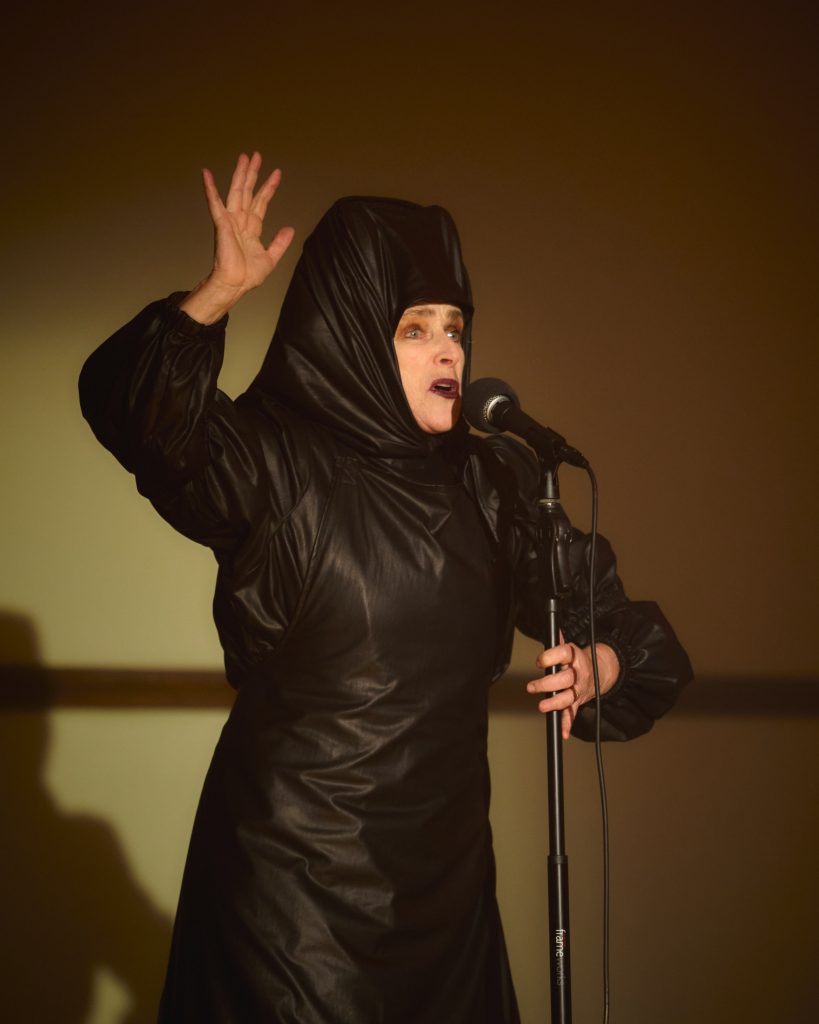
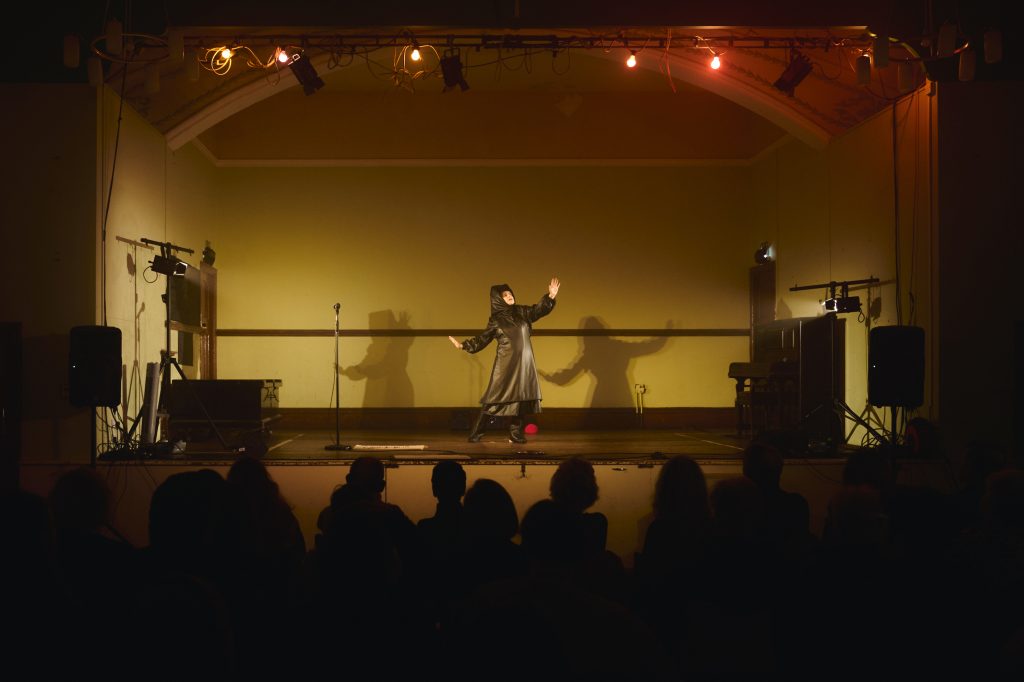
Liz Aggiss in Crone Alone. Photo Luke Waddington

In 2019 the supernova of avant-garde dance Liz Aggiss performed an excerpt of her first new show since 2016’s internationally acclaimed Slap and Tickle

Programmed by Sadler’s Wells Elixir Festival, which celebrates ‘the artistry of the older dancer’ her persona in Crone Alone was described as “charismatic to the point of perplexing” by Matthew Paluch, in his SeeingDance review. It took another five years, and much re-working, for her to show it again, presented as a work-in-progress at South East Dance in Brighton, in August 2025. 

Given the demand for her work from promoters and festivals across the globe, how exactly, and why, particularly, has she chosen to premiere the new, full version here, at The Tute, in a place with no shop, no post-office, no café, no library, no doctor and barely a bus? 

 “I knew I was going to love it just talking with Esther,” says Liz. She had read about her and The Tute in a 2023 Guardian article and got in touch. Over a long career latterly defined by relentless touring, Aggiss had no desire to pitch Crone Alone to the vagaries of the current venue and festivals circuit. The ethos and ballsiness of Esther and Alex appealed to her; the idea of playing to an audience that doesn’t know her or what to expect, of fitting herself and the show into the opposite of a black box theatre humming with technology. 

They talked, and Esther was clear that Liz needed to come for a week, stay locally, mix with the community, and run a workshop for the regular dance group.

She would also co-host an evening of short films, Women, Dance and The Sea, by female artists, including one by Esther and Katja Roberts filmed on Cambois sands; and the Liz Aggiss and Joe Murray 2011 classic Beach Party Animal. Finally, she would perform Crone Alone.  

Liz Aggiss in Crone Alone . Photo Luke Waddington

In her programme note Liz says: “I’ve missed the delight in sharing, communicating and revelling in performance. So I thank The Tute for shoving me back in the limelight and giving me the opportunity to reconnect with my former self… and to bring this work to a new and equally unsuspecting audience.”

With its intricately constructed mix of music-hall tropes, personal revelations, elegantly wrought choreography, and wondrous costume reveals, Crone Alone astounds and delights this rookie audience. An instantaneous standing ovation is the only possible response. The piece poses a question about individual and collective value and worth, in life and in the arts, that resonates with everyone present. 

With their determination that visiting artists dig in and get to know the area and the people, Esther and Alex are enriching the lives of this community and proving that culture really can lift people beyond their expectations. “There’s a lot of people that have been on a real journey with us,” says Esther. “They begin feeling ‘do I have place here? What is this?’ and now regularly come back.”

Becca Sproat was their first volunteer, having got in touch after spending 16 months at home during lockdown. “She’s our pillar,” says Esther, “she comes to everything and is in all of our groups, completely out of her comfort zone a lot of time”. Even more gratifying is that Becca’s family has started to attend events too – and it’s this gradual process of acceptance and personal development that fuels The Tute team. 

This year’s Rude Health Festival culminates with a scratch performance of From The Sea, a new play by Alex featuring the stories of people with lived experience of asylum seeking, directed by Amy Golding. He’s tentative about how it will be received: Cambois sits in within the district of Blyth, a Reform stronghold. Strong anti-immigrant rhetoric is prevalent throughout the community, from the school-gates to the Cambois Club bar. With their children growing up here, the couple are taking every opportunity to try and open conversations that counter prejudice.

That’s why Rude Health includes artists from diverse backgrounds such as Yuvel Soria, whose work explores his Bolivian culture, and the Indian Kuchipudi dance of Payal Ramchamdani, both based in Newcastle.

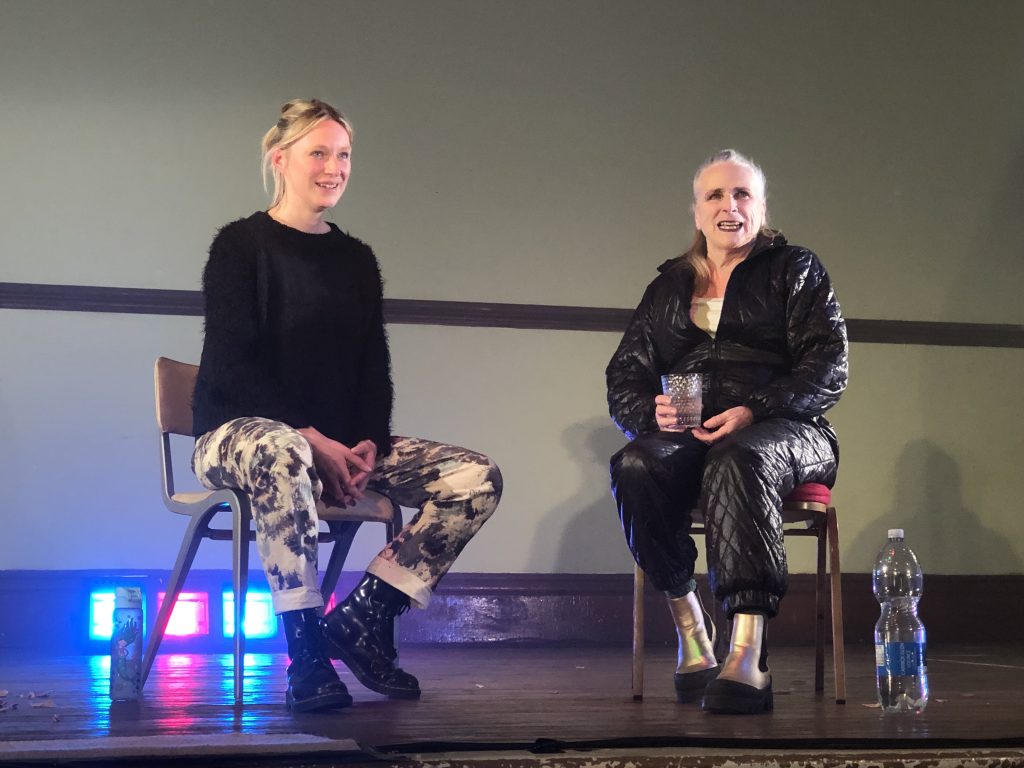
Esther Huss and Liz Aggiss: post show Q&A at The Tute. Photo Peter Chrisp

In Crone Alone Liz has a catchphrase “just try and stop me” and it applies equally to her own thirst to create and perform as it does to The Tute’s power couple. When the national arts news is dominated by headlines about institutional mismanagement and lack of engagement, when the Chancellor’s latest budget shows zero interest let alone support for the creative industries, when theatres are closing almost as fast as pubs, isn’t it time for a new, nimble, artist-led model? For The Tute to go from an empty, forgotten space to a finalist in the 2025 North East Culture Awards (Best Museum or Cultural Venue) is a well-deserved accolade. 

The pits closed in 1968, the railway three years earlier. Rows of terraced houses were demolished and not replaced. Companies promising growth and investment move into the area but don’t deliver; battery manufacturer Britishvolt notoriously went bust after two years. A massive QTS data campus is planned for the area, offering some sponsorship but few jobs.

Meanwhile, two artists are bringing together a network of colleagues and big gang of supporters, making and sharing some of the best creative experiences in the country. So let’s toot a horn for the Alex and Esther’s of the world, the artists who join them and the communities that get involved. It is they who, with grace, imagination, ingenuity and grit, enrich all our lives.

Liz Aggiss in Crone Alone at The Tute. Photo Luke Waddington

Featured image (top): Liz Aggiss: Crone Alone at the Tute, December 2025. Photo Luke Waddington.

The Tute is a hub of creativity located in an old miners’ welfare institute in the heart of Cambois, a coastal community in Southeast Northumberland. From this atmospheric space, The Tute is gently transforming Cambois and fostering social growth for the better. It is recognised that this area is at a turning point, and there is a growing need for meaningful engagement to support the changes ahead. The Tute’s goal is to build empathy, alleviate social isolation, and enhance aspirations through the arts. https://thetute.uk/   Facebook: @TheTuteCambois | Instagram: @thetute_cambois

Liz Aggiss is a Brighton-based, award-winning performer, director, choreographer and writer. For the past 45 years she has been re(de)fining her own brand of contemporary dance performance, dodging categorisation and being classified as unclassifiable. Blurring the boundaries between high art and popular culture, she makes uncompromising, challenging, feminist work. www.lizaggiss.com 

Crone Alone has been programmed for Brighton Festival 2026. Dates tbc – see updates on the website. The Festival runs Saturday 2 May till Monday 25 May: www.brightonfestival.org

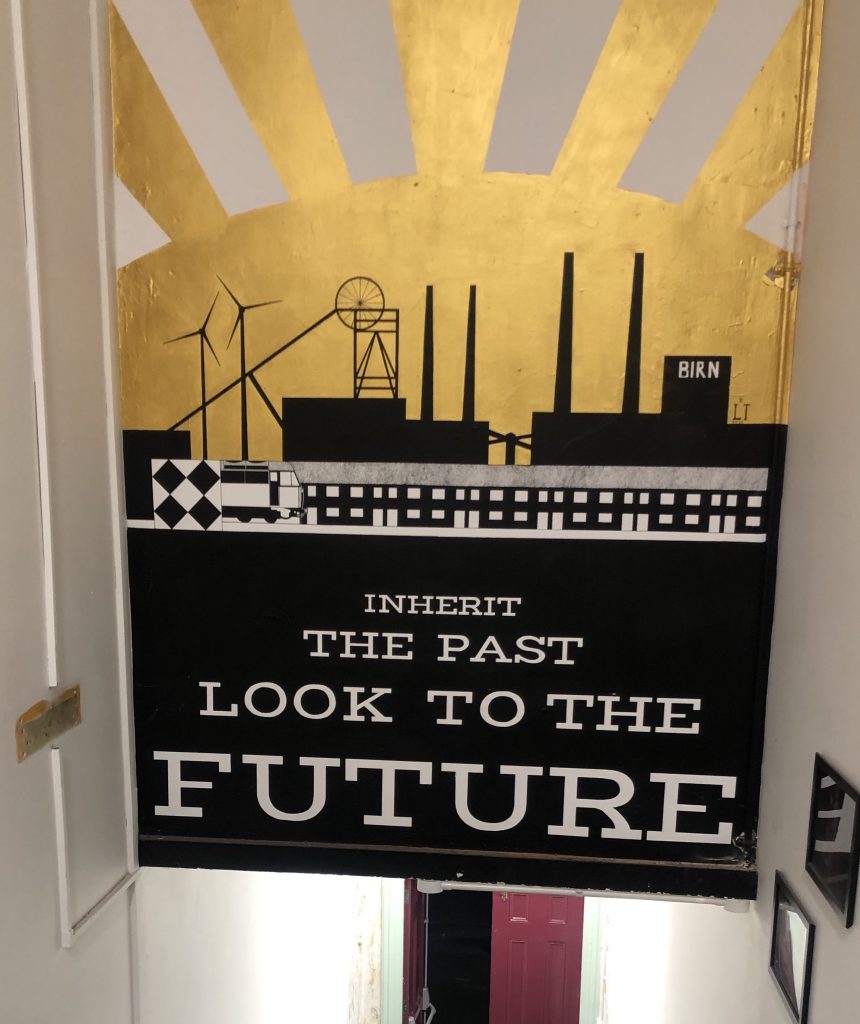
The Tute starwell. Photo Peter Chrisp

Troubled Laughter: Encountering the Dark Clown

Pain, humiliation, pressure, panic… Kunal M Rajput enters the world of Dark Clown, courtesy of the legendary Peta Lily, and lives to tell the tale.

Few encounters in an artist’s life truly unsettle the ground beneath their practice, but Peta Lily’s Dark Clown did so for me. I attended Dark Clown – An Experiential Talk at the first Bouffon Festival in London in October 2025, where Lily delivered a performance-lecture of remarkable precision and intellectual depth. What struck me first was her command of the room, a performer guiding an audience with the charm of her performance and the sensitivity of a teacher. The experience was unlike any session-performance I had attended. It was not only that the aesthetic reached for darker tonalities within the clowning palette. It was that the event forced a reconsideration of what theatre asks of its audiences, what it demands of performers, and how actor training equips practitioners to meet both craft and conscience.

Lily trained with master teachers including Jacques Lecoq, Philippe Gaulier, and Monika Pagneaux, amongst others, and she has spent decades practising the craft, performing and training performers around the world whilst refining what, since its inception in the early 1980s, she has called Dark Clown. Her care with language is striking. She reminded the audience that her form is not violent-clown or horror-clown but an extension of clowning’s expressive range and dramaturgical possibilities. Dark Clown draws on the technical foundations of red-nose clowning such as rhythm, elasticity, and timing, yet it relocates the clown into situations specifically designed to release what she calls ‘Marginalised Emotions’ such as pain, humiliation, pressure, panic, oppression etc. The laughter that emerges is not simple release. It is what she calls ‘Troubled Laughter’, a tightening of breath that blends relief with a sense of shame. Imagine actors in the near-death scene of the movie Final Destination being able to make the audience laugh at their life-or-death moment.

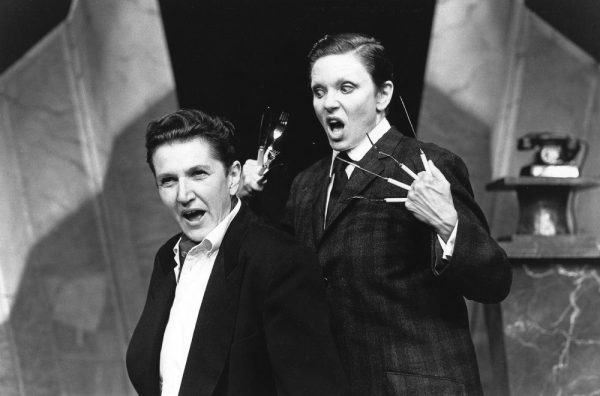
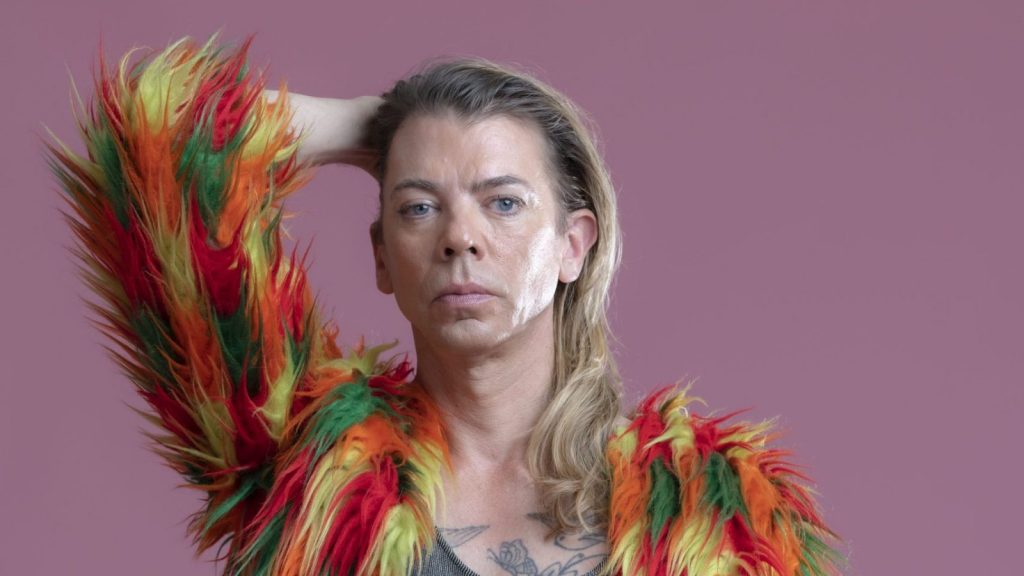
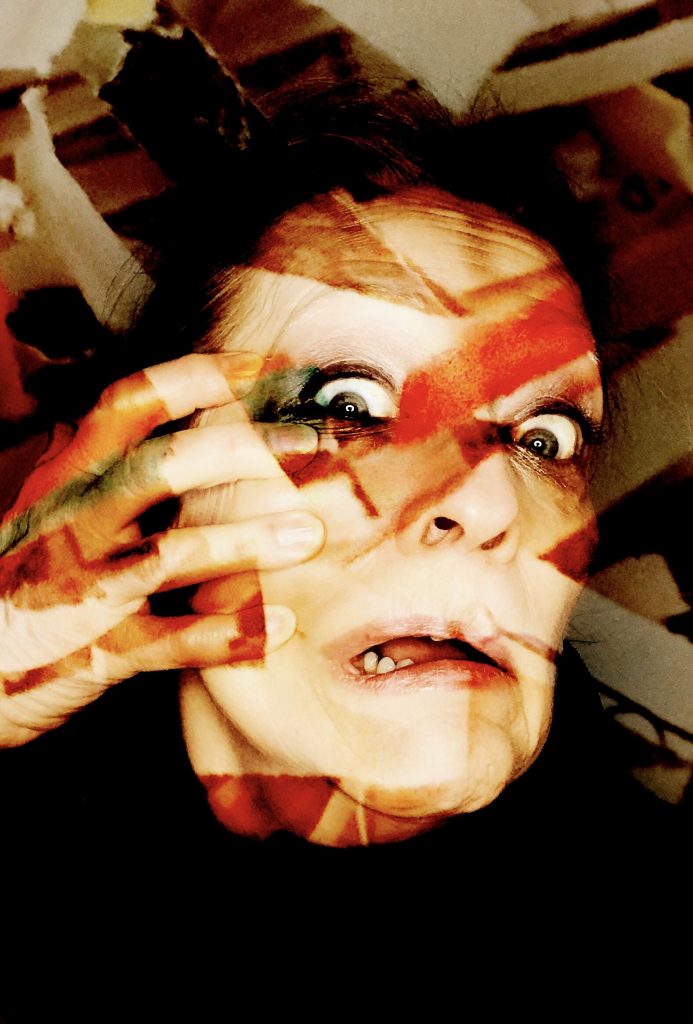
Publicity images for Dark Clown. Photo (auto portrait) by Peta Lily.

The origin of the form illustrates its philosophy. In 1980 at the ICA, Lily watched a scene in a show in which a prisoner was compelled to perform for his captors within a totalitarian regime. He sang, moved, and struck his head with a metal tray. The scene was both grotesque and absurd. The audience laughed, although they sensed they should not. Lily mentions that she felt a sharp sensation in her body in that moment of laughter, which she later named ‘troubled laughter’. This physiological detail is not anecdotal alone. Neuroscience suggests that spectators mirror rhythm and breath, meaning theatre’s impact is not limited to thought but resonates through the body. Bertolt Brecht’s Verfremdung or alienation effect sought to unsettle audience’s thought, whereas Dark Clown unsettles audience’s breath. The performer becomes a conductor of audience physiology: coaxing, pressing, and releasing. In doing so, they implicate the audience. Spectators feel complicit in what unfolds and understand, at a visceral level, the moral stakes.

This, I believe, is the political potency of the practice: not argument delivered through rhetoric, but argument felt through the body.

Some young actors may initially perceive Dark Clown as ethically uncertain or harsh, but Lily avoids anything gratuitous. She begins sessions with content notes and wellbeing guidance, emphasising that Dark Clown is a disciplined craft rather than a pursuit of shock. She distances it from horror tropes and cynical clowning. Instead, it opens a path toward emotions that often sit at the margins: distress, shame, panic, humiliation, dread, and existential unease. Safety remains central. The actor does not need to rely on personal trauma. Imagination and craft carry the work.

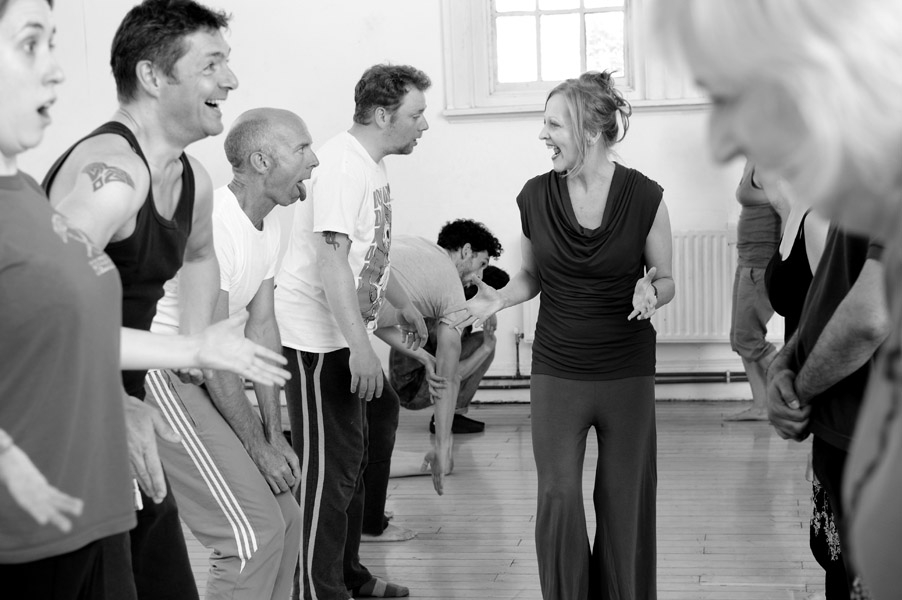
Peta Lily teaching. Photo Graham Fudger.

Lily’s methodology is pragmatic and specific. One strand focuses on comic technique, such as motif, rhythm, and contrast, which are rooted in red-nose clowning. Another strand trains performers to inhabit impossible circumstances with conviction. The final strand demands the capacity to calibrate and respond to an audience in real time. This structure offers actors significant advantages: it allows them to explore intensity and extremity without mining personal trauma. Instead, it encourages imaginative commitment rather than self-exposure, while still maintaining the inner sense of play of the red-nose clown.

A crucial requirement of the form is believable suffering. Dark Clown relies on audiences accepting the reality of distress or pressure: if the portrayal seems false or indulgent, the implicating effect collapses. Lily contrasts her practice with shock-based performance, which often centres on the performer’s thrill. Dark Clown is not built on transgression. It is built on calibration. She cites a circus scene where a small clown receives repeated electric shocks while a larger clown controls the dial. The audience laughs even as the discomfort grows, and the guilt that follows sharpens rather than erases the humour. This tension is not a desire for cruelty. It is a deliberate dramaturgical device that prompts spectators to question their visceral reactions.

I believe this implicating effect is political at its core. Political theatre is often expected to present arguments to be effective, yet Dark Clown shows that political insight can emerge through physical sensation. A tightening of the diaphragm, a flicker of guilt, an altered breath: these physiological responses create a different cognitive terrain. A room that laughs with unease becomes alert, unsettled, and no longer a passive witness. This shift echoes one of theatre’s oldest functions: the transformation of human consciousness. Here the transformation arises from discomfort, and Dark Clown offers a contemporary way of producing that cathartic shift. It brings shame, horror, and release into an interplay that shapes the audience’s moral sense, all through the implicating effect at the heart of the practice.

The form is also rich for actor training. Many drama schools now treat emotional vocabulary in training as too subjective or risky, but Dark Clown provides a structured mechanism for actors to engage rigorously with difficult feeling-states. Dark Clowning exercises such as competitive crying rituals, guilt-based panels, or prisoner-games are not sensational tricks. They serve as rehearsal grounds for ethical decision-making and for sustaining extreme contradiction while holding an audience’s attention. They prioritise the performer’s wellbeing while extending their expressive range.

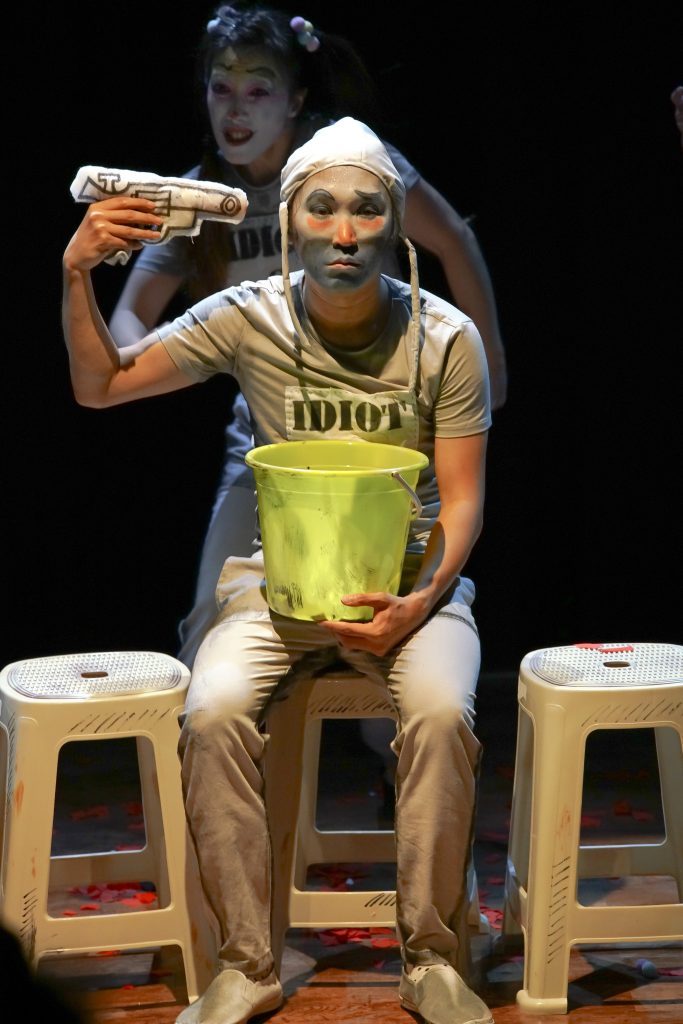
The Death of Fun devised and directed tby Peta Lily for Mime Lab Hong Kong 2017. Photo: Samuel Au-Yeung

Dark Clown is, above all, a craft of attention. It refines rhythm and escalation, teaching actors how to intensify moments without slipping into melodrama. It also sharpens the ability to sense and respond to an audience’s breath, encouraging performers to maintain an internal clown even within naturalistic work, keeping spontaneity alive. These skills are transferable, allowing performers to escalate tension without excess, implicate without exploiting, and make an audience feel the moral cost of laughter in problematic contexts. In this sense, Dark Clown teaches play and stakes within dramaturgy as much as comic technique for an actor.

If theatre hopes to poke and provoke us, Dark Clown is clearly one of the important instruments. It brings discipline to discomfort and responsibility to provocation. It guides audiences toward uncomfortable truths without abandoning care for the performer. Troubled laughter becomes a mirror that reflects complicity and empathy at once. At a time when performance often feels cautious or overly cerebral, Dark Clown brings feeling back to the centre of craft and restores theatre’s essential promise: to unsettle, to move, and, when the moment is right, to implicate us.

Featured image (top): Hamlet or Die, devised and directed by Peta Lily for Hong Kong Mime Lab 2000. Photo Esvigo.

For more on Peta Lily’s work, see www.petalily.com

For her blog on Dark Clown see here.

You can follow her @petalily on Instagram and Facebook.

Kunal Rajput attended Peta Lily: Dark Clown – An Experiential Talk at the world’s first Bouffon Festival at The Pen Theatre, London, 16 October 2025.

Kunal Rajput took part in Peta Lily’s Clown and Dark Clown Workshop in August 2021.

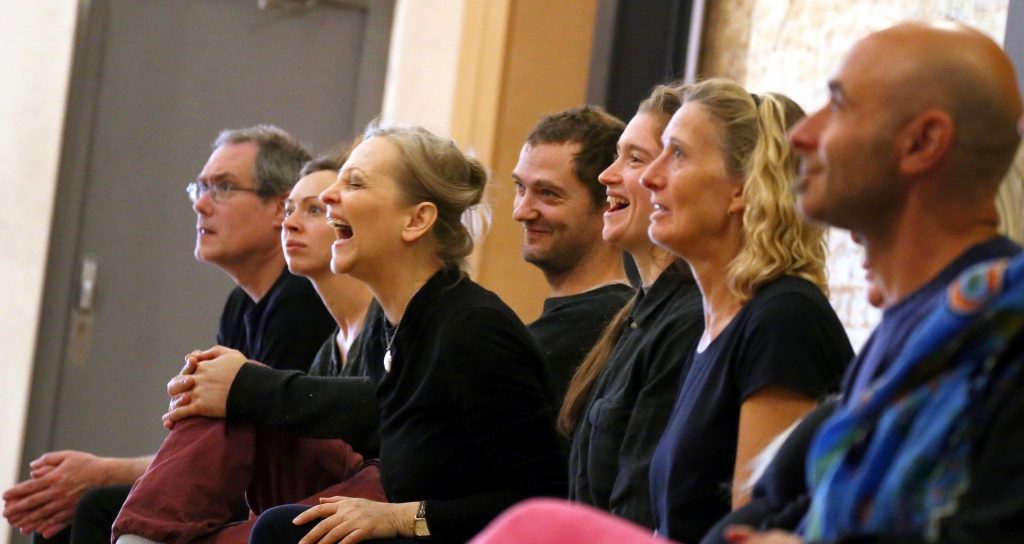
Peta Lily and students watching work: the complex reactions to Dark Clown workshop. Photo Robert Piwko.

This Is Who I Am – Postcards from South Africa

Writer, director, performer, producer! Jeremy Goldstein’s latest project, This Is Who I Am, follows the enormous success worldwide of his Truth to Power Café. Here, he tells us about the show’s latest edition at The Market Theatre in Johannesburg.

I’m going to start by recalling how I came to discover the world-famous home of protest theatre, The Market Theatre in Johannesburg. 

I first came across The Market Theatre at London International Festival of Theatre (LIFT) in 1999 – less than six years after Nelson Mandela and the African National Congress (ANC) toppled apartheid and came to power. Back then, I was LIFT’s fundraiser, working on a trilogy of productions from South Africa which in their very different ways dealt with the toxins of apartheid. There was Project Phakama, a new participatory arts project; William Kentridge and the Handspring Puppet Company’s production of Ubu and The Truth Commission, and Mehlo Players with The Khulmani Support Group in The Story I’m About to Tell at Tricycle Theatre (now Kiln Theatre) in northwest London. 

Jump forward to 2022 and I’m mentoring Congolese theatre maker Eliezer Kasereka as part of the Total Theatre Artists as Writers project. We invited all twenty artists taking part in the project to write one hundred words in response to the title of my new show, This Is Who I Am

Gcebile Dlamini and other cast members This Is Who I Am Johannesburg. Photo Roger Machin

Conceived as a companion work to Truth to Power Café, This Is Who I Am is the younger sibling of a long-term theatre project inspired by the political and philosophical beliefs of Nobel Prize winning playwright Harold Pinter and his inner circle The Hackney Gang, who included my late father Mick Goldstein, and poet and actor Henry Woolf. For sixty years, The Hackney Gang remained firmly on the side of the occupied and the disempowered, believing in an independent media, and speaking their truth to power.

I didn’t plan it like this, but both projects have become my path towards truth and reconciliation marked by twenty-five years of AIDS/HIV activism and the very difficult relationship I had with my father. These are the stories I started telling in 2016 when I began working with Henry Woolf on Truth to Power Cafe – directed and developed by Jen Heyes. 

Ten years into the work, over a thousand revealing portraits of identity have emerged, proving who we are is inseparable from trust, reliance, jealousy, and betrayal – themes which run through both Pinter’s writings and the real-life stories from participants that express the truth of their lived experience, in their own five-hundred-word-monologue.

Minenhle Masina in This Is Who I Am Johannesburg. Photo Roger Machin

In Truth to Power Café participants write their monologue in response to the question: “Who has power over you and what do you want to say to them?” and in This Is Who I Am, monologues are written in response to the show’s title. From eyewitness accounts of the 1936 Battle of Cable of Street in London’s East End, to the 1984 Battle of Orgreave in South Yorkshire, to queer stories in the Australian outback, to our most recent theatrical journey into Hillbrow in inner-city Johannesburg – here, private memory meets public performance. Personal testimony and cultural history intertwine to create a living dialogue and an act of remembrance – an intersectional conversation across generations between the living and the dead.  

I make multiple editions of both projects in the belief that the real power within the work is in the accumulation of untold stories and the compassionate truth-telling from those taking part.

Since its Singaporean premiere in 2022, I’ve re-created This Is Who I Am with older people at my mother’s aged care centre in Sydney, with queer identifying participants at Broken Hill City Art Gallery in the Australian outback, and at the mighty Queer Zagreb in Croatia.

Tshiyeya Kalombo and other cast members in This Is Who I Am Johannesburg. Photo Roger Machin

The fifth edition of This Is Who I Am is set in Johannesburg. Described by Nadia Virasmy as “a recalibration of time, space, experience and truth”, the work is a theatrical journey into Hillbrow and beyond; a place where history and present collide with contradictory illusions and dreams of a mercurial South Africa. A storied, yet troubled inner-city area of Johannesburg, Hillbrow remains a safe harbour for an ever-changing mix of iconoclasts.

Imbued with all the passion and power of ten deeply personal real-life stories driven by memory and desire, participant monologues – each one a play in waiting – were developed by Windybrow Arts Centre (a division of The Market Theatre Foundation) and Stacy M Hardy, Head of Creative Writing at Wits University. All ten monologues are co-directed for the stage and digital theatre screens by me and emerging independent Johannesburg based theatre-maker Jaden Mosadi. They have been created in collaboration with media editor Flick Harrison and photographers Roger Machin and Quintin Mills; and are individually scored by radically inclusive UK music makers Kris and Nicci Halpin of Dyskinetic, whose meditative rock ’n’ roll / trip hop /electronica soundscapes merge seamlessly with participants’ texts and glorious a-cappella South African song.

Sandiso Mbatha in This Is Who I Am Johannesburg. Photo Roger Machin

“I face life head-on to reclaim what was taken from me,” says Caleb Nyanguila from the Democratic Republic of Congo, recalling a traumatised childhood. Sandiso Mbatha is a schoolboy who longs for a big brother, and to rebuild the home of his grandmother, “the home that doesn’t feel like home anymore”.  Reneilwe Leopeng, a first-year student at The Market Theatre Laboratory, says “hold your breath and gaze upon my imperfections for you will see what death looks like”; as Minenhle Masina, a young student, struggles to come to terms with her upbringing “blaming no one but myself for not speaking up”.  And Gcebile Dlamini, an award-winning theatre activist and an alumnus of Arts & Culture Trust in Johannesburg, returns to the stage to disclose an intimacy story she was forbidden to tell her father when he was alive. 

Reneilwe Leopeng and other cast members in This Is Who I Am Johannesburg. Photo Roger Machin

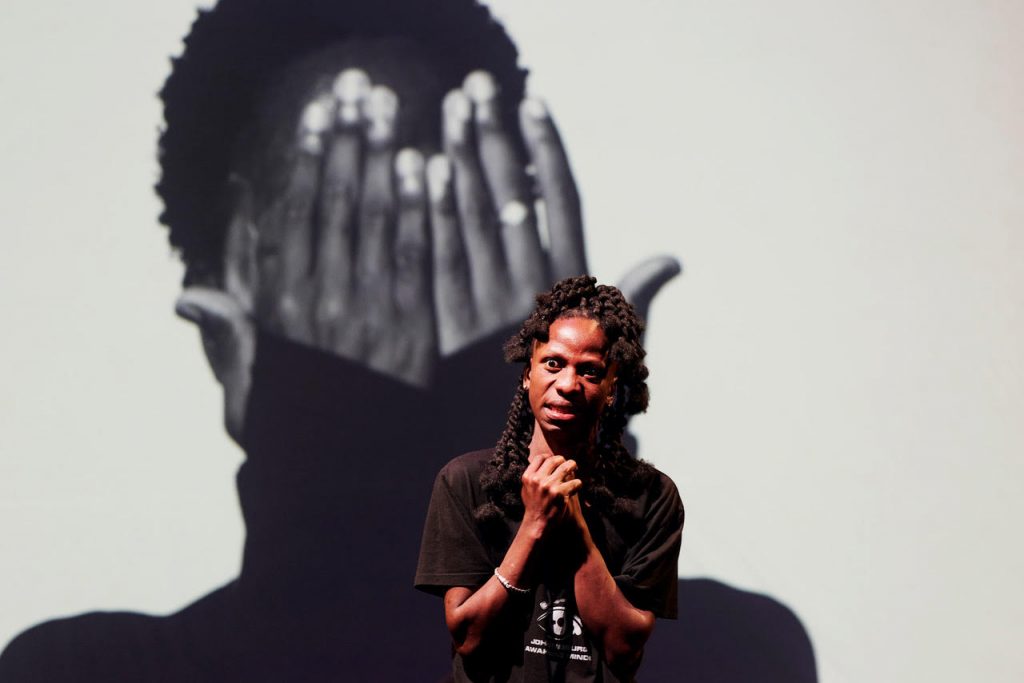
Participants from the homeless theatre company Johannesburg, Awakening Minds, resident at Windybrow Arts Centre, include writer Teshiyaya Kalombo, and non-binary  storyteller Tyson Nkala. Tyson, who grew up in Hillbrow, talks about their life as a “shattered illusion” while desperately seeking the warmth of a happy family, which they found in homeless shelters with Tshiyeya Kalombo. Writing from a park where they sometimes sleep, Tshiyeya’s epic state of the nation address about homelessness demands justice and dignity and the right to a better future.

Hlengiwe Masonda and Simphiwe Dube are both members of the Johannesburg Society for the Blind: “Although my eyes cannot see,” says Hlengiwe, “in the darkness I find my way with all the world’s delight”; and Simphiwe, a sporting champion, tells us that “playing blind soccer is how I learned to see through sound”. 

Tyson Nkala in This Is Who I Am Johannesburg. Photo Roger Machin

Thabang Lucky Matsaung’s monologue traces his disillusionment through the burial of his two favourite childhood action figures, and ends with a re-enactment of his grandmother’s pep talk:

1      “If it bleeds it can be killed”

2     “Don’t ever let a man belittle you to feel manlier”

3     “Polish your school shoes and wash your uniform every day”

4     “Wash the chicken before you season it”

5     “Don’t you dare shed a tear”

6     “If I catch you in front of the mirror or touching water during a storm, you’ll wish the lightning struck you before I did”

7     “God can only do so much. Protect yourself and meet him halfway”

8     “Swim in the waters like you’ve been there before”

9     “Take off your hat in the house when you eat”

10  “You don’t have roll-on? Okay dip the soap bar into water and rub it on your armpits”

“These are the words from my guardians,” says Thabang, “words that build me” – words of wisdom and defiance.

Thabang Matsuang and other cast members in This Is Who I Am Johannesburg. Photo Roger Machin

At the end of the show a chorus of “THIS IS WHO WE ARE” rings out from the stage as rose petals drop from the rig. The fourth wall breaks as the audience storm the stage and become one with the participants. It’s a moment of liberation and defiance that only live theatre can do. 

In South Africa we played The Barney Simon Theatre which was named after one of The Market Theatre’s first artistic directors, and one of South Africa’s most courageous and innovative playwrights and directors.


Telling my story, as I did in 2016, has enabled me to connect with over a thousand other stories of loss, hope and resistance from people all over the world. Arguably, these stories would have never been told from our stages, so as 2026 comes into view, I realise the work is as much about me remembering the legacy of my father and his chums in The Hackney Gang, as it is about challenging the status quo of societal systems of oppression and power structures controlling our theatre

As our artistic freedoms and hard-won battles over diversity, equity and inclusion come under attack, our conversations between the living and the dead continue. Now more than ever we need to be controlling our own narratives, and holding space for others to do the same.

Portraits of cast members for This Is Who I Am Johannesburg. Photos Roger Machin and Quintin Mills

This Is Who I Am Johannesburg cast members: Caleb Nyanguila, Gcebile Dlamini, Tyson Nkala, Tshiyeya Kalombo, Sandiso Mbatha, Reneilwe Leopeng, Thabang Lucky Matsaung, Hlengiwe Masondo, Simphiwe Dube, and Minenhhle Masina.

Featured image (top): Caleb Nyanguila in This Is Who I Am Johannesburg. Photo Roger Machin.

For more on This Is Who I Am, Truth to Power Café, and other work by Jeremy Goldstein see London Artists Projects.

This Is Who I am Johannesburg digital theatre monologues will premiere at Johannesburg Film Festival 3-8 March 2026, followed by We The People Human Rights Festival on Constitution Hill at the end of March 

This Is Who I Am Johannesburg is presented by British High Commission as an ongoing multidisciplinary, intercultural arts platform, and UK / South Africa cultural exchange. Launched at The Market Theatre as part of the G20 Culture Ministerial, the project is a London Artists Projects and Windybrow Arts Centre co-production supported by Canon South Africa. 

 Stephanie Peacock MP, UK Parliamentary Under-Secretary of State for Sport, Media, Civil Society and Youth; Jeremy Goldstein; Gayton McKenzie MP, South African Minister for Sports, Arts and Culture

Together We Are Giant

Yew trees, giants, wassailing, and witches’ lore. The Inside Out Festival 2025 stretches across Dorset and beyond, and digs deep into the county’s folklore and landscape to bring great works of outdoor arts to life. Dorothy Max Prior reports

Arriving to the quayside at Christchurch on a breezy late-summer Friday evening, I see that there are flags everywhere, fluttering madly. 

No, not Union flags or St George flags, but 60 beautifully-designed multi-coloured flags depicting birds, butterflies, fish, flowers, and humanoid figures composed of a multitude of faces. Some are very clean-cut and graphic; some bear texts in cut-out lettering; some are quite abstracted, so that the colours and patterns become more immediate than the figures depicted. Collectively, all seem to convey the message that we are one united world, animal vegetable and mineral – the natural world bearing no regard to political boundaries of state or allegiance.      

This is River of Hope, created by artist Heidi Steller and poet Matt West who, inspired by three local rivers – the Stour, the Avon and the Allen – have worked with local young people to respond to those rivers with poetry and visual imagery. The Christchurch iteration of River of Hope, presented as part of the Inside Out Festival 2025, is the culmination of a project run by Thames Festival Trust, which has taken place in seven UK locations; the programme focusing on young people’s reflections on climate change, with concurrent projects taking place in France and Ethiopia.

Immediately before the outing to see the installation, there is a reception to launch this year’s Inside Out Festival, held in a lovely garden that is rather bizarrely populated by models of dinosaurs – a kind of miniature Crystal Palace Park! Here, we gather to drink Pimms; to listen to teenage rapper DJ Lola, whose song ‘What’s the Dream?’ celebrates love and optimism; and to hear co-directors Bill Gee and Kate Wood speak. 

Bill notes that it is twenty years since he and Kate first started the conversation about what would become the inaugural Inside Out Festival, founded 18 years ago as a biennial event. He highlighted the international aspects of the Festival, which this year has a strong Catalonian contingent included in the programme; and also flags up (excuse the pun) the three national projects that had a Dorset iteration: River of Hope, Nature Calling, and Beach of Dreams (this last another flag-creating project that I saw last May at Out There Festival in Great Yarmouth, now heading to Corfe Castle for its Inside Out iteration). 

For her part, Kate reminds us of Activate’s motto, which is that ‘anything’s possible and everyone’s invited’ telling us that the organisation’s aim is to break down barriers and reach the widest possible audiences, connecting people to the arts whilst celebrating Dorset’s natural landscape.

Speeches done, Pimms drunk, it’s time to head of down to the quay, just a short walk away…

River of Hope at Christchurch Quay, Inside Out Dorset 2025. Photo Jayne Jackson

The following morning my companions and I gather at breakfast to compare notes on the storm that raged through the night – which I somehow managed to sleep through. The ground is damp and it is still a little windy, but gathering raincoats and sturdy boots, we set off to Moors Valley Country Park and Forest for the opening day of Canopy: 24 ideas about trees, the brand new immersive sound-work from Lorna Rees (of Gobbledegook Theatre), in which the audience is invited to follow a trail though the forest where we will encounter twenty-four ‘pods’, each housing its own sound world. We arrive dead on 10am, the start time, and the production team are just putting the final touches in place. Luckily nothing has been damaged by the night’s rain and wind, and we are all set to start.

In previous commissions for Inside Out, Lorna has given us artistic explorations of, and guides to, rock forms and to clouds. Now she has turned her attention to trees, working with arborists, earth scientists, artists, writers, folk musicians, and members of the local community.

‘The work is actually about seven years in the making,’ says Lorna. ‘I realised that I very much love trees, but don’t know much about them, even some of the basic identification knowledge. I’m really good at identifying clouds and not too shabby at rocks, but living things have really eluded me. As an environmentalist I wanted to know more about the science of trees, and their role in our planet and ecosystems. I always start my making process with a notion and Canopy was inspired by the idea of who a British forest is for, and what our psycho-geographical forests are. There was just so much to say! I realised that I wanted a collective of voices – different perspectives and communities to respond with their ideas about trees. All of these perspectives and ideas go through my curatorial lens, and some conversations became songs instead of people just talking to me.’  

So, what’s the end result? We head off to find out. We are given a map and invited to follow a trail though the forest to discover and experience these 24 different ‘pods’ of various colours and sizes, each suspended in the forest.

‘I’ve worked with some amazing folk to create the pods themselves,’ says Lorna. ‘Liam O’Brien is a product designer and forager, and Amanda Moore is an artist and architect, and together we’ve worked on the special design universe of Canopy, one of slime moulds and fungus and seeds. We’ve worked really hard to be as environmentally careful as possible, and to work with people who really make things. The sonic acorns in the domes [that deliver the soundscapes] were specially made in Birmingham by a team of craftsmen, out of beech and oak. And artist and designer Sophie Fretwell has collaborated with me on costume and design. I love fungi and slime moulds and the seed pods – the idea was to look retro-futuristic – slightly sci-fi – but also to be clearly of the place it’s sprung from’.

Lorna Rees and a Canopy pod. Photo Poppy Joy

In the very first pod, artist, philosopher and clown (great combination, that!) Remi Oriogun-Williams tackles the key issue: ‘What is a Tree?’ Later, we get more specific musings on, or odes to, different tree species. There’s ‘Oak’ by folklorist Lally Macbeth; a song called ‘Yew Tree’, dedicated to ‘the oldest living beings in Europe’, with one yew racking up a lifespan of 4,000 years; a wassailing ditty celebrating the ‘Old Apple Tree’, sung by Lorna and members of the community in Chettle, North Dorset; another song called ‘Blossom Queens’ about the cherry blossom that heralds the arrival of spring; and a lament called ‘Oh Magnolia’, inspired by a conversation with ecologist Professor Adrian Newton.

I notice that a lot of these songs are co-written by Lorna and her son Rufus Rusic, and ask her about working with him and other family members.

‘My son Rufus – who for most of this project was just 17 – worked incredibly closely on the music with me. A couple of years ago we performed as mother and son with a Dutch company called Collectief Walden on Songs For A Shifting Soil. It was a real revelation to me that so many people loved seeing our relationship on a stage like that. And, him being fairly immersed in folk music and us having sung together since he was tiny, we have a real shorthand when creating music together. He’s been dragged to countless wassails and cloud-gazings and maypole dances! We have played with so many ideas with the music. One song is based on an old German folk canon, which the 90-strong choir (run by Sandie Wood) I’ve sung with for nearly 20 years sings; another is a song Rufus and I recorded whilst sitting under a yew tree in a graveyard in North Dorset. I think our voices have a sort of unique blend which I don’t think it’s possible to replicate with anyone else. And I love that a young person has been so involved in making the work.’

One of their excellent collaborations is on a piece called ‘Trees Are People Too’ which reminds us that ‘Nature’s not just there for you – the trees are people too’.

Lorna has more to add on ‘the family tree’ collaborations:

‘On reflection, I think it’s quite a feminist act – acknowledging and working with the family I’ve worked so hard to create – and four generations of my family have been involved in the creation of this piece, from my granddad to my parents to my sons and nephews. And they are my family tree after all! I make things at my kitchen table. It’s very – domestic. I hope that this is reflected in the things I make, I hope they’re connecting and on a human scale.’

I will also add that for me, one of the most moving pieces in Canopy is ‘The Trees of my Father’, a personal reminiscence by Lorna’s husband Adam Coshan reflecting on his Anglo-Indian heritage, and his father’s encountering of cobras on forest walks!

‘It was inspired by my partner Adam’s father’s forest from where he grew up in India – the jungle is part of my family’s British forest too!’

Another favourite pod of mine is ‘In the Neighbourhood of Trees’ in which author John Grindrod sings the praises of city trees and nature in the urban environment: conkers bouncing on bus shelters, plane trees pushing up paving stones, and tree roots knitting underneath our streets. Being a city girl, and someone who has made work exploring the relationship between the natural world and the urban environment, I very much appreciated and identified with this particular piece of writing.

I experience and enjoy all the pods, but I find myself most drawn to those with the poetic, literary, musical and meditative content. The music and sound art that underscore the spoken or sung text is excellent, with much created (as discussed earlier) by Rufus, but with additional sound design work by Jo Tyler, in beautiful pieces such as ‘The Forests That Were’, recorded on location in the petrified forest of Portland, Dorset. Less engaging – although I know this is down to personal taste and interest – are the pods that discuss climate change and endangered species. Perhaps because I feel I know these things are occurring, but I want to focus on being in the present moment in this beautiful forest, listening to the rustling trees and singing birds in tandem with the pod sound recordings. But the beauty of having twenty-four pods to listen in to is that there is something for everyone.

When we finally reach the end of the trail, we come across the vintage horse trailer that has been lovingly transformed by Lorna and her granddad into a little hub for books and research materials – also providing the opportunity for trail participants to talk to Lorna or producer Natalie Querol or one of the other team members. 

Such an ambitious and engaging project, beautifully realised – Canopy is a great addition to this year’s Inside Out Festival, and will hopefully live on in other locations.

‘The shows I’ve premiered at Inside Out Dorset (Ear Trumpet, Cloudscapes and GEOPHONIC) have all had successful touring lives far beyond their first outings. So I’m incredibly grateful for the Festival’s belief in me and the continued relationship. I’m keen to take Canopy to urban parklands as well as woodland and forested places – we have the most extraordinary treescapes and parks in the UK. I’d like to explore them more.’

Canopy producer Natalie Querol with the vintage horse trailer at the end of the trail. Photo DM Prior

Our next stop is a hefty 70-minute drive away. We are off to Yeovil to see Becca Gill of environmental art collective Radical Ritual, here with their project Consequences.

Fascinated by the enduring mystery of the Cerne Abbas giant, Radical Ritual have created a vast temporary artwork, conjuring up a monumental new mythical creature. Consequences, a large-scale participatory project, draws on folk traditions, surrealist art-making, and collaborative storytelling ‘to create a new myth that reflects contemporary communities and their connection to the land’. The end result comprises the large-scale visual art piece, displayed on a hillside; together with workshops, parades, and a very lovely sound installation set alongside it.

‘I’m inspired by how myths shape our connection to place and to each other – how we have lost many of these connections, and how we might create new ones together,’ says Becca. ‘Consequences is an act of reclaiming belonging – to land, to shared histories, to each other – and is a symbol of what we can achieve when we embrace our differences and create together. I love that it is a great big game that breaks down the barriers to creating, that there is surprise in what others do, and that it taps into the subconscious at the same time as allowing people to co-create simultaneously.’

Becca Gill of Radical Ritual in the Consequences workshop tent. Photo DM Prior

Now, geography is not my strongest subject, but even I know that Yeovil is in Somerset not Dorset – if only just over the border! But we are in Yeovil because it has played a key role in the development of the piece, as Becca explains:

Consequences started in conversation with Nick Hayes (Right to Roam) who was really inspired by the issue of access to land. We worked with over 200 people from Yeovil to create a new giant in Cerne Abbas, collecting plants to make inks and charcoal and pigments to create the body parts of the new giant. We worked with them in the landscape – played games of Consequences on a smaller scale, and then had a huge canvas outside which they could collage onto, working collectively and then individually to make their section. The flora and fauna you see in the giant is all from the hillside.  They felt that they belonged in that landscape although none of them had ever been there before, even though they only lived 20 minutes down the road.’

The new Consequences giant made its first appearance alongside the legendary Cerne Giant, an ancient land art work depicting an enormous male figure carved on to the hillside. Now it has moved to Yeovil, giving locals a chance to see the artwork that was created in collaboration with members of their community.

So here we now are, on Summerhouse Hill above Yeovil. At the foot of the hill is the workshop tent, featuring a wonderful array of natural materials, from chalk to charcoal to wool and dyes made from local plants. There’s also a small orchard where the sound installation is sited. This has been created by Douglas Dare, and is a beautiful piece, merging folk instruments and electronics with a compelling spoken text full of witches’ lore that tells of houses where ox hearts studded with nails are found under the floorboards, and mummified cats are found bricked up behind the walls.

‘Douglas is an incredible musician who grew up near to the Cerne Giant in Dorset on a farm and when we first met we realised we both had a postcard of it on our fridges!’ says Becca. ‘His music is evocative and beautiful and I was keen to work with him. The soundtrack was created using found sounds from the hillside.  He also incorporated the poem ‘This Patch of Land’ written by Louisa Adjoa Parker for Nature Calling, and we reached out to the people she interviewed when writing this so that their voices are featured in the composition.’

Radical Ritual Consequences artwork, on site in Yeovil. Photo DM Prior

Moving on up the hill track: we can’t clearly see the whole piece from where we are, and thus trek right up the hillside, walking the circumference of the 30 x 40 metre ‘canvas’ (in fact, a specially constructed breathable material that, whilst being environmentally sound for the ground beneath it, can withstand the vagaries of the British weather). The images on it have been  digitally created from the participants’ original drawings, using chalks coloured with inks and dyes taken from local plants.

We see heads, hands, torsos, legs and feet of very many different creatures, real and mythical. There are beady eyes and beaks, scales and wings and tails, in many different hues. Just as in the parlour game Consequences, each team working on their section didn’t get to see what others had drawn until the end reveal.

Becca tells me that Fairmead School for neurodiverse teenagers worked on the Head section. The Heart group was made with Global Majority, an organisation for refugees and asylum seekers. ‘Some of the kids wanted to paint the flags of their countries of origin and have these as petals at the centre of the heart, so we have Syrian and Palestinian flags at the heart centre,’ says Becca. The Legs were tasked to able2achieve: ‘a non-verbal boy took a stick and started to draw an elephant,’ says Becca. ‘We later discovered that there have been findings that show that elephants may have walked on this hillside in prehistoric times’. The Feet section was created by a group of local Year 4 primary school children, who loved mixing and creating with the paints and charcoal, enjoying how messy they got, and saying that they had only ever thought paint came from a plastic pot. One of the key elements of the project was making and using art materials created from the raw materials foraged from the local landscape.  

‘I’ve been a long-time fan of ancient monuments, stone circles, chalk land art, and the ambiguity and power that these hold,’ says Becca. ‘I’m also a fan of the folklore around giants especially here in UK and the intangible pre-history which has been lost through many years of capitalism and colonialism. I’m excited by the resonance that these places hold and the imagination that they spark as we try to work out how and why they are there. This is an exciting starting point for working with many people to co-create new myths.’

Becca’s team of collaborators include the acclaimed author Sita Brahmachari and artist Grace Emily Manning, both of whom ran and continue to run the project workshops. They were also key to the parade that took place in Yeovil on the morning of Saturday 2o September. Sita had this to say about the parade:

‘On the day that there were marches seeding unrest and discord in our capital, I was proud to be part of a radical ritual here in Yeovil – a beautiful parade. The parade brought together people from each of the groups we had worked with. It was a gentle parade in keeping with the bright, beautiful, gentle new giant. What a joy to see the people of Yeovil with local and global roots and branches, from across generations, gather to see the giant they had helped to make. We held up our banners and sang. The sun shone as people living in the same town met – some for the first time, others  reunited – and carried flags, making the sentence: ‘Together. We. Are. Giant.’

Leaving Yeovil, I take a train to Clapham Junction. As I cross the station, I’m moving through crowds of people wearing flags and waving flags – Union flags, the St George cross. There are beer cans thrown on the ground, and a lot of loud jeering. I remember that there has been a big far-right rally in London today, called Unite the Kingdom, organised by Tommy Robinson and addressed by Elon Musk.

I hurry on by, glad to have experienced a very different sort of flag flying at Inside Out Dorset. 

Radical Ritual : Consequences, the parade in Yeovil. Photo Lindsey Harris

Featured image (top): Lorna Rees: Canopy. Photo Poppy Joy.

Dorothy Max Prior attended Inside Out Dorset 2025 on Friday 12th and Saturday 13th September as a guest of Activate and Martha Oakes PR. 

The Inside Out 2025 programme ran Friday 12th to Sunday 21st September, with installations, artworks, performances and events across Dorset and into Somerset, with sites including Christchurch Quay, Forestry England’s Moors Valley Country Park and Forest, Corfe Castle, the beach in Weymouth, and Summerhouse Hill in Yeovil. 

Inside Out Dorset is an international biennial outdoor arts festival. It presents live performance in unexpected places – in town centres, by the sea, in fields and in woodland – for everyone to enjoy. Some of Dorset’s most remarkable urban and rural spots are transformed with experiences that touch hearts and minds like nothing else. Inside Out Dorset is produced by Activate Performing Arts.  www.insideoutdorset.co.uk 

Inside Out Dorset: co-directors Bill Gee and Kate Wood

Activate exists to promote, support and produce performing arts projects in its communities. It brings world-class events to unexpected places, like town centres, village squares, beaches and hilltops. Supporting its performing arts community is at the heart of everything it does. It brings people together, offers advice, and provides access to learning and resources. It’s there to help creatives at all levels on their journey towards creating outstanding, inspiring work. As one of Arts Council England’s National Portfolio Organisations, it receives regular funding to initiate, develop and sustain a range of dance, theatre and outdoor arts opportunities for the people of Dorset and the South West. It is also core funded by Dorset Council and BCP Council. As a not-for-profit organisation, it works in many ways and with many partners.  www.activateperformingarts.org.uk 

Lorna Rees Company: Canopy: 24 ideas about trees was presented at Forestry England’s Moors Valley Country Park and Forest in Dorset, 13 to 21 September 2025, as part of Inside Out Festival. It was commissioned by The National Memorial Arboretum, Activate/Inside Out Dorset and Forestry England, with funding from Arts Council England National Lottery and Cultural Hub.

Lorna Rees Company: at Inside Out Festival Moors Valley Country Park and Forest. Photo DM Prior

Radical Ritual: Consequences was presented in Yeovil 13–14 September and at Corfe Castle 20–21 September 2025 as part of Inside Out Festival. It was commissioned by Dorset National Landscape for the project Nature Calling, with executive producers the National Landscapes Association and Activate Performing Arts. It is supported by Arts Council England, Defra and Imaginators.

Radical Ritual: Consequences at Inside Out Festival Corfe Castle Dorset. Photo Roy Riley

Thames Festival Trust with Heidi Stellar and Matt West: River of Hope was presented at Christchurch Quay 13–15 September 2025 as part of Inside Out Festival. It is delivered in partnership with Thames Festival Trust, and supported by Arts Council England (as part of the National Lottery Creative People and Places programme) and Paul Hamlyn Foundation.    

River of Hope at Inside Out Dorset. Photo DM Prior

Khalid Abdalla: Nowhere

“Welcome to Nowhere. I’m going to share with you how I got here. And what ‘here’ actually means to me.”Bianca Mastrominico reports on Khalid Abdalla’s powerful solo show Nowhere, seen at the Traverse, Edinburgh Festival Fringe 2025 

When Khalid Abdalla walks on stage and begins speaking about the title of his performance, Nowhere, he does so with a gentle voice and an unassuming, soft presence, marking the difference between the ‘somewhere’ we all are right now – at the Traverse Theatre in Edinburgh, for the Edinburgh Festival Fringe 2025 – and a ‘nowhere’ which is a space built by absences, memories of personal struggles, and collective crisis. For somebody like Abdalla, belonging to two cultures and two nations – Egypt and Great Britain – ‘nowhere’ embodies an inner place of contradictions and the painful recognition of having to always negotiate the feeling of being estranged at home. 

On stage, behind the performer, a big set-screen (conceived by the production’s costume and set designer Ti Green) becomes a window into the world of history that shaped the life journey of Abdalla and his family from Egypt to the UK. 

The slick video design by Sarah Readman, including screening of raw footage of the Egyptian revolution in 2011 shot with a mobile phone and images of the counterrevolution that followed, signal the moment when Abdalla, eager to reconnect with his Egyptian roots, finds himself involved in the wave of rebellion known as the Arab Spring. 

Emotionally charged stories of friendship, loss and grief are visualised together with family heirlooms, such as the portrait of Abdalla’s grandfather passed down through generations, symbolically reminding the family of the political activism that runs in the blood. 

The projected images not only conjure a visual memoir but create a liminal space between past and present which Abdalla uses to question and expose in picture (which sometimes are physical polaroids projected onto the screen) – the colonial history which has shaped his path in life and that of his family. 

Defining himself as both an actor and an activist (beside being a writer and a well-know filmmaker and producer), Abdalla’s dramaturgical process (working with Ruth Little and Chris Thorpe) and embodiment seems to be continuously split between these two dimensions: the desire to tell a story; and re-enacting what he calls an anti-biography through which he connects the historical, economic and geopolitical circumstances that laid the path for his grandfather and father to become political prisoners in Egypt, and the ethical drive to make sense of his own experiences of xeno-racism and micro aggressions in Britain, particularly as an actor during casting calls and interviews for films in which he is inevitably offered the part of an Arab character – be it playing one of the hijackers in Paul Greengrass’s feature United 93 or Dodi Al Fayed in The Crown on Netflix. 

Born in Scotland and raised in London, the first impression of Abdalla’s stage voice is that of a well-educated and well-mannered British man. However, this register is actively and consciously put to the test throughout the performance when Abdalla comes out as Glaswegian, or speaks Arabic to recall conversations with family and friends. 

Abdalla is candid and fully aware of how his life path was affected by the choice of his parents to stay in Britain, to not risk that the father would be put into prison back in Egypt due to his political views, and there are many beautiful and raw moments in the performance where bitterness hits, such as in the remark ‘the darkness of the world creates the frame for so much joy…’ 

Merging physical performance and atmospheric soundtrack with strong visual storytelling – all brilliantly directed by Omar Elerian, an Italian director, dramaturg, and theatre maker of Palestinian descent – this is an exceptional, heartfelt and transformative show because it never lets us forget our shared humanity behind the political stance. 

Before the ending, Abdalla asks us to draw a blind self-portrait on a square piece of paper which we have been handed in an envelope together with a pencil and a tiny mirror, while queuing in the foyer. Is it an act of acceptance of who we are or a way of reminding us of our own identity and privilege in Western society? 

At the very end of the performance Abdalla makes an origami dove and the process is projected onto the screen where the dove appears huge and almost threatening. He then tells us that he feels uneasy talking about peace in a way that doesn’t recognise the complexity of cultural as well as political forces shaping our world, which include neoliberalism, capitalism and colonisation. These are the forces that lead to greed, violence and war. 

However, while in this ‘nowhere’ it is difficult to reconcile with the idea of global peace, in this somewhere – the theatre – Abdalla hopes we might find resolution because we can still play, and all is possible. 

And so, for the epilogue, he reverts to the soft presence and compassionate quiet voice of the beginning to talk candidly about Gaza, war, genocide, and the injustice of conflicts. Tears start to pour down the actor’s face – honest, felt, human tears – and our collective heart melts. As an activist he leaves a recommendation with us, to bring that feeling of freedom and understanding we gained from being somewhere (in the theatre) out into the nowhere of our shared lives. 

I see audience members pausing at the exit. I see them crying – and I want to cry too. As Abdalla appears in the foyer, I go to greet him and ask him how he manages the shift between two very diverse cultural mindsets while continuing to be so honest and critical, yet compassionate, towards both his Egyptian cultural roots and British upbringings, and he candidly answer that it is always a tension. In Nowhere Abdalla recognises these tensions with compelling urgency and an outstanding presence, warmly inviting us to reconsider and reconcile with what it means to be human. 

Featured image (top) Khalid Abdalla: Nowhere, photo Manuel Vasson.

Nowhere is produced by Fuel and plays at The Traverse, Edinburgh, 12 – 24 August 2025. For further information and to book, see www.edfringe.com 

Nowhere is part of the Here and Now Showcase 2025. Here & Now – Performance Created in England  is delivered by Battersea Arts Centre, FABRIC and GIFT, and is  funded by  Arts Council England. The show premiered at Battersea Arts Centre in October 2024.

Further dates in 2025:

Scènes du Grütli, Geneva, 11 – 13 September 2025. Part of La Bâtie, Festival de Genève.

Project Arts Centre (Space Upstairs), Dublin, 10 – 12 October 2025. Tickets available via the Dublin Theatre Festival. Part of Dublin Theatre Festival.