Author Archives: Dorothy Max Prior

Dorothy Max Prior

About Dorothy Max Prior

Dorothy Max Prior is the editor of Total Theatre Magazine, and is also a performer, writer, dramaturg and choreographer/director working in theatre, dance, installation and outdoor arts. Much of her work is sited in public spaces or in venues other than regular theatres. She also writes essays and stories, some of which are published and some of which languish in bottom drawers – and she teaches drama, dance and creative non-fiction writing. www.dorothymaxprior.com

Opus No. 7

Moscow Theatre School of Dramatic Art / Dmitry Krymov Laboratory: Opus No. 7

Opus No. 7

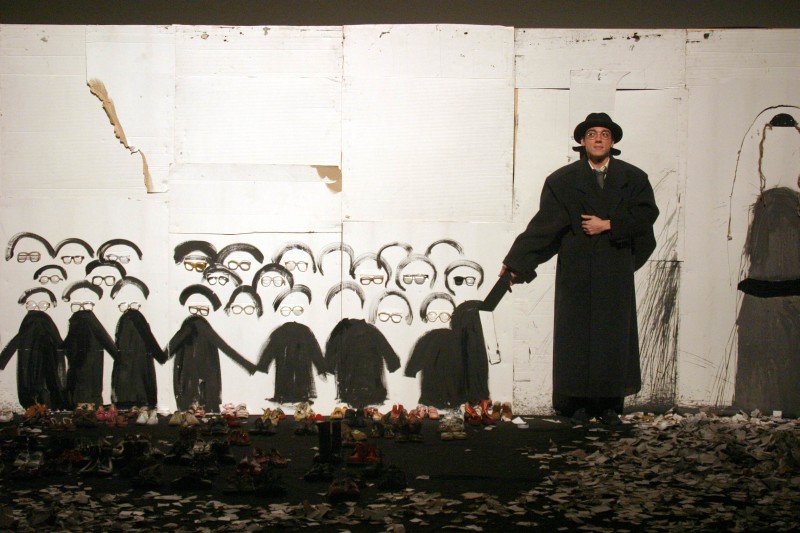
Visual theatre, you say? Here it is in shed-loads: the awesome Opus 7 – created by Russian designer-director Dmitry Krymov and a team of performer-devisers and co-designers – is truly epic, and takes up every inch of the Brighton Corn Exchange with cardboard, paint, a football game, a giant puppet (she’d be ceiling height in most venues, but has a bit of clearance, just about, here), besuited men hanging from chandeliers, waltzing cut-outs, and a herd of beaten metal pianos racing through the space to the sound of Shostakovich’s Leningrad symphony.

Two days on and the images are racing through my mind like greyhounds on speed – I shut my eyes and there are those pianos playing bumper cars, there are the beguiling eyelash-fluttering eyes of that enormous Mother Russia tucking a small figure under her skirt, there are the row of clerics and madonnas throwing tubs of black paint in unison, there is the woman’s leg splintering the plywood door, there is the on-screen image of a Stalinist (or is it Nazi?) guard looking with evil intent into a pram, a real 3D pram hurtling into the space a split-second afterwards.

And sounds, sounds are important too. There are Russian words, and there are surtitles, which I ignore mostly – I catch references to Abraham and Isaac; to a destroyed school; to lost children; to religious and political oligarchies; to award ceremonies; to wars. The sound of the words is what I like – poetic texts, incantations, liturgies. And there is song: church madrigals and bracing folk songs from the ensemble, tiny little voices singing hymns, deep bass drones, or a solo contralto voice rising out from a surprisingly slight young woman. There is the ringing of tiny bells, and there is the boom and crash of Shostakovich’s bombastic orchestrations.

In essence, Opus 7 is not one show, it is two hour-long pieces linked thematically – with a half-hour interval in between, which gives the company time to transform the space completely. Part one is called Genealogy. The whole length of the space is used (although there are some problems with sightlines, I feel, sitting at one end of a very long row of chairs). The tubs of black paint thrown early on at the white wall create dripping silhouettes representing fearful and scurrying residents of a Jewish ghetto. Photographic images of real ghetto Jews are projected into the gaps, and a row of black suits hang in other gaps. There is a further layering as performers interact with the 2D images, often creating hybrid 2D/3D pictures. Images of burning fires, heaps of children’s shoes, shredded paper, and that ominous guard rolling the pram. We don’t need words to tell this story – it is sadly the story of the Jewish diaspora throughout Europe in the 20th century. ‘Shot by both sides’ we could say, musing on Russia’s treatment of its Jewish population (Hebrew banned, schools closed, books burnt, and then worse under Stalin). And then, the enemy without as well as within, as the Nazi regime attacks Russia.

After the interval, Shostakovich takes a different tack, focusing specifically on that composer’s troubled relationship with his motherland. He’s played by a petite young woman, and later by a small puppet engulfed by the enormous bosoms and skirts of the Mother figure – a towering puppet that has the magical ability to shift from grandmotherly piano teacher to terrifying commandant in just the blink of an eye. Part one of Opus No. 7 is disturbing and exhilarating in equal measure, but part two ups the ante considerably – perhaps because the story is so clearly told in sound and vision. At the start, a group of workmen drill and hammer a rickety oversized piano set in the centre of the space. Beneath it are the torn and stained ‘white walls’ from part one. The piano is mounted by a small figure in round glasses, overseen by the enormous Mother – all smiles and nods at this point, but a menacing presence none the less – and Shostakovich is there with us, starting on a career which is always overshadowed by his troubled relationship with Mother Russia.

You don’t have to know that the composer was at various times in his life feted by the Russian state and given prestigious awards, then at other times ostracised and vilified – it’s all here in the image of the enormous badge pinned on that pierces right through his slight body. The infamous debut of the Leningrad symphony, written about a city that Shostakovich apparently claimed ‘Stalin destroyed and Hitler merely finished off’ comes to life here in that extraordinary bumper-car piano sequence, the enormous metal wrecks wheeled at full speed through the length of the space. It is easy to imagine Nazi bombs falling on Russia’s cities, and the desperate and depleted musicians from the orchestra dropping dead from exhaustion and hunger.

Opus No. 7 could be held up as a shining example of how stories can be told in sound, physical action, and visual image. The work of Kantor comes to mind as a comparison – a true marriage of visual and performing arts. This is a monumental piece of theatre – what a joy to see such marvellously visual, physical, visceral storytelling taking centrestage at the opening of the Brighton Festival (and also being presented at other UK festivals throughout the spring and early summer months).


Eric Kaiel: Murikamification

‘No matter what they wish for, no matter how far they go, people can never be anything but themselves. That’s all.’

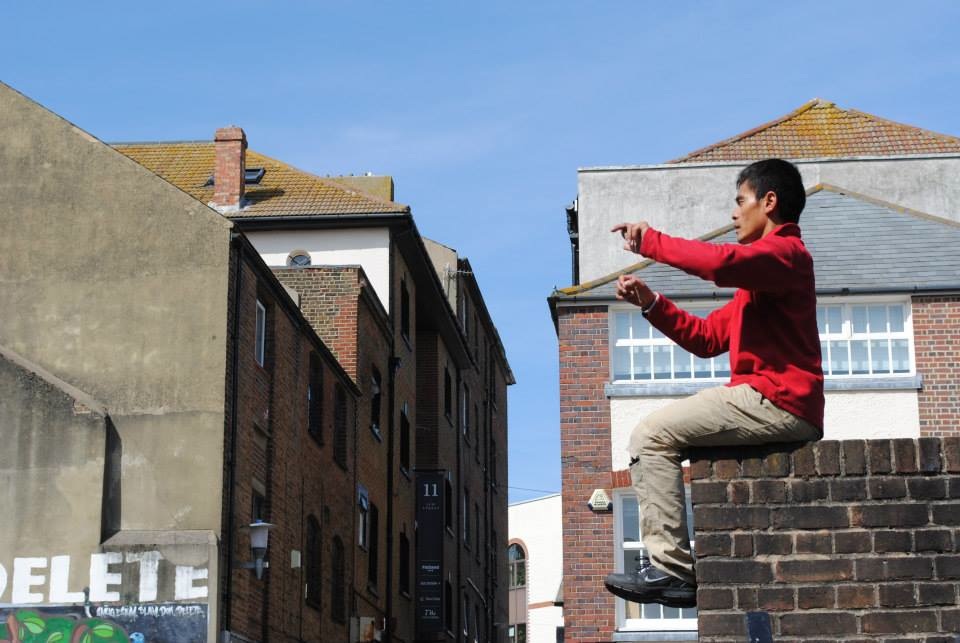
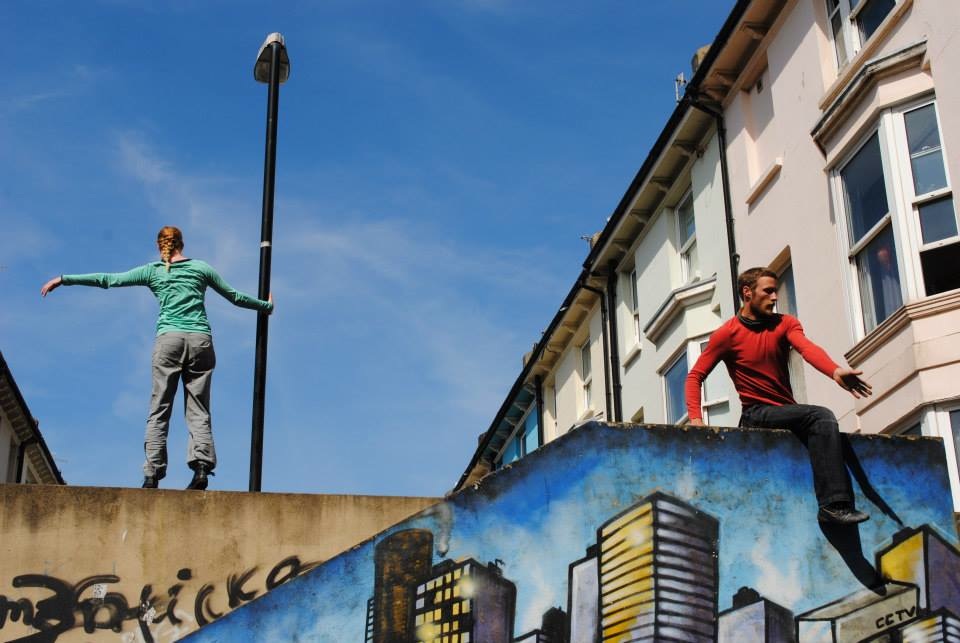
Three young people negotiate the urban environment. A man in a red hoodie rolls across the ground (‘Like the rolling saint of India!’ says my companion). A woman with strawberry-blonde plaits scales the wall of a building, creating a window-frame with her arms. A different man in a roll-neck, quiet and lithe as a cat, walks across a narrow ledge from one building to the next. Brickwork, guttering, grafitti – all is highlighted, framed, as the three move around, by, through, the spaces in-between. The dancers bodies meet the concrete harshness of pavements, walls, alleyways, and staircases with an astonishing softness and suppleness, alternating between melting into the urban landscape and standing out against it. Often they move calmly, quietly. Sometimes they break into a run.

‘Chance encounters are what keep us going.’

Occasionally they encounter other humans – a man sitting on a bench eating a take-out salad; another just sitting and watching. These people are sat next to, leant upon, danced around.

‘What we call the present is given shape by an accumulation of the past.’

Always we feel that our three protagonists are existing in an alternate reality – they connect, but they are on another plane. They have slipped through the cracks into a world where (perhaps) the streets rearrange themselves, cats can talk, and love affairs can be kindled with ghosts.

‘Whatever it is you’re seeking won’t come in the form you’re expecting.’

Murikamification by Dutch choreographer Eric Kaiel (who makes a Hitchcock-style appearance in his own work as a map-reading tourist) is a promenade piece using dance and parkour that takes us on a journey through the backstreets of the North Laine area of Brighton. It’s a piece that’s been shown in cities across the world, and is justifiably well received wherever it goes. There’s no denying its beauty, its accomplished choreography, and its wonderful interaction with the environment. As for the title and theme: I spent the first part of the show seeking out the Murakami references – I’m a keen fan of the Japanese author. They are not overt, unless I missed something. But I ended up feeling that the spirit of Murakami’s books has been served well. Triangular relationships, brief encounters between strangers filled with poignancy, cities that shape-shift. The magic realism of everyday life, there and visible if we just re-focus our eyes. The feeling that there is something strange just around the corner. The discovery that familiar urban landmarks take on a different light if viewed from another angle. The notion that the streets we walk every day might suddenly twist into new shapes. Was that gap in the wall always there? What’s under that manhole cover? And where does that metal staircase lead to?

‘If you can’t understand it without an explanation, you can’t understand it with an explanation.’

There’s nothing more wondrous than looking at something we think we know well through re-tuned eyes and re-programmed brains. No need to understand. Just be.


Welcome in the Mighty May

Eric Kaiel Murikamification at Brighton Festival. Photo Peter Chrisp

Murikamification at Brighton Festival. Photo Peter Chrisp


OK, first weekend done…

I’m sure you know, but in case you don’t: the Brighton Festivals (that is, the Festival, the Fringe, House, the Open Houses, and various stray programmes that get tacked on, such as the Caravan showcase) amount to the biggest arts festival in England, second only in the UK to the Edinburgh extravaganza that takes Edinburgh by storm (or by hostage, depending on your viewpoint).

People sometimes ask me for advice about putting on a show in Brighton in May, and in reply I suggest doing a show in April or June: May is so completely overloaded that it can (mirroring Edinburgh) be hard to get an audience, unless you have the backing of the main festival or the support of a good fringe venue. Opting out of the party altogether are The Basement arts centre, for years a Brighton Festival hub, who have decided this year to focus on their March-April Sick Festival, which is establishing itself as a regular Spring date on the arts calendar.

But of course there are many other venues on board for the Brighton Festival: old regulars like the Theatre Royal and newer hot-spots such as The Old Market (TOM) hosting Festival shows. In the case of TOM, hosting both main festival and fringe shows (such as The New Ten Commandments by the enterprising artist and filmmaker Simon Wilkinson) side-by-side.

The Dome complex is being used (as it should be) fully, with shows in the opening weekend including the Tim Crouch / A Smith collab what happens to the hope at the end of the evening, reviewed here by Beccy Smith (who gets the TT gold star for first review of the fest, posted less than 24 hours after seeing the show), this seen in the Dome Studio (Pavilion Theatre as was); guest artist director Hofesh Shechter’s bombastic Sun in the main space (this also reviewed by Beccy, seen by us both on Sunday 4 May); and the epic and awesome Russian piece Opus 7, taking up every inch of the Corn Exchange with cardboard, paint, a giant puppet and a herd of beaten metal pianos. I’ll be tackling that one. (‘Rather you than me’ said Beccy we left after the two-and-a-half hour marathon).

Elsewhere, the Total Theatre Award-winning Bonanza opened at the Sallis Benney Theatre, University of Brighton. It’s a multi-screen theatre/installation/film/time-based art piece (hard to define the form) about a town in Colorada, made by a Belgian company called Berlin. Yep, confusing I know. It is part of their ongoing Holocene project, focusing on different geographic locations. Such a relief to see this show again, a year later, outside of the Edinburgh bubble, and to think ‘yep, that’s an award winning show…’ It was a contentious winner, I can now reveal – opening up a heated debate on what we can consider to be ‘theatre’. More on that another time! The UK premiere of the company’s new piece, Perhaps All the Dragons, is at the Brighton Fest 21–24 May. I’ll be interviewing the company for a special feature on their work…

Also seen this first weekend: Eric Kaiel’s Murikamification, a beautiful promenade piece using dance and parkour that takes us on a journey through the backstreets of the North Laine area of Brighton. It’s a piece that’s been shown in cities across the world, and is justifiably well received wherever it goes. That too will be reviewed soon. (Gosh, so much writing to do…)

A feature of the Brighton Festival is a significant amount of free-to-audience work – either outdoors or in. Like most arty residents I sorely miss Streets of Brighton, but those days are gone, and we have to take what morsels we are given. Which are mostly given to us by Without Walls, who this year are at least supporting some people with a bit of a track record in making outdoor / off-stage work, including Metro Boulot Dodo (premiering Safe House in Hove Park on 17 May); Frantic, the new work by circus-theatre company Acrojou, (seafront, 10 May); and Tangled Feet’s One Million, billed as ‘a Brighton Festival exclusive’, although originally commissioned by Greenwich and Docklands Festival. No, I don’t understand either… Anyway, that’s at Black Rock on 24–25 May. Outdoor arts wild card is The Legend of Hamba by British–African company Tiata Fahodzi  at Pavilion Gardens, 11 May.

Indoors, free to audience, is William Forsythe’s Nowhere and Everywhere At the Same Time No.2. It’s a delightful piece – a choreographic exploration in which an enormous empty space (the Old Municipal Market) is hung with pendulums swinging in timed sequences, the audience invited to walk/run/play throughout the sea of hanging wires. The audience members thus become the dancers in the piece, either walking in purposeful patterns, or skipping like spring lambs to avoid collisions with the pendulums; art–savvy adults and innocent children enjoying the game with equal delight. Like much of the best art, it operates on many levels simultaneously – a real success.

Also indoors, also free, is Zimoun’s Sound in Motion, set in the University of Brighton Gallery. The exhibition comprises two large pieces, one a set of cardboard boxes fitted with DC-motors powering little cotton balls; the other a great wall-length ‘loom’ of motor-powered wires clattering away in almost-perpetual motion. There is also a video of other works – and although I usually dislike videos of absent works not included in exhibitions (it often feels like a poor excuse for not having more of the actual work), this is a particularly well-made one, which I enjoyed immensely. Swiss artist artist Zimoun conforms to national stereotype with his obsession with rhythmical precision – except instead of cuckoo clocks, we have a wonderful array of everyday materials (cardboard, wire, cork, metal springs, nylon filaments) used to create a symphony of mechanised sound and movement. Magical!

The Brighton Festival has a formidable reputation, sometimes deserved, and its shows are often sold out well in advance. Meanwhile, out there in the parallel world of the Brighton Fringe, it’s a dog-eats-dog consumer’s market, and audiences are spoilt for choice with more shows on than anyone is ever going to get to see. So, in an echo of the Edinburgh Fringe, which is also an uncurated free-for-all, Brighton Fringe artists need a hard-core fan-base and/or nifty way with leafleting and social media to get a crowd. I’m putting on a series of events (Ragroof Tea Dances) at the Spiegeltent so know what it’s like on the other side of the fence…

Often, again like Edinburgh Fringe, the only way to make sense of such a mountain of shows and events is to head for the venues you know and trust. The Spiegeltent of course have an envious reputation as the cabaret, physical comedy and vaudeville hub for any festival – Brighton Spiegeltent this year have a mixed bag that in the opening weekend included not only The Ragroof Players but also Copperdollar’s The Back of Beyond and Lucy Hopkins’ Le Foulard (both reviewed, by Beccy Smith and Lisa Wolfe respectively). Coming highlights include Spiegeltent house show Lost in Transit, Bernadette Russells’ 366 Days of Kindness, Casus’ Knee Deep (an extraordinary piece of circus, shortlisted for a Total Theatre Award) plus their new show Jerk, TT favourites The Tiger Lillies, the inimitable Ida Barr, and the dementedly funny Slightly Fat Features.

Over at The Warren, a pop-up venue behind a church with the sort of outdoor bar and astroturf entrance that screams ‘Edinburgh Fringe’, there’s an eclectic programme that encompasses everything in the way of fringe theatre – new writing, physical theatre, mask, puppetry, music, cabaret etc. I went along to see Feral Theatre’s Invisible Giant, a puppet-theatre piece with a conscience, aimed at young audiences (review to come).  A flag-up here too for the Marlborough Theatre (encompassing Pink Fringe programme) who are hosting Brian Lobel, Rosana Cade, and Sleeping Trees amongst others; and for the now sadly venue-less Nightingale Theatre’s Host, a five minute one-to-one pass-the baton performance instigated by performer/playwright Tim Crouch, and taking place in two of the mock-Victorian bathing machines last seen in the Nightingale’s Dip Your Toe commissions.

I passed both machines numerous times over the weekend, and hope that sometime over the coming month I can find five minutes to get in there…

www.brightonfestival.org

www.brightonfringe.org

www.brightonspiegeltent.com

Company 2: She Would Walk the Sky

Birds, we are told, are clocks with feathers – they serenade us at dawn, entering our dreams and guiding us from the mysterious realms of the night into the break of each new day. Company 2’s She Would Walk the Sky is (yes, you’ve guessed it) another contemporary circus show using the oft explored bird-world metaphor – cue fluttery tightrope walks and twitchy hand-balancing acts – although it is simultaneously (hedging their bets here) a show exploiting the also much used ‘ye old world circus family’ trope. So the flutterers and twitchers are not dressed as birds, they sport vintage leotards in duck-egg blue, or red cloaks with gold braid trim – and there’s a fair few comedy moustaches. At times, the jumble of whimsical imagery is rather too close to early Cirque du Soleil for comfort. There is, for example, a character called The Clown, a white-ruffed narrator who would look completely at home in Quidam. Then, there’s The Strong Man (David Carberry, bike balancing whiz kid)), in love with The Distant One (dancer and hand-balancer extraordinaire Alex Mizzen) – for this is indeed a world of archetypes.

But I’m a sucker for it all – circus nostalgia, birdlands, whimsicality – and I enjoy it greatly, although some of the hip young circus kids I’m with have reservations. But not me, I’m hooked. And it has live music! A great female singer and violinist (Sue Simpson) joining Company 2 musical mainman Trent Arkleysmith – or The Time Keeper as he is called here – on cello and very many other things. Sometimes the strings wail with the poignancy of a Alan Hovhaness piece. The music isn’t mere adornment, it weaves in and around the circus brilliantly. The drumkit accompaniment to the aerial work is spot-on, providing a sharp-edged dramatic soundscape to the physical action. Elsewhere, there are bells and xylophones and musical saw – what more could you want? Now is probably the time to note that Company 2’s previous work – going out under the Strut and Fret banner – was the highly successful Spiegeltent show Cantina, which also merged circus and live music beautifully.

Although they fill the stage well, and reach out into the voluminous corners of the Roundhouse with their lovely sounds and images, I do feel that Company 2 is more at ease with the intimate environment of a Spiegeltent – squashed in on a teeny stage, wire-walking above the crowd, racing down the aisles into each other’s arms. She Would Walk the Sky seems a little too – distant.  It is at its best when it bursts out beyond the constraints of the stage – for example, in a fight cum acrobalance scene that teeters beautifully on the edge of the space.

Beyond the other references and associations, the merge of poetic text (by Tasmanian playwright Finegan Kruckemeyer) and circus action in She Would Walk the Sky is reminiscent of No Fit State’s work. Specifically, of Immortal, in which the balance between the two hadn’t quite negotiated itself in a satisfactory way. The show loses the plot after a while, and seems to give up on trying to resolve the dilemmas of merging the bird world and the old-time circus world, but by then nobody is bothered because the divine Mozes (aka The Stoic One) is on the rope or trapeze and we don’t care what anything means as long as we can watch him. More, more, more! Rather too much wire walking and poetic musing and not enough aerial for me in this show…

Directed by Chelsea McGuffin, who we saw onstage in Cantina but who stays offstage this time round, She Would Walk the Sky is not a perfect show, it has a way to go yet, but it is a show full of delightful and engaging moments.

Walk This Way

Our Dancing Feet. photo Ray Gibson

Our Dancing Feet at Oceana, Brighton. Photo Ray Gibson

Oh won’t you walk with me! Dorothy Max Prior reflects on recent promenade theatre work

West Street, Brighton on a chilly Saturday night in November. Reader beware, we are entering the brash and breezy land of street fighting, arcade gambling, and hen night shenanigans. Walking down this street is like entering a film set, or an impromptu street performance, where it is hard to believe that the scenes playing out haven’t been staged for our amusement. Here, a group of extremely drunk women in high heels and bunny ears stagger into the road, bringing traffic screeching to a halt. There, a pair of topless muscle-bound men in white tutus stride confidently along. Down we go, past the whizz-bang clamour of the one-armed bandits in the Regency Arcade and the smokers leaning against the peeling green-paint front of Molly Malones pub; the smell of take-away noodles, spilt beer, and vomit following us as we go; the sound of  pounding rock, shrieking laughter, and breaking glass competing with the hooting of the cars that are trying to negotiate the sea of pedestrians veering into the road. St Paul’s church spire rises up in protest at the decadence and debauchery playing out all around it.

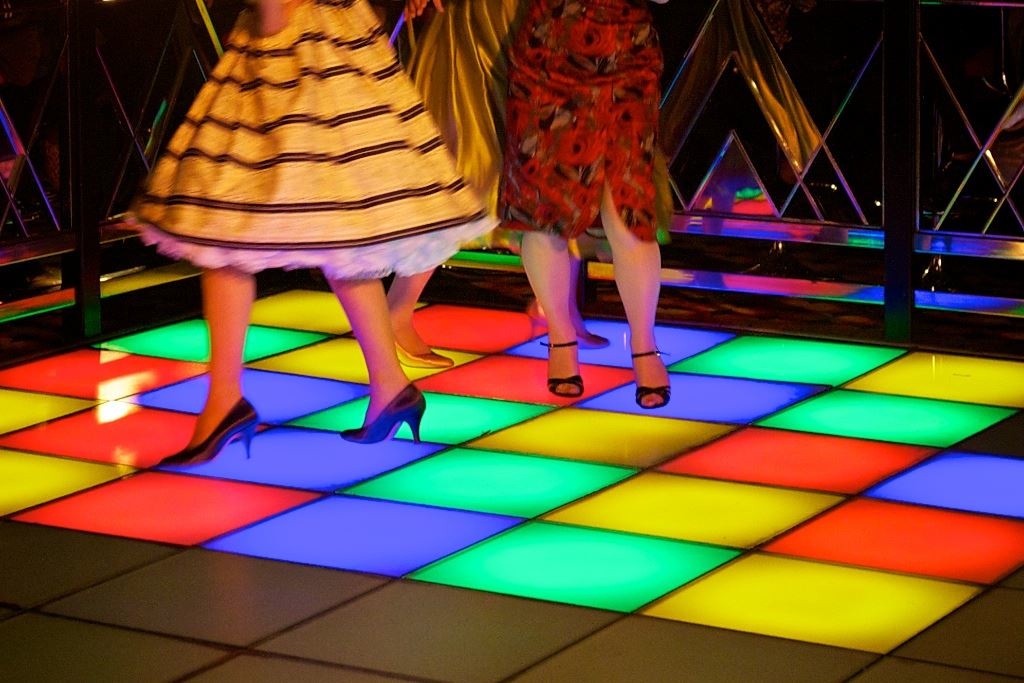
At the bottom of West Street, where it meets the blustery seafront, stands Oceana nightclub. Its capacity is two thousand plus, it is designed to look like an ocean liner, and it boasts a whole raft of differently themed spaces – the Tahiti Room, the Monte Carlo, the Boudoir, the New York Disco, the Reykjavik Icehouse. Visit the whole world in one night, as the publicity says. On this particular night, the venue is host to Our Dancing Feet, a multi-discipline site-responsive project from Zap Arts and Inroad Productions, featuring a cast of fifty professional and community performers and artists. The production includes a video mapping piece by Shared Space and Light, sited outdoors at the Clocktower, where the audience start their journey; an interactive installation piece by sound artist Thor McIntyre Burnie, sited in a bar at Oceania, linked by screen to a secret location inside the building, on which the audience can see a quartet of performers improvising to the audience’s instructions; and Our Dancing Feet itself, a promenade theatre piece that takes its audience on a journey through the venue’s many spaces.

Our Dancing Feet is based on a written script by Sara Clifford – a play, no less! In the hands of director Terry O’Donovan and the rest of the creative team, it is taken not from page to stage but from page to staircase, table, toilet, bar, dancefloor and corridor. Referencing the glory days of the Regent Dancehall, the audience are taken from the original site of the Regent (now a branch of Boots by the Clocktower in Brighton – where the video mapping piece is projected, reflecting on the site’s former life as a dancehall) down West Street (the site for street performances staged and unstaged) to Oceania, and are then led through the labyrinth that is this modern nightclub – hopefully appreciating the contrast between the setting of the play (1953, on the eve of Queen Elizabeth’s coronation) and the slightly tawdry bling and pizzazz of this contemporary successor to the dancehalls of yore.
Our Dancing Feet on West Street. Photo Ray Gibson

Our Dancing Feet, West Street, Brighton. Photo Ray Gibson

As one of the creative team involved in the production – and thus needing to get myself into place before the arrival of one of the split groups of audience members, or to usher community performers from one scene to the next down hidden staircases – my experience of the show is by necessity a fragmented one. Most of the time I feel like a rather large and clunky mouse, taking off my clippy-cloppy dance shoes so I can creep along a corridor below a scene on a staircase, not only unseen but also unheard. Ah, yes moving around unheard – there’s the rub. At the beginning of the show, I need to take a group of twenty young performers from their slot doing small street theatre vignettes on aformentioned West Street into the building and downstairs for their first scene in the Disco. During the dress rehearsal, they understand the not-being-seen part of the process, but as soon as they are out of sight of the audience, the whispering and throat-clearing starts – and as we head down the hidden staircase at the back of the building, the shoes clomp merrily down… Lesson number one in promenade performance: how to get around the building not only wearing an invisibility cloak but also silent as the night. By opening night, they’ve got it – quiet as mice.

I remember years ago interviewing Punchdrunk when they had just made Faust and were about to start work on The Masque of the Red Death. What’s the first thing you’ll do? I ask. ‘Play hide-and-seek throughout the building, in the dark’ says director Felix Barrett. Punchdrunk are current leaders of the promenade pack, having made their reputation on large-scale site-responsive performance. They’ve previously worked in many different ways: in outdoor and indoor performance; in street arts and in collaboration with the ENO; and in their site-responsive promenade work have played with small-scale intimate work like The Yellow Wallpaper through to their famous large-scale extravaganzas such as current success The Drowned Man. The format that they’ve used for many of their best-known works is to create an environment through which the audience promenade at their own pace, choosing to be diverted by performance scenes, or to loiter in empty rooms or corridors, investigating the installation pieces created in each space. Audience members are issued with masks which they are instructed to wear at all times – the troupe of masked people being thus distinguishable from the actor-dancers, but also becoming part of the scene – like a group of ghosts observing the action. The masks theoretically stop people nattering to friends, taking on board that they are part of a mise-en-scene, although that isn’t always the case. Punchdrunk’s work creates a setting where the ‘promenade’ is of the audience’s own choosing. There are always many different possibilities: to stay and witness a scene or to walk away in search of the next one; to move away from the action into the quieter corners, or to hot-tail after a chosen character to see where their journey takes us. Not only is the narrative fragmented, but it is also not deemed necessary to piece it all together. Two or three friends going their separate ways will find at the end of a show that their journeys have been radically different. For many people, this is a huge part of the appeal – the ‘Oh but didn’t you go through the fireplace into the hidden room?’ syndrome. Further to this, Punchdrunk often set up secondary performances within the show, to be discovered by some but not all audience members; or create real-life gaming challenges in which solutions to quests are informed by interaction with a linked website. For these and all sorts of other reasons, Punchdrunk’s work has broken out of the theatre ghetto and into the mainstream, bringing the notion of site-responsive and promenade performance into the public consciousness.
Dreamthinkspeak Before I Sleep

Dreamthinkspeak – Before I Sleep

Meanwhile, back at the arthouse, dreamthinkspeak have set up a contrasting example of the promenade form. Although they have experimented with other ways and means, their most commonly-used format is for a character (or characters) to welcome the audience into an opening scene, then to set the audience loose without a human guide, but for the space and the route through it to be very carefully orchestrated and manipulated – with sound and light playing a key part in drawing audiences through the space. In works like Don’t Look Back, Underground and Before I Sleep, we find ourselves drawn deeper in and further down by the sound of a violin playing around the corner, a muttering of voices, or a flickering of lights. Often we encounter performers behind glass, or in dark corners, or speeding past us at a distance. The notion of the remains, the trace, the echo of human action is a common motif in dreamthinkspeak’s work: the half-eaten feast, the slammed door, the receding footsteps, the toys abandoned mid-game. Often, film is used to give further layering and echoing. We see characters that we’ve glimpsed in the distance in close up; or we see filmed scenes that inform scenes we’ve witnessed live. Dreamthinkspeak have mastered the art of audience manipulation (in the best sense of that word). We find our way through the site, loitering at will, yet never feeling hurried – and we get a complete experience, the whole performance text, so to speak.

Promenade performance – partly due to the success of Punchdrunk, dreamthinkspeak, and other companies – has become increasingly popular over recent years. Why? No doubt there are many reasons, but surely one must be that with sitting down to focus on screens (computer, smartphone, tablet, game console, TV) taking up so much of our time, when we go out to play at the theatre, we don’t necessarily want or need to be sat on our behinds to be entertained…

Although we sometimes view the promenade theatre form as something fairly recent, those of us who’ve been around a while are aware that it has been steadily growing for decades. Pioneers of the form in the UK, such as The People Show and Geraldine Pilgrim, are still going strong. Geraldine Pilgrim’s most recent work is TOYNBEE. As Beccy Smith says in the opening to her Total Theatre review of the show: ‘Geraldine Pilgrim has been creating site-responsive performances and installations since long before Punchdrunk ever donned a mask or dreamthinkspeak first re-cast classic text into architectural form.’

Geraldine Pilgrim has previously made work in a many different extraordinary sites, from empty hotels to disused swimming baths and abandoned cigarette factories. In 2013, she was commissioned to create a work for Toynbee Studios, exploring the history of this philanthropic organisation and long-standing centre for arts, education and the promotion of social welfare. How to get the audience through the space is the biggest challenge of promenade performance, and in TOYNBEE a mix of modus operandi are used. At some points on the journey, ushers welcome us in or out of rooms. As the show progresses, each audience group is assigned a character from the show who appears at various crucial moments as that particular group’s guide, acting as a kind of liaison between audience, performers and space.

In Our Dancing Feet, a key element of the text of the play provides a natural solution to the problem of moving the audience around, at least for the first section of the show: there is a narrator character (Joan) looking back on her youth, and encountering her younger self (Joanie) – so it is an obvious and easy decision to have Joan draw the audience into her world and lead them through the space, encountering aspects of her earlier life brought to life by her memory. This device is used for the first 20 minutes of the production. When the audience arrive, they are discretely divided into groups and led off from a bar at staggered times, weaving through corridors and bars, meeting a bevy of characters who tell their dancehall stories through monologue, dialogue, visual tableaux, dance, or physical action. Through a frosted window we see a young women waltzing in slow motion on a tabletop. Beyond a glass door, a man in a glittering tuxedo dances a deconstructed mambo. Weaving through a crowded corridor comes a young man in an elegant suit, marking out a quickstep. Later in the production, the audience groups are brought together and one section of the audience encounters another group enjoying a dance class. The audience are later led by the voices of the main characters through a maze of corridors, toilets and back alleys in the darker recesses of the club, to then enter the main ‘ballroom’ enticed by a blaze of lights and the sound of jazz played by a live band. From here on in, the action moves around the enormous main space of Oceania, sometimes ‘onstage’ – that is, on the dancefloor – and sometimes by the bar, on the bandstand, or at the DJ booth. The audience are free to sit and stand where they like, and to move freely around to gain a new viewing point. In this final section of the show, the audience are ‘led’ from scene to scene by the shifts in location of the actors, helped by a sound and lighting design that moves the attention to the relevant place in this cavernous space.
Dante or Die I Do

Dante or Die – I Do

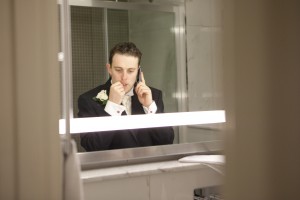
When we think of promenade work, we often imagine this type of larger-scale work, leading an audience through a labyrinth of spaces, and negotiating the demands of a big site – but the form also lends itself to more intimate encounters. Terry O’Donovan, director of Our Dancing Feet, is also founder/co-director of Dante or Die, whose promenade show I Do is soon (February–March 2014) will return to the Almeida in London, where it premiered in July 2013. Or at least, the show is presented by Almeida – it is actually sited in a hotel, and tells six different interwoven stories about the dawn of a wedding day, viewed in six different hotel bedrooms. It’s a very cleverly managed piece of work. The six scenes could be thought of six short stories in one volume. Each is intertextual with the other; each fills in gaps of knowledge that arise in other stories. Yet each is its own complete tale told well, presenting the perspective on the day of one character or group of characters. Thus we meet (the order depending on what wedding usher we are assigned to): the neurotic mother of the bride; a very nervous best man (O’Donovan himself, on brilliant comic form); the hilariously hung-over bride and bridesmaids; an angst-ridden groom having second thoughts; the elderly grandparents tussling with the complications of wheelchairs and easing stroke-bound limbs into dress shirts; and the Matron of Honour behaving not so honourably in a secret tryst in the bridal bedroom. Because each story is complete in itself, they can be presented in any order – and it is a sign of how well the show works that everyone who sees it is convinced that the order of scenes they witnessed is the right one! The stories are not only told concurrently, but are intended to be viewed as happening in the same 15-minute time-slot. So as we leave each room, we encounter a hotel chambermaid cleaning the corridors, and then see her moving back in time – iPod playing her music backwards as she reverses down the hall. A very clever note! I Do is now in its second successful year – I saw it in October 2013 in a hotel in Reading as part of the Sitelines Festival, an annual event dedicated to off-site and site-responsive performance work.
Touched Theatre Blue

Touched Theatre – Blue

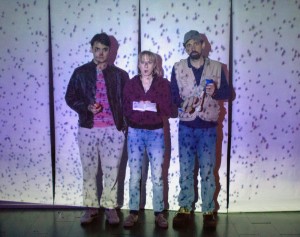
Also on the smaller scale is Touched Theatre’s Blue, which is a promenade piece staged in a succession of small rooms (these could perhaps be the smaller spaces and out-of-bounds areas of a theatre). At the Suspense Festival (London, November 2013), the work is presented in a series of usually unused basement spaces. Reflecting on Blue gives an opportunity to flag up that although much promenade work is specific to a certain site, it is the ‘promenade’ aspect that is the key element in Blue, not the specificity of the site. The show is adapted to each site but unlike, say, I Do (which needs to be set in a hotel) or Our Dancing Feet (which needs to be sited in a dancehall or nightclub) – Blue can be performed in any succession of small rooms. The content of the piece is distinct to the site: within the show, there is the construct that we are in a bar, or a fisherman’s cottage by the sea, or in someone’s kitchen. In this sense, the piece is closer to conventionally staged theatre in that we suspend disbelief about our surroundings and allow ourselves to be taken someplace else. Why then make it as a promenade piece? It’s a show about displacement, about being ‘lost’ and the constant upping and moving of the audience creates an ambience of actual transition that echoes the perceived experience of the absent main character – a missing girl. Ultimately, the show is less about her than it is about the people she leaves behind – which of course is always the case when someone is gone to us. They remain as an echo, a series of memories, an impression – there is no knowing what they actually think or feel themselves, or even if they are still able to think and feel. On a practical note, the audience is moved through the space by the characters, with elements of puppetry, film and sound (with an ingenious device of the soundscape emanating from a series of little boxes set up in each room) adding crucial extra layers of imagery and resonance to the text of the piece. Touched will be re-touring Blue in autumn 2014.

Meanwhile, Our Dancing Feet dances on – the second phase of the project is now (February 2014) in process, at the Winter Garden in Eastbourne. It’s a very different venue to Oceana – instead of a contemporary nightclub we have a splendid old building with a long history, replete with not one but two functioning ballrooms, a gilded and flock-wallpapered foyer, and numerous adjoining rooms, corridors and staircases – how the show gets reworked into this space is yet to be seen, and what the audience’s journey will be is yet to be discovered…


Our Dancing Feet was performed at Oceana, Brighton on 15, 16 & 17 November 2013. Written and conceived by Sara Clifford, directed by Terry O’Donovan, designed by Lucy Bradridge, choreography by Dorothy Max Prior. Produced by Veronica Stephens for Zap Art and Sara Clifford for Inroads Productions, in partnership with The Ragroof Players, Shared Space and Light, and Thor McIntyre Burnie. Additional street performances on West Street Brighton by performing arts students from City College, Brighton. Our Dancing Feet next  plays at The Winter Garden Eastbourne on Saturday 22 March 7.30pm and Sunday 23 March 1pm & 6pm. The show is free but ticketed. To book please call the Box Office on 01323 412000 or email boxoffice@eastbourne.gov.uk. See the project website here.

Dante or Die’s I Do will be performed 26 Feb – 9 March at Hilton Docklands Riverside Hotel, tickets via www.almeida.co.uk

For more on Touched Theatre’s tour of Blue, and the opening of their latest show, Faust [redacted], a new adaptation of Dr Faustus, presented at the Little Angel Theatre 16 & 17 March 2014, see the company website.

Punchdrunk’s The Drowned Man: a Hollywood Fable, supported by the National Theatre, continues its London run until 6 April 2014. For dates and to purchase tickets, see here. For more about the company, visit www.punchdrunk.com

For more on dreamthinkspeak, visit the company’s website.

For information on Geraldine Pilgrim’s TOYNBEE and other work, see here.