Why would Liz Aggiss premiere her new show Crone Alone in a former miners’ welfare institute in a remote part of Northumberland? Creative producer Lisa Wolfe explains what The Tute has that bigger and better-funded venues in the UK lack.
“I never in a million years thought I would have my own space,” says dancer and performance maker Esther Huss. We’re sitting together in that space; an ex-miners’ welfare institute called The Tute, on a street facing the disused railway line that blocks access to the sea.
This is Cambois (pronounced Cammus) an isolated former mining village on the southeast coast of wild and beautiful Northumberland.
Esther moved here in 2019 with her now-husband, playwright Alex Oates, not knowing anyone. He has family in nearby Whitley Bay, but for Esther this was a leap of faith. “People are very open here,” she says, “but it was lonely. I started with the feeling “today I am going to make a friend’”. That’s a hard enough task at primary school; in your early forties, and coming from a vibrant arts scene in London, it must have been hugely daunting. It was the space that spoke to them first.
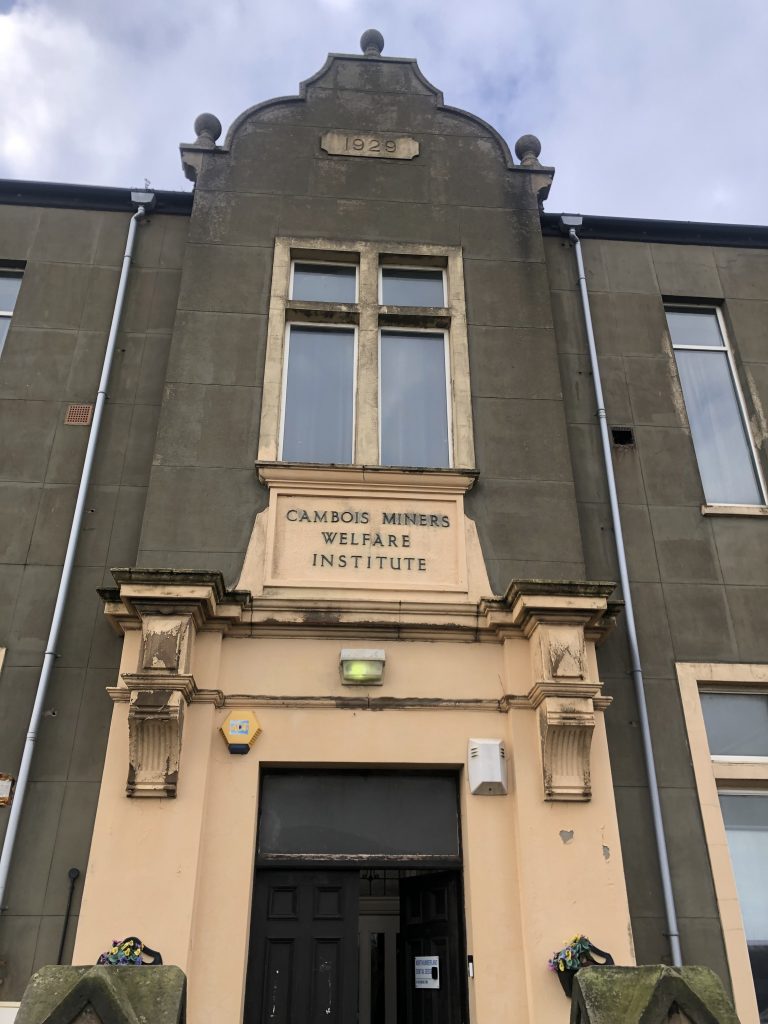
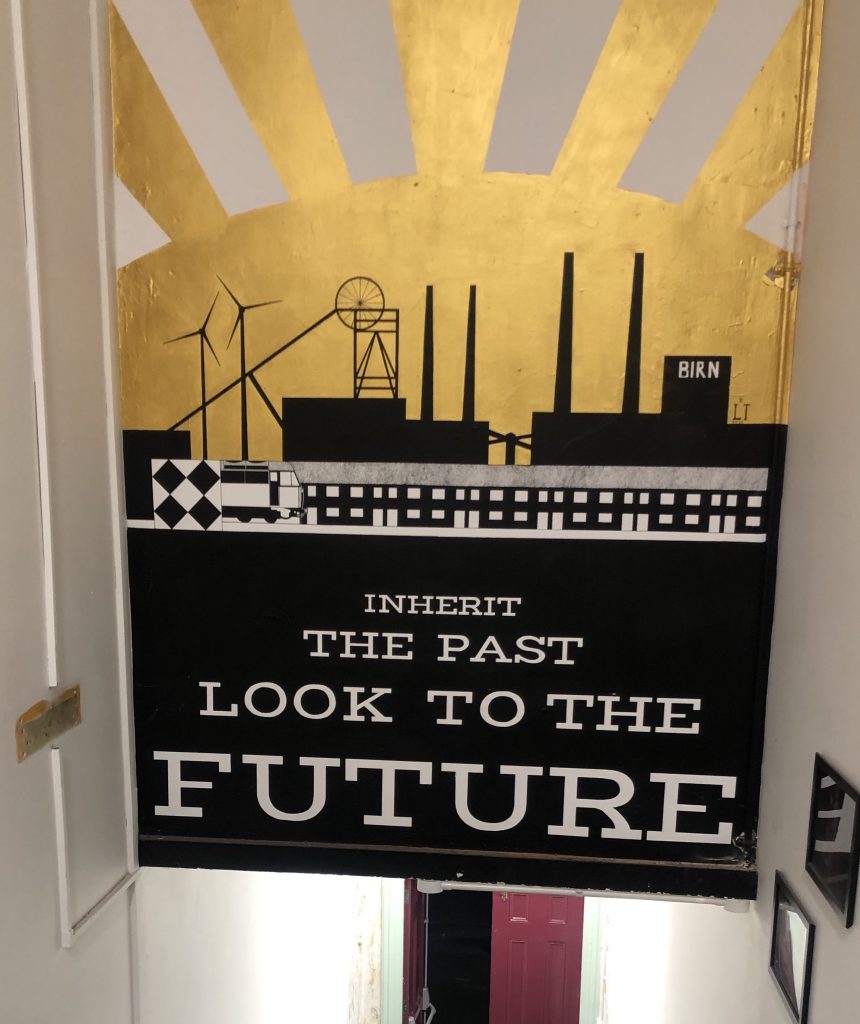
Built in 1929, with a decorative barrel roof, wooden floor and curious side rooms, its rough and readiness was instantly welcoming. Prior to the pit closures it hosted brass bands, film nights and no doubt some fiery union meetings. Esther began using it as a rehearsal space for her own commissioned work and fell in love with the building and the potential it held. She started a dance group, and Alex a writing group, putting leaflets through doors. Slowly interest built in what they were offering, and people began to come.
For Alex, the impetus was partly frustration at a lack of vision from the large regional organisations whose remit, and funding, is to work with communities. Cambois seemed ignored, as were his approaches for a conversation. For the first three years they raised money through community funds, working unpaid, until they could register as a charity and begin to broaden their options. Somewhat inevitably the landlord put the rent up, and raised the asking price for the lease, but the financial position, while still precarious, is at least more stable.
Five years of hard graft – and two children – later, between them Esther and Alex have not only made friends, they have also built a strong participant base for dance, writing and art classes and a children’s playgroup. They take work into schools and connect with local groups and businesses when opportunities arise.
The Tute’s most ambitious undertaking is the Rude Health Festival which they launched in 2024, tag-line ‘Because Creativity is Healthy’. Over two months the Festival embraces all genres of the arts, mixing classes with performances and films, with multi-cultural events indoors and in the landscape. Esther and Alex programme artists whose work they admire; those who create with integrity and who they know will surprise, delight and quite possibly challenge the audience. It’s this holding tight to their principles that sets The Tute apart, and is why I’m here this weekend, getting a full blast of Northumberland weather, art and hospitality.
I’m here with Liz Aggiss for the premiere of her new show, Crone Alone; which came with a related workshop, and a film screening…
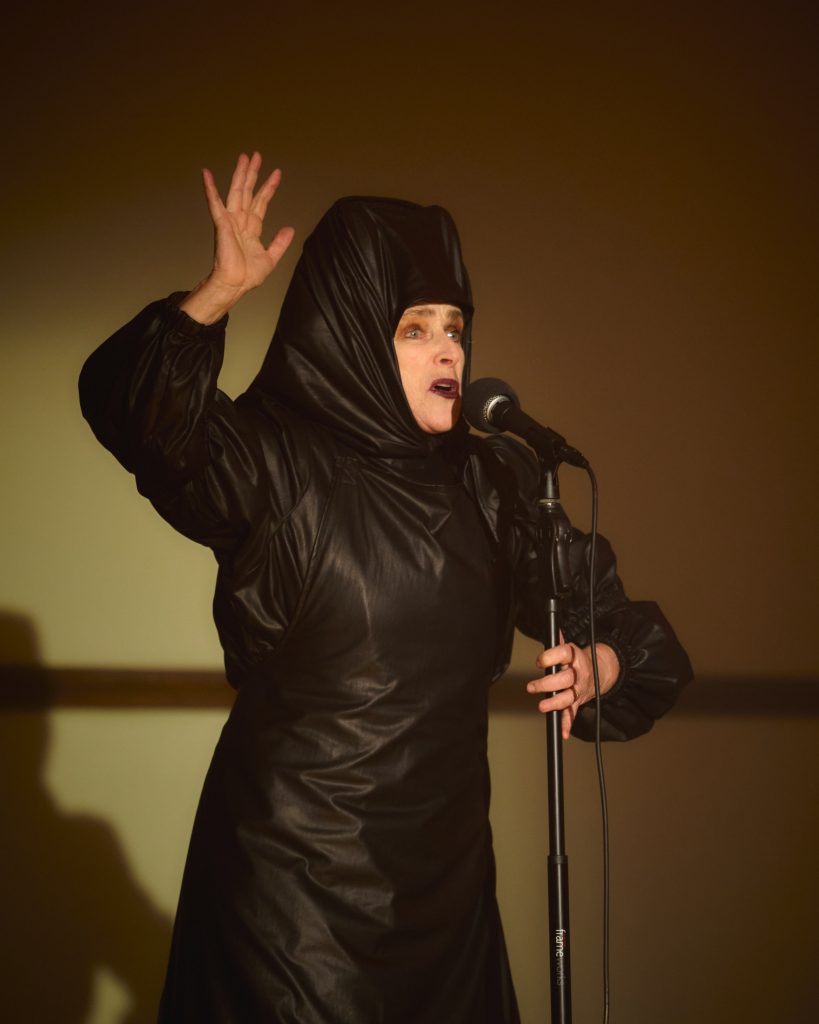
In 2019 the supernova of avant-garde dance Liz Aggiss performed an excerpt of her first new show since 2016’s internationally acclaimed Slap and Tickle.
Programmed by Sadler’s Wells Elixir Festival, which celebrates ‘the artistry of the older dancer’ her persona in Crone Alone was described as “charismatic to the point of perplexing” by Matthew Paluch, in his SeeingDance review. It took another five years, and much re-working, for her to show it again, presented as a work-in-progress at South East Dance in Brighton, in August 2025.
Given the demand for her work from promoters and festivals across the globe, how exactly, and why, particularly, has she chosen to premiere the new, full version here, at The Tute, in a place with no shop, no post-office, no café, no library, no doctor and barely a bus?
“I knew I was going to love it just talking with Esther,” says Liz. She had read about her and The Tute in a 2023 Guardian article and got in touch. Over a long career latterly defined by relentless touring, Aggiss had no desire to pitch Crone Alone to the vagaries of the current venue and festivals circuit. The ethos and ballsiness of Esther and Alex appealed to her; the idea of playing to an audience that doesn’t know her or what to expect, of fitting herself and the show into the opposite of a black box theatre humming with technology.
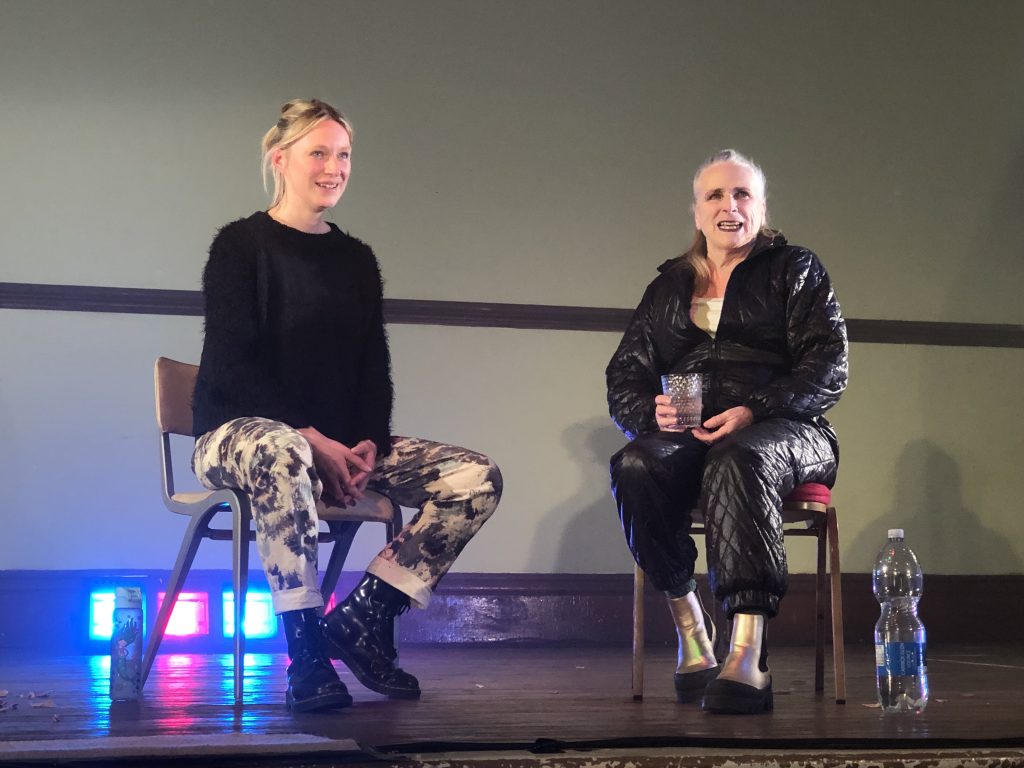
They talked, and Esther was clear that Liz needed to come for a week, stay locally, mix with the community, and run a workshop for the regular dance group.
She would also co-host an evening of short films, Women, Dance and The Sea, by female artists, including one by Esther and Katja Roberts filmed on Cambois sands; and the Liz Aggiss and Joe Murray 2011 classic Beach Party Animal. Finally, she would perform Crone Alone.

In her programme note Liz says: “I’ve missed the delight in sharing, communicating and revelling in performance. So I thank The Tute for shoving me back in the limelight and giving me the opportunity to reconnect with my former self… and to bring this work to a new and equally unsuspecting audience.”
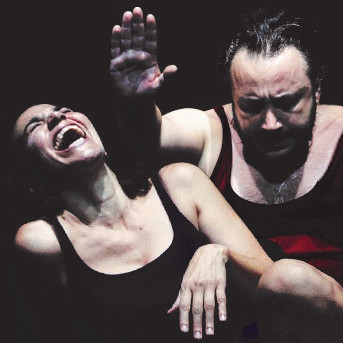
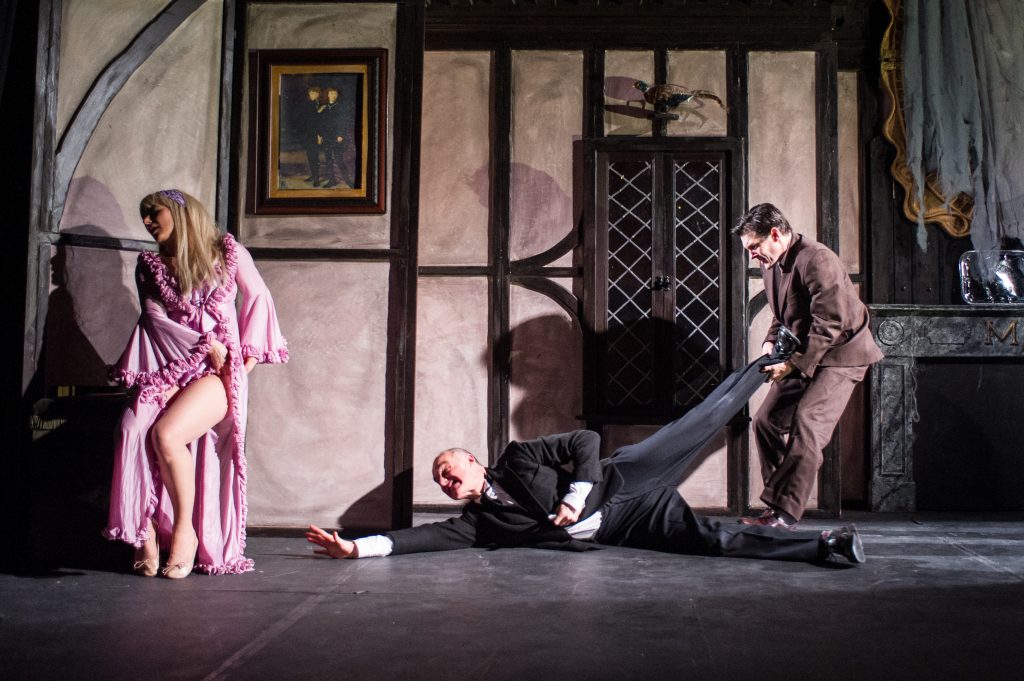
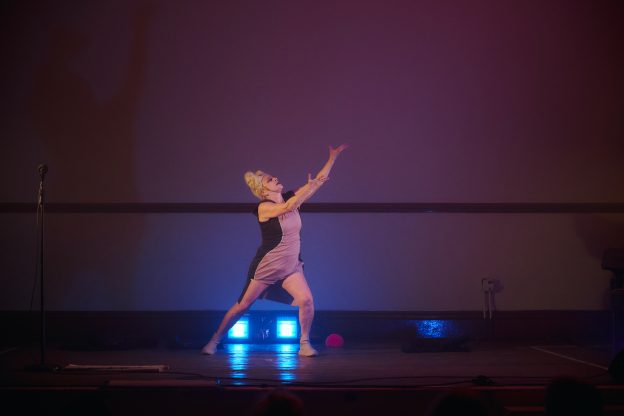
With its intricately constructed mix of music-hall tropes, personal revelations, elegantly wrought choreography, and wondrous costume reveals, Crone Alone astounds and delights this rookie audience. An instantaneous standing ovation is the only possible response. The piece poses a question about individual and collective value and worth, in life and in the arts, that resonates with everyone present.
With their determination that visiting artists dig in and get to know the area and the people, Esther and Alex are enriching the lives of this community and proving that culture really can lift people beyond their expectations. “There’s a lot of people that have been on a real journey with us,” says Esther. “They begin feeling ‘do I have place here? What is this?’ and now regularly come back.”
Becca Sproat was their first volunteer, having got in touch after spending 16 months at home during lockdown. “She’s our pillar,” says Esther, “she comes to everything and is in all of our groups, completely out of her comfort zone a lot of time”. Even more gratifying is that Becca’s family has started to attend events too – and it’s this gradual process of acceptance and personal development that fuels The Tute team.
This year’s Rude Health Festival culminates with a scratch performance of From The Sea, a new play by Alex featuring the stories of people with lived experience of asylum seeking, directed by Amy Golding. He’s tentative about how it will be received: Cambois sits in within the district of Blyth, a Reform stronghold. Strong anti-immigrant rhetoric is prevalent throughout the community, from the school-gates to the Cambois Club bar. With their children growing up here, the couple are taking every opportunity to try and open conversations that counter prejudice.
That’s why Rude Health includes artists from diverse backgrounds such as Yuvel Soria, whose work explores his Bolivian culture, and the Indian Kuchipudi dance of Payal Ramchamdani, both based in Newcastle.
In Crone Alone Liz has a catchphrase “just try and stop me” and it applies equally to her own thirst to create and perform as it does to The Tute’s power couple. When the national arts news is dominated by headlines about institutional mismanagement and lack of engagement, when the Chancellor’s latest budget shows zero interest let alone support for the creative industries, when theatres are closing almost as fast as pubs, isn’t it time for a new, nimble, artist-led model? For The Tute to go from an empty, forgotten space to a finalist in the 2025 North East Culture Awards (Best Museum or Cultural Venue) is a well-deserved accolade.
The pits closed in 1968, the railway three years earlier. Rows of terraced houses were demolished and not replaced. Companies promising growth and investment move into the area but don’t deliver; battery manufacturer Britishvolt notoriously went bust after two years. A massive QTS data campus is planned for the area, offering some sponsorship but few jobs.
Meanwhile, two artists are bringing together a network of colleagues and big gang of supporters, making and sharing some of the best creative experiences in the country. So let’s toot a horn for the Alex and Esther’s of the world, the artists who join them and the communities that get involved. It is they who, with grace, imagination, ingenuity and grit, enrich all our lives.
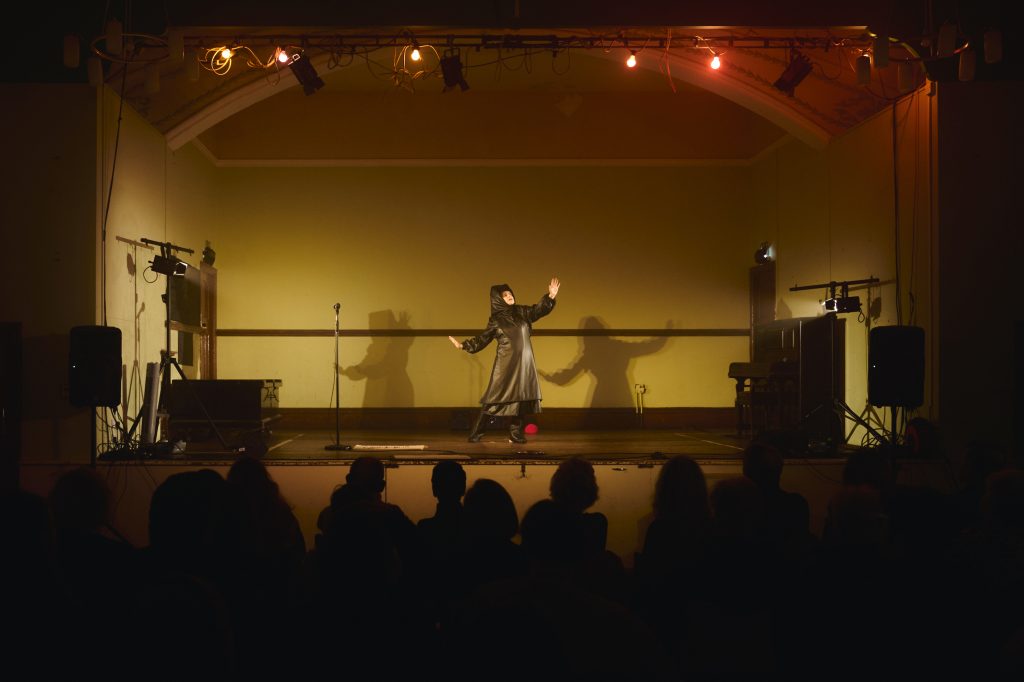
Featured image (top): Liz Aggiss: Crone Alone at the Tute, December 2025. Photo Luke Waddington.
The Tute is a hub of creativity located in an old miners’ welfare institute in the heart of Cambois, a coastal community in Southeast Northumberland. From this atmospheric space, The Tute is gently transforming Cambois and fostering social growth for the better. It is recognised that this area is at a turning point, and there is a growing need for meaningful engagement to support the changes ahead. The Tute’s goal is to build empathy, alleviate social isolation, and enhance aspirations through the arts. https://thetute.uk/ Facebook: @TheTuteCambois | Instagram: @thetute_cambois
Liz Aggiss is a Brighton-based, award-winning performer, director, choreographer and writer. For the past 45 years she has been re(de)fining her own brand of contemporary dance performance, dodging categorisation and being classified as unclassifiable. Blurring the boundaries between high art and popular culture, she makes uncompromising, challenging, feminist work. www.lizaggiss.com
Crone Alone has been programmed for Brighton Festival 2026. Dates tbc – see updates on the website. The Festival runs Saturday 2 May till Monday 25 May: www.brightonfestival.org