Author Archives: Lisa Wolfe

Lisa Wolfe

About Lisa Wolfe

Lisa Wolfe is a freelance theatre producer and project manager of contemporary small-scale work. Companies and people she has supported include: Thirunarayan Productions, A&E Comedy, Three Score Dance, Pocket Epics, Jennifer Irons, Tim Crouch, Liz Aggiss, Sue MacLaine, Spymonkey and many more. Lisa was Marketing Manager at Brighton Dome and Festival (1989-2001) and has also worked for South East Dance, Chichester Festival Theatre and learning disability arts charity Carousel. She is an occasional performer and installation maker in collaboration with other artists, and is a Trustee at Brighton Open Air Theatre.

Old Dears Marcia Farquar. Photo Peter Chrisp

Old Dears: A Final Fling for Sacred 2015

Dear Diary: Lisa Wolfe reports on a weekend spent in the company of  a feisty bunch of Old Dears at Chelsea Theatre, the culminating event of Sacred 2015

 Friday 27 November 8pm

Batten down the hatches – we’re entering choppy waters. Old Dears, a weekend of radical feminist performance by an older generation of women, is fittingly launched by The English Channel, in which Liz Aggiss conjures archive dance into the present and gives the older female artist permission to please herself on stage.

It is the perfect starting point from which to celebrate mature women who will not, or cannot, pull the plug on their experimental and challenging work; and to reflect on the state of play between Live Art and feminism.
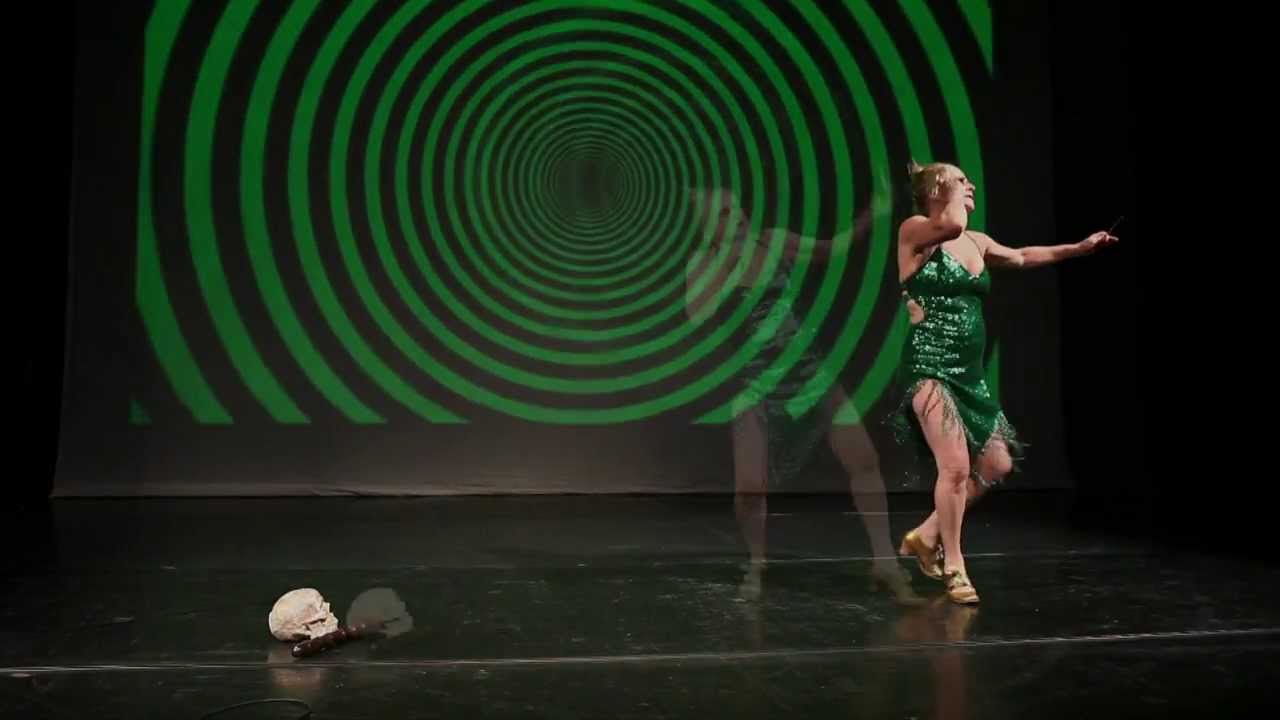
 

Liz Aggiss: The English Channel

Liz Aggiss: The English Channel. Photo Joe Murray


 Friday 9pm

After a good old Essex knees-up on stage with Liz, the audience settles to watch a short compilation of seminal films from the Live Art Development Agency (LADA) archive.

The screening encapsulates the breadth of work gathered under the Live Art banner: video works, performance, installation, and body-based art – artists finding the form to best express the idea.

When Lois Weaver’s alter-ego Tammy WhyNot asks older people at a care home in Poland about their sex lives, the most elderly and elegant woman states without a blink: ‘Women can have sex at 98 and men can’t, we are more than men.’ It’s as if she always knew this, never felt less… Francis Mezetti and Pauline Cummins spend a day as male alter-egos doing slightly errant acts in the back-streets of Dublin… The late Monica Ross leads the reading of the Universal Declaration of Human Rights, an international project that becomes more potent with each new reader… Bobby Baker (rendered a ghost by the mal-functioning projector), performs Spitting Mad, merrily making art from junk food, a flag to wave for better nutrition. We glimpse Anne Bean pouring honey into her open mouth…

 

Penny Arcade. Photo Steve Menendez

Penny Arcade. Photo Steve Menendez


Friday 10pm

For Susana Ventura, who takes the stage from the front row of seats, the medium is a life lived as Penny Arcade. Her autobiographical monologues The Girl Who Knew Too Much, and Longing Lasts Longer, the latter fresh from a three-week run at Soho Theatre, provide some of the material for tonight’s partly improvised show.

She is harsh and uncompromising one minute and brimming with compassion the next. In the only nod to stage-craft, instructions are barked at the lighting technician ‘Change the lights! Change them again!’ This playfulness succeeds, but a period spent in total darkness feels lazy; talking to herself, without us to riff against, the material weakens. When a phone goes off in the front row it sparks a fascinating section about caring for your elderly mother, funny and heartfelt.

I believe Penny when she says ‘I didn’t prepare anything, I didn’t see the point’ because I know, and she knows, that she can pull it out the bag. I don’t believe her when she says ‘You can’t break a Penny Arcade show, I don’t care enough’ because there are moments of truth and understanding here that demonstrate otherwise. Tonight these moments are rare, but enough to prove that she cares deeply about her art.
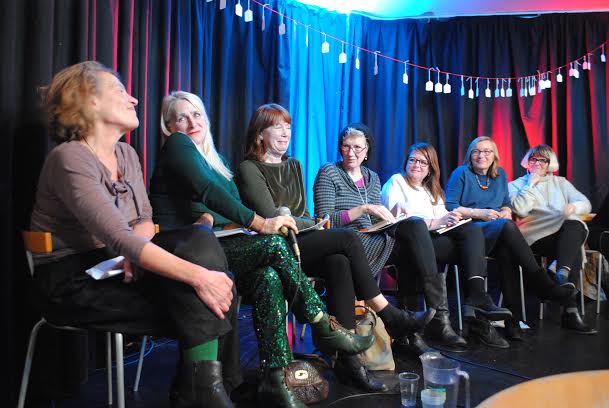
 

Old Dears panel discussion. Photo Peter Chrisp

Old Dears panel discussion. Photo Peter Chrisp


Saturday 27 November 6pm

At Saturday evening’s discussion, the panel is so weighty with the heavy-hitters of contemporary performance that it inevitably outruns its time-slot and denies the audience a contribution. The speakers are asked to reflect on the impact of feminism on their work.

The choices and potted histories are fascinating. Geraldine Pilgrim (Hesitate and Demonstrate) describes her early days in theatre, appalled at the opportunism of male producers. She is still combating sexism in academia today. For Judith Knight (ArtsAdmin) the Thatcher years heightened her political awareness.The roll call of women artists supported by her organisation is a glorious reminder of how far we have come. The writings of Helen Keller and Anne Frank obsessed a young Anne Bean, who wrote letters to her older self, understanding from early on that you contain your own future. Being described in 1986 by dance critic John Percival as having ‘a body as unconventional as it is unattractive’ did not deter Liz Aggiss from making uncompromising dance inspired by Hilde Holger and Valeska Gert. Lois Weaver, proud originator of Split Britches, reminds us that most large organisations are still run by men. We don’t get into pay differentials, religious subjugation or ingrained sexism in classrooms and societies around the world, but the undercurrent is there.

Central to all these reflections on lives spent making or supporting art, is the notion of an idea or passion that needs to be creatively realised and transmitted. If we are now in the fourth wave of feminism, we need, as Judith says, to recognise that young female artists are just as influential as these old dears, that they are strident and fearless too. Had the time-keeping been tighter, and the panel smaller, it would have been good to broaden out the debate and share our thoughts.
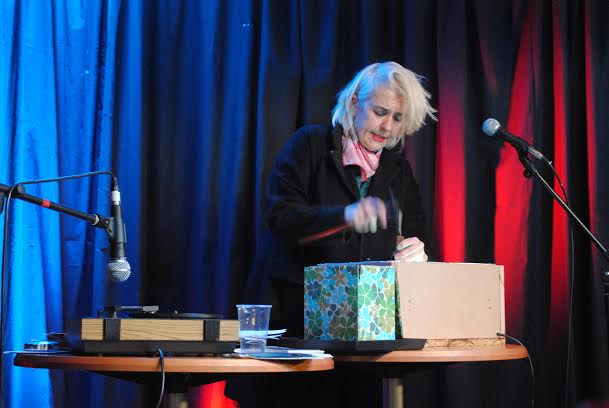
 

Marcia Farquar: Recalibrating Hope. Photo Peter Chrisp

Marcia Farquar: Recalibrating Hope. Photo Peter Chrisp


Saturday 7.30pm

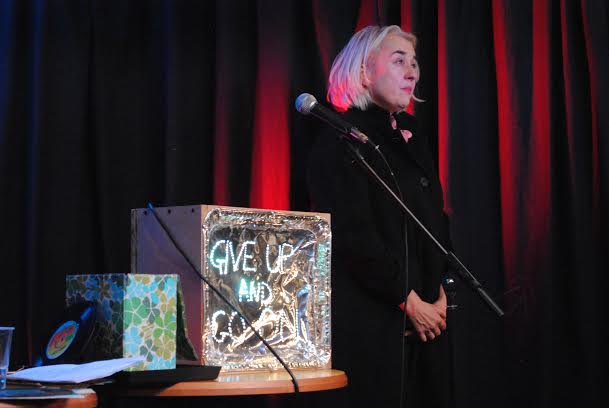
For her new piece, Recalibrating Hope: (h)old dear and let go, Marcia Farquhar has decided to think happy thoughts in her ‘dotage’, using her large collection of seven-inch singles as a spur to memory. She recalls the moment when she realised one could ‘wear lipstick and think at the same time’ or had to make a choice between reading about Camus’s suicide or eating a sandwich (a reference to a Helen Shapiro tune). But the happy thoughts are framed by sadder memories and by rage: her mother widowed at 41, in a pale lemon linen suit at her father’s funeral, his death rarely ever mentioned (Johnny Cash, Born to Lose.) Opinions are fired out: ‘We must remove the word “should” from the vocabulary’ and ‘I used to want to shout out “what’s the use?”’ As the recollections and anecdotes mount up (‘Every girl in Chelsea had 2.5 hamsters’) Marcia paints a vivid picture of her life as a misfit amongst the bohemians; an artist who found her way through force of will, pushing herself into the limelight and gaining the courage to perform. While the records spin, she is banging away on a tin-tray lightbox, or dancing sexy to Marc Bolan, or asking what music we want to hear. It’s an energetic, vital, hilarious hour, full of soul, and nailing what it was like to be a girl in Swinging London. The final record is God Save The Queen, (Sex Pistols) to which Marcia stands erect, her lightbox glowing with the message Give Up and Go On. Now that’s a freeing notion for all of us, regardless of age or gender.
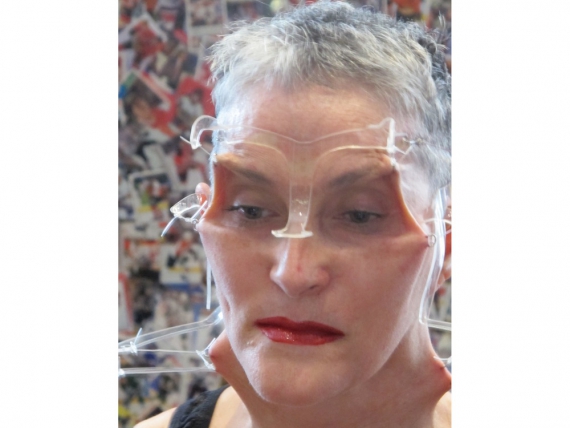
 

Rocio Boliver. Photo courtesy of the artist

Rocio Boliver. Photo courtesy of the artist


Saturday 9pm

Earlier, in the discussion panel, producer Nikki Milican observed that Live Art by older makers is not necessarily made as entertainment. That only holds true in the final performance of the weekend, Between Menopause and Old Age, Alternative Beauty. It is a showcase of work by a group of women who have spent a week with the influential Mexican artist Rocio Boliver.

Katherine Araniello guards the entrance to the space, her face a Fauvist painting, her expression severe. She is bit of a sweetie really, letting me pass with a wink. On the landing, two women are performing a version of Yoko Ono’s Cut Piece, slicing fabric from their unitards to reveal a breast here, a scar there. Similar in size, colouring and body shape, they are pleasantly symmetrical and tender to each other.

In the theatre, things take a darker turn. Pools of light frame women performing acts of subversive beautification; one with legs akimbo plucking her inner-thighs, another sewing hair onto a kipper, positioned as a vagina. On the floor, a naked form can be glimpsed wriggling inside a giant rubber tube and another woman straps herself to a chair with tape, falls, and repeats. In the corner a woman has a heart carved into her back with a scalpel. There are pomegranates. Rocio Boliver, spot-lit on a rostrum, is being strung with fishing line to transform her body shape. Only Helena Waters, as a Mexican wrestler-cum-gimp offers some audience interaction, climbing over seated bodies, inviting a slap on the bum. It is more exhibition than performance, and I struggle to find a personal connection to it, aesthetically, intellectually or emotionally – mainly aware that sharing work made after a week of intense immersion in ideas and issues takes courage. As I thank Katherine for allowing me to leave (with another wink) I know that these scenes will linger in my memory, they’ve made an impact.

Old Dears was the culmination of the final three-year tranche of LADA’s Restock, Reflect, Rethink investigation into live art and feminism (2013–2015). It also brought to a close Chelsea Theatre’s Sacred Season 2015.

From Penny Arcade passing down the wisdom of 47 years as a performer, Liz Aggiss and Marcia Farquhar putting a spin on youth and embracing the future, to Rocio Boliver and her colleagues challenging expectations of what the ageing female body can do and be, it’s been an interesting ride.
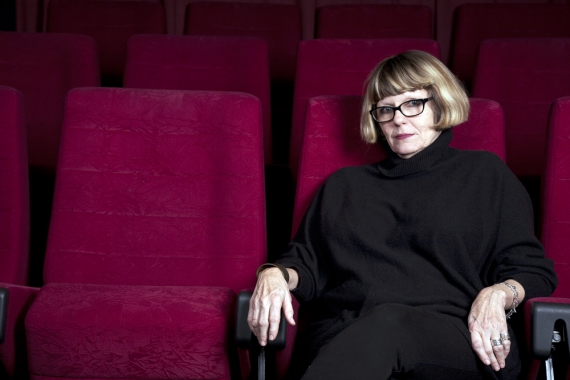
 

Lois Weaver. Photo Christa Holka

Lois Weaver. Photo Christa Holka


Featured image (top of page) is Marcia Farquar: Recalibrating Hope. Photo by Peter Chrisp.

Old Dears was presented at Chelsea Theatre 27 & 28 November 2015 as part of the Sacred Season: www.chelseatheatre.org.uk 

It was curated by the Live Art Development Agency (LADA): www.thisisliveart.co.uk 
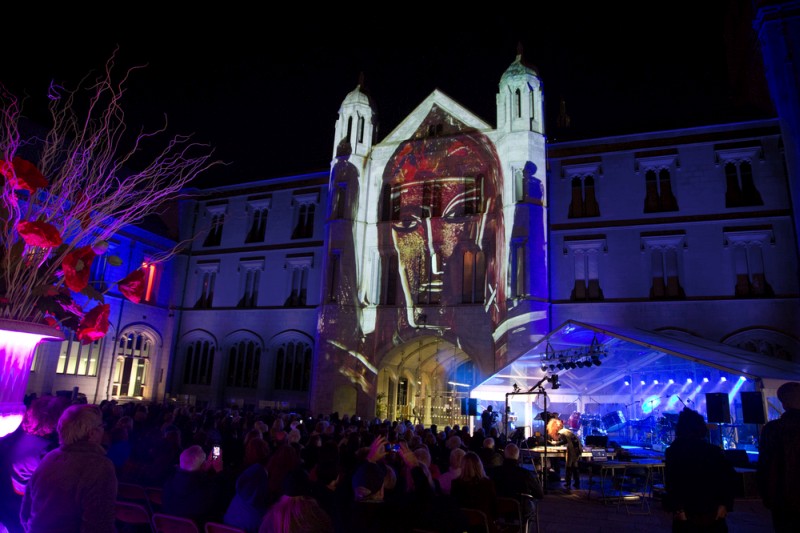
The AniMotion Show - Photo by Douglas Robertson

Maria Rud, Ross Ashton & Evelyn Glennie: The AniMotion Show

The AniMotion Show - Photo by Douglas RobertsonI was fortunate to catch the final twenty-five minutes of Aurora Nova’s large scale show in the ‘Hogwarts’ school quad. The location is superb. Tucked behind the vast gothic buildings, it is an enclosed square with a dominant tower and corner staircases heading spookily upwards.

There is a sense of awe and hush from the eighty or so people standing or sitting here. Some stroll about, others just stare. They are looking at an enormous colourful painting being projected onto the crenellated wall, textural and splashy, forming into human and animal shapes, becoming abstract, being swept or sponged away. The hands doing this belong to Russian artist Maria Rud who has a big smile and flaming red hair. Maria is responding to a percussive score being played by virtuoso musician Evelyn Glennie, who bounces around a large set of instruments with vigour and panache.

The imagery is very Russian and has a religious flavour. Is that Ivan The Terrible? It’s an illustrative style reminiscent of 1950s children’s books on ancient history, all earthy colours and patterning. The scenes are choreographed to fit the shape of the architecture by projection artist Ross Ashton.

The finale is a solo for gong, with Glennie on her knees in the centre of the façade, very slowly building up resonance as the painting swirls around and over her. The sound of the castle fireworks bounces off the quad walls as the gong gets louder and Maria works and reworks her final image.

AniMotion is a proper festival event; accessible, interesting, beautifully performed, and providing a good thump of emotional impact. You may only want to see it once, as the images, if not the music, are pretty exactly repeated each night, but you certainly won’t forget it.

Dreamthinkspeak - Absent - Photo by Johan Persson

Dreamthinkspeak: Absent

Dreamthinkspeak - Absent - Photo by Johan PerssonDreamthinkspeak has an international reputation for creating extraordinary immersive theatre installations and its latest production, Absent, is a welcome addition to its canon.

The experience begins before you enter the building. The transformation of the exterior of Shoreditch Town Hall into a hotel is so effective that I actually walked straight past it. Inspired by the life of the Duchess of Argyll, who lived in a luxury hotel until eventually evicted, the piece is a haunting exploration of loneliness, declining gentility and corporate greed.

The audience is free to wander a building in transition, filled with ghosts of the past and glimpses of the future.

Artistic Director Tristan Sharps has always been fascinated by architectural models and here they are a perfect fit for the subject. Absent is about a building changing from grand to functional and we are potential investors on a viewing.  The switches from macro to micro make sense. The Shoreditch Group’s profits are booming, room rates start at £60, the project will regenerate the area. It is grimly real. Just read the Evening Standard.

As in most of his work, Sharps plays here with scale and form, using film and false mirrors, inviting us through wardrobe doors into barren spaces, leaving clues of habitation. Here a bottle of Chantal perfume on a creaky shelf, its scent pervading the room, there a pile of Burmatex carpet tiles ready for laying. I felt like a forensic scientist investigating a missing person.

It is not a spoiler to say (as Sharps did on Radio 4) that there is a lack of physical presence in the piece. Had I known in advance, I would have spent more time observing the one live actress playing Margaret de Beaumont. Fortunately the filmed world is compelling and evocative, featuring a luminous performance by Marion Déprez.

Absent is a simpler piece to those of recent years but no less powerful. In The Beginning Was The End (2013), at Somerset House, inspired by Leonardo da Vinci, was playful and interactive, brightly lit and slightly scary. Before I Sleep, which I saw at the old Co-Op in Brighton, 2010, was a lavish and thrilling take on The Cherry Orchard with a cast of hundreds.  Whereas in those productions the building was a space in which to make the work, in Absent the building is the work. There are some familiar tropes – the bringing of ‘outside’ into this interior landscape, a child, a gentle sound-score, and the silent guides. If the scale is more of a novella than epic, it remains a beautifully executed experience.

On leaving, you can’t help but notice how pertinent the vision is, with gentrification all around. The former magistrates’ court and police station opposite is, guess what? A hotel.

Light, Ladd and Emberton - Caitlin - Photo by Warren Orchard

Light, Ladd and Emberton: Caitlin

Light, Ladd and Emberton - CaitlinThey give us the money shot early. Caitlin curled around Dylan’s head like a Welsh blanket. Is she suffocating him or shielding him from something? From himself perhaps, or more likely, from her. For while Dylan Thomas was a notorious boozer and womaniser, it is Caitlin’s wilder and less predictable spirit that we are here to witness.

Set in a circle of folding chairs, we are addressed as if at an AA meeting (Caitlin joined AA twenty years after Dylan’s death.) We hear snippets of their life together, how they met before he became a great writer, her ambition to be a dancer: ‘It was to be a truce, my body and his brains.’ Then the babies, how she followed him to London, to America. It’s not a direct narrative but more like remembered episodes, filtered through the lens of a hangover. Each nugget of biographical information is exploded physically in a fierce and passionate duet with chairs. As Caitlin, Eddie Ladd is fully convincing, raw, dynamic, and scary. Gwyn Emberton gives Dylan a sinuous quality. Words wriggle out of him like demons, as if his poetry is a curse. He later eats his words. He is not a happy soul.

This battle of wills crashes and burns around the space, chairs are flung and bruises shown like prizes. They pick up and knock down, pull and punch, roll and lift. The message comes through loud and clear – they are a dysfunctional couple and they are equals. The love between them struggles to rise above the lack of trust.

As the piece progresses there is little choreographic development and it becomes a relentless game of what one can do with a chair. There are brilliant moments – the pair yoked together through a chair, Dylan eating sweets off a tray – and the performances are exquisite. While this is the woman’s story – hurray – it felt to me that it would have been helpful to know more about their relationship. Caitlin asks the audience for money, but what if we don’t know that Dylan never sent her any? What about Dylan’s illnesses and their effect on her? Some further context would have enriched the piece. The final all-out battle to a demonstrative sound score by Thipaulsandra lacked impact because of all that had come before.

At twenty minutes this would be fantastically exciting dance. But Caitlin, rather like the woman herself, didn’t know when to stop.

Caroline Horton - Islands

Caroline Horton & Co: Islands

Caroline Horton - IslandsOh Mary, oh Eve, what alarming, degrading, furious role models you are for womankind. Ruling your shitty, filthy world, with your lack of morals and shifting affiliations, with your disorganised bodies, shallow greed and steel hearts. Who should I follow and what should I believe?

Caroline Horton’s ensemble show, which premiered in January, set the critical elite howling and some of the Bush audience spluttering out part-way through. It has since gathered deeper, more informed comment online. Coming to it now, with so much back-story, I was still unprepared for the force of the thing which from the moment of entry is a dystopian feast for the senses.

Mary (Caroline Horton) is a greedy, ambitious god who with her acolytes (John Biddle and Seirol Davies, trans-gender clad) wants to shit on Shitworld from her floating island, called Haven. The story is painted with a broad brush on a mucky canvas.  Nothing is subtle here, there is no subtext or interrogation of economics (despite the involvement of specialist advisors). What you see, hear, and smell is a playful, overblown, monstrous journey that takes in social climbing, stock market crashes, capitalism, and tax evasion.

The writing is over-explanatory at times, but there are some knock-out sequences featuring radio hosts and some great lines. I enjoyed a reference to ‘Ayn Rand on glockenspiel,’ the idea of God ‘watching porn and listening to the Archers’ and the notion that in Shitworld everything is made better by a cup of tea. As it rolled along, with coups and crashes, and play-acting and a sense of its own ridiculousness, Islands brought to mind Enda Walsh’s The Walworth Farce and Ubu Roi.

The cast goes at it with gusto and Hannah Ringham, as Eve, is the thumping heart of the piece. She offers an intense, emotional response to the alarming events unfolding around her. Eve and Adam (Simon Startin) both get flipped; lose their moral compass. Their degradation is quite sickening.

The visual world is perfectly realised by the design team and Elena Pena’s sound design is full of texture. The songs are less convincing. God feels the need to end on a big number, of course she does, but it didn’t quite hit the spot for me. The action moves around inside a square, neatly choreographed but a somewhat obscured from the second row of seats.

In essence, Islands sets up a crazed, anarchic playground for a very bitter, rather over-long, fairy tale. It lambasts religion and rails against corruption while shitting on the weak. If you go to it with an open mind, prepared to face its verbal and stylistic challenge, you will find the humour in it – as the actors so clearly do. Islands is as much a howl against bland theatre as against society.

Produced by Caroline Horton & Co, China Plate and the Bush Theatre