Author Archives: Dorothy Max Prior

Dorothy Max Prior

About Dorothy Max Prior

Dorothy Max Prior is the editor of Total Theatre Magazine, and is also a performer, writer, dramaturg and choreographer/director working in theatre, dance, installation and outdoor arts. Much of her work is sited in public spaces or in venues other than regular theatres. She also writes essays and stories, some of which are published and some of which languish in bottom drawers – and she teaches drama, dance and creative non-fiction writing. www.dorothymaxprior.com

Casus: Driftwood

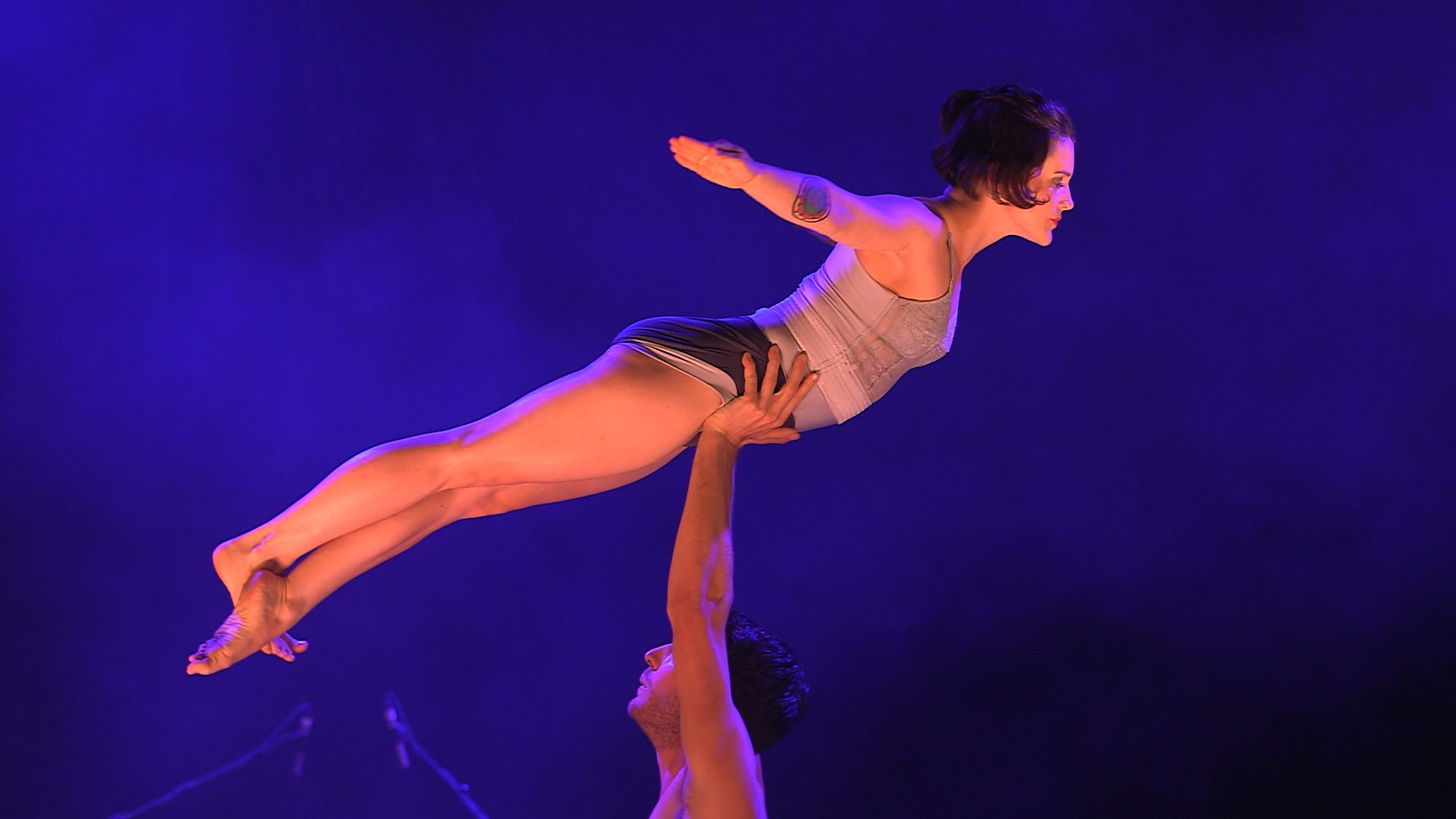
Five performers, two female, three male, walk through the audience, down the aisles, making their way onto the small, round stage in the centre of the Spiegeltent. They are dressed in a tasteful palette of maroon, stone, and dove-grey. A red pendant lamp hangs over the performance space and the five group around it – a beautiful oil painting. An ensemble acrobatics number explodes out of the huddle, in which the five bodies twist and tumble and form astonishing Chinese Puzzle shapes. Men and women base and fly. Three-person-high towers grow and fall as bodies scramble up and down other bodies. Pyramids are built with a body in backward-bridge position astonishingly holding the weight of others clambering on top of her. They organically morph from one shape and formation and cluster to another. What skill, what beauty. And my goodness these three-high shoulder stands look so extraordinarily high and frightening when you are just yards away from the performers – the pleasure of seeing circus work in the round, with everyone close to the action.

This opening section sets the bar for an hour of immense and awe-inspiring circus skills, elegantly packaged into a nicely designed show that sets out to investigate joy and intimacy. There is no narrative beyond the stories intrinsic to the scenes themselves, which have a very lovely gender-loose mobility, suggestion encounters between friends and encounters between lovers (of all sexes). The performers are the three (male) Casus co-founders Natano Faanano, Jesse Scott, and Lachlan Mcaulay, with two new female members of the ensemble, Abbey Church and Kali Retallack, joining them for the creation and presentation of Driftwood.

Skills-wise, the emphasis is on acrobatics/acrobalance. Equipment is used sparingly, although we do, along the way, get aerial hoop, hula hoop, trapeze, and rope. All, it goes without saying, are used with great skill and flair. The trapeze act sees an elegant alternating of singles and doubles work; in the hula-hoop act, two women and one man (and nice to see a man hooping!) act out a kind of joyful playground game. There is a gorgeous acrobalance routine between two of the men which plays on capture and release, with one placing his eyes over the other’s eyes as they cartwheel and tumble together. The women capture our attention with their ability to base and fly with equal assurance. Natano Faanano gives us outstanding strength and beauty when working in partnership with Abbey Church, in a choreography that seems to swing between acrobatics, martial arts, and ritual dance. He also allows himself the indulgence of a little bit of burlesque-ish mime, reminding us that he is also a co-founder and star of the boylesque Briefs company. He’s older than the others, and brings a gravitas to his work that I’ve always admired. The structure of the piece works, for the most part, although I find the placing of ’s corde lisse act a few minutes before the very end a little odd as it seems to interrupt the concluding rhythm of the show.

Scenography relies mostly on the bodies in space and the lighting: that pendant lamp is used in little interludes of whimsical physical comedy, between the major scenes.The lighting design is excellent – moving from low and moody, the red shade of the pendant the focus, to a whirligig of lights flashing a rainbow of colours off of the stained glass windows of the tent. The company work to an eclectic selection of music tracks that includes jazzy rhythm and blues, moody contemporary ballads, and whimsical waltzes.

Casus are the company that made the highly successful show Knee Deep – although their enterprising and inventive co-founder member Emma Serjeant has parted company with them, and is presenting her own show, Grace, at the Edinburgh Fringe 2016. Another sometime performer in Knee Deep is also in Edinburgh for August, with Perhaps Hope at Circus Hub.  Both of these productions are shows that aim to smudge the boundaries between circus and theatre; to push circus into something other than well-executed skills.

Driftwood is a clever creation that is elegantly designed, and beautifully performed. It is a highly tasteful and well-executed piece of new circus – but it pushes no boundaries. It is, however, great circus – and that is no doubt more than enough for the sold-out crowd of 400 punters at the Palace du Variete Spiegeltent, who were suitably wowed and stunned, and showed their appreciation with rapturous applause.


Lemon Bucket Orkestra: Counting Sheep

Please NOTE this performance contains: HAZE, GUNSHOTS & LOUD NOISES, FLASHING LIGHTS, FOOD THAT YOU MIGHT BE ALLERGIC TOO, AUDIENCE MOVEMENT, SHEEP.

Well, with a welcoming notice like that, you can’t help but be excited! What will happen? What will happen to us? As it turns out, we are the sheep.

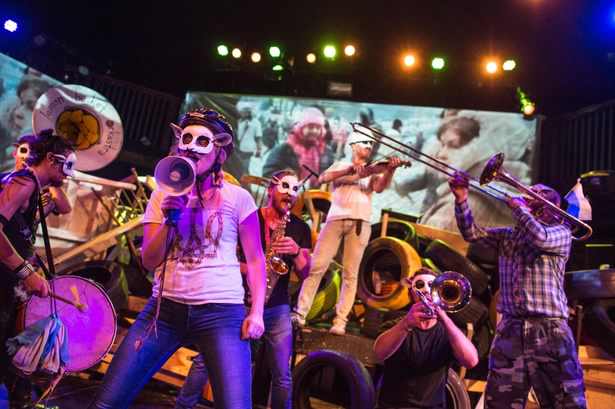
Right from the start the start, and all through the extraordinary, exhilarating, heartbreaking 90 minutes that follow, there is a dichotomy set up – a tussle between life and death. Glorious exuberant live music and the silence following a death. Wedding waltzes and the sound of a barrage of bullets battering the barricades. TV and YouTube footage of rioting crowds projected above the heads of audience members who sit at long dining tables laid with white linen cloths. There is drink; there is Ukranian food (on the menu tonight: a rather nice beetroot salad, and then dumplings with mushroom sauce); there is the opportunity to have a riot – a riot of your own.

As the 15-strong team of ‘guerrilla-folk party-punks’ from Kiev pull audience members up to dance a jolly mazurka or polka, chaos breaks out. Tables are trashed, tyres piled up into heaps. Facing us is a row of cops with riot shields.  We have bricks. On your marks, get set, throw…

The exuberant spirit of resistance is infectious. Onstage, onscreen, all around us we are bearing witness to the true-life stories of the performers and their friends – the protesters marching and demonstrating daily against the Ukranian president’s corruption and the Russian interference in their country – and we enjoy casting ourselves in the romantic role of fellow freedom fighters. Hard-hats on, hand-painted banners waved, a communication tower climbed and adorned with the blue and yellow flags of Ukraine. Meanwhile, the sheep-masked musicians playing a fabulous mix of folk / street / gypsy jazz on a variety of instruments – trombones, tubas, drums – and there is beautiful polyphonic choral singing. Bring it on, we’re with you.

Then it turns nasty – a protestor is killed. We see the TV footage of the real-life funeral projected onto the three enormous screens above, and live, weaving through us, we see the cortege of performers carrying a draped body through the space. The cortege halts. The mournful, soulful singing stops and there is total, absolute silence, other than the sound of a woman sobbing quietly. Without spoiling the surprise for anyone who goes to see the show, there is, breaking this silence, a genius moment of theatre…

On the screens above, we see the statistics reeled out. The hundreds of protestors who are killed, with official numbers far lower than unofficial estimates, yet still – even officially – in their hundreds. The statistic that cuts me to pieces is the average age of the dead. 24. The age of my youngest son. The terrible reality of events in Kiev in 2014 (and continuing – the war is not over) is hammered home. But this skilful theatre company does not send us home desolate and with open wounds; there is a rounding-off, a closure, a coming together in peace and harmony.

At every Edinburgh Fringe there is one show that you unequivocally tell anyone who asks that this is the show to see –this year, Counting Sheep is that show for me. A wonderful piece of immersive, interactive, politically engaged, and inspirational ‘total theatre’.


Yinka Kuitenbrouwer: One Hundred Homes

We are led to a wooden cabin at the rear of Summerhall, a wee building put together lovingly using a quirky assortment of new pine and found wood, like a little fairy-tale house in the woods. We are grateful to get out of the torrential rain. Somewhere to shelter; a temporary home.

Yinka has entered with us, as if it were her home, and she was bringing us in. Which it is, and she is. We are given tea in big metal mugs, and little biscuits shaped like houses. She tells us that her mother thinks that the biscuits don’t quite work, don’t really look like houses, but I think they do. Anyway, she has baked them and they are sweet and tasty. The rain hammers down. How good it is to have shelter, to have four walls and a roof to protect you, and some hot tea. She takes off her raincoat and sits down behind a table that is occupied just by a box of filing cards/photos and an old-school Sony Walkman cassette player and tapes. And the stories begin…

One Hundred Homes is, as you’d expect, a show about home and homes. A hundred people were visited and interviewed about their home, or lack of a home; their attitude to what ‘home’ means to them, to what makes a home.

Her interviewees include people who live in houses, people who live in flats, people who live on farms, people who live in vans, and people who live on  houseboats. There are people who live in grand houses, people who live in squats, and people who live on the streets. Some people have lived in the same house all their lives; some people move constantly through choice; and some have been forced to move, to flee war zones and seek refuge elsewhere. She interviews her own family, and she interviews old school friends. She interviews total strangers and old friends, in her home town of Ghent and in Amsterdam.

The performer’s mode is ‘storyteller’ rather than ‘verbatim’, although she does incorporate the actual words of her interviewees as and when it fits the dramaturgy of the piece. The stories are told in many and various ways – all engaging and inventive. Some are straightforward, some are gently deconstructed and rearranged. Sometimes Yinka recites lists – for example, of names (she says all 100, with hardly a pause for breath). She gives us lists of the types of food and drink she has been offered – tea here, coffee there. Beer here, Coca Cola there. Candies, cakes, even full-blown dinners. These lists are like litanies; a recurring motif.

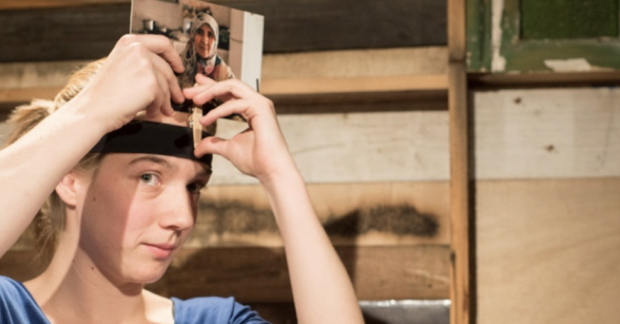
She turns her attention to the filing cards, and as she takes out each card, she places the photo with it onto the headband she wears – holding the image in place with a peg. It is lovely to see her taking on a token of each person’s identity in this way, as she reads their words, and tells us more about the encounter. The photos show us a couple in love, living together in harmony; a woman who has separated from her partner; a woman who has migrated from Turkey with her whole family; a young man (her own brother!) who lives with his parents but keeps all his belongings in a van; a middle-aged man who is a veteran squatter. All human life is here – men, women and children who started life in very many different places and have somehow all gravitated to the same geographical locations.

Not everyone has a photo. On one occasion, her interviewees plied her so generously with red wine over dinner that she was incapable of using her camera. On another occasion, she interviewed a heavily pregnant woman she met at a soup kitchen in a railway station. The woman went into labour. Yinka broke her self-imposed rules and followed up with a hospital visit to see mother and new born, and the woman’s two other children, safe and warm in a hospital room. She wears the baby’s hospital ID card on her headband. Two days later, the family had to leave. She has no idea where they went.

The joy in the piece is in witnessing the amazing range of human stories and responses encountered and retold. Some people live somewhere for decades and never feel at home. Others, like the couple from Iraq who have fled war, say that home is where their partner is; home is the people, not the place.

I enjoy the fact that the project is more than a theatre show – it is an ongoing art project, Yinka continuing to meet and interview people in every place she travels to. So we can expect Edinburgh to feature in a future incarnation of the work. I like the fact that we got one song, sung by an interviewee, played on the Walkman, but it would have been nice to hear a few more voices.

One Hundred Homes is a beautifully constructed piece of theatre from a young Belgian artist who has the ability to communicate directly with the audience, making everyone feel at home in her presence. Nice biscuits, too.


One Hundred Homes is presented at Summerhall as art of the Big in Belgium programme.

Natalie Reckert: Image – Selfie With Eggs

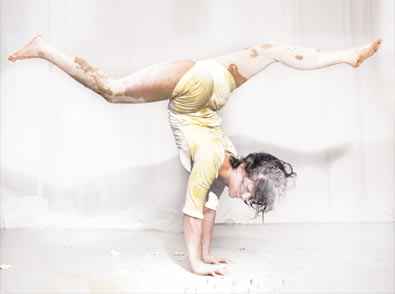
‘I am Natalie and I like to do handstands. When I do a handstand  I feel strong and straight as a rocket. When I do handstands people notice me.’

This is a show that features Natalie Reckert doing an endless number of handstands and hand-balances on canes, and is almost exclusively about Natalie doing handstands and balances: the whens, the why’s, the wherefores. It is this, and it is so much more – the ability to do a handstand, and to stay upside down for long times, is used as a push-up point from which to launch an autobiographical reflection on life as a physical performer / circus artist. Sometimes Natalie feels as strong as a rocket, but sometimes she feels as fragile as an egg. The eggs come out to play brown ones because, ‘ it is so hard to get white eggs here’, and there is a contest to find the strongest one; the egg that survives the balances and body-smashes. Here it is, the super-egg, in its place of honour. Ta-da!

Natalie noticed early in life that some things get attention. Throwing her ice cream out of her pram, for example. A little older, around the age of five, she learnt to do a handstand, her gym teacher holding up her legs. She demonstrates, without the teacher to steady her. She is straight and strong as a rocket. She liked the attention being good at handstands got her; she made a life’s work of it. She talks to us from all sorts of strange positions: upside down, balancing one-handed on the canes, twisted or curved around the equipment. Sometimes, she says, I am as supple as a piece of liquorice.

These sections of beautiful moves counter-balanced with her autobiographical reminiscences and reflections on the nature of physical performance are totally gripping. I also enjoy her object play with the balancing equipment, the eggs, a fan and confetti, and with the white tissue paper her balancing canes are wrapped in, which she calls ‘sandwich paper’, the words sounding endearing when delivered with her charming German accent. The word-free sections of electro-robotic dance and gestural movement motifs I like less – her dance choreography and execution is so much less than her circus skills, and the discrepancy makes for a slightly uneven performance, although I do find the vogueing moves amusing.

But for the most part, I love it. I love her, I love her story, I love her honesty and her self-exposure. The show’s title is appropriate – the whole show is a kind of selfie, a reflection on putting yourself in the centre of the picture. This is a funny, but also moving and thought-provoking, show about the choice to use your body as your art, your instrument.

Arts Printing House: Contemporary?

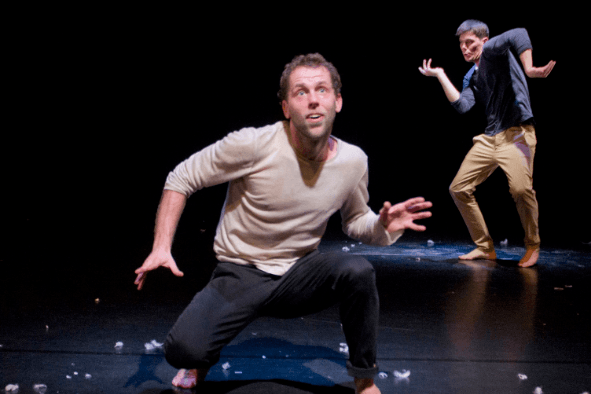
A phone rings; a warning to turn off our mobiles. Lights. Low, moody lights. Three bodies – two male and one female, in minimal sporty underwear; fit and honed bodies – are curled up on the floor. There is some flexing and contorting of their back and shoulder muscles, a bit of writhing and twitching. A typical start to a contemporary dance piece. Beautiful but bori…

‘Boring!’ A voice booms out. Up bounces the female dancer, and the other two drag themselves up sheepishly. Boring, this is boring, she says… One of the others counter-argues: that was only five minutes, we could easily do that for 15 minutes. We laugh. We’ve been there, on one or other side of the footlights. How better to start the show? Let’s start with my solo, she says. She stands, she dances, stretching  her limbs. The men have put on rehearsal trousers or shorts and baggy T-shirts. The man in the shorts takes on the role of director, shouting up to the sound operator, ‘ play track 2’. A schmaltzy tune comes on, something about love, emotion, devotion. The dancer glares at him. Cut. That won’t do.  Cue Hallelujah. A duet between the woman and the man in shorts. All going fine until the other guy decides to join in, singing from the pulpit, revealed at the rear of the stage when he pulls back the blacks.

Contemporary? aims to both send up and celebrate the Lithuanian contemporary dance scene. When I read that in the programme, I feared it might be too specific and not translate, but never fear, it is universal – every experience any of us have ever had in the rehearsal studio, anywhere at anytime, is here on this stage!  The agonised tag between getting your own way, and fitting in with the group. The alternating of roles as performer and outside eye. The worries that things will be too obscure, or too obvious, the giving of feedback that ends up being hilariously careful not to offend whilst offending. The agonised conversations about costumes: I want a red dress, says the woman – something elegant. She probably has Pina Bausch in mind. You look good like that, it is very ‘dance’, says one of the men, as she stands there in her black underwear. We laugh, of course we laugh…

A favourite scene sees shorts-man doing an impro with props: a bucket, a handful of feathers, a plastic strip, a pair of trainers (‘they’l be high heels, this is just for now.’) The ‘impro’ itself and the discussion afterwards on its meaning (involving the audience) is brilliantly funny. And I love the scene where the woman (still in her underwear) sits out in the audience shouting out choreographic instructions to the two men: ‘ More power – yes! – stronger. More like men! Hup! Jump! Hup!’ They bounce around more and more manically, ending up panting like dogs.

We do, eventually, get the show we’ve seen them making. The phone rings, again – the warning about turning off mobiles. They enter, and we see the reconstruction of the deconstruction. It’s a lovely piece of contemporary dance, made all the lovelier by us seeing what they’ve kept and what they’ve discarded. The bucket and feathers don’t make it to the final mix, and there are no high heels…