
Author Archives: Dorothy Max Prior

Dorothy Max Prior

About Dorothy Max Prior

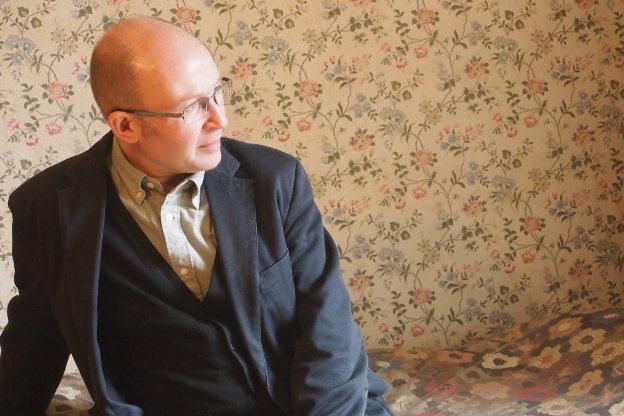
Dorothy Max Prior is the editor of Total Theatre Magazine, and is also a performer, writer, dramaturg and choreographer/director working in theatre, dance, installation and outdoor arts. Much of her work is sited in public spaces or in venues other than regular theatres. She also writes essays and stories, some of which are published and some of which languish in bottom drawers – and she teaches drama, dance and creative non-fiction writing. www.dorothymaxprior.com

Blast Theory: Fixing Point

Blast Theory: Fixing Point

Blast Theory: Fixing Point

‘Have you used a GPS system before?’ asks the steward, handing me a smartphone and a pair of headphones. Alarm bells ring: I never have much luck with Google Maps. ‘Me’ is me, she explains, and there’s a white dotted line to follow. When circles show up on the screen, I’m to move towards them to locate the sound recordings.

And thus I find myself in a field full of bemused cows, which I need to cross to reach the small copse in which the recordings are located. Being nervous of cows, I develop a strange looped cow-avoidance walking pattern, which throws the GPS into overdrive as it tries to realign me with the dotted line. It’s not a good start, and it’s downhill from there on in.

On my headphones is a pretty average electronic soundscape (by Chris Clark of Warped Records – I’m a great fan of Warped, but what I’m hearing isn’t particularly inspiring), interspersed with verbatim soundbites about a ‘disappeared’ person that pop into your headphones when you and the GPS system coincide at a given spot. The absent character at the heart of the piece is a real person: Newry man Seamus Ruddy, who went missing in a wood in France almost thirty years ago – killed (it is claimed) by the Irish National Liberation Army, a breakaway group from the Provisional IRA. The words are those of Seamus’ sister Anne Morgan, although spoken by an actor (Amanda Jones). I manage to locate two recordings out of a possible six or so, and also get to hear an introductory text that pops up as I cross the field. I understand that I am supposed to receive this as a fragmented narrative, but the combination of the minimalism of the texts, the imbalance of sound levels of texts and soundscape, and the fact that I only locate some of the spots, means that I come away feeling I’ve learnt very little about this man, and the devastating effect of his disappearance. It is immensely frustrating. There was more to learn about Seamus from the A4 sheet of photocopied paper we are given afterwards than is manifest in the show itself.

We are, I suppose, placed in a wood in a field because Seamus disappeared in a wood (in France, 28 years ago) but, for goodness sake, writing and theatre exist to evoke a sense of place – we don’t have to be physically placed in a woodland to understand Seamus’s plight, and that of the family who have never found his remains. The source material (email correspondence transposed into spoken word) might have made a good sound piece in someone else’s hands, and had that been the case it would have made more sense to me as an experimental radio play, broadcast on Radio 3.

I suppose you could argue that being alone in the woods, frustratedly searching for something you can’t locate, is a metaphor for the plight of the lost man’s family, but I wasn’t even alone – the small copse was occupied by three other people whilst I was there, and at least two of them were having as many problems as me with locating the sound recordings. I spent a lot of time standing still, waiting for the system to catch up, and often it froze completely for many minutes. After 30 minutes it cuts out, sending a ‘your time is up’ message.

So the fundamental problems with the piece could be summed up as: technology that isn’t yet up to the job; a nebulous connection between site chosen and the core content of the piece (the story of Seamus Ruddy); a less than inspiring soundscape by the collaborating musician; a desire to tell an important story that gets strangled by the chosen means of communicating that story.

The worthiness of the cause – promoting the plight of the ‘disappeared’ – should mean that the art that attempts to address it really is worthy of that cause, and this sadly isn’t. Seamus deserves better.
www.blasttheory.co.uk

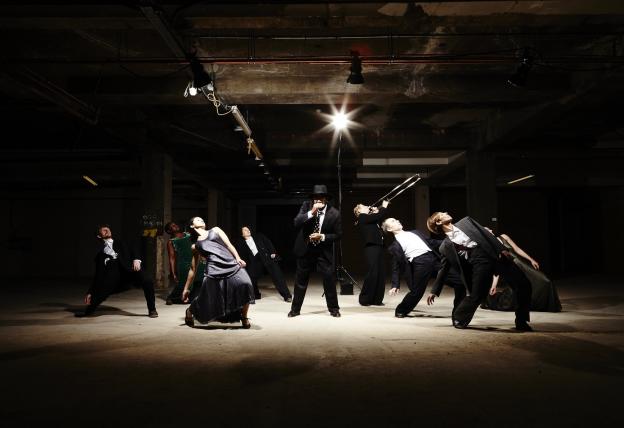
Clod Ensemble: Zero| Photo: Manuel Vason

Clod Ensemble: Zero

Clod Ensemble: Zero| Photo: Manuel Vason

‘You are nothing but a big zero,’ says the Fool to Lear. I paraphrase, apologies Mr Shakespeare. But this is not, you understand, a version of King Lear, although that was the starting point – a period of research supported by the Royal Shakespeare Company, in which Clod Ensemble discovered that what they didn’t want to do was make a version of the play.

What they’ve done instead is take the play’s five-act structure, some of its themes (jealousy, desire, father/daughter dynamics, sibling rivalry, the absent mother), and some of its motifs and metaphors (weather, nature, storms) to create Zero, which has been commissioned by Sadler’s Wells and Brighton Festival, in collaboration with South East Dance. I see it on its second ever performance, and it does feel very new and, to be honest, not quite cooked yet. Actually, even more crucially, there are some fundamental flaws in the piece…

It’s an end-on piece presented in a large space (as in large stage and large auditorium). The large performance space is familiar territory for Clod, but many of their works (An Anatomie in Four QuartersRed LadiesUnder Glass) are presented in spaces that are shared with small audience groups, or, in the case of shows in which the audience is in a more traditional seated auditorium, that have an intense and intimate feel (for example, in two of their collaborations with Split Britches – Must, and It’s a Small House and We Lived in it Always). Zero tackles the big stage / big auditorium dynamic by going for a full-on visual and aural assault with things happening all over the place, and hardly a chance for the audience to draw breath or take in what they are experiencing. Certainly, when it comes to the physical action anyway, as soon as something interesting starts, it stops, or is interrupted.

As always with Clod, this show is a collaboration between the company’s two co-directors, composer Paul Clark and movement theatre director Suzy Wilson – and as always the two artforms are both of equal importance. It is – despite the fact that it is supported by Sadler’s Wells and South East Dance – not a contemporary dance piece; it is a total theatre piece, in which the aural, visual and physical elements interweave harmonically.

At least, that’s what it should be. At the moment, the movement work feels much too far into the contemporary dance camp for comfort, and to a contemporary dance that feels pretty dated: there are rather too many references to Pina Bausch’s gestural dance; too many sections of choreography that doggedly tag and illustrate the blues-inspired score; too many references to popular dance (Charleston, for example) that get repeated too many times; too many clichés of contemporary dance and theatre (such as the stopping-another-dancer-in-her-tracks intervention so beloved of Wendy Houston/Forced Entertainment). I often find myself thinking that I’ve seen so much of this choreography so many times before. It is almost as if Suzy Wilson hasn’t quite allowed herself to do what she does best – make visual/physical theatre that uses dance as one of its elements, rather than dance per se.

And yet despite the criticisms I enjoyed a lot about Zero. I loved the robust and earthy music, played by a group of seven musicians that includes legendary harmonica player Johnny Mars and trombonist Annie Whitehead; I loved the energy of the performers, and mix of bodies of different ages and sizes and experiences onstage (the ensemble including Clod favourites like Zoe Bywater and new company members such as Antonia Grove); I enjoyed the soundtrack of found or recorded texts from many different sources (including clips of siblings Jackie and Joan Collins, and the Kray brothers) that were cleverly edited and placed in counterpoint to the live music. There are some lovely hero/chorus ensemble sequences, some good same-sex duets exploring power struggles within relationships, and some great solo vignettes – I particularly enjoyed the Hebrew rant by charismatic Israeli actor/dancer Uri Roodner.

So there is a lot to like in Zero, yet still it feels lacking. Previous Clod Ensemble shows bear the mark of a highly talented director of physical theatre, a marvellous manipulator of bodies and spaces; Zero suffers a little from Suzy Wilson being cast (or casting herself) as a contemporary dance choreographer, and falling a little short. More visual theatre, less contemporary dance please, Clod!

www.clodensemble.com

Victoria Melody: Major Tom | Photo: Liquid Photo

Victoria Melody: Major Tom

Victoria Melody: Major Tom | Photo: Liquid Photo

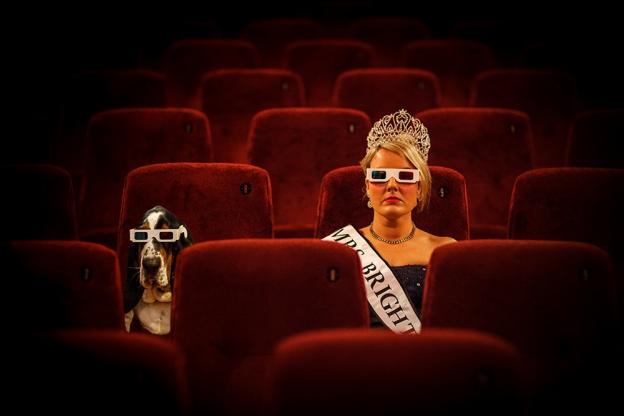
In which Victoria Melody, a 35 year-old performance artist with a winning smile and an interest in anthropology, and her trusty dog Major Tom, a six year-old Basset hound with lovely long ears and an interest in Schmakos dog treats, pursue parallel paths of gruelling competition in their endeavours to become beauty queen / champion show dog, respectively.

And all in the name of art! What some might call intensive research for a theatre show, others might view as a life-as-art decision to really live it in order to know it, before you can even start to tell the story. And here onstage, telling that story in their very different ways, are Victoria Melody and Major Tom.

There’s a deceptively simple, beautifully designed set: dark stage, white dog cushion and bowl (stage left), white semi-opaque folding Chinese screen for the costume changes (stage right), and upstage a large screen, with underneath it a set of rather nice letter blocks spelling out Major Tom’s name in lights. Victoria mostly talks (well, you’d be surprised if I said the dog did) whilst Major mostly snoozes, and the anecdotes are supplemented by short bursts of video that take us, directly and without the need of any additional ironic framing, straight into the world of dog shows and beauty pageants – plus we get a number of quick-change costume catwalks (dress wear, swim wear, evening wear) and a little bit of pimping and preening of Major’s basset assets. The lighting design is elegantly crisp and simple, the sound and video perfectly supportive of the live performance. Everything that happens on stage is carefully choreographed, and executed with panache and precision – there is evidence of the influence of Victoria Melody’s mentor, Ursula Martinez, and that is only for the good.

Major Tom is the one wild card, free as he is to do as he will. He looks, says Victoria, like an old Tory, and that is exactly how it is – he dozes through the rhetoric like a House of Lords veteran, occasionally looking up and yawning or shaking those long ears, as if in agreement or approbation. Now and again there’s some noisy slurping from his water bowl, and the occasional stroll round the space. As Pina Bausch and Alain Patel have found, having a dog on stage adds a wonderful extra dimension to performance work – dogs are just so perfectly present.

Victoria Melody is an engaging performer, and her show is a clever weaving of the parallel stories of dog shows and beauty pageants. It all starts with Major Tom. We hear the history of his provenance and pedigree, and we learn that Victoria and her husband Mitch agreed that they’d first buy a plant, and if that lived buy a dog, and if that lived have a baby. Victoria (whose previous work includes an intensive and long-term engagement with Northern pigeon-fanciers) decides that an investigation of the world of dog shows will be her next artistic venture, so Major finds himself propelled into the limelight. Unfortunately, although he does well as an amateur, once he turns pro he keeps coming last, so needs a fair bit of training and grooming. Later his ‘mummy’ decides that it is only fair that she puts herself through a similar ordeal, and thus starts her journey on the beauty trail, with her eventually winning the title Mrs Brighton and being entered for the coveted crown of Mrs England (no, really!). Meanwhile, back in the dog world Major Tom’s success has risen to dizzy heights and he finds himself being entered for Crufts…

The story of how they both get sucked into the world of competition, and eventually ease out back into normal life, is a ‘gentle ride’ (as one fellow theatre-maker described it after the show), but the gentleness is deceptive. Had this been presented as a polemical rant against the Beauty Myth and the ways in which women’s bodies are judged, we’d have switched off in the first five minutes. Instead, Victoria Melody seduces us into her world with laughter. We guffaw at the absurdities, and we share her ambivalence towards it all, questioning the ethos whilst still loving it, as she does. I mean, who wouldn’t want to have lovely legs, shown off to their best advantage in a pair of five-inch-heeled sparkly silver shoes?

There are hard-hitting undercurrents – but they hit us through the holes forged with laughter. There are many cutting moments of awareness of the convoluted and simultaneous demands of so many different cultural attitudes to beauty – human and canine. We feel for Major when his ears and ribs and teeth and legs are commented upon. We are with Victoria as she battles with her weight, takes on a personal trainer, forces herself into skin-tight frocks, gets waxed and tanned, learns to walk in the highest of heels. I’m reminded of Germaine Greer’s The Female Eunuch, and its discussion of women taking on ‘femininity’ as a drag queen does. Victoria’s stance is of someone taking on a feminine identity that is other than her own, although one she enjoys indulging in and playing with, almost treating herself as a real live Barbie Doll.

No doors are left unopened – there’s a fantastic moment when she recounts an incident in a changing-room, as she realises that all her beauty contestant companions are staring aghast at ‘her hairy bush’. At other moments, we hear of criticism of her thin, fine hair (she gets extensions) and her ‘upside-down’ mouth, which she is told will turn further downwards when she ages unless she gets plastic surgery now (she doesn’t do it, which causes the female members of the audience to roar in approval).

At the end of it all, the competitions won or lost, and the making of the theatre show underway, we learn that Victoria’s husband Mitch asks, ‘Can we go back to normal now?’

Major Tom, created and performed by Victoria Melody, commissioned and produced by Farnham Maltings, is a major achievement – bright and breezy sexual politics without the polemic, entertaining and thought provoking. It’s beautifully designed, carefully choreographed, and performed with panache. A grand success!

http://www.victoriamelody.co.uk/

Peter Reder: The Contents of a House

Peter Reder: The Contents of a House

Peter Reder: The Contents of a House

Pedigree and provenance, that’s what it’s all about. This ‘subversive promenade performance’ is one of the key commissions for this year’s Brighton Festival, and follows in the Festival’s tradition of commissioning high quality site-responsive work as a key part of its theatre programme.

It takes the form of a tour around Preston Manor, described quite accurately as ‘the epitome of Edwardian glamour’, set in its own luscious grounds on the outskirts of central Brighton. The provenance of the objects within – many of which, we learn, were not originally here at all, but were bussed in by Preston Manor’s enterprising first curator, a Mr Roberts, who saw the place as ‘his very own Wendy House’. The pedigree of the people who lived here – to wit, the formidable Lady Stanford, who could give Oscar Wilde’s Lady Bracknell a run for her money by all accounts; her half-sisters, who were thrown out on their ear somewhere along the way; her as-good-as disinherited son; her beloved grandson who tragically died young; and her various husbands, who were obliged to take her surname. Not to mention the dogs…

The dogs play a crucial part in this story, serving to illustrate the importance of ‘pedigree’. The dog-owners of Brighton and their peculiarities get casually mentioned in Peter’s introductory talk, as we gather in the manor’s dining room. Later, the dogs that have occupied the house get solemnly name-checked, as we stand in the morning room (or is it, asks Peter, a mourning room?). He skilfully segues together a reflection on grandsons lost to mustard gas poisoning in the Great War with tributes to the occupants of Preston Manor’s famous pet cemetery. It’s interesting, says Peter, that we know the names of the dogs that lived here, but we don’t know the names of the servants. And it is noted that Jock and Queenie and the rest of Lady Stanford’s pedigree chums have the expected epitaphs – ‘faithful friend’ and ‘beloved pet’ bar one that reads ‘Here Lies Tatters, Not that it Matters’. And why doesn’t it matter? Because poor Tatters was a mongrel. Towards the end of the show we see film footage of a black dog frisking around the grounds, unencumbered – we presume the ghost of Tatters (ghosts being another thread through the show).

And as for provenance, there are a hundred and one fascinating tales about the things in the manor that are in and out of time and place. We see a library now stripped of books and turned into a dining room, and a maid’s bedroom with furniture that has been subsequently brought in: because, says Peter, when the house first opened to the public, who’d have been interested in seeing a maid’s room? This is one of many points on the tour where the upstairs-downstairs binary divide of Edwardian life is discussed, and Peter makes the interesting point that a girl in service was significantly less free than a girl working in a factory. She would have had almost no private life, may even have been stopped from marrying by her masters, hardly more than a slave.

And so where are the books? In the very public drawing room there’s a few novels that the Stanfords (or perhaps the curators that re-arranged their possessions) wanted their guests to see – including a very nasty 1930s book on eugenics that nowadays, if we were to own such a thing, we would almost certainly hide from view. Yet hidden away in the vaults, Peter came across a copy (in French!) of the Karma Sutra, which no one nowadays would be at all ashamed about owning. In another room, there’s a bookcase devoid of books but stuffed full of white porcelain – we surmise, says Peter, that Lady Stanford was not a big reader. The hideous Foo-dog statues lined up hardly strike us as desirable objects, but apparently they were (quite likely) looted from China, so their provenance no doubt added a frisson of desirability.

Running through The Contents of a House is a constant questioning of what is ‘real’ and what is not. There are numerous references throughout to ways in which reality and fantasy interweave: the house as a real home versus the house as a film set; the real snow in the grounds when Peter started his research in January and the fake snow that caused a mess when the house was hired by Noel Edmonds for a TV Christmas Special; the real life staff who work here and the Edwardian ghosts they may or may not have encountered; the traces on the wrangles and bell-pulls of the nameless cooks and butlers who really lived and worked here versus the fictional cooks and butlers – hammy actors who play out the imagined stories for the parties of school children who come along to dress in pinafores and caps and learn about Edwardian life. We are told again and again that things are not what they seem to be – everything on view has been tampered with or changed in one way or another, often many times over. And it’s not just inside the house that’s been tampered with, changed: the noise of the busy London Road traffic outside would once have been the flow of a small river, now forced underground.

There are stories and musings and things to look at and reflect upon, this augmented by a number of short video pieces interspersed throughout the tour – the best of which is a nicely edited montage of short interviews with Preston Manor employees about ghosts and ghostly encounters. And as in earlier works by Peter Reder that use a similar format (the performance lecture cum guided tour), the artist’s own autobiographical material is weaved into the work – the most poignant example being the placing of a photo of his deceased father on the four-poster in the main bedroom, prompting a monologue on the desire to die in one’s bed and the changed roles that beds play in our lives nowadays. How many of us, like Peter, grow up sleeping in the very bed we were born on? A section that tries to link the Stanford family’s relationship with the SW7 district in London to Peter’s own memories of South Kensington is less successful, feeling a little forced.

The Contents of a House was seen by Total Theatre on the press night, which (bizarrely for a whole-month run) was the very first show. Peter Reder is a seasoned performance artist, and for the most part relaxed and in control, but a little unsure of himself at times, as anyone would be on the first outing of a complex one-man promenade work. And it was a tough audience – a bunch of journalists with crossed arms and frowns and/or notebooks in hand, which hardly helps. There was one scene (the Karma Sutra one) in which a would-be humorous suggestion that the second husband of Lady Stanford was gay falls flat on its face. He also caused a little bit of consternation at one point by asking the audience not to walk around behind him whilst he was talking, whereas at the beginning of the show they had been encouraged by the person introducing the event to feel that they could look (if not touch) quite freely. So a little adjusting in audience management needed – which will surely come throughout the month.

First nerves and early teething troubles aside, an interesting piece, well researched and well delivered. Perhaps a little too bound to its tour guide format – Peter Reder could, potentially, subvert the set-up more forcefully – but a very full and rich experience.

www.peter-reder.co.uk

Liz Aggiss, The English Channel | Photo: Joe Murray

Do I please you, or do I please myself?

Liz Aggiss, The English Channel | Photo: Joe Murray

The title of this blog is a quote – or misquote, or paraphrase perhaps – from Liz Aggiss’s new work-in-progress The English Channel, an excerpt of which was presented 9 April at the Brighton Dome’s new venture The Works. (And where do I know that name from? Ah yes it was the title of a soon-to-be-revived series of features in Total Theatre. But we won’t complain, imitation being the sincerest form of flattery.)

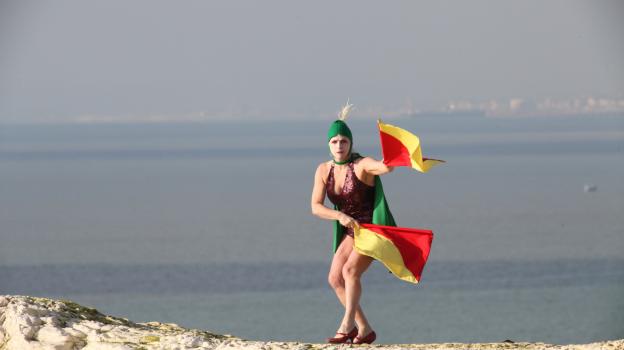
Anyway, back to Liz. There she is in all her glittery green glory, standing before us with hips a twitchin’ and a goblin grin on her face. ‘Do I please you, or do I please myself?’ she asks. It’s a statement that is at the core of an artistic investigation into the nature of performance, and of being a performer – and in particular of being a female performer age 60, who has long past the stage in her life or her career when she has to bother too much about what others think. And yet of course you never stop being bothered – never stop trying to please, never stop giving them what they want. That’s what performing is all about, isn’t it? That’s what being a woman is all about, isn’t it? ‘I’m a one-woman variety show’ says Liz as she takes her seat for the after-show discussion.

But the question raised in Liz’s piece – who this is actually for, the artist or the audience, who is pleasing whom? – is a pertinent one for the whole evening.

The latest new night of new work to hit Brighton, The Works is an open evening, advertised publicly, ticketed but free, in which works-in-progress are presented by three artists or companies at various stages of their career. But why? Who is it for? What are the expectations of both artist and audience?

I’ll admit straight away that I’ve developed a mistrust, steadily growing over the past decade or so, of Scratch nights and work-in-progress showings. There is an irony here, as without blowing my own horn too loudly, I did play a part in establishing this now-commonplace theatrical activity, so perhaps have only myself to blame. In the late 1990s, as director of an artists’ forum called Bodily Functions (yes I know – I didn’t choose the name), I set up something called Platform at the Komedia Theatre – a twice-yearly space for artists working in physical, visual and devised theatre / live art performance to present the beginnings of their ideas to a (hopefully) receptive audience. One of our production assistants was one Louise Blackwell, who then left Brighton to work at BAC in London, and subsequently coin the term Scratch nights, using a similar format to the Platform at the Komedia: a number of 10–15 minute acts; feedback forms to pass comment on work seen; and the chance to chat to the artists informally in the bar afterwards.

What we found with Platform was that even educated audiences often found it hard to really understand how to receive the work. ‘Most of the things I saw were not really developed’ said our then Arts Council officer in response (and ACE hadn’t even funded this particular part of our work, to add insult to injury). Er yes, it is unfinished work so it is not yet developed – that’s the point…  But actually, is it fair to present snatches of unfinished work to an audience and expect them to understand? Can it do the artist more harm than good to present their yet-to-incubate musings in public? Maybe it’s a personal thing, but I know that when I’m developing work I often hold it close to my heart for a very long time, not even letting close family and friends in on it. Yet theatre is an artform in which the artist’s relationship to the audience is at the heart of the matter, so they have to be let in at some point. There are some venues / organisations who have worked hard to improve the scratch format: the Nightingale Theatre, for example, structures their evenings very well, with the post-show feedback set up as small roundtable discussion groups, audience members free to flow round to whichever artists’ tables they would like to join. I’m still wary of scratch evenings, but theirs is better than most.

The Works was work-in-progress excerpts rather than scratching new ideas, I suppose I should make that clear – and the three pieces shown were at very different stages of development. Liz Aggiss, I suspect, wouldn’t go anywhere near an audience until she’d put in a lot of legwork and was reasonably sure of where she was going and what she was attempting to achieve. Her excerpt from The English Channel was the very necessary stepping out from the solitary space of the rehearsal studio into the engagement with audience that is necessary for something to become a real piece of performance work. It was very new, very fresh, finding its way – but it was clear about what it was and where it was heading, and was thus immensely entertaining and thought-provoking.

So I’m fine with the idea of seeing work that is in progress, once progress has been made – I think there is a value in presenting early versions of newly created shows, and for artists to then rework them as a result of trying out before an audience, but that’s different to this bitty ‘a taste of this and a slice of that and tell us what you think’ approach. I’ll confess that I didn’t read the publicity properly and I thought I was just going along to see an early version of Liz’s show, so when I found out I was in for a two-hour marathon – three excerpts from three very different works, plus this rather formal discussion process after each one – I got a bit sulky!

Also to say that another gripe against the pot-pourri approach is that I feel unsure how to respond to something when I’m only privy to part of the picture. To just get 15 or 20 minutes of what will be a full-length show, then to be asked what we’ve seen and understood, is inevitably encouraging discussion along the lines of ‘I didn’t understand this’ or ‘’you need to make that clearer’. It’s like being in a writers’ workshop and reading out chapter four of your novel-in-progress and someone saying,‘Well, you’ll need to make that clearer, I didn’t understand what that character was doing’. Well of course you didn’t – I’ve just read you chapter four and you haven’t read chapters one, two or three, have you? How can you possibly understand?

But the aspect of the evening I had most problems with was the feedback format. The pieces were presented to a large audience in a formal theatre setting, with the feedback session after each one set up like a regular post-show discussion – i.e. with the artist or company and facilitator (director/dramaturg Lou Cope) sat on chairs facing the audience, who are then led into the discussion with pre-decided questions about the work, followed by some open/general discussion. To give Lou her due, she did start the evening by reminding the audience that this ‘wasn’t about them’ and that questions or comments made should be precise and to the point and relate directly to the work seen – but of course that didn’t happen. Instead we had the usual post-show horrors: the awkward silences as people try to think up answers to the questions thrown out to them; the gushers who can’t stop telling the artist how wonderful she is (and that’s helpful to the making of the new work? I don’t think so); the ‘maybe you could do it this way instead’ problem-solvers; and the ‘I haven’t really got an opinion about any of it but I feel the need to say something, and say it at length’ ramblers. Perhaps some people find this useful, but it just felt strained and uncomfortable to me. Both artists and audience were placed in the spotlight (literally and metaphorically) and when on the spot didn’t necessarily talk much sense. I tend to feel that just presenting the work to an audience is enough for the artist, who can then form their own opinion of what worked and what didn’t. Do it in front of people and you can feel when something sinks sadly into the ground or when something is a genius moment of inspiration – you don’t need a post-show discussion to tell you.

In many ways, this new venture feels like an audience development initiative disguised as something else. ‘Do give us your email addresses so we can tell you when these shows are on’ being an obvious give-away. As a friend of mine said, if that is what it is, let’s be upfront about it, rather than pretending it’s there to help the artist make the work. I dislike the pretence that it is useful to get the audience engaged with the dramaturgical process of making a show. In my humble opinion, that’s the artist’s job.