

Author Archives: Dorothy Max Prior

Dorothy Max Prior

About Dorothy Max Prior

Dorothy Max Prior is the editor of Total Theatre Magazine, and is also a performer, writer, dramaturg and choreographer/director working in theatre, dance, installation and outdoor arts. Much of her work is sited in public spaces or in venues other than regular theatres. She also writes essays and stories, some of which are published and some of which languish in bottom drawers – and she teaches drama, dance and creative non-fiction writing. www.dorothymaxprior.com

Ontroerend Goed: Audience

Ontroerend Goed have created a body of interactive/immersive theatre work that plays with the audience, investigating the borderlands occupied by ‘performer’ and ‘audience member’, and interrogating the role of audience. Their latest piece is called, simply, Audience. It was a given that this ongoing investigation was going to be at the heart of the piece.

The first ten or fifteen minutes are good. As we enter the space our coats and bags are taken off us. We find our seats; we sit down – as you do. A young woman comes out to tell us to turn off our mobiles. And to check that we’ve been to the bathroom. She says that if you aren’t used to going to the theatre, here’s a few tips: It’ll get dark. You’re expected to sit still and be quiet. If an actor speaks to you, you’re not expected to answer. Don’t eat crisps. Don’t cough.

She takes her seat in the auditorium and a young man with a camera comes onstage and stands in front of the giant screen taking up the whole back wall. He pans the camera over us, and the images loom large on the screen. He homes in on hands or feet, then zooms out to give a whole-group shot. He returns to focus on faces, and we get actors’ voiceovers imagining what people are thinking; ‘I want to be taken out of my comfort zone’ is one. Well, yes, it’s obvious that you will be.

There’s some footage taken earlier of us entering the space. A fashion show of actors parading in our coats and jackets is mildly amusing; the tipping out of handbags less so – nothing is done around that other than to just state the obvious or go for the lowest common denominator jokes: ‘Headache pills and condoms – optimistic!’

But there’s worse, much worse, to come. The mood switches from comedy-show low-level fun to a scene that is so unpleasant, so unnecessary, that I can hardly bring myself to describe it. The actor onstage asks the camera to rove around the audience, and it settles on a young woman, who is then insulted, harangued and harassed in the most unpleasant way imaginable. The camera remains on her, in close-up, throughout. Her face is enormous onscreen, her lip is trembling, her eyes blinking away the tears. The actor says that he will only stop if she agrees to ‘spread her legs for the camera’. Some audience members call out for this to stop, and one brave man pushes the camera away.

Of course, seeing how the audience will respond is the point of the exercise, but there is no excuse on earth for what has just happened. If she was a plant, or an audience-member briefed beforehand (and I am pretty sure she wasn’t either of those), then this is still inexcusable. If she wasn’t, it is more than inexcusable, it is despicable.

I struggle to see how the company do not realise that this is not a theatrical examination of abusive behaviour, it is abusive behaviour. It is not an ironic parody of sexual harassment, it is sexual harassment. If Ontroerend Goed want to highlight these distresses in our society, then they need to learn to be part of the solution, not to perpetuate the problems.

I suspect that Ontroerend Goed’s actors wouldn’t risk trying this sort of thing on a man – they may well get punched in the face! Women – especially young women – are an easy target, as they internalise violence directed at them. The young woman abused so unpleasantly at this show was not an actor; she did not enter into the contract that actors agree to when playing a role. We have no way of knowing what histories of violence and abuse anyone might carry with them, so this is an extremely dangerous and horrible game being played.

I have seen, and I have supported, much of this company’s work to date and I have defended many of the company’s previous controversial artistic decisions. But not this time. Audience deserves no support or defence. An enormous disappointment.
www.ontroerendgoed.be

Ramesh Meyyappan: Snails and Ketchup

Ramesh Meyyappan: Snails and Ketchup

Ramesh Meyyappan: Snails and Ketchup

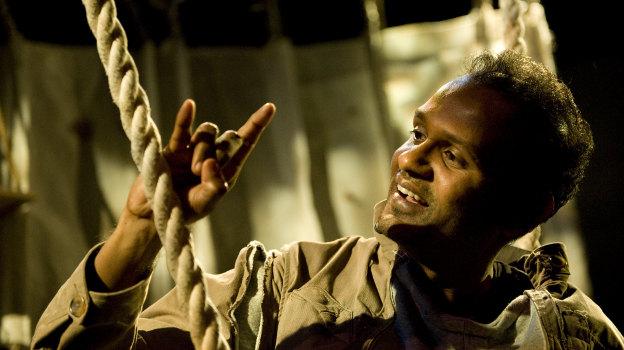
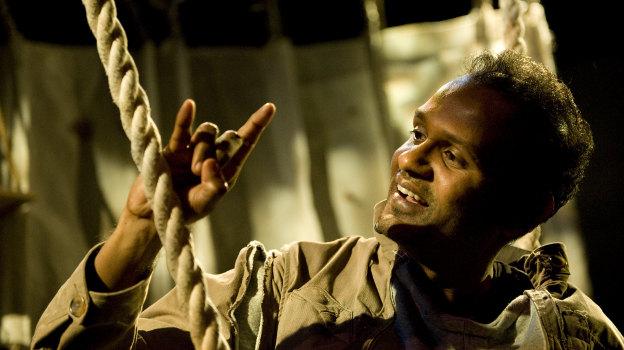
Snails and Ketchup is a wordless retelling of Italo Calvino’s The Baron in the Trees, just one man (Ramesh Meyyappan) and his pianist (Toh Tze Chin) conjuring up the before-its-time tale of social protest and environmental concern as the son of a dysfunctional aristocratic family defies convention and protests against his lot by taking to a life lived in the trees. It is presented by Iron-Oxide and Universal Arts under the auspices of the Made in Scotland programme.

It’s a purely physical and visual performance, but it comes with a written synopsis given out to audience members before the start of the show, which set a small alarm bell ringing for me: surely a visual theatre performance should be able to tell its tale without this aid?

The problem is that the story is a convoluted one, and the performer/deviser has decided to focus strongly on linear narrative rather than working thematically and developing other aspects of the tale. Ramesh Meyyappan is a skilled performer, and I have read Calvino’s novella, but the narrative twists and turns rapidly, and it is (I have to confess, having spurned the synopsis) difficult to follow. The brutal father, nervous mother, mischievous twin sister, and ‘baron’ himself are all played by Ramesh, who has developed a personal style of illustrative mime that seems to have incorporated elements of signing and perhaps also of eurythmy. A concern for me was that this all keeps him frantically busy throughout and there is little stillness or space to breathe in the piece (ironically, as the baron’s stated aim in taking to the trees is to find a space where he can breathe) and for this audience member anyway, too much time was spent trying to work out what was happening rather than really relaxing into the show.

The piece is directed by circus/physical theatre stalwart Josette Bushell-Mingo, with aerial choreography by Jennifer Patterson and Lucy Deacon, so I had expectations of a high level of aerial circus work, particularly as on entering the venue we saw the stage set with a forest of ropes hanging down. However, this is not realised, and although the rope work that there is is clearly and competently presented, it is not an aerial performance to thrill. On the positive side, design, lighting and the cleverly-integrated video projection are all of a high quality, and add a strong visual dimension to the show. The live piano accompaniment is also very lovely, adding a silent film quality to the action.

Ultimately, Ramesh Meyyappan is a competent and skilled performer, but not (for me anyway) a riveting presence onstage, and I thus feel that the piece would be stronger if there were other performers to carry some of the burden of the storytelling. Snails and Ketchup is a work in development that has interesting aspects – but has a way to go yet.

www.rameshmeyyappan.com

Company XIV: Pinocchio: A Fantasy of Pleasures

Company XIV: Pinocchio: A Fantasy of Pleasures

Company XIV: Pinocchio: A Fantasy of Pleasures

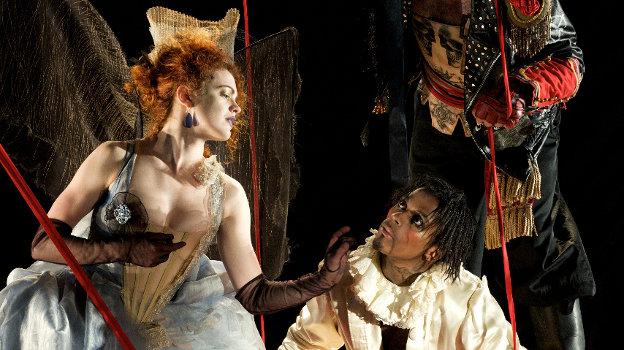
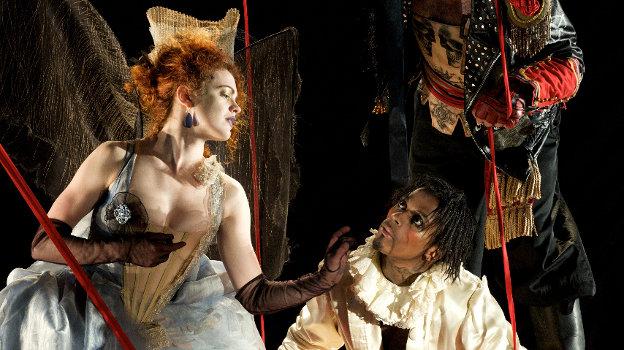
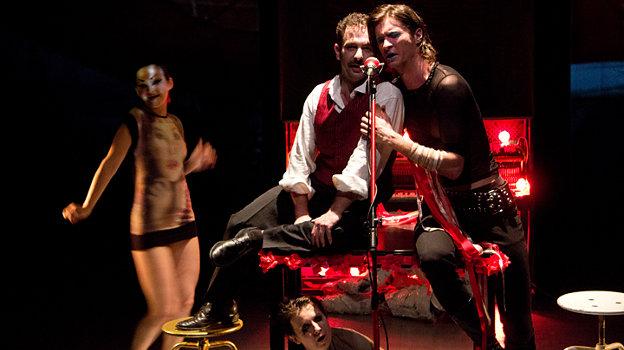
Pleasure Island: ‘It’s right there in the name’. Venetian masks, raunchy dancers in basques (the boys too!), a boisterous MC in a leather biker jacket, gas masks and feathers, and a blue fairy caught by her wings… Sweet dreams, you bad, bad boys! Company XIV take Pinocchio’s trip to the debauched fantasyland where boys grow donkey ears as their starting point and central motif. Life’s a carousel, my friend, so come to the carousel. And this is some carousel – a merry-go-round of decadent delights.

Inspired by the films of Fellini (it shows!), American ensemble Company XIV bring a whole mix of forms to this sumptuous ‘Neo-Baroque’ production – Bob Fosse style jazz dance, modern ballet, classical opera, Commedia del’Arte, burlesque – while at the heart of the piece is the power of sexual desire and the pain of growing up.

The costumes are sumptuous and spectacular, the choreography lovely in an old-fashioned way (no bad thing), performed by an ensemble whose dance and performance skills are top-notch – and there’s even a live opera singer in the mix. She gives us arias and torch songs, whilst elsewhere harpsichords meet bump and grind blues or sentimental waltzes. There’s a strong element of kitsch and irony – a sequence to Elvis Presley’s ‘Wooden Heart’, for example. The play on puppetry and ‘the puppetesque’ is very cleverly done – the show-within-the-show (where Pinocchio becomes a marionette!) is done very nicely, and extended into a gorgeous sequence with Pinocchio tied up with red ribbons and pulled hither and thither. There’s a great visual aesthetic, and I enjoy the blue-red theme that is developed throughout, with the Blue Fairy (Pinocchio’s heart’s desire) in one corner; and little Pinocchio, all bleeding red heart, in the other.

Our showman MC holds the whole thing together with rhyming couplets and raucous songs, and it all romps along very merrily. A good night’s entertainment of a high level – naughty but nice!

This way to Toyland, everybody…

www.companyxiv.com

NeTTheatre: Turandot ¦ Photo: Fourtheye Photography

NeTTheatre: Turandot

NeTTheatre: Turandot ¦ Photo: Fourtheye Photography

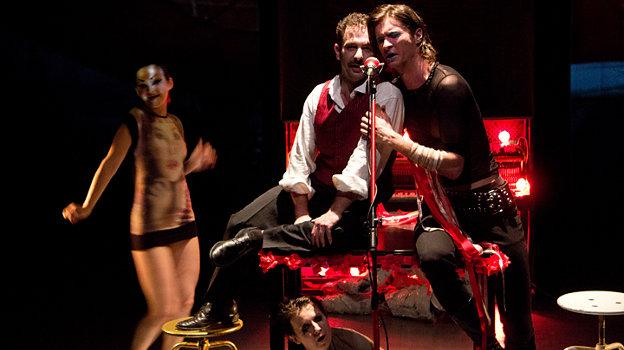
None shall sleep, not if Poland’s NeTTheatre have anything to do with it… Leather queens in bullet belts and kitten heels belting out karaoke versions of ‘Nessun Dorma’; a bank of Barbie dolls mounted on table football rods and real-life Barbie-doll-girls dancing disjointed dances; the incessant looping of snatches of Turandot’s score; a mannequin hung by its neck from the ceiling; a woman caged under a kitchen table; a kitsch 70s-style home organ belting out opera faves, blood-red washes of light, armies of miniature figures, Chinese lanterns and lacquers, projections of flock wallpaper everywhere – and always the silent screams of those with no voice. ‘If I could write one word on a piece of paper it would be “shame’’.’

It’s a nightmare. A bloody mess. A brilliant bloody mess. A wonderful postmodern deconstruction of Puccini’s last opera, a story of the Chinese princess Turandot (who tells riddles and puts to death suitors who cannot solve them), mulched in with the tragic real life story of the throat cancer the composer developed whilst trying to finish this last major work of his life, and the terrible treatments he endured (we learn at one point that he has his lips ‘bound together’). All of this is informed by the fact that this work has been devised in collaboration with an ensemble of people with and without hearing and speaking disabilities. To hear, to speak, to voice, to lose voice, to be denied voice… what these mean, literally and metaphorically, are explored throughout the piece. The meaning and value of ‘silence’ is explored: enormous close-ups of silent screaming faces give way to words spoken haltingly: ‘When I am silent I give him pure love.’ Just to add to the lunacy, William Burroughs’ hallucinogenic masterpiece Naked Lunch also supplies meat for this feast…

Director, writer, sound designer – auteur I suppose best describes him – Pawel Passini uses every trick in the theatrical book: live and recorded music (arias heard on scratchy recordings, the live singing onstage, looped samples, easy-listening organ playing), puppetry of many scales, film (including some horribly compelling footage of young Chinese gymnasts being tested to the limits: Turandot’s Chinese themes and tropes are another element to the piece), cabaret pastiche, Kantor-esque stepping out of and observation of the action by ‘silent’ (in myriad senses of that word) witnesses.

Bold and brave and beautiful; a show I’m drawn to see more than one time. One of the most interesting and inspiring shows at this year’s Fringe. I think I’ll have to go back for more; there is so much to experience and unravel…

www.nettheatre.pl

Stockton, Stockton!

‘If Stockton can’t come to Las Vegas, Las Vegas can come to Stockton!’ So says Johnny, star of Johnny’s Stuntshow, who’s revving up the Friday night crowd here in Market Square – the epicentre of the Stockton International Riverside Festival. Well, more than that: the epicentre of Stockton – apparently there’s been a market on this site since the 14th century.

Stockton-on-Tees, in case you don’t know it, is a northern town not too far from Newcastle that was once at the heartland of the British industrial revolution: the Stockton and Darlington Railway was the world’s first regular rail route – Stephenson’s Rocket pulling the carriages that ferried coal miners back and forth daily. Nowadays, Stockton is fighting to survive: its castle has gone (replaced by the Castlegate Shopping Centre), and there’s little in the way of work. The railway station is hardly used. An empty waiting room boasts a sign warning that ‘drunken revellers from Middlesborough, Thornaby and Yarm’ will not be tolerated.

Yet the place is far less gloomy than I’d pictured it: yes, there’s drab call centres (just about the only local industry nowadays) and rows of boarded-up shops – but there’s also the prettily-lit Millennium Bridge across the Tees, some nice old waterfront buildings, and a bustling high street (well, two High Streets, but that’s another story) that seems to specialise in jewellery shops. There’s a surfeit of old-fashioned barber shops – the red-fronted, gilt-signed Paul Henry’s is the prettiest – and although there’s the usual identikit coffee companies and a depressingly large drive-in Burger King, there are also proper tea rooms, and plenty of independent and resolutely down-to-earth eateries with names like Tommy Tuckers and Barnacles. There’s also pubs a-plenty: the coiffed and lip-glossed ladies of the town frequent Georgia Browns, whereas The Stag, whilst not actually boasting a ‘men only’ sign, might just as well, as it’s frequented exclusively by elderly male drinkers in threadbare pullovers and dingy grey trousers who peer out through nicotine-stained nets. Of course nowadays they have to sit outside to smoke, so there’s always a park-bench-full of gents staring gloomily over at the street arts shenanigans across the road in Market Square.

Which is where, on this balmy summer’s evening, the slightly podgy daredevil driver Johnny and a nameless lank-haired sidekick are strutting round inside a metal-fenced enclosure that has a rusty Ring of Fire construction in the middle, and a marquee to the side bearing the legend ‘Johnny Goes Olympia’.

The gathered crowd is mostly families and teenagers – Stockton may be the town that God forgot, but SIRF has been going for decades, so this is a street-arts-savvy audience, who twig pretty quickly that our two stuntmen (dressed in a hotch-potch of ill-fitting racing driver leathers) are not all they purport to be… They are, in fact, German street arts company Bangditos.

So it begins, and the twosome make increasingly botched attempts to manoeuvre their souped-up VW Beetle up the ramp and through the ring. The car limps round in circles, and our two heroes perform a few low-grade acrobatic tricks, leaning out of the car’s front windows. Then, the lank-haired sidekick abandons the car for a miniature motorbike, and he and Johnny have a bit of a drive-off. Eventually, Johnny also gives up on the car, leaving it driving itself round in circles, Herbie style. My friend’s gentleman friend tries to explain how you do this with a car, something about a ‘toe-in’. Or maybe it’s a tow-in. Anyway – back to the car: there’s a lot of banging and crashing, wheels fly off, things catch fire, and the whole thing eventually goes up in smoke.

It all goes down well with the locals, although there’s a bit of a debate amongst the arty festival participants about whether the audience really get the irony, or are taking it all at face value. But I think they get it – I’m sure they do. It’s my first visit to Stockton, but it’s clear, seeing the range of work presented at this festival – from the high-end large-scale Wired Aerial Theatre show As The World Tipped (‘Arts de la Grue’ as someone cheekily dubbed this big-crane-dominated show, reviewed here) to Reial Companyia de Teatre de Catalunya’s furry-costumed shop window animation Bunny Me – and witnessing the audience responses, that this is a community that understands how to play the street arts game.

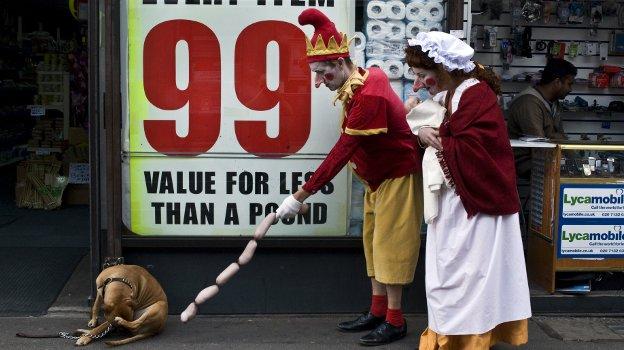
This becomes really clear the next day, at Red Herring’s live Punch and Judy show, That’s The Way To Do It. This is the third time I’ve seen this one, and Stockton is by far the liveliest audience – grandmothers shout abuse at the policeman, kids are quick off the mark to volunteer a list of offences committed by Punch and Judy (‘She killed the monkeys!’ ‘He threw the baby on the floor’) and there are raucous whoops and cheers when the policeman’s trousers fall down.

Rain stops play for most of the afternoon – including the second afternoon’s performances for the show I’m working on. I’m here with Ragroof Theatre forBridges y Puentes, a site-responsive show made in collaboration with French company Vendaval, and presented here in Stockton under the auspices of Meridians, a consortium of European festivals. Bridges is set in a multi-storey car park… except our car park got taken out of action by its owners (first time it’s been painted in ten years and they choose this week!) and the show ends up being sited partly on the ground floor of a disused shop, and partly in the outdoor car park next to it. A little bit of rain we can handle – but this is torrential. Still, mustn’t grumble – we managed two shows the day before, received well…

Also at Stockton were another Meridians-supported show, Scuba Club Collective’s Images of Villages. I caught the last ten minutes of this one the evening before. Placed on the other side of the town hall to the Stuntshow, it’s about as far away from it’s neighbour in style and content as you could imagine, being a very gentle exploration of pan-European traditions, featuring recorded birdsong, trance-like dances, and percussive music-making played out on a set made up of broken picket fences, wooden pallets, oil-can drums, and children’s toys. It’s early days for this one, but it did feel a bit like watching a series of workshop exercises rather than a show…

With rain putting a dampener on most of the outdoor action, it was good to have a few indoor ‘booth’ shows to shelter in. German company Fatalia presented a Cabinet (well, back of a truck anyway) of Curiosities called Cabinet Fatalia. Referencing medical display cases and fairground ‘penny arcade’ peepshows, Fatalia mixes 2D photomontage and 3D found object assemblage, a mix of monochrome and kodachrome with a kind of Victorian toy shop meets Fritz Lang aesthetic. There are faces everywhere, ‘real’ and artificial: miniature plastic robot-heads, Venetian masks, and spirals of tiny neon skulls. Real hair, filmed eyes, and photographs of leggy models and arm-waving astronauts. Fish-scales, fish-tailed mermaids, and fish-eyed lenses. Butterflies and birdsong, fossils and clockwork. There seems to be some sort of theme of the fight to tame nature, or artifice versus nature, and the more you look the more you see.

Most people seem content with a few minutes inside but I get a bit lost in the worlds within worlds, and find that a good half hour or more has passed by the time I emerge. By now, the rain is easing off and the plucky people of Stockton are back on the streets, ready for whatever might next turn up to entertain them…