Author Archives: Dorothy Max Prior

Dorothy Max Prior

About Dorothy Max Prior

Dorothy Max Prior is the editor of Total Theatre Magazine, and is also a performer, writer, dramaturg and choreographer/director working in theatre, dance, installation and outdoor arts. Much of her work is sited in public spaces or in venues other than regular theatres. She also writes essays and stories, some of which are published and some of which languish in bottom drawers – and she teaches drama, dance and creative non-fiction writing. www.dorothymaxprior.com

Zecora Ura / Persis Jade Maravala: Hotel Medea ¦ Photo: Flávia Correia

Zecora Ura / Persis Jade Maravala: Hotel Medea

Zecora Ura / Persis Jade Maravala: Hotel Medea ¦ Photo: Flávia Correia

What is your heart’s desire? What do you dream of doing? What is the strangest thing you’ve ever done? Is your heart a stone or a feather?

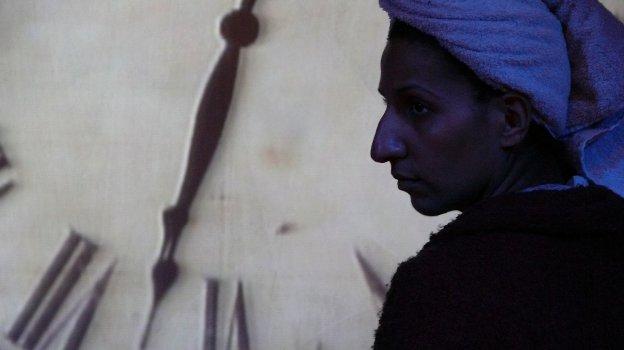
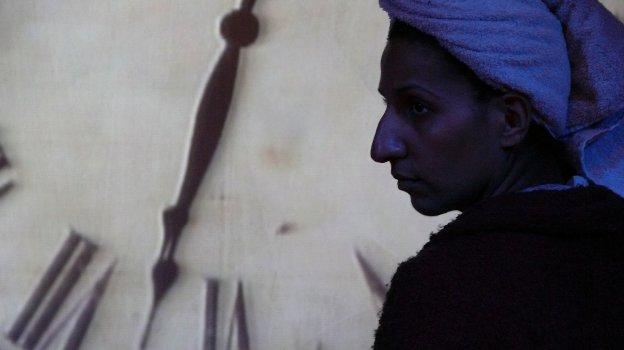
From the very start, Hotel Medea (a collaboration between Brazilian company Zecora Ura and UK artist Jade Persis Maravala) asks its audience to do more than watch and listen. As we are whirled into a madcap marketplace of dancing giant umbrellas bedecked with multicoloured ribbons, with a cacophony of musical rhythms erupting from cassette machines taped to performers’ bodies, we start our shared journey – an enquiry into concerns that are at the heart of human interest: What is it to be a stranger in a strange land? How do different cultures relate: assimilate and appropriate each other’s differences, or conquer and divide? What is it to be a man, to be a woman? How far will a man go in his quest for political domination? What is it to be a woman in a man’s world, fighting for your autonomy? What lengths would a woman go to to get revenge on the man who has ditched her for a younger rival? What is the nature of love: erotic, filial, maternal, sacrificial?

All of this plays out in an exhilarating promenade performance that takes place between midnight and dawn – less a theatre show than a ritual journey of theatrical treasures that we are seduced into discovering with seamless ease; a rollercoaster of sounds, images, songs, dances, and games that takes us from the revelry of midnight sensuality and abandonment, through the soul-searching reflectiveness of the early hours, into the darkest hour of the night, and finally into the spiritual awakening of dawn. Along the way there’s a football match, a wedding, a rave, a lonely-hearts club, a deadly game of hide-and-seek, and finally a funeral – biers heaped with flowers, candles and teddies.

I’m not giving anything away when I say that the children get it: that’s the whole point with Greek tragedies; you know the outcome, you can do nothing to stop it – it is the terrible unfolding that is so thrilling. The delicious twist inHotel Medea is that we, the audience, are collectively the children: eavesdropping on the adult conversations as we are tucked into bed by our nurses, popped into pyjamas, placated with hot chocolate, soothed and stroked when the household erupts into mayhem, spirited away to avoid danger, and finally – well, you can imagine.

But then again, we are also Medea’s confidantes: the women of the harem, sipping gin (mother’s ruin!), sharing confidences on heartbreak and betrayal, witnessing Medea’s frustration and fury erupt into murderous madness.

And now we are something else altogether: the ‘focus group’ engaged in moulding the political campaign of Medea’s husband, Jason – wheeled out for photo call opportunities, or observing action from elsewhere relayed on a bank of monitors.

It all works so beautifully because of the care and attention that has gone into the placing of each character in relation to the audience: the protagonists, Medea (Persis Jade Maravala) and Jason (James Turpin), interact with us, but often at a distance – placed on a plinth, table, stage, or staircase. Urias De Oliveira plays Medea’s murdered brother, yet also represents the archetypalSinistra – a figure of foreignness, savagery, magic, a catalyst to action, a wild card, but not one in direct interaction with us. Juxtaposed with him is Medea’s nurse and protector (Thelma Sharma): the voice of reason, the worrier, the harbinger of doom.

This inner circle is supported and developed by a clever play on the Greek chorus: a team of women play both warrior Argonauts and the children’s nurses; a team of men play both Medea’s entourage and Jason’s campaign team.

Then, there is another circle of engagement: Zecora Ura’s company director Jorge Ramos Lopes and a team of helpers are our guides on the journey, helping us make it through the night.

Midnight to dawn – a little over five hours at this time of the year – might seem like a long haul, but we are taken every inch of the way: cosseted, nurtured, guided, loved, and supported – like the innocent children that we all are.
www.zecoraura.com

Traverse Theatre Company: Ten Plagues ¦ Photo: Richard Campbell

Traverse Theatre Company / Mark Ravenhill / Conor Mitchell: Ten Plagues

Traverse Theatre Company: Ten Plagues ¦ Photo: Richard Campbell

In London the plague came in 1665: ‘one hundred thousand dead but I alive’.

This is not the opening line from Ten Plagues but the ending, the epilogue, a joyful ‘I will survive’ statement from our protagonist, who has worked his way though fear, disgust, panic, loneliness, isolation, superiority, and humility to reach this point of liberation. Along the way he has encountered empty churches, fleeing physicians, lost lovers, greedy butchers, swelling groins, blistering bodies, heaving plague pits, and grieving mothers.

Ten Plagues is a contemporary music theatre work, a song cycle with libretto by playwright Mark Ravenhill. The texts are based on eyewitness accounts from 1665 – in which the city of London was ravaged by plague and ‘one third died, one third fled, and one third survived’ – and informed by Pepys’ diaries and by Daniel Defoe’s A Journal of the Plague Year. The music is composed by Conor Mitchell, our nameless plague survivor is played by iconic post-punk pop star Mark Almond, and the show is directed and designed by Stewart Laing. In the clever marrying of scenography and music, there are echoes for me of the work of Heiner Goebbels, and of young company 1927 who similarly use a mix of filmed and staged action which is supported by the key musical role of a solo pianist (and they also share an obvious scenographic interest in German expressionism).

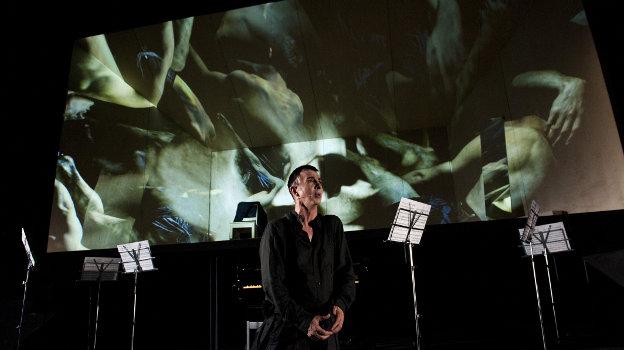
At the start of the piece, we are seduced into believing that there will be a large musical ensemble performing; music stands (at least fifteen or sixteen) are spread across the width of the stage, on either side of the piano. Above is a set-within-the-set, an open-fronted box that is a bare-walled room fitted only with a wooden chair and a mirror. The stands stay unused, ghostly figures, the faceless hordes who died, perhaps, or the nameless occupants of the city. So just a lone pianist (Conor Mitchell I assume, although this isn’t stated), and singer Marc Almond, both clad in black kilt-like ‘skirts’, trousers and jackets, a look reminiscent of Vivienne Westwood’s Seditionaries phase.

Marc Almond is, as always, a mesmerising presence onstage, but oddly – given that the words and music were written for him – there are times when the musical range seems to be challenging for his voice. Less surprisingly, there are times when he doesn’t seem 100% comfortable with the simple, dynamic choreography – reminding us that, actually, acting isn’t easy: perfecting the simplest onstage physical actions such as walking, sitting, and standing still are a lifetime’s work for the actor.

Where he comes into his own fully are the sections that play the Kurt Weil / Jacques Brel / Music Hall card to the max: for example, in a gorgeous scene where he denotes a newly-shaven head (no fleas, no lice!) by donning a tight hairnet, then scoops a wig out of the skirting board, and flirts with himself in the mirror: ‘I’ve bought a wig … and in the mirror I admire myself for hours.’

In other memorable moments, led by the scenography, friends and lovers are played by filmed figures who enter and leave the boxed space, untouchable others; the empty buildings and fleeing masses are portrayed by contemporary, speeded-up and layered footage of London’s city centre; and our hero’s moodswings are mapped by a constantly changing palette of colour washes, from jaundice yellow to sky blue via putrid greens. This, perhaps, a reference to Edgar Allan Poe’s Masque of the Red Death and the succession of differently-coloured rooms passed through, an image that has also been appropriated in recent times by Punchdrunk and in the David Hughes/Al Seed collaborationThe Red Room. There are also, for me anyway, strong echoes of Orhan Pamuk’s first novel The White Castle, which tells the tale of Istanbul’s plague.

Perhaps it is fair, though, to say that this is a universal human story: from the biblical ten plagues to AIDS, the fear of plague, and survival of infections that sweep communities, is a key part of the story of how we have all come to be here still. We’re all the sons and daughters of survivors, so this story is our story.

www.traverse.co.uk

Roland Schimmelpfennig: The Golden Dragon ¦ Photo: Stephen Cumminsky

Roland Schimmelpfennig: The Golden Dragon

Roland Schimmelpfennig: The Golden Dragon ¦ Photo: Stephen Cumminsky

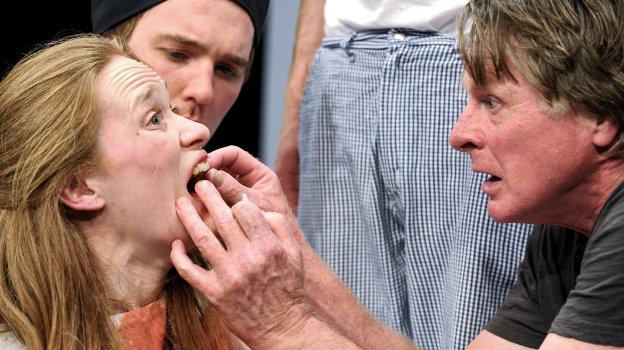
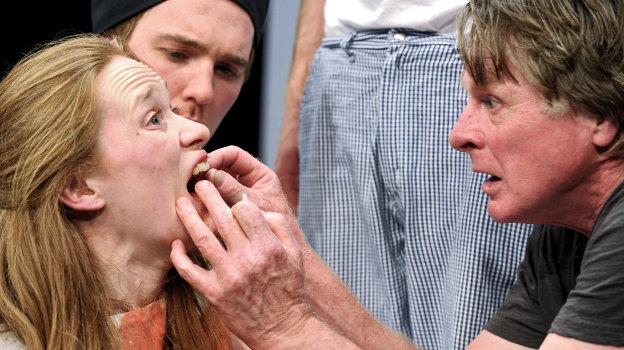
‘Take care not to tread on the props,’ says the usher as we enter the space – an empty space save for a row of tawdry everyday objects and accessories placed at the front-row audience members’ feet. There’s a few plastic toys, a pair of spectacles, a walking stick, a wok. Some green Lycra leggings, a sparkly headband, a spanner. Enter five actors – young man, older man, young woman, older woman, man of indeterminate age. They pull down paper from four great rolls of newsprint, so the floor now has a crackly white carpet, and the show is on the road.

We are at The Golden Dragon, a Thai/Chinese/Vietnamese local restaurant anywhere in the world. We meet workers, customers, and occupants of the upstairs flats. Everyone is transient in one way or another: the migrant workers in the kitchen, the air stewardesses just back from a long-haul trip, the couple whose marriage is falling apart, the trafficked sex worker held in an upstairs flat who never sees the light of day. A thousand and one stories interweave – some heartbreaking, some mildly amusing. We are taken on a journey across the world and back again, it all circling round the extraction of a rotten tooth in the mouth of the young Chinese kitchen worker.

What at first seems to be a rather clichéd take on ‘poor theatre’– with characters, for example, denoting old age with the addition of a pair of spectacles and a shaking hand, or waving the wok around to express frying up a Pad Thai – turns into something more interesting as the play progresses: the instant costuming-up becomes more surreal, and the characterisation and storytelling ever more layered – as one example, those green leggings and the hen-party headband with the jangling silver-bobble ‘antennae’ turn the young man into The Cricket, in a little folk tale telling of the industrious Ant and the lazy Cricket, and this character in turn becomes the representation of the ‘vulgar, sexy, abused’ girl upstairs. Meanwhile, the carefully crafted ebbs and flows of the text draw us in, or pull us out, of each storyline.

In his notes in the introduction to the playscript, director Ramin Gray reflects that a British playwright would more than likely have been drawn to naturalism to tackle the subject of migration, but that Schimmelpfennig – a German – draws on his own nation’s Brechtian tradition in the creation of this cleverly multi-layered and ‘playful’ play.

Viewing The Golden Dragon provides an opportune reminder that many of the dramaturgical choices that we associate with devised theatre – the mixing of storytelling mode with dialogue, actors playing many different characters, the transposing of one character’s words to another, actors stepping in and out of the action whilst remaining visible onstage, the voicing of stage directions – can in fact be scripted in, as is the case in The Golden Dragon: the deconstruction of the text occurs within the text.

It’s a clever play, beautifully constructed – a play that has been ‘wrought’ well by the playwright. But more importantly it’s a moving piece of theatre; we travel readily on the journey offered.

Wired Aerial Theatre: As The World Tipped

Wired Aerial Theatre: As The World Tipped

Wired Aerial Theatre: As The World Tipped

Directed by Nigel Jamieson, Wired Aerial Theatre’s As the World Tipped is a large-scale outdoor spectacular that takes as its subject the Copenhagen Conference and the subsequent failure of world leaders to initiate any meaningful directive on climate change.

It starts well. A large, square white stage is occupied by scurrying suits who move from desk to desk, working their way through towers of paperwork. The soundtrack gives us voiceover samples of speeches and discussions from the conference: President Obama’s bland, placating reassurances pitted against the impassioned plea from President Mohamed Nasheen of the low-lying Republic of Maldives, who says, ‘If things go business-as-usual, we will not live, we will die. Our country will not exist.’

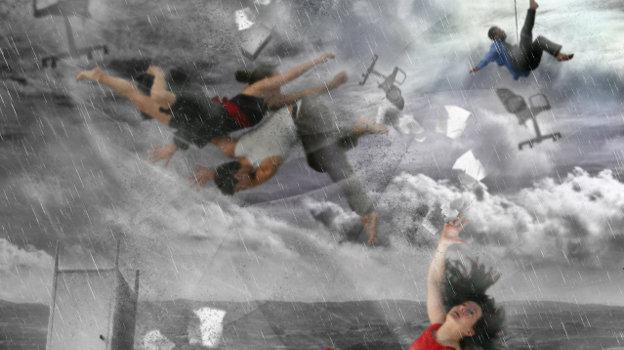
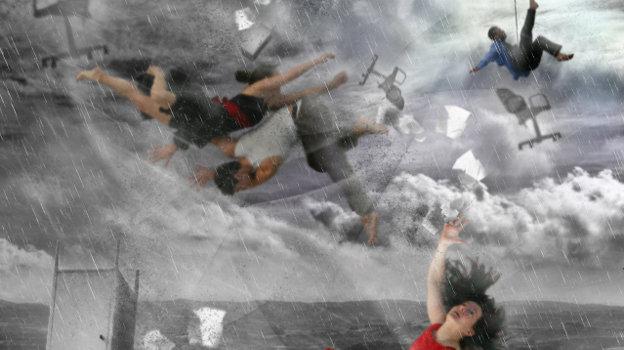
Then comes the expected grand theatrical moment (the big crane behind the set is a giveaway!), as the enormous stage slowly starts to tip, and everything begins to roll off – paper flying, desks crashing to the ground (well, not quite – they are rescued by roadies as they fall, which is a slight disappointment). The now-vertical stage is raised ever-higher, becoming a giant screen.

The next section is an exciting interweaving of live and filmed action that plays beautifully with the relationship between 2D and 3D. Harnessed performers race over a speeding walkway of words, words, words; zig and zag along the lines of a graph; leap from square to square on a chequerboard of TV monitors which morphs into cuboid twin towers from which the tiny human figures tumble.

But it’s all downhill from then on – in both subject matter and performance content. We are presented with documentary-style footage of a series of global disasters – drought, tsunami, bushfire, tornado, earthquake. As giant projections of sorrowful human faces of various ethnicities stare accusingly at us, or as the screen is engulfed in floodwater or fire, the now seemingly mouse-sized performers dangle on their harnesses squealing, or bounce off the screen in various enactments of running to escape, falling off the edge of the world, jumping into the abyss – or attempting to rescue others who are falling/running/jumping.

The harnessed performers know their stuff, the film footage is brilliantly edited, and the soundtrack is cleverly mixed – I appreciated the occasional touch of ironic humour, such as the inclusion of the Elizabeth Welsh classic ‘Stormy Weather‘. The play with scale is interesting: there is one particularly lovely moment where a dangling person is apparently dropped into the open palm of an onscreen sleeping child.

So a technically brilliant show; beautifully executed; an extraordinary opening. The first 20 minutes, taken alone, would qualify the show as one of the best ever large-scale pieces by a UK company. But for the most part, the second half of the show offers no more than a repetition of the polemical points made earlier in the piece: in essence, that climate change is bad and someone ought to do something about that. ‘Demand change now?’ Perhaps ‘Be the change you want to see’ would be a stronger message.

I’m reminded of the Richard Schechner quote, ‘life is raw, but art is cooked’. More cooking needed here, I feel…

www.wiredaerialtheatre.com

Pina – A Film for Pina Bausch

Pina
by Wim Wenders
Sep 2011
£8.99

Total Theatre Magazine doesn’t often review feature films – but Pina, Wim Wenders’ cinematic homage to the late great Pina Bausch, godmother of experimental dance theatre and director of the Tanztheater Wuppertal, is no ordinary film. More than documentation, more than a tribute, it is an exploration of Bausch’s work that marries dance and film artfully and beautifully.

It was planned as a collaboration between these two extraordinary artists – an exploration of how dance-for-screen or dance-to-camera (pick your favourite label) could move out of the ‘experimental shorts’ ghetto and into mainstream cinema as a fulllength feature. Wenders’ wonderful Buena Vista Social Clubhad raised the benchmark for film that documented live performance, and Pina Bausch, his friend of more than two decades, saw him as the perfect collaborator. A plan was hatched to focus on a number of key Tanztheater Wuppertal works – including Café MuellerRites of Spring, and Kontakthof – and to make the film in 3D. Plans proceeded, then two days into the shoot Pina died. The film was at first abandoned, then resurrected, and what has been described as ‘the first 3D arthouse documentary’ eventually emerged.

The bereavement is raw and upfront. Interviews with longterm company members are transposed to voiceovers expressing shock or paying tribute, played over solemnly held shots of silent faces full of sorrow and confusion. The dance works are as cleverly filmed as you’d expect from Wenders: live footage of Pina herself performing in Café Mueller is weaved into footage from the most recent version of the show; and the editing cuts in the Kontakthofsections are a witty play on Bausch’s remaking and remodelling of this seminal work, shifting us from teens to elders and back again with giddying confusion. The 3D is hyped as a key element, and certainly in the big ensemble scenes ofRites of Spring the stage depth is captured very well, but it isn’t the most interesting aspect of the film. By far and away the best scenes are those shot on location in Wuppertal. Solo, or in extraordinary and poignant duets, the dancers (more often than not dressed in ’trademark’ Bausch evening wear) move into, through, over and along the landscape, taking in flyovers, el-trains, dual carriageways, parks, ponds, and hilltops in a series of eerily beautiful and surreal moments that are an homage both to Bausch’s choreography, and to the city to which she remained everloyal. Last word goes to Wenders: ‘Pina had trained her eyes to what the soul can teach us through the body.’ Whether you’re a longterm admirer or new to Bausch’s work – this is a film to be seen.